Table of Contents >> Show >> Hide
- What Is Petals Around the Rose?
- What You Need Before You Start
- How to Play Petals Around the Rose: 12 Steps
- Step 1: Choose the person who knows the secret
- Step 2: Tell players the only clues they are allowed to have
- Step 3: Roll all five dice where everyone can see them
- Step 4: Announce the answer, but not the explanation
- Step 5: Let players make guesses after each roll
- Step 6: Remember that the arrangement of the dice does not matter
- Step 7: Focus on the phrase “around the rose”
- Step 8: Count only the dice that can have petals
- Step 9: Add the petals from all five dice
- Step 10: Prove you know the rule by answering correctly several times
- Step 11: Do not spoil the rule for other players
- Step 12: Use smart teaching tricks if you are introducing beginners
- Common Mistakes Players Make
- Why This Puzzle Is So Good
- Experience and Lessons from Playing Petals Around the Rose
- Final Thoughts
Some games are loud. Some are flashy. And some just sit there on the table looking innocent until they quietly rearrange your brain. Petals Around the Rose is firmly in that last category. All you need are five dice, at least one person who already knows the secret, and a group of players willing to suffer through the delightful frustration of being so close
for far longer than expected.
If you have never played before, here is the fun twist: this is not a normal dice game where you memorize rules and go. It is a pattern puzzle disguised as a game. The person who knows the answer gives clues, rolls the dice, and announces the correct score. Everyone else studies the dice and tries to discover the hidden rule on their own. It sounds simple. It is not simple. It is glorious.
This guide walks you through exactly how to play Petals Around the Rose, how to teach it, how to avoid the most common mistakes, and how to make the experience more fun for first-time players. By the end, you will either know how to run the puzzle or at least know why your friend is smirking while tossing dice like a wizard at a county fair.
What Is Petals Around the Rose?
Petals Around the Rose is a classic dice puzzle where one player knows a secret scoring rule and everyone else must figure it out through observation. The title matters. The answer for every roll is always an even number or zero. Players are allowed to hear the answer after each roll, but they are not allowed to hear the reasoning until they have solved it themselves.
That setup is what makes the puzzle addictive. People start by guessing wildly. Then they look for symmetry, addition, subtraction, color, order, diagonals, luck, moon phases, and possibly the emotional energy of the room. Eventually, if they stick with it, the simple pattern reveals itself and everyone suddenly realizes they were giving the dice way too much credit.
What You Need Before You Start
You do not need a game board, special dice, or a dramatic soundtrack, though a dramatic soundtrack would be funny. You only need:
- Five standard six-sided dice
- At least two players
- One person who already knows the rule
- A table or flat surface
- Optional: paper for notes
Now let’s get to the 12 steps.
How to Play Petals Around the Rose: 12 Steps
Step 1: Choose the person who knows the secret
One player must already know how the puzzle works. This person is sometimes called the leader, presenter, or, if you want to sound dramatically overqualified, the Potentate of the Rose. Their job is to roll the dice, announce the score, and keep a straight face while everyone else spirals into elegant confusion.
If nobody knows the rule yet, you cannot really play the traditional version. Someone needs to learn it first and then teach the puzzle by running the game, not by blurting out the answer immediately like a spoiler-loving raccoon.
Step 2: Tell players the only clues they are allowed to have
At the start, the leader gives the standard clues:
- The name of the game is Petals Around the Rose.
- The name is important.
- The answer is always zero or an even number.
That is enough to begin. Resist the urge to add extra hints too early. The whole point is for players to notice patterns and test ideas. If you give away too much, the puzzle collapses faster than a cheap card table.
Step 3: Roll all five dice where everyone can see them
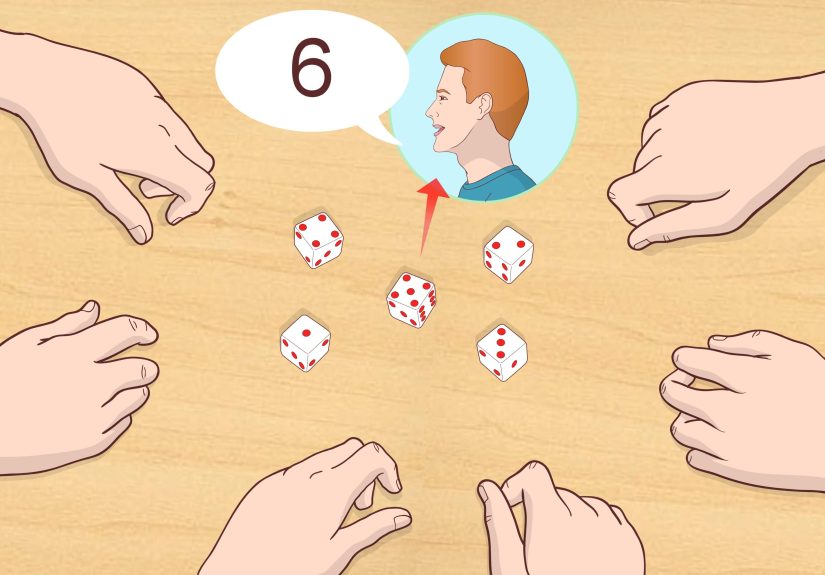
The leader rolls the five dice in plain view. Every player studies the faces showing on top. The group then looks at the result while the leader announces the correct number of petals for that roll.
Example: imagine the dice show 3, 5, 2, 6, and 1. The leader says the correct answer aloud. Players are not told why. They simply record the roll mentally or on paper and start hunting for the pattern.
Step 4: Announce the answer, but not the explanation
This is where the magic happens. The leader says the answer for each roll immediately. Players may guess, discuss possibilities, and ask for another roll. What the leader must not do is explain the rule before someone solves it.
That means no wink-heavy comments like look at the middle dots
or you’re overthinking it.
Those are hints in disguise. Stay neutral. Be kind, but be mysterious. This is your moment.
Step 5: Let players make guesses after each roll
After hearing several examples, players may begin guessing the answer before the leader reveals it. This is the real test. If someone announces the correct number for a roll, that does not automatically prove they know the rule. It might just mean they guessed well or got lucky.
Keep rolling. Let them keep predicting. The pattern becomes clearer over time, and players start to separate random guessing from real understanding.
Step 6: Remember that the arrangement of the dice does not matter
Many beginners get distracted by the order of the dice. They assume the leftmost die matters more, or that pairs and sequences must mean something. Nice theory. Wrong puzzle.
Only the top face on each die matters. It does not matter whether the 5 is at the far left, the middle, or sitting there with the smug energy of a die that knows it is important. Location does not change the score.
Step 7: Focus on the phrase “around the rose”
This is the most important thinking step in the whole game. The title is not decorative. It is the clue. When players hear Petals Around the Rose, they should ask: what is the rose, and what counts as petals around it?
Here is the key idea: on a standard die, the center pip can be treated as the rose. The dots around that center pip are the petals. Not every die face has a center pip, which means not every die face matters.
Step 8: Count only the dice that can have petals
Once you realize the center pip is the rose, the scoring starts to make sense. A die showing:
- 1 has a center pip, but no petals around it, so it counts as 0
- 3 has a center pip with two surrounding pips, so it counts as 2
- 5 has a center pip with four surrounding pips, so it counts as 4
- 2, 4, and 6 have no center pip, so they count as 0
That means only 3s and 5s add petals. The 1 looks important at first because it has a center dot, but it adds nothing. That little fake-out is one of the reasons the puzzle is so sneaky.
Step 9: Add the petals from all five dice
To get the final answer, add the petals from every die in the roll. That is it. No multiplication tables, no hidden geometry, no secret handshake with the dice gods.
For example:
- Roll: 3, 5, 2, 6, 1
- Score: 2 + 4 + 0 + 0 + 0 = 6
Another example:
- Roll: 5, 5, 3, 4, 1
- Score: 4 + 4 + 2 + 0 + 0 = 10
Once you see it, the puzzle becomes beautifully simple. Before you see it, it feels like the dice are mocking you in fluent algebra.
Step 10: Prove you know the rule by answering correctly several times
In many groups, a player is considered to have solved the puzzle once they give the correct answer for several rolls in a row without hesitation. Six consecutive correct answers is a common benchmark.
This matters because the goal is not to say, I think I know it.
The goal is to demonstrate that you truly understand the scoring rule well enough to apply it on command. A real solver can look at a roll and answer quickly, even if the dice are arranged differently.
Step 11: Do not spoil the rule for other players
This step is almost sacred in the culture of the game. Once someone figures out the answer, they should not explain it to the rest of the room right away. Instead, they should start giving correct answers and let others continue the puzzle.
Why? Because discovering the rule is the whole experience. If you hand it over too early, you are not helping. You are stealing the best part of the game. It is like fast-forwarding to the ending of a mystery and then pretending you did everyone a favor.
Step 12: Use smart teaching tricks if you are introducing beginners
If you are the leader and want people to enjoy the puzzle instead of flipping the table, use a few gentle strategies:
- Give several rolls in a row before expecting guesses
- Encourage note-taking
- Repeat the title clearly every few rounds
- Remind players the answer is always even
- Use example rolls with obvious 3s and 5s to build confidence
You can also ask players what they have ruled out. That helps them think like problem-solvers. For example, if they already know position does not matter, that is real progress. Eliminating bad theories is part of solving the puzzle.
Common Mistakes Players Make
Almost everyone makes at least one of these mistakes when learning Petals Around the Rose:
- Adding all the dots on the dice. Logical, but wrong.
- Counting odd numbers only. Better, but still incomplete.
- Assuming the answer depends on arrangement. It does not.
- Ignoring the title. Big mistake. The title is the hint.
- Overcomplicating the puzzle. The rule is simpler than people expect.
The funniest part is that smart, analytical players often struggle because they search for a complicated formula first. Meanwhile, someone else notices the center pip and solves it in ten minutes while eating pretzels. Humbling stuff.
Why This Puzzle Is So Good
This game works because it teaches pattern recognition without feeling like homework. Players form theories, test them against evidence, throw away bad ideas, and try again. That is real problem-solving. It also creates a shared moment of tension and laughter, especially when half the room is convinced the answer involves prime numbers and cosmic injustice.
Teachers love it because it encourages observation and perseverance. Families love it because it is portable, cheap, and surprisingly memorable. Puzzle lovers love it because it creates that rare, wonderful snap of insight where confusion suddenly becomes clarity.
Experience and Lessons from Playing Petals Around the Rose
The experience of learning Petals Around the Rose is almost always the same in the best possible way. First comes confidence. You see five dice and think, How hard could this be?
Then comes the second stage, which is chaos dressed as optimism. You invent theory after theory. Maybe the answer is the total of the odd numbers. Maybe it is the number of visible corners. Maybe it depends on how many pips touch imaginary lines. Maybe the leader is making it up. A lot of players visit all these theories like tourists collecting bad souvenirs.
Then the room changes. People stop guessing randomly and start paying attention. Someone notices that some dice seem to matter more than others. Someone else realizes that even numbers never help. Another player becomes weirdly suspicious of the number 1. The discussion gets livelier. The leader keeps rolling. Correct answers appear, then disappear. A player who got one answer right by accident suddenly feels like a prophet, then immediately crashes back to earth on the next roll. It is a beautiful emotional roller coaster powered entirely by cubes.
What makes the puzzle memorable is the moment the rule finally clicks. There is no fireworks show, but it feels like there should be. Once the idea of the center pip as the rose lands in your head, every previous roll suddenly makes sense. All the confusion rewrites itself into a neat pattern. You do not just get the next answer. You understand why the answer must be what it is. That feeling is deeply satisfying because you earned it through observation rather than being handed the rule.
Another interesting part of the experience is how social the game becomes. People groan together, compare wrong ideas, celebrate near-misses, and study the dice like detectives examining evidence at a tiny casino crime scene. Even quiet players often get drawn in because the puzzle invites curiosity rather than speed. There is no penalty for being thoughtful. In fact, thoughtful players often do best.
If you use Petals Around the Rose in a classroom, family gathering, or game night, you quickly notice that it teaches more than the rule itself. It teaches patience. It teaches how to test a theory instead of falling in love with it too early. It teaches that simple answers can hide behind confusing surfaces. And perhaps most importantly, it teaches that being wrong a few times is not failure. It is the normal path to figuring something out.
That is probably why people remember this puzzle long after the dice are put away. You may forget specific rolls, but you remember the sensation of nearly understanding, the laughter when someone announces an absurd theory with total confidence, and the snap of insight when the secret finally becomes obvious. It is a tiny lesson in logic wrapped in a game, and it proves that sometimes the best puzzles do not need a box, batteries, or a twenty-page rulebook. They just need a handful of dice and a title that quietly tells the truth.
Final Thoughts
Petals Around the Rose is one of those rare games that stays charming even after you know the answer. As a player, it gives you a satisfying puzzle to crack. As a host, it gives you a fun way to challenge friends, students, or family members without needing any fancy setup. The secret is elegant, the learning curve is entertaining, and the payoff is worth the head-scratching.
So grab five dice, find a willing victim, and say the title clearly. The name matters. The answer is always even. And somewhere around roll seven, someone at the table is going to stare at the dice like they have personally been betrayed. That is when you know the game is working.