Table of Contents >> Show >> Hide
Three years ago, I moved to Seoul from the US with two suitcases, a phone full of translation apps, and the wildly optimistic belief that I would “figure it out.” Technically, I did. Emotionally, Seoul figured me out first. It won me over with neon-soaked streets, peaceful palace courtyards, subway rides so smooth they made my old commuting standards look like a practical joke, and meals so good I started treating dinner like a personality trait.
What makes Seoul unforgettable is not just that it is stylish, fast, and endlessly photogenic. It is the way the city keeps changing moods on you. One minute you are standing in a hanok-lined alley that feels suspended in time, and the next you are in a sleek neighborhood packed with design stores, coffee bars, and people dressed like they all accidentally wandered out of a fashion editorial. Seoul is a city of dramatic contrasts, but somehow nothing clashes. Everything hums together.
This is not a relocation guide pretending to be a love letter. It is a love letter that just happens to know where to get a midnight snack, where to take a riverside walk when your brain feels fried, and why your camera roll becomes a full-time job the moment you start living here. If you have ever wondered why someone would move from the US to Seoul and then fall embarrassingly, enthusiastically, hopelessly in love with it, here is the answer.
Why Seoul Sneaks Up On You
At first, Seoul feels like pure sensory overload. The streets glow. The food sizzles. The cafés look like they were styled by people who take table surfaces very personally. There are always people out, always somewhere to go, always one more side street that turns out to be more interesting than the place you were actually trying to find. In a lot of American cities, you plan your day around distance. In Seoul, you plan it around curiosity.
That was the first thing I noticed after moving here: Seoul rewards wandering. You leave home to buy toothpaste and somehow return four hours later with a pastry, a face mask, a book you did not need, and seventeen photos of a tiny alley with perfect lighting. The city has a talent for turning errands into adventures.
Then there is the rhythm of daily life. Seoul moves quickly, but it does not always feel chaotic. It feels organized, alive, and strangely comforting once you learn its tempo. Public transit makes the city feel accessible. Neighborhoods have distinct personalities. Convenience is not an occasional luxury here; it is basically civic architecture. Need dinner late? Easy. Need coffee at an absurd hour? Also easy. Need a place where tradition and trendiness coexist without rolling their eyes at each other? Welcome to Seoul.
The Beauty Of Contrast
One reason I fell so hard for Seoul is that it refuses to be one thing. It can be elegant, loud, playful, serene, chaotic, and soft all in the same afternoon. You can start your day near a palace gate, spend lunch in a market, drift into an art-forward neighborhood by late afternoon, and end the night beside the Han River with convenience store ramen and the skyline glittering in the distance. That is not a special occasion itinerary. That is just Tuesday if you are lucky.
As someone from the US, where cities often feel segmented by function, Seoul felt thrillingly layered. History is not tucked away in a museum box. It sits next to coffee shops, fashion boutiques, office towers, and late-night food stalls. The old and the new do not just coexist here. They flirt shamelessly.
30 Picture-Worthy Moments That Made Me Fall In Love With Seoul
- A palace roofline cutting across a bright blue morning sky, making me stop in the middle of my walk like a distracted pigeon.
- The first time I saw a quiet hanok alley framed by shadows and wooden doors that looked hand-painted by time.
- A steaming paper cup of street food on a cold evening, with the entire block glowing gold under shop signs.
- Cherry blossoms turning an ordinary sidewalk into something suspiciously close to a movie set.
- A subway platform so clean and efficient it made me rethink every commuter complaint I had ever made in America.
- Couples and friend groups picnicking near the Han River while the skyline softened into sunset.
- A convenience store snack run that somehow turned into dinner, dessert, and a tiny cultural education.
- Layers of signage stacked above a narrow street, each one promising fried chicken, karaoke, cocktails, or all three.
- My first late-night walk through Myeongdong, where beauty stores, food stalls, and shopping energy all collided beautifully.
- A tray of banchan arriving before the main meal and making me wonder why every dinner in the world cannot begin this way.
- The elegant calm of a temple courtyard surrounded by busy city blocks and very modern impatience.
- Seongsu’s cool industrial corners, where former workspaces now feel like catnip for designers and caffeine addicts.
- A café interior so stylish I briefly forgot how beverages work and just stared at the lighting.
- Hongdae at night, where youth culture, music, fashion, and chaotic joy spill across the streets.
- A plate of Korean barbecue sizzling so loudly it deserved its own microphone.
- Autumn leaves on a hillside trail, proving that Seoul can go from high-energy metropolis to peaceful retreat in under an hour.
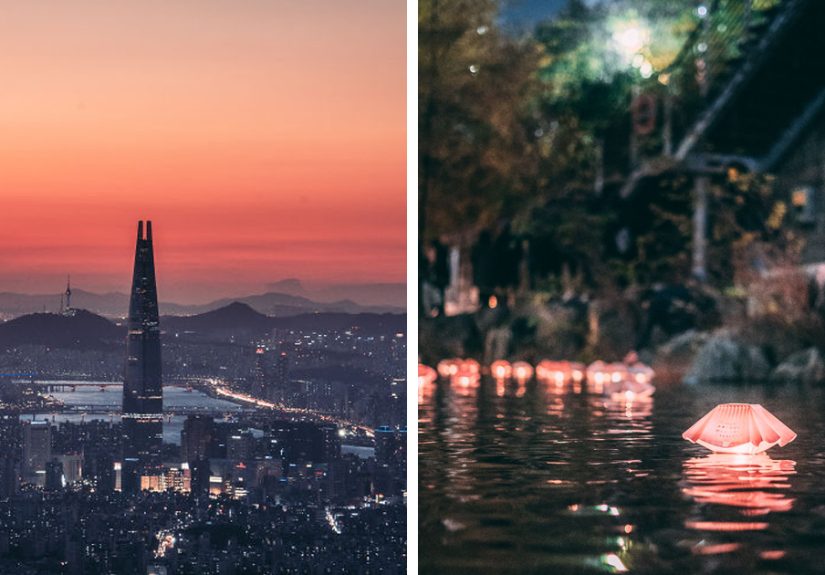
- A view from above the city where towers, mountains, and neighborhoods all folded into one giant visual flex.
- Cheonggyecheon after dark, when the stream path feels like the city quietly exhaling.
- A market stall where everything smelled amazing and I trusted the line more than any review app.
- Glass skyscrapers reflecting old roofs nearby, like Seoul was showing off its dual personality on purpose.
- A rainy evening turning every neon sign into watercolor on the pavement.
- A basket of salt bread and pastries that made me understand why Seoul’s café culture has such a loyal following.
- Friends laughing over shared dishes while someone inevitably says, “Order one more thing,” and everyone immediately agrees.
- A bookstore corner that felt like a secret, complete with soft music and the dangerous illusion that I needed another notebook.
- Bukchon streets where tradition feels lived-in rather than staged.
- A noraebang room at 1 a.m., when dignity is gone and everyone suddenly believes they are debuting as a pop star.
- Street vendors working with total focus while crowds swirl around them in a blur of movement and appetite.
- The first truly crisp fall day, when Seoul looks like it got professionally color-graded.
- A delivery meal arriving so quickly I became suspicious that teleportation had been invented locally.
- The moment I realized my phone gallery had become less “memories” and more “evidence that I live in a city I adore.”
What Surprised Me Most After Moving From The US
1. The City Feels Hugely Urban, Yet Weirdly Livable
Before moving here, I expected Seoul to impress me. I did not expect it to feel so livable. That is a different compliment. A city can be dazzling and exhausting at the same time. Seoul certainly has intense days, but it also has soft landings. Parks, river paths, quiet cafés, temple grounds, neighborhood bakeries, and mountain trails create little pressure-release valves throughout the city. You do not have to flee Seoul to recover from Seoul.
2. Food Is Not Just A Highlight. It Is A Lifestyle
In Seoul, food is social glue, comfort system, hobby, and entertainment package. Meals feel communal. Street snacks feel nostalgic even when you are trying them for the first time. Markets are not just places to eat; they are places to watch the city behave like itself. I learned quickly that “I already ate” is not always the end of the conversation. It often means, “Fine, but there is still room for hotteok, right?”
3. Nightlife Is Not Just About Clubs
Back in the US, people often flatten the idea of nightlife into one thing. Seoul taught me that nighttime can mean a thousand different versions of being awake. It can mean barbecue with friends, dessert after midnight, a walk by the river, shopping, casual drinking, tiny bars hidden upstairs, karaoke, or just lingering outdoors because the city still feels very much alive. Seoul after dark is not a sequel to daytime. It is a second main character.
4. Neighborhood Loyalty Is Real
One of the joys of living here is learning neighborhood personalities. Some areas feel polished and trendy. Others feel artsy, historical, youthful, residential, or delightfully chaotic. After a while, you stop saying, “I live in Seoul,” and start saying, “I’m in the mood for this part of Seoul today.” That distinction matters. This city is not one giant blur. It is a collection of moods with subway access.
The Seoul Experiences That Stayed With Me
The most memorable parts of living in Seoul are not always the obvious attractions. Yes, the big landmarks are beautiful. Yes, the famous food areas deserve the hype. But what really attached me to this city were the everyday rituals. Picking up coffee from a place so aesthetically intense it made me sit up straighter. Stopping by the river after a long day just to watch people exist. Grabbing a simple lunch that somehow turned out to be one of the best things I had eaten all month. Hearing the city buzz outside while I ducked into a quiet lane that felt untouched by time.
I also love how Seoul invites participation. It does not want you to observe from a safe, detached distance. It wants you to eat, walk, climb, browse, linger, sing badly, shop impulsively, and accept that your plans are probably about to change because something more interesting appeared down the block. This city is not passive. It collaborates with your day.
That active relationship changed how I travel, and honestly, how I live. Since moving here, I have become more open to spontaneity. I trust neighborhoods more. I pay attention to small details more. I have learned that beauty is not always a landmark. Sometimes it is steam rising from a food cart on a cold night, or bikes lined up near a park, or the way old stone walls look at dusk, or a group of friends sharing convenience store snacks like it is the most natural picnic in the world.
500 More Words On The Everyday Experiences That Made Seoul Feel Like Home
Three years in, what surprises me most is how many of my favorite Seoul memories are not dramatic at all. They are small, repeatable, ordinary things that slowly stopped feeling foreign and started feeling like home. In the beginning, I chased the obvious highlights. I wanted the skyline view, the popular café, the market everyone talks about, the neighborhood that looked best on social media. And to be fair, Seoul is outrageously good at first impressions. But what made me fall in love was what happened after the novelty wore off and the city still kept delighting me.
I fell in love with early mornings when the streets felt freshly arranged and the city had not fully turned up the volume yet. I fell in love with stepping out after rain, when the sidewalks reflected neon and everything looked like a movie scene with excellent production design. I fell in love with wandering without a strict destination, because Seoul consistently rewards the kind of person who says, “Let’s just see what’s down this block.” Usually the answer is a tiny bakery, a gallery, a stationery shop, or a restaurant with five tables and unforgettable noodles.
I fell in love with how social food feels here. In the US, meals can sometimes feel rushed, siloed, or squeezed between tasks. In Seoul, eating often feels like the event itself. A dinner can stretch into drinks, then dessert, then another stop simply because nobody is ready to go home yet. Even a quick meal carries a sense of intention. There is care in the side dishes, care in the presentation, care in the ritual of sharing. That changed me. I eat slower now. I notice more. I appreciate the atmosphere as much as the plate.
I also fell in love with the city’s emotional range. Seoul knows how to be loud, but it also knows how to be gentle. Some days I want the full spectacle: bright shopping streets, packed restaurants, music leaking from storefronts, people everywhere. Other days I want a temple visit, a quiet café, a bookshop, a park bench, a long walk beside water. Seoul can hold both versions of me. That is rare. Some cities only love you when you match their energy. Seoul gives you options.
And then there are the moments that still catch me off guard, even now. A perfect sunset over the river. A traditional roofline framed between modern buildings. A cold-weather snack that tastes even better because your hands are freezing. A side street in Bukchon or somewhere equally charming that makes you slow down without being told. A neighborhood in the middle of reinvention where old workshops, new brands, and local life all keep negotiating space with each other. Seoul is constantly becoming, and somehow that makes it feel even more alive.
Living here has made me more observant and more playful. I take more walks. I say yes to last-minute plans more often. I trust a long line outside a restaurant. I take photos of shadows, windows, rooftops, and random snacks like they are museum pieces. Most importantly, I no longer think of Seoul as the city I moved to from the US. I think of it as one of the places that changed how I see everyday life. That is deeper than travel. That is love.
Final Thoughts
If you had told me before I moved that Seoul would become one of my favorite places on earth, I would have nodded politely and assumed you were being dramatic. Now I know better. Seoul earns devotion the same way it earns repeat visits: by giving you more than one version of itself. It is beautiful without being precious, modern without erasing its history, convenient without feeling soulless, and energetic without forgetting how to be calm.
Three years later, I still find new reasons to love it. Sometimes they are grand, like a sweeping city view or a flawless autumn afternoon. Sometimes they are ridiculously small, like a perfect cup of coffee or a spontaneous stop for street food on the way home. That is the magic of Seoul. It does not just impress you. It gradually, convincingly, and very stylishly moves in on your heart.