Table of Contents >> Show >> Hide
- Why Measuring Stairs for Carpet Matters
- Step 1: Identify Your Staircase Type
- Step 2: Learn the Basic Stair Anatomy You’ll Measure
- Step 3: Gather Your Tools and Make a Simple Sketch
- Step 4: Measure Straight Stairs for Carpet
- Step 5: Measure Landings and Add Them In
- Step 6: Add Waste and Pattern Allowance
- Step 7: Measuring Special Stair Conditions
- Step 8: Common Measuring Mistakes (and How to Avoid Them)
- Step 9: When to Call in a Professional
- Real-World Experiences: What Homeowners Learn the Hard Way
- Final Thoughts
If you’ve ever tried to guess how much carpet you need for a staircase, you
already know how risky the “eyeball method” can be. Order too little, and
you’re stuck with a bare step or an awkward seam. Order too much, and
you’ve basically bought a bonus rug you never wanted. The good news:
measuring stairs for carpet is completely doable for a DIY-minded
homeowneras long as you follow a clear, step-by-step process.
This guide walks you through exactly how to measure your stairs and landings
for carpet, from straight staircases to bullnose steps and tricky turns.
We’ll break down the basic formulas, show you a real-world example, and
share pro tips to help you avoid common mistakes that can cost you time and
money.
Why Measuring Stairs for Carpet Matters
Stairs are one of the highest-traffic areas in your home. They see shoes,
pets, kids, and the occasional sprint when someone is running late. Carpet
not only softens noise and adds comfort, it also improves safety by adding
traction. But it only looks and performs its best when it fits correctly:
- Too short and you’ll have exposed wood or awkward gaps.
- Too narrow and you lose the polished, custom look.
- Poor planning can leave you with noticeable pattern mismatches or seams in bad places.
Flooring pros and stair runner specialists all agree on one thing: accurate
measurements are the foundation of a good stair-carpet job. That’s what
we’re going to nail down here.
Step 1: Identify Your Staircase Type
Before you grab a tape measure, take a minute to really look at your stairs.
Different layouts change how you measure and how much carpet you’ll need.
Straight stairs
These are the simplest: a straight run of steps from one floor to the next
with no turns. You’ll measure one typical step, count how many you have,
and multiply.
Stairs with a landing
Many staircases have a landing at the top, bottom, or in the middle where
the stairs change direction. Landings are usually measured like rectangles
(length × width) and added to the total.
L-shaped or U-shaped stairs
These have one or more turns, usually with a landing or with pie-shaped
“winder” steps. You’ll measure each unique section or step type separately.
Bullnose or curved bottom steps
A bullnose step is a wider, often rounded first step. It needs its own set
of measurements, including the curve of the front edge.
Once you know which types you’re dealing with, you can move on to measuring
the parts of each step accurately.
Step 2: Learn the Basic Stair Anatomy You’ll Measure
You don’t have to be a carpenter to measure stairs like a pro, but you do
need to know what each part is called.
-
Tread: The horizontal part of the step where your foot
lands. You’ll measure its depth from front to back. -
Riser: The vertical part between each tread. You’ll
measure its height from top of one tread to the top of the next. -
Nosing: The front lip of the tread that often overhangs
the riser slightly. When measuring for carpet, you include this
overhang in your tread depth. -
Stair width: The distance from one side of the step to
the other, usually measured from wall to wall or from stringer to
stringer. -
Landing: The flat area where stairs start, end, or turn.
Landings are measured in length and width, just like a small room.
While you’re at it, keep safety in mind. Home-improvement experts
recommend low- to medium-pile carpet, often around 1/2 inch or less, for
stairs to avoid creating a squishy, slippery nosing that can increase the
risk of tripping. Choosing the right profile now will help your
measurements translate into a safe, comfortable installation later.
Step 3: Gather Your Tools and Make a Simple Sketch
Here’s what you’ll want before you start:
- 25- or 30-foot tape measure
- Notepad or graph paper
- Pencil and eraser
- Calculator (or your phone)
- Painter’s tape (optional, for marking)
Draw a quick top-down sketch of your stairs and landing. This doesn’t need
to be artisticboxes for landings and rectangles for steps are enough. Label:
- Each section (e.g., “Lower flight,” “Landing,” “Upper flight”)
- Number of steps in each flight
- Any special steps (bullnose, winders, extra-wide steps)
As you measure, write each number directly on the sketch so you don’t have
to guess later which measurement belongs where.
Step 4: Measure Straight Stairs for Carpet
For a simple straight staircase, you can follow a clean formula. The key is
to measure one “typical” step accurately, then multiply by the total number
of steps.
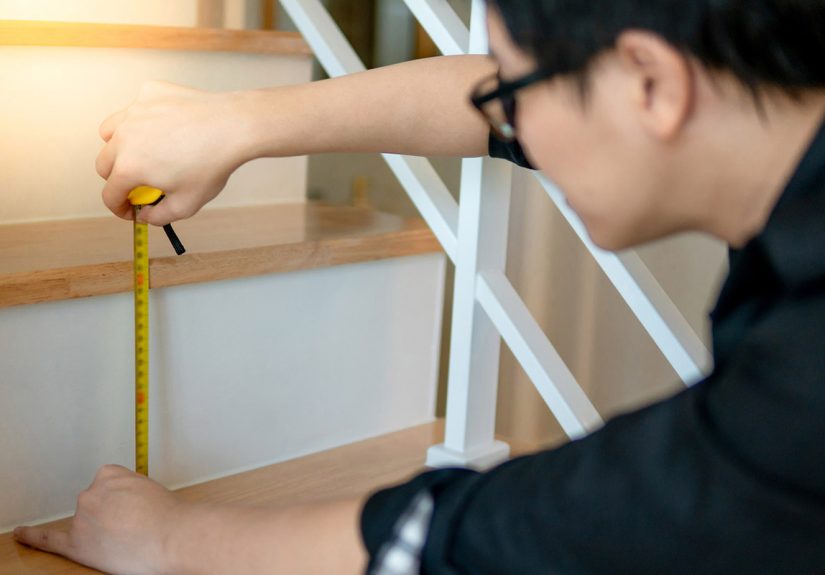
1. Measure tread depth and riser height
-
Place the tape at the back of the tread and pull it to the very front edge
of the nosing. Note this tread depth in inches. -
Measure the riser height from the top of one tread to the top of the next.
Again, record this in inches. - Add the tread depth and riser height together.
For example, if your tread depth is 10 inches and the riser height is 7.5
inches:
10″ (tread) + 7.5″ (riser) = 17.5″ per step
2. Count the number of steps
Count each step that will be carpeted. A typical residential staircase might
have 12 or 13 steps, but always countnever assume.
3. Calculate total length of carpet for the steps
Use this simple formula:
Total stair length (inches) = (Tread depth + Riser height) × Number of steps
Using our example values:
17.5″ × 12 steps = 210″ total length of carpet needed to cover the steps.
Now convert inches to feet by dividing by 12: 210″ ÷ 12 = 17.5 feet of
length.
4. Measure the stair width
Measure from one side of the stair to the other at the widest point, usually
from wall to wall or trim to trim. For a full-width carpet installation,
this might be 36″ (3 feet), 42″, or more.
For our example, let’s say the width is 36″, which is 3 feet. To get the
square footage for the steps:
Stair area = Total stair length (feet) × Stair width (feet)
So: 17.5 ft × 3 ft = 52.5 square feet for the steps.
Step 5: Measure Landings and Add Them In
Landings are often where people forget to measure properly. Carpet usually
runs from the landing down onto the first step or from the upper hallway
over the nose of the top step and downso you must include that transition
in your numbers.
1. Measure the landing dimensions
-
Stand on the landing and measure its length (front to back) and width
(side to side). -
If the landing includes the top or bottom step in one continuous piece of
carpet, measure from the wall or doorway across the landing, over the
nose of that step, and down to the tread in a single measurement.
For example, if your landing is 3 feet by 3 feet, the area is simply:
3 ft × 3 ft = 9 square feet.
2. Combine stair and landing measurements
Add the landing area to your stair area to get the total square footage for
the staircase:
- Stair area: 52.5 sq. ft.
- Landing area: 9 sq. ft.
Total so far: 61.5 square feet
Step 6: Add Waste and Pattern Allowance
Carpet pros almost universally recommend adding a buffer to your calculated
amount. This covers trimming, fitting, and any irregularities in your
stairs.
-
For most straight staircases with basic carpet:
add about 10% to your total. -
For patterned carpet, complex stairs, or multiple turns, you may want to
add 10%–15%.
Using our example total of 61.5 square feet, adding 10% looks like this:
61.5 × 1.10 = 67.65 square feet
You’d round up and plan on around 68–70 square feet of
carpet for this staircase and landing. Carpet is usually sold off a roll
with a specific width (such as 12 feet), so your installer or retailer will
translate this into actual cut sizes, but your measurements ensure you’re in
the right range.
Step 7: Measuring Special Stair Conditions
Bullnose steps
If you have a large, curved bottom step, you’ll measure it slightly
differently:
- Measure tread depth plus riser height as usual.
- Measure the width from side to side.
-
Wrap the tape around the curved nosing to capture the full curve and add
that to your calculations.
You’ll typically treat the bullnose step as a unique piece and add it to
your total stair area.
Winder or pie-shaped steps
For wedge-shaped steps in a turn:
-
Measure the shortest tread depth (at the narrow end) and the longest
depth (at the wide end). - Measure the width along the widest usable walking area.
-
Use the larger measurements as a safe baseline, or measure each winder
individually and add them together.
When stairs are heavily irregular, it’s wise either to overestimate or to
have a professional double-check your figures.
Stair runners vs. full-width carpet
If you’re installing a stair runner instead of full-width carpet, the
process is similar but you’ll use the runner width instead
of the full stair width. For example, if your stairs are 42″ wide and
you’re using a 27″ runner with exposed wood on each side, you’ll plug 27″
into your area calculations instead of the full width.
Step 8: Common Measuring Mistakes (and How to Avoid Them)
Even careful DIYers can fall into the same traps. Watch out for these:
-
Forgetting to include landings. Landings and small
hallways at the top of stairs often get missed in the first draft. Always
measure and add them separately. -
Not including the nosing. If you only measure tread depth
back to the riser and ignore the overhang, your carpet may come up short
on each step. -
Assuming all steps are identical. Older homes in particular
can have slightly different tread depths or riser heights. Measure at
least a few different steps to confirm consistency. -
Ignoring pattern repeats. If your carpet has a strong
pattern or stripe, you’ll need extra length so the pattern lines up from
step to step. -
Skipping waste allowance. Trying to buy “exactly” the
bare minimum is almost guaranteed to cause frustration later.
Step 9: When to Call in a Professional
Measuring stairs for carpet is a great DIY project for straightforward
staircases. But there are times when bringing in a pro is worth every
penny:
- Multiple turns, winders, or split staircases
- Very narrow or unusually steep stairs
- High-end patterned carpet where alignment is critical for appearance
-
When your measurements and the installer’s suggested quantities don’t
match and you want a second opinion
Many carpet retailers will happily confirm your measurements or send a
measurer for a modest fee. Think of it as cheap insurance against an
expensive mistake.
Real-World Experiences: What Homeowners Learn the Hard Way
Numbers and formulas are helpful, but nothing beats hearing what actually
happens when real people measure stairs for carpet. Here are some
experience-based lessons that installers, DIYers, and homeowners often share
after the job is done.
“We forgot the mini-landing at the turn.”
One common story goes like this: a homeowner carefully measured all 12
steps, added a generous 10% for waste, and congratulated themselves on being
extremely preparedonly to realize later they’d forgotten the tiny landing
where the stairs turn. It was only a 2′ × 3′ platform, but that missing
6 square feet meant the carpet roll came up short by a few inches on the
last step.
The fix? They had to seam in a small piece from an off-cut. It was barely
noticeable, but it bothered them every time they walked upstairs. After
that, they made it a rule: Walk the entire route the carpet will
follow and measure every surface it touches.
Patterned runners are beautifuland demanding
Another frequent lesson comes from homeowners who fell in love with a
striped or geometric stair runner. The installer could make the carpet fit,
of course, but lining up the pattern so each step looked uniform took extra
length and careful planning. One homeowner admitted they originally measured
“by the book” but didn’t add any extra for pattern repeat. When the pro
came to install, they needed additional material to keep the stripes from
looking crooked or staggered.
If you’re choosing a strongly patterned carpet, consider:
- Adding more than 10% wastesometimes 15% or even a bit higher
- Asking the retailer how big the pattern repeat is (e.g., every 18″ or 27″)
-
Consulting an installer in advance about how much extra length they
prefer to work with
Old houses rarely have “perfect” stairs
In newer homes, stair dimensions tend to be fairly consistent. In older
homes, it’s not unusual to find minor variations: a slightly deeper tread
here, a shorter riser there, or a nosing that’s more rounded on certain
steps. One DIYer measured only the middle step, assuming all the others
were the same. When the carpet was installed, the tightest steps at the top
looked fine, but the slightly deeper step at the bottom ended up with a
very small tuck under the nosing. It wasn’t unsafe, but it looked a bit
skimpy.
Their takeaway: Measure at least three stepsone at the top, one in
the middle, and one at the bottom. If you notice differences, use
the largest tread and riser dimensions in your calculations so you don’t
undershoot.
Carpet choice matters as much as measurements
Several homeowners also discover that even perfect measurements can’t make
the wrong carpet perform well on stairs. Very thick, plush carpet that feels
amazing in a bedroom can be a poor choice on stairs, where a lower-pile,
denser construction offers better traction and wears more evenly. Some
people report that after a few years, the plush stair carpet showed
“smiles”those curved lines where the carpet bends over the nosingand
flattened in the center.
Experienced installers often recommend:
- Low- to medium-pile carpet for better safety and durability
- Dense, tightly twisted fibers that bounce back from wear
- A quality underlay that supports the carpet without being too bouncy
When your measurements are accurate and your material is suited to
the job, the final result not only looks better but feels better underfoot
for years.
The confidence boost of doing it right
On the positive side, many DIY-minded homeowners say that measuring their
own stairs gave them a huge confidence boost. Once they understood the
tread-plus-riser formula, how to handle landings, and how much waste to
add, the mystery disappeared. They felt more prepared when talking to
retailers and installers and more in control of their budget.
Whether you’re planning to do the entire project yourself or just want to
provide accurate measurements to a professional, learning how to measure
stairs for carpet is one of those practical skills that pays off every time
you refresh your home.
Final Thoughts
Measuring stairs for carpet doesn’t have to be complicated. Start with a
simple sketch, learn the basic stair anatomy, measure tread plus riser for
each step, account for landings and special shapes, and always add a
reasonable waste allowance. From there, your carpet retailer or installer
can help you translate your measurements into an exact order.
With a bit of patience and a tape measure, you can avoid costly surprises,
make smart decisions about materials, and give your staircase the safe,
stylish upgrade it deserves.