Table of Contents >> Show >> Hide
- 15 Wild Facts About The Nightmare Before Christmas
- 1. Tim Burton did not direct the movie
- 2. The movie started as a poem years before it hit theaters
- 3. The idea came from holiday decorations fighting for shelf space
- 4. Burton originally imagined it as a TV special, not a feature film
- 5. Disney thought it was too dark for the main Disney label
- 6. Jack Skellington had two performers, and both mattered
- 7. Danny Elfman’s fingerprints are all over the movie
- 8. Catherine O’Hara and Ken Page gave the movie some of its biggest personality
- 9. Patrick Stewart recorded narration, but it was cut
- 10. Vincent Price nearly voiced Santa Claus
- 11. Jack’s pinstripe suit was a smart visual fix
- 12. Disney wanted Jack to have eyes
- 13. The stop-motion production was gloriously absurd in scale
- 14. One minute of finished film could take about a week to shoot
- 15. The movie went from oddball gamble to cultural institution
- Why The Nightmare Before Christmas Still Feels So Different
- Bonus: on the Experience of Loving This Movie
- Conclusion
- SEO Tags
Note: Body-only HTML for direct web publishing, with SEO JSON tags displayed at the end.
The Nightmare Before Christmas is one of those rare movies that gets to crash two parties every year and still leave with everyone’s candy. It is spooky, sweet, weirdly cozy, and somehow still feels fresh decades after Jack Skellington first wandered into Christmas Town like a skeleton who had just discovered espresso, snow, and existential purpose all at once.
If you love stop-motion animation, Disney movie trivia, Tim Burton lore, or just enjoy arguing whether this is a Halloween movie or a Christmas movie, this film is a gold mine. Behind its crooked hills, stitched-up romance, and gloriously gloomy charm is a production story packed with surprises. Some facts are delightful, some are bizarre, and some make the movie feel even more impressive once you realize how much work went into every tiny twitch of Jack’s bony fingers.
15 Wild Facts About The Nightmare Before Christmas
1. Tim Burton did not direct the movie
Let’s begin with the fact that shocks people every single year: Henry Selick directed The Nightmare Before Christmas, not Tim Burton. Burton came up with the story, the world, and the main character designs, which is a huge creative contribution. But Selick was the filmmaker guiding the actual production and shaping the movie scene by scene. The confusion stuck because Burton’s name was placed so prominently in the title that generations of viewers basically went, “Well, mystery solved.” Not quite. This is one of the most famous cases of a movie being widely miscredited.
2. The movie started as a poem years before it hit theaters
Before it became a stop-motion classic, The Nightmare Before Christmas began as a poem Burton wrote while he was working at Disney in the early 1980s. That origin helps explain why the story feels a little like a gothic fairy tale with musical energy baked into its bones. It was never just a regular movie pitch. It started as a mood, a voice, and a strange little holiday collision that already felt complete in Burton’s imagination long before the cameras rolled.
3. The idea came from holiday decorations fighting for shelf space
One of the wildest and most relatable bits of movie inspiration ever: Burton has said the concept was sparked by seeing Halloween and Christmas decorations overlap in stores. Honestly, that tracks. Few things are more surreal than pumpkins disappearing while wreaths and snowmen barge in like they own the place. Burton turned that retail whiplash into a full-blown fantasy world where the king of Halloween becomes obsessed with Christmas. So yes, one of the most beloved animated films of the modern era was born from seasonal aisle chaos.
4. Burton originally imagined it as a TV special, not a feature film
At first, the project was envisioned more like a television special or short-form holiday event than a theatrical feature. That makes sense when you consider its poem roots and its storybook rhythm. But once the concept grew, the world of Halloween Town clearly needed more room to breathe, sing, scheme, and spiral into festive disaster. In hindsight, the feature-length version feels inevitable. Still, there is something charming about knowing this giant cult favorite almost arrived as a smaller seasonal oddity.
5. Disney thought it was too dark for the main Disney label
Today, the movie is treated like a treasured Disney jewel. Back in 1993, though, Disney got cold feet and released it under Touchstone Pictures instead of the main Disney banner because it was considered too dark and strange for the studio’s core family image. Which is funny now, because the same movie became a merchandising powerhouse and a holiday tradition. That decision also tells you how unusual the film felt at the time. It did not fit neatly in a cheerful little mouse-shaped box, and that was exactly why audiences fell for it.
6. Jack Skellington had two performers, and both mattered
Jack’s speaking voice was performed by Chris Sarandon, while his singing voice came from Danny Elfman, who also wrote the music and lyrics. That split helped create one of the most memorable animated leads of the 1990s. Sarandon gave Jack his theatrical charm and restless curiosity. Elfman gave him musical electricity, melancholy, and mania. The result is a character who feels seamless on screen, even though two performers helped bring him to life. It is one of those behind-the-scenes facts that makes you appreciate the character even more.
7. Danny Elfman’s fingerprints are all over the movie
Elfman did not just write a catchy score and call it a day. He helped define the film’s emotional identity. The songs are a huge part of why The Nightmare Before Christmas remains so rewatchable. They move the plot, reveal character, and create the movie’s offbeat rhythm. Elfman even slipped into the cast in more ways than casual viewers realize, lending vocals beyond Jack. Without his music, the movie might still have looked amazing, but it would not have had the same haunted heartbeat.
8. Catherine O’Hara and Ken Page gave the movie some of its biggest personality
Sally would not be Sally without Catherine O’Hara, whose performance gives the character warmth, wit, and a quiet sadness that cuts through all the visual spectacle. Meanwhile, Ken Page turned Oogie Boogie into one of Disney’s most unforgettable villains by making him slimy, theatrical, funny, and genuinely unsettling all at once. The cast in general is terrific, but those performances are a major reason the movie feels so alive. In a world full of stitched dolls, skeletons, and monsters, personality still does the heavy lifting.
9. Patrick Stewart recorded narration, but it was cut
Yes, Patrick Stewart once recorded narration for The Nightmare Before Christmas. The original plan leaned more heavily into the poem-like framing, with Stewart providing a storybook voice for the opening and closing. In the end, most of that material was removed from the film, though his version lived on through the soundtrack. It is a delicious little “what if” from movie history. The final film works beautifully without it, but the thought of Captain Picard guiding us into Halloween Town is almost too tempting.
10. Vincent Price nearly voiced Santa Claus
Imagine the movie with horror legend Vincent Price as Santa. That almost happened. Price had agreed to do it, but after personal tragedy, the performance no longer felt right for the character, and the role ultimately went to Edward Ivory. It is one of those alternate-history casting stories that sounds made up by an especially dramatic film nerd, but it is real. And honestly, it fits the movie’s DNA perfectly that even its near-misses sound like spooky fan fiction written under candlelight.
11. Jack’s pinstripe suit was a smart visual fix
Jack’s iconic pinstripe suit was not just a fashion statement from the underworld. Henry Selick added the white stripes because early tests showed Jack’s original all-black look disappearing into the dark backgrounds of Halloween Town. So the suit became both a design triumph and a practical solution. That is classic movie magic: solve a technical problem and accidentally create one of the coolest animated costumes ever. It is hard to imagine Jack any other way now. The stripes are basically part of his skeleton-level branding.
12. Disney wanted Jack to have eyes
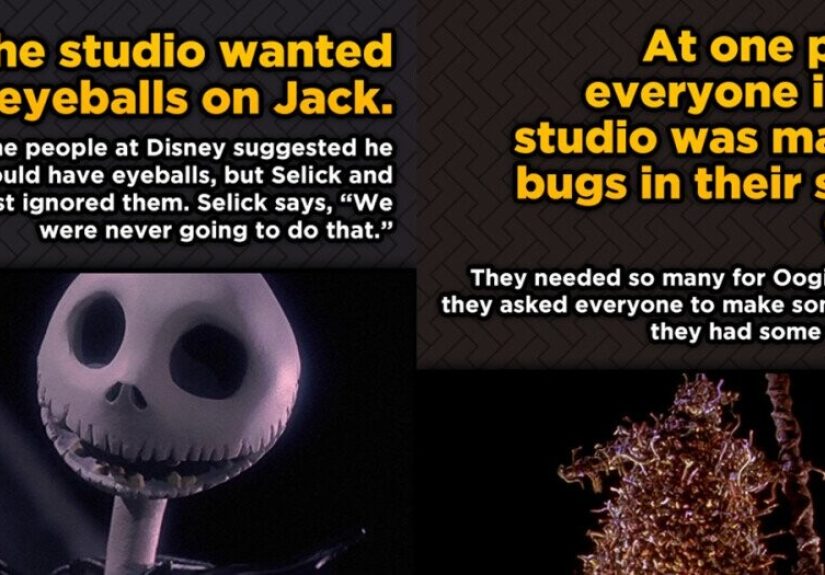
Studio notes can be wild, and this one is legendary. Disney reportedly pushed for Jack to have eyes because animators often rely on them to make characters more relatable. Selick and Burton held the line. Good call. Jack’s empty eye sockets are a huge part of what makes him visually striking. More importantly, the film proves that expression is bigger than eyeballs. Through posture, movement, voice, and design, Jack remains deeply emotional without ever needing a pair of cute cartoon peepers pasted onto his skull.
13. The stop-motion production was gloriously absurd in scale
The making of this movie was not just difficult. It was delightfully bananas. Production involved 19 sound stages, around 230 model sets, special trapdoors so animators could reach the puppets more easily, and more than 400 heads for Jack Skellington alone so he could cycle through expressions. That is not filmmaking. That is organized obsession with a side of engineering and a large helping of sleep deprivation. Every gesture had to be created frame by frame, which makes the movie’s fluidity feel even more miraculous.
14. One minute of finished film could take about a week to shoot
Stop-motion is the art of patience pretending to be movement. Reports from the production note that one minute of the film could take about a week to shoot, and the movie required roughly 110,000 frames of animation. The whole process stretched across years. Suddenly, every tiny head tilt and finger curl feels heroic. Viewers tend to watch stop-motion and think, “Wow, that looks cool.” What they should also think is, “A team of artists spent an outrageous amount of time making this skeleton raise his arm, and I respect that.”
15. The movie went from oddball gamble to cultural institution
At release, The Nightmare Before Christmas was unusual enough to make executives nervous. Now it is permanently lodged in pop culture. It earned an Oscar nomination for Visual Effects, was added to the National Film Registry in 2023, inspired Disneyland’s long-running Haunted Mansion Holiday overlay, returned to theaters in multiple re-releases, and still fuels sequel debates that Burton keeps swatting away. That is not just cult status. That is legacy status. The movie did not simply survive its weirdness. It turned weirdness into tradition.
Why The Nightmare Before Christmas Still Feels So Different
A holiday movie with two addresses
Part of the movie’s lasting power is that it never behaves like a normal seasonal film. It belongs to Halloween and Christmas without fully surrendering to either. It is spooky but not cruel, sentimental but never syrupy, musical but still a little macabre. That balance is hard to pull off. Most movies pick a lane. The Nightmare Before Christmas built its own twisted little roundabout and keeps circling beautifully.
It also helps that the movie looks handmade in a way modern audiences still crave. In an age of slick digital perfection, the textures of this stop-motion world feel personal. You can almost sense the fingerprints, the fabric, the carved faces, and the enormous amount of labor behind every second. That makes the film feel less like disposable content and more like a crafted object you return to every year.
Bonus: on the Experience of Loving This Movie
Watching it feels like entering a holiday mood swing in the best possible way
There is a very specific experience that comes with watching The Nightmare Before Christmas, and it starts before the movie even begins. The title alone already sets the tone. You know you are about to get Christmas filtered through cobwebs, curiosity, and at least one questionable leadership decision from Jack Skellington. And somehow that combination feels comforting instead of chaotic.
For a lot of viewers, the movie becomes less of a one-time watch and more of a seasonal ritual. Some people press play in October because the skeletons, witches, and graveyard energy fit perfectly with Halloween. Others save it for December because the whole story turns on Jack’s enchanted encounter with Christmas. Then there are the overachievers who watch it twice and act like they have solved the holiday movie debate through sheer commitment. Honestly, that might be the correct approach.
What makes the viewing experience special is the emotional contrast. Halloween Town is loud, crooked, theatrical, and proudly strange. Christmas Town is bright, soft, orderly, and full of wonder. Jack moves between those worlds like someone trying on a new identity, which gives the movie a surprising emotional pull. Underneath the songs and spooky gags, this is a story about longing, boredom, reinvention, and learning that admiration is not the same thing as understanding. That is a pretty big meal for a movie featuring a ghost dog with a glowing nose.
The film also has a communal quality that keeps it alive. Families watch it together. Friends quote it. Fans decorate trees with Jack and Sally ornaments, wear themed sweaters, visit Disney park attractions tied to the movie, and somehow find room in their homes for yet another Zero plush. The movie is not just watched. It is collected, replayed, sung, debated, and folded into seasonal traditions. That kind of attachment does not happen by accident. It happens when a story feels emotionally specific but visually universal.
Then there is the atmosphere. Very few movies feel this cozy while being filled with monsters, kidnapping plots, and a villain shaped like a burlap casino fever dream. But The Nightmare Before Christmas manages it. The music is playful and moody. The visuals are eerie without becoming punishing. The romance between Jack and Sally is tender without overpowering the plot. Even the darker moments are presented with wit and style instead of heaviness. It is spooky comfort food, basically.
Maybe that is why the movie ages so well. It understands that people are complicated. Sometimes you want celebration, but not the usual version. Sometimes you want magic with a little edge. Sometimes you want a holiday classic that lets bats into the decoration scheme. The Nightmare Before Christmas meets viewers in that in-between place. It is for the people who love Christmas lights and moonlit graveyards, carols and cobblestones, sweetness and strangeness. In other words, it knows exactly how to make misfits feel at home.
Conclusion
The Nightmare Before Christmas is more than a quirky stop-motion hit from the 1990s. It is a technical achievement, a design marvel, a music-driven character piece, and a rare movie that became more beloved as the years passed. The deeper you dig into its production history, the more impressive it gets. Whether you came for Jack Skellington facts, Disney trivia, or the joy of revisiting Halloween Town, one thing is clear: this movie did not just survive as a cult favorite. It became an annual event with bones, heart, and a seriously excellent tailor.