Table of Contents >> Show >> Hide
- What “Delft Tile” Means (and Why It Still Feels Fancy)
- So… What Exactly Is a “Dustpan and Brush Delft Tile”?
- Where to Use a Dustpan and Brush Delft Tile (Without Overthinking It)
- How to Style Delft Blue Without Turning Your Home Into a Souvenir Shop
- Buying or Spec’ing the Right Tile: What Actually Matters
- Installation Tips That Save You From Regret
- Cleaning and Care: Keeping the Charm, Losing the Grime
- Budget-Friendly Ways to Get the Delft Look (Even If You’re Not Re-tiling)
- Why Delft Tiles (and These Playful Motifs) Are Trending Again
- of Real-World Experiences With a Dustpan and Brush Delft Tile
- Conclusion
Somewhere between “I should really clean this” and “If I ignore it, it becomes décor,” there’s a tiny design miracle:
the Dustpan and Brush Delft Tile. It’s the kind of thing you add to a laundry room, mudroom, or pantry
and suddenly your home starts whispering, “Yes, we sweep here… but we do it with style.”
Delft tiles have a long history of turning ordinary life into something worth looking atships, flowers, farm scenes,
little everyday moments. So a tile that celebrates a humble dustpan-and-brush pairing isn’t random. It’s actually
pretty on-brand for the whole Delft vibe: practical, charming, and a tiny bit smug (in a fun way).
What “Delft Tile” Means (and Why It Still Feels Fancy)
Delft tile style traces back to the broader tradition of Delftwaredecorative ceramics often recognized by their
crisp white background and cobalt-blue illustrations. Historically, the look was closely tied to tin-glazed
earthenware, where an opaque, bright white surface made detailed painted designs pop.
A quick backstory: blue-and-white that traveled the world
Part of Delft’s visual “click” comes from its cross-cultural journey. Museum descriptions of Dutch Delftware often
connect the tin-glaze tradition to earlier ceramic technologies and global trade influencesespecially the European
fascination with imported blue-and-white porcelain and the desire to capture that feel at home.
And here’s the best part: Delft tiles weren’t only made to be precious. They were used in hardworking spotsthink
areas that benefited from a surface that could handle life and be wiped down without drama. Better Homes & Gardens
notes how Delft tiles were historically used around fireplaces and later spread throughout the home, which tracks
with why they still make sense in today’s “mess zones.”
So… What Exactly Is a “Dustpan and Brush Delft Tile”?
In modern interiors, Delft has moved beyond windmills and sailing ships into something more playful: illustrated
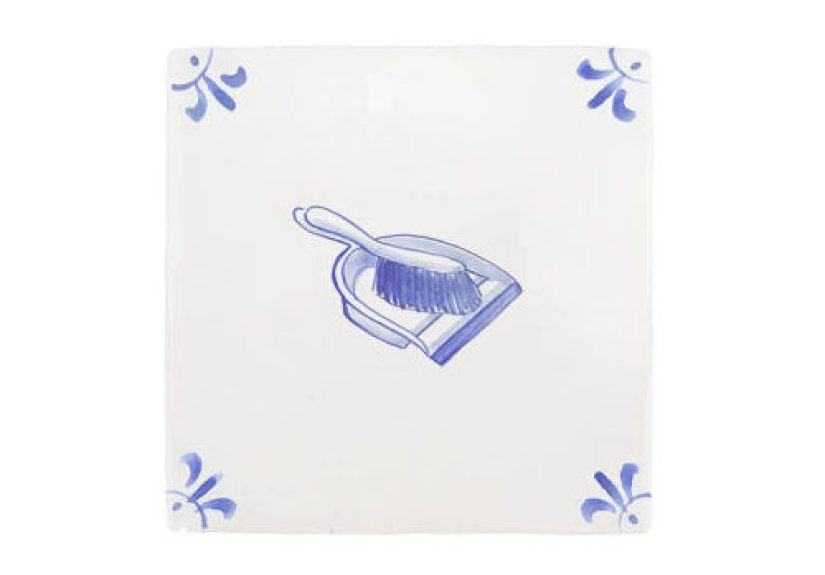
tiles featuring everyday objects. One popular example is literally a tile that depicts a dustpan and brushdesigned
to make the “keeping the house tidy” routine feel a little more cheerful and a lot less like a never-ending group
project you didn’t sign up for.
For instance, a contemporary Dustpan and Brush Delft Tile is offered as a small-format decorative tile with multiple
color options, sizes, and corner styleslike choosing a frame for a tiny piece of functional art.
Why this motif works better than it has any right to
A dustpan and brush isn’t glamorous. That’s the jokeand also the magic. In a laundry room or mudroom, it’s a
wink that says: “Yes, this is the mess-management HQ. No, we will not pretend it’s a spa.” It’s the design version
of putting googly eyes on your cleaning caddy: strangely motivating.
And because Delft-style illustration tends to be simple, graphic, and high-contrast, it reads clearly from a
distance. That matters in utility spaces where you’re usually walking past quickly… probably carrying a basket
of towels that is somehow heavier than your future.
Where to Use a Dustpan and Brush Delft Tile (Without Overthinking It)
The sweet spot for this tile is anywhere you want a tiny “organized home” signalespecially in spaces that do real
work. Think of it as a label you actually enjoy looking at.
1) Laundry room: the “cleaning products live here” backsplash
Add one Dustpan and Brush tile into a small run of classic white tile behind a sink or above a counter. It acts like
a visual icon for the areaalmost like a friendly sign. If your laundry room doubles as a utility sink station,
it’s a perfect match.
2) Mudroom/boot room: the dirt checkpoint
Delft tiles are often used to add character and narrative to interiors (and they’re having a noticeable design
comeback right now). In mudrooms, a single illustrated tile can be the difference between “random wall” and
“intentional moment.”
3) Pantry or broom closet entry: the most honest spot in the house
If you’ve got a closet door that hides your vacuum, mop, and the tangled extension cord you’ve been “meaning to
organize,” placing this tile nearby feels delightfully self-aware. It’s also a clever cue for guests in a rental
or Airbnb: “Cleaning stuff is here if you need it.”
4) Kitchen: the crumb zone (aka reality)
Consider installing a single decorative tile near a breakfast nook or under-counter area where crumbs gather like
they’re paying rent. Delft tiles are frequently used in kitchens today, especially as backsplashes, because they
bring charm without feeling overly precious.
5) Fireplace surround or hearth-adjacent storage
Historically, Delft tiles have been associated with fireplaces (both for practicality and decoration), and modern
design coverage continues to highlight fireplace surrounds as a natural home for the look. A dustpan-and-brush motif
can be especially fitting if you keep a hearth brush or ash tools nearby.
How to Style Delft Blue Without Turning Your Home Into a Souvenir Shop
Delft style is instantly recognizable, which is great… until you accidentally go “full theme park.” The trick is to
use the Dustpan and Brush Delft Tile as an accentlike punctuation. One tile is a clever joke. Twelve tiles can start
feeling like your wall is yelling.
The “one-tile punchline” rule
If you’re nervous about commitment, do a single tile in a mostly neutral installation: white subway tile, warm
off-white zellige-style tile, or even simple square ceramic. The Delft illustration becomes the focal point without
taking over the room.
Pair it with materials that calm it down
- Warm wood (oak, walnut, bamboo shelves) keeps blue-and-white from feeling icy.
- Brass or unlacquered metal adds warmth and a little vintage glow.
- Matte black hardware makes Delft feel graphic and modern.
- Natural textiles (linen, canvas, cotton) keep the space relaxed.
Buying or Spec’ing the Right Tile: What Actually Matters
This isn’t just a pretty squareyou’re putting it in a place where water, soap, and chaos exist. Here’s what to look
at before you click “add to cart” and start imagining grout lines in your sleep.
Finish and placement
- Glossy glazed tiles are common for Delft looks and are usually easy to wipe clean.
- For floors, double-check slip rating and durability; a wall tile doesn’t always belong underfoot.
- For shower areas, confirm the tile is rated for wet environments and ask your installer about waterproofing.
Size and proportion
Dustpan-and-brush illustration tiles are often offered in compact sizes (roughly “hand-sized”), which makes them
easy to mix into standard layouts. Smaller tiles also feel more authentic to the traditional Delft vibe, which often
reads as a grid of small illustrated moments.
Corner detail (yes, it matters)
Traditional Delft tiles often feature decorative corner motifs that frame the central illustration. Modern versions
sometimes let you choose corner styles (or no corners), which changes the whole vibe: corners make it feel more
“classic Delft,” while no corners can feel more minimal and contemporary.
Installation Tips That Save You From Regret
This is the part where enthusiasm meets geometry. A little planning goes a long wayespecially if you’re only using
one or a few illustrated tiles.
- Mock it up first: Use painter’s tape to mark the tile position at eye level and from across the room.
- Choose grout like a stylist: Soft gray can highlight edges; warm off-white can make the tile feel integrated.
- Use it as a “marker” tile: Place it where it visually labels an areanear hooks, a cleaning shelf, or a utility sink.
- Ask your installer about cut lines: Don’t let a plumbing fixture slice through the illustration if you can avoid it.
Cleaning and Care: Keeping the Charm, Losing the Grime
Delft-style tiles typically look best when the white stays crisp and the blue stays clear. In utility spaces, that
means gentle cleaning is your friend.
- Use mild soap and water for routine wipe-downs.
- Avoid abrasive powders that can dull glossy glazes over time.
- Seal grout if needed (especially in laundry rooms and near sinks) to reduce staining.
- Handle scuffs quicklythe longer a mark sits, the more it wants to become “part of the story.”
Budget-Friendly Ways to Get the Delft Look (Even If You’re Not Re-tiling)
Not everyone wants to install tile. Some people just want the vibelike ordering dessert without committing to a
three-course meal.
Frame a single tile like art
A single Dustpan and Brush Delft tile can be mounted or framed and hung near a laundry shelf. It gives the same
visual wink without needing thinset, spacers, or a sudden interest in grout color theory.
DIY painted “Delft-inspired” tile moment
DIYers sometimes paint Delft-style motifs onto plain white tiles for a similar effectan approach that has shown up
in home makeovers as a cost-conscious way to get the look. If you try it, seal it properly and treat it as decorative
rather than heavy-duty functional tile.
Why Delft Tiles (and These Playful Motifs) Are Trending Again
Delft tile has been enjoying a modern resurgence across design media, with editors and designers highlighting its
“storytelling” powerthose little illustrated scenes that make a home feel collected rather than cookie-cutter.
What’s changed is the subject matter. Alongside traditional florals and landscapes, modern makers are adding humorous,
everyday iconslike cleaning toolsso the tile becomes both decorative and delightfully specific. In other words:
it’s not just pretty; it has personality.
of Real-World Experiences With a Dustpan and Brush Delft Tile
People who add a Dustpan and Brush Delft Tile to a laundry room or mudroom often describe the same unexpected outcome:
it changes how the space feels. Utility rooms are usually the first place homeowners “mean to upgrade later,”
which is interior-design code for “this room will stay beige forever.” But a single illustrated tile breaks that spell.
Suddenly there’s a focal point, and the room reads as intentional instead of temporary.
In busy family homes, that tile often becomes a tiny behavioral nudge. It sounds silly, but when a space looks cared-for,
people tend to treat it like it matters. Hooks get used. Shoes land closer to the mat. The dustpan actually returns
to its home instead of going on a mysterious cross-country tour under the couch. Parents sometimes say kids notice it
firstbecause it’s basically a picture that labels what the area is for. It’s like a friendly sign that doesn’t feel
bossy.
In small apartments, the tile can act like a “zone marker.” If your laundry setup is a washer-dryer stack next to a
closet (and your closet is also where your vacuum lives and your recycling waits for its next life), adding one Delft
motif tile nearby gives that corner a defined identity. Renters who can’t install tile sometimes mimic the effect by
propping a single tile on a shelf or leaning it against a backsplash ledge. The visual cue still works: “This is the
tidy-up station.”
Hosts and short-term rental owners talk about it as a subtle guest-friendly detail. Guests don’t want an instruction
manual for your home, but they do appreciate not having to ask where the cleaning supplies are. A dustpan-and-brush
tile near a cabinet or shelf makes it obvious where to find the basics. It’s hospitality without a speech.
In design-forward homes, the tile is often used as a “serious room with a sense of humor” move. Picture a pristine
kitchen with stone counters and perfect lightingthen one tiny tile depicting a dustpan and brush. It’s the visual
equivalent of wearing sneakers with a suit: it relaxes the vibe and makes the space feel lived-in, not staged.
People report that guests comment on it, not because it’s loud, but because it’s clever. The tile becomes a
conversation starter that doesn’t require you to explain anything. It just sits there being charming and slightly
self-aware.
And maybe the best real-life experience is the most practical one: it makes chores feel a little less dreary.
No tile will magically make you love sweeping, but a small, beautiful reminder that “maintenance is part of living”
can soften the mood. The dustpan and brush stop being symbols of never-ending work and start feeling like tools you
actually own on purpose. That’s a surprisingly good trade for one small square on the wall.
Conclusion
The Dustpan and Brush Delft Tile is proof that the smallest design choices can have the biggest personality.
It borrows the charm and storytelling of classic Delft style, then applies it to real lifewhere crumbs happen,
laundry piles exist, and the dustpan deserves a little respect. Use one as a playful accent, place it where it
“labels” a utility zone, and you’ll get a space that feels more finished, more cheerful, and (somehow) more you.