Table of Contents >> Show >> Hide
- Who Is Anthony Smith, and Why Do These Cat Comics Work So Well?
- Why These One-Panel Cat Comics Feel So Relatable
- The midnight zoomies are not fiction
- The box will always beat the expensive bed
- Your desk is not your desk anymore
- Scratching is not vandalism from the cat’s point of view
- Knocking things over is a hobby, a science, and a performance art
- Kneading, trilling, and slow blinks are the soft side of the joke
- Why the One-Panel Format Is Perfect for Cat Humor
- What These 40 Cat Comics Really Say About Living With a Cat
- Extra : Real-Life Experiences That Make These Cat Comics Even Funnier
- Conclusion
- SEO Tags
Living with a cat is a little like renting a room from a tiny, furry landlord who pays no bills, ignores your rules, and still somehow makes the place feel like home. That is exactly why Anthony Smith’s one-panel cat comics hit so hard. They are quick, clever, and devastatingly accurate in the way only good cat humor can be. In a single frame, Smith manages to bottle the full emotional weather system of cat ownership: affection, chaos, confusion, amusement, and the occasional silent stare that feels like a performance review.
This collection of 40 comics works because it does not try too hard. It does not need long setups, complicated punchlines, or a dramatic finale. It simply drops one very familiar cat truth in your lap and lets you laugh because, yes, that is exactly what your cat does. Maybe your cat gallops through the hallway at 3 a.m. like it is auditioning for an action movie. Maybe it ignores the plush bed you bought and chooses the shipping box instead. Maybe it plants itself on your laptop at the precise moment you become productive. Smith understands all of it, and that is what makes these one-panel cat comics feel less like jokes and more like documentary footage with better timing.
Who Is Anthony Smith, and Why Do These Cat Comics Work So Well?
Anthony Smith has built a recognizable style around feline behavior, attitude, and the very specific nonsense cats bring into a household. His work has often been associated with series such as Learn to Speak Cat and other cat-centered gag cartoons that take everyday pet-owner moments and sharpen them into a single-panel punchline. That format is important. Cats are creatures of sudden drama. One second they are asleep in a sunbeam, the next they are offended by air. A one-panel comic mirrors that rhythm beautifully.
Unlike longer strips that explain too much, Smith’s cartoons trust the audience. Cat owners do not need a lecture to understand why a cat staring at a closed door can be funny. We have all seen a cat demand to enter a room, inspect it like a suspicious landlord, then leave in under seven seconds. The joke lands because the behavior is real. That is the sweet spot of these comics: they exaggerate just enough to be funny, but not so much that they stop feeling true.
There is also something charming about how Smith captures the emotional contradiction at the heart of cat ownership. Cats can be affectionate and aloof, graceful and ridiculous, deeply loving and wildly inconvenient. They slow blink at you like you are the center of their universe, then knock your water glass off the nightstand with the calm focus of a supervillain. Smith’s comics thrive in that contradiction. They remind us that cats are not trying to be difficult. They are simply being cats, and cats are delightfully committed to the bit.
Why These One-Panel Cat Comics Feel So Relatable
The midnight zoomies are not fiction
If one of Smith’s comics shows a cat behaving like a caffeinated gymnast after dark, that joke lands because cat owners know the routine. Cats are not truly nocturnal, but they are naturally more active around dawn and dusk. That crepuscular energy helps explain why your peaceful evening can suddenly turn into a hallway sprint, curtain inspection, or a surprise toe attack from under the bed. In comic form, that behavior looks absurd. In real life, it sounds like furniture moving by itself.
That is what makes the humor work: it gives shape to a universal cat-owner experience. The joke is not just that cats are energetic. It is that their energy arrives with the timing of a prank call. You lie down, close your eyes, and suddenly your cat remembers it has a body, a mission, and an urgent need to ricochet off three surfaces before sunrise.
The box will always beat the expensive bed
Smith’s cat comics also tap into one of the oldest laws of pet ownership: the more money you spend on a cat item, the more likely your cat is to reject it in favor of packaging materials. Cats love boxes because boxes are hiding spots, lookout stations, warm napping zones, and instant private apartments. To a human, a cardboard box is trash with corners. To a cat, it is a fortress, a theater, and a meditation retreat.
That mismatch between human effort and feline opinion is comic gold. You bring home a deluxe cat lounger with memory foam and stylish fabric. Your cat studies it for a moment, then climbs into the box it came in like it has made a wise financial decision. Smith understands that particular insult, and more importantly, he understands why cat owners cannot even be mad for very long. The cat looks too pleased.
Your desk is not your desk anymore
Any collection of funny cat comics worth its whiskers has to address the desk takeover. Cats love keyboards, papers, books, charging cords, and any object you happen to be using right now. That is because cats are experts at combining comfort, curiosity, and attention-seeking into one move. A keyboard is warm. A notebook is in the center of your focus. A laptop sits exactly where your hands are. Naturally, your cat concludes that the correct place to sit is on all of it.
Smith’s one-panel format is perfect for these interruptions because the scene is instantly familiar. The cat is not merely in the way. The cat has become the meeting. The cat has absorbed the workflow. The cat now appears to be reviewing emails, and frankly, the expression suggests disappointment in your performance.
Scratching is not vandalism from the cat’s point of view
One reason Anthony Smith’s cartoons ring true is that they do not treat cats as random little chaos engines. There is usually a real feline instinct underneath the joke. Scratching, for example, is not just a plot against your couch. Cats scratch to stretch, maintain their claws, and leave both visual and scent signals in their environment. That reality makes the comic version funnier, not less funny. Your cat is not destroying the armchair for no reason. Your cat is redecorating according to ancient biological principles.
That said, the cat does always seem to choose the one piece of furniture you were hoping to keep intact. Which is where the comedy lives. The joke is not that cats scratch. The joke is that they scratch with confidence, as if they are doing quality craftsmanship and you should be grateful for the texture update.
Knocking things over is a hobby, a science, and a performance art
If cats had résumés, “batting an object off a high surface while maintaining eye contact” would deserve its own section. Smith nails this behavior because every cat owner recognizes the setup: the paw extends slowly, the object teeters dramatically, and the cat watches the fall with the calm focus of an experimental physicist. It feels personal, but often it is just predatory curiosity, play, or a fast way to get attention.
That is why the gag lands so well. It turns an annoying real-life moment into a shared joke. Somewhere, right now, a cat is testing gravity with a pen cap, a tube of lip balm, or the one thing that would make the loudest possible noise on hardwood floors. Somewhere else, a cat owner is saying, “You saw me looking at that.” Both parties are correct.
Kneading, trilling, and slow blinks are the soft side of the joke
Not all of Smith’s humor is built around feline anarchy. Some of the funniest and sweetest cat comics work because they capture the gentler side of living with a cat. Kneading is a perfect example. Cats knead soft surfaces when they are settling in, showing affection, or scent-marking a favorite spot. It is adorable right up until that favorite spot is your bare stomach. Then it becomes adorable with consequences.
The same goes for cat communication. Meows can be greetings, demands, objections, or dramatic announcements. Trills often sound like little requests to follow them somewhere important, which usually means the food bowl, an empty hallway, or a room they no longer want to be in. And then there is the famous slow blink, the feline version of trust and relaxed affection. Smith’s comics succeed because they understand that cat ownership is not only about chaos. It is also about these weird little moments of tenderness that feel oddly profound for something involving an animal who once tried to fight a cucumber-shaped shadow.
Why the One-Panel Format Is Perfect for Cat Humor
There are some topics that thrive in a single image, and cats are near the top of the list. A one-panel comic can freeze the exact moment when a cat’s logic collides with human expectation. That pause is the joke. A full comic strip might explain too much. A one-panel cartoon simply points at the madness and says, “Look. You know this creature.”
Anthony Smith’s approach works because cats are masters of visual comedy. Their body language is expressive, their confidence is enormous, and their decision-making often seems powered by a mysterious mix of instinct and theater. One raised paw, one blank stare, one impossible sleeping position, and the entire joke is already there. The best cat comics do not invent feline weirdness. They edit it.
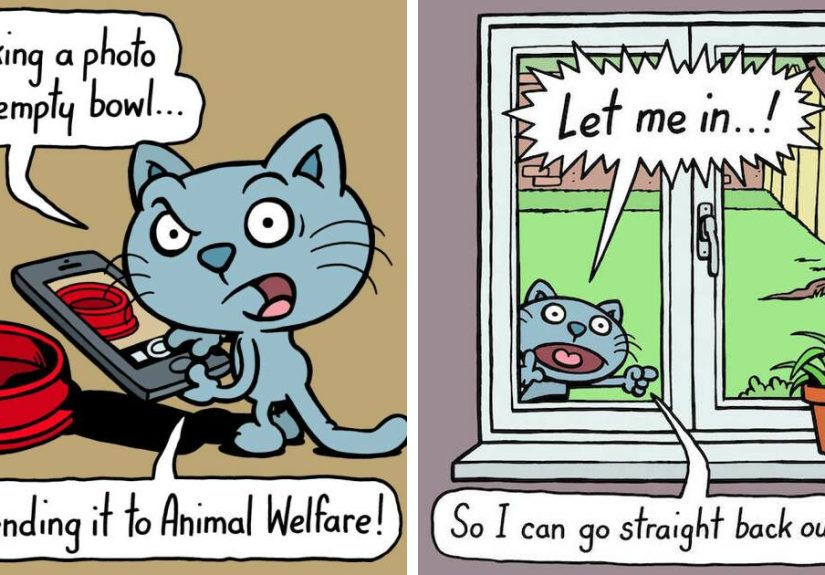
That is also why these comics appeal even to people who do not currently own cats. Cat behavior is dramatic, recognizable, and strangely human-looking in all the funniest ways. Cats sulk. Cats negotiate. Cats ignore expensive gifts. Cats insist on doors being opened for reasons that evaporate upon entry. The comedy feels universal because the emotions look familiar, even when the logic is pure feline nonsense.
What These 40 Cat Comics Really Say About Living With a Cat
Under the jokes, there is a surprisingly accurate portrait of the cat-human relationship. Living with a cat means learning that affection does not always look the way you expect. Sometimes it looks like a slow blink. Sometimes it looks like a cat sleeping near your feet instead of in your lap. Sometimes it looks like being followed into the bathroom by a furry creature that acts offended by your presence there. Cats have a funny way of making people work for emotional validation, which only makes the reward feel bigger when it arrives.
That emotional push and pull is why Anthony Smith’s one-panel cat comics feel more observant than generic. They understand that cats are not tiny dogs, and cat owners do not want them to be. We love cats because they are opinionated, particular, and gloriously strange. They want choice, routine, safety, climbing spots, hiding spots, and play that taps into their hunting instincts. When those needs are met, they become even more entertaining because their confidence really starts to shine. In other words, a happy cat is often a very funny cat.
And that may be the secret to the success of these comics. They do not laugh at cats so much as laugh with everyone who has ever loved one. They understand the daily absurdity of sharing a home with an animal that can look majestic in a sunbeam and ridiculous five minutes later with equal commitment. The result is a collection that feels light, easy to enjoy, and surprisingly sharp about what cat life is actually like.
Extra : Real-Life Experiences That Make These Cat Comics Even Funnier
If you have ever lived with a cat, you know the funniest part of these comics is not the punchline. It is the flashback they trigger. You look at one panel and instantly remember that one evening when your cat screamed at a closed door for ten full minutes, got the door opened, walked inside, stared at the wall like it had received confidential information, and then walked out again. No explanation. No apology. Just vibes.
That is the cat-owner experience in its purest form. Cats turn ordinary moments into tiny surreal sketches. You pour a cup of coffee, sit down to work, and your cat arrives like a disapproving manager. It steps onto your keyboard, sits on the exact sentence you were trying to finish, and somehow makes you feel like you are the one disrupting the schedule. The wild part is that most cat owners do not even stay annoyed. We sigh, adjust the laptop, take a photo, and tell ourselves this is normal now.
There is also the daily comedy of cat preferences. You can spend half an hour choosing the perfect toy, only for your cat to fall in love with a bottle cap, a twist tie, or a paper bag that sounds like it came with a warning label. The expensive cat tree becomes a decorative object while your cat claims the laundry basket, preferably the clean clothes you just folded. And somehow, despite the rejection, you feel proud. Look at that weird little genius making bad choices with such confidence.
Then there is the emotional whiplash. Cats have a gift for switching from “I am an elegant forest spirit” to “I have forgotten how my body works” in under thirty seconds. One minute they are perched in perfect profile on the windowsill like a Renaissance painting. The next they miss a jump, glare at the floor as if it betrayed them, and leave the room pretending nothing happened. If you laugh, they hear it. If you do not laugh, your soul hears it.
The sweetest experiences, though, are the ones that make the comics feel unexpectedly true. The cat that acts independent all day but sleeps outside your bedroom door at night. The one that pretends not to care where you are, then follows you from room to room like a very quiet bodyguard. The little chirp from the hallway that clearly means, “Come with me. I have found something important,” even if the important thing turns out to be an empty food bowl with three pieces of kibble still in it. These moments are ridiculous, but they are also the glue of the relationship.
That is why Anthony Smith’s cat comics connect so well. They remind people that living with a cat is not just owning a pet. It is entering a long-running sitcom where the co-star sheds on your black clothes, judges your decor, and occasionally head-butts you with astonishing sincerity. The show is messy, the plot makes no sense, and the lead actor refuses direction. Still, you would not cancel it for the world.
Conclusion
These One-Panel Cat Comics By Anthony Smith Purrfectly Capture What Having A Cat Is Like (40 Pics) succeeds because it understands a simple truth: cat ownership is hilarious precisely because it is so specific. The late-night zoomies, the box obsession, the desk takeovers, the mysterious vocal performances, the selective affection, and the dramatic relationship with gravity all show up in these comics because they all show up in real life. Anthony Smith takes those familiar moments and condenses them into sharp, funny snapshots that make cat owners feel instantly seen.
That is the real magic of great cat comics. They do not just deliver a laugh. They capture the strange emotional contract between humans and cats: we provide the food, the furniture, the toys, the heating, and the endless admiration, and in return we get companionship, comedy, and the occasional blessing of a slow blink. Honestly, not a bad deal.