Table of Contents >> Show >> Hide
- What Was Actually Discovered?
- Why Finding Tiny Moons Is So Hard
- Jupiter’s Moon Family Is Wildly Uneven
- Why These 12 Moons Matter More Than Their Size Suggests
- The Jupiter-Saturn Moon Rivalry Is More Fun Than It Should Be
- How the Discovery Fits Into the Bigger Jupiter Story
- Can You See These New Moons?
- What the Discovery Says About Science Itself
- A Stargazer’s Experience: Why This Discovery Feels Bigger Than 12 Tiny Dots
- Conclusion
Jupiter was already the show-off of the solar system. It is the biggest planet, the one with the giant storm, the strongest swagger, and a moon collection that was already making other planets look a little underbooked. Then astronomers found 12 more moons orbiting the gas giant, because apparently Jupiter took the phrase “go big or go home” a little too personally.
The discovery made headlines for a simple reason: big number, bigger planet, and a cosmic scoreboard that suddenly changed. But the real story is more interesting than a celestial head count. These newly confirmed moons were not dramatic, Earth-like worlds waiting to star in a sci-fi series. They were tiny, faint, irregular objects circling far from Jupiter, and they mattered because they help scientists piece together how giant planets build, steal, smash, and sort the debris around them.
In other words, the phrase “12 new moons of Jupiter discovered” sounds like a fun astronomy headline, but it is also a clue to the messy history of the outer solar system. And like many of the best space stories, it starts with patience, powerful telescopes, and the kind of tiny moving dots that can make astronomers wildly excited while everyone else squints and says, “That one? Really?”
What Was Actually Discovered?
The headline-making announcement referred to the confirmation of 12 additional Jovian moons that had been spotted during observations in 2021 and 2022. Once their orbits were tracked and verified, Jupiter’s official moon count rose to 92 at that moment in time. That pushed Jupiter ahead of Saturn in the ongoing and surprisingly competitive race to be crowned the solar system’s “moon king.”
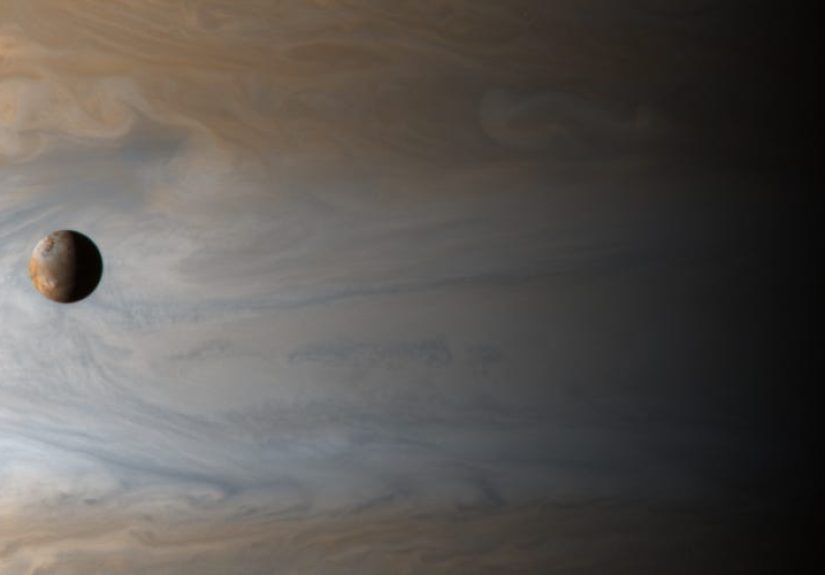
These were not giant, famous moons like Io, Europa, Ganymede, or Callisto. Those four are the VIP section of Jupiter’s moon family. The new discoveries belonged to the far less glamorous outer crowd: small, dim satellites orbiting at great distances from the planet. Most were only about 1 to 3 kilometers across, which makes them tiny by moon standards and very difficult to detect from Earth.
That size matters. A moon that small does not gleam in the night sky like a cosmic beacon. It lurks. It whispers. It photobombs telescope images so faintly that astronomers have to return again and again to confirm that it is actually orbiting Jupiter and not just drifting through the background like an unrelated rock with excellent timing.
Why Finding Tiny Moons Is So Hard
They Are Faint Enough to Ruin Your Confidence
Discovering a large moon is difficult. Discovering a tiny moon circling a bright giant planet from hundreds of millions of miles away is the astronomy equivalent of spotting a fruit fly beside a stadium floodlight. Jupiter itself is bright. Its small outer moons are not. That means astronomers rely on powerful instruments, dark-sky observing sites, and repeated imaging to separate real satellites from noise, stars, and other moving objects.
The 12 newly confirmed moons were detected using telescopes in Hawaii and Chile, including some of the best ground-based observing tools available. Even with that hardware, scientists still needed follow-up observations over time to prove that the objects were genuinely bound to Jupiter and not just passing through the frame. Space is big, but orbital paperwork is apparently still required.
Orbit Confirmation Takes Time
A suspected moon does not become an officially recognized moon just because it showed up in one image. Astronomers must track its motion long enough to calculate a stable orbit. That can take months or even more than a year, especially for faint outer moons. This is why announcements about “new moons” often happen well after the objects were first seen.
So when people hear that Jupiter suddenly gained 12 moons, it is not because those moons popped into existence overnight. It is because scientists finally gathered enough evidence to say, with confidence, “Yes, these little wanderers really belong to Jupiter.”
Jupiter’s Moon Family Is Wildly Uneven
When most people think of Jupiter moons, they think of the big four discovered in 1610. That is fair. The Galilean moons are famous for good reason. Ganymede is the largest moon in the solar system. Europa may have an ocean beneath its icy crust. Io is basically a volcanic tantrum with orbital privileges. Callisto looks like it has survived every bad day in solar system history.
But beyond those headline grabbers lies a much larger and stranger population of small moons. Many of Jupiter’s distant satellites are considered irregular moons. They often orbit far away, follow tilted paths, and can move in the opposite direction of Jupiter’s rotation. Scientists think some of the larger distant moons may have been captured objects, while smaller ones may be fragments left behind by ancient collisions.
That is what makes discoveries like these so important. The new moons are not just extra items on a checklist. They are potential fossils of planetary formation, capture events, and smashups that happened billions of years ago. Jupiter does not merely have a lot of moons. It has a complicated moon neighborhood, and every new member helps map that history more clearly.
Why These 12 Moons Matter More Than Their Size Suggests
They Help Reconstruct Jupiter’s Past
Small moons are scientifically valuable because they preserve clues about how the Jovian system evolved. If a distant moon is a captured asteroid, it may carry information about material that once wandered elsewhere in the early solar system. If it is a collision fragment, its orbit and size may reveal the aftermath of violent impacts that broke larger objects apart.
Think of Jupiter as a cosmic vacuum cleaner with a black belt in gravitational chaos. Its enormous gravity shapes the traffic around it, captures some objects, flings others away, and organizes its satellites into families and clusters. The newly recognized moons help astronomers understand how that process works.
They Show How Much We Still Miss
One of the most exciting parts of the discovery is what it implies: there are probably more moons still waiting to be confirmed. Astronomers involved in the search have said they are tracking additional moon candidates around the giant planets. That means the current total is not the final total. It is more like an updated score in a game where the referees keep finding extra players in the parking lot.
This is a reminder that our solar system is not a finished book. It still has footnotes, revisions, and the occasional surprise chapter. The planets we think we know best can still spring new discoveries on us, especially when better instruments and deeper surveys come into play.
The Jupiter-Saturn Moon Rivalry Is More Fun Than It Should Be
Yes, astronomers care about serious things like orbital mechanics, planetary history, and the architecture of the early solar system. But let us be honest: they also enjoy the moon-count rivalry between Jupiter and Saturn.
At the time of the 12-moon announcement, Jupiter reclaimed the title for most known moons, jumping ahead of Saturn. That crown did not stay perfectly still, because the totals for both planets continue to change as deeper surveys find additional small satellites. The important point is not which planet wins the cosmic popularity contest this week. It is that our ability to detect tiny objects around giant planets has improved dramatically.
In other words, the rivalry is not just fun trivia. It reflects a technological leap. As astronomers get better at finding extremely faint objects, the outer solar system starts to look even busier, more crowded, and more chaotic than older textbooks suggested.
How the Discovery Fits Into the Bigger Jupiter Story
The timing of the discovery also mattered. Interest in Jupiter’s moons has surged in recent years because major missions are focused on the Jovian system. NASA’s Juno mission has transformed our view of Jupiter and provided striking observations of some of its major moons. The European Space Agency’s JUICE mission launched in 2023 to study Jupiter and three of its icy moons in depth. NASA’s Europa Clipper launched in 2024 to investigate whether Europa has conditions suitable for life.
Those missions are not aimed at these tiny new moons. Nobody is sending a billion-dollar spacecraft to a 2-kilometer rock just because it recently made the attendance sheet. But the discovery still matters because it adds context. Jupiter is not just a planet with four famous moons and a bunch of extras. It is an entire system, rich with objects that tell different parts of the same story.
The big moons help scientists explore oceans, geology, radiation, and habitability. The small moons help scientists reconstruct capture events, collisions, and the leftovers of planetary formation. Together they turn Jupiter into something like a mini solar system, a phrase astronomers often use because it fits so well.
Can You See These New Moons?
Not with a backyard telescope. Sorry. I know that is rude of the universe.
The newly confirmed moons are far too small and faint for casual observers. Even strong amateur setups will not reveal them. But that does not mean the discovery is irrelevant to skywatchers. Quite the opposite. It gives more meaning to what people can observe.
When you look at Jupiter through binoculars or a small telescope and notice the Galilean moons lined up like bright dots, you are seeing the visible part of a much larger system. Those four bright moons are the front porch. Behind them lies a vast and complicated neighborhood of tiny objects, strange orbital families, and ancient debris. The discovery of 12 more moons turns a familiar planet into an even richer place to imagine.
What the Discovery Says About Science Itself
There is something wonderfully human about this story. The objects involved are tiny. The distances are absurd. The data are faint. And still, scientists keep looking. They take image after image, run calculations, compare observations, and slowly turn uncertainty into knowledge.
That process is not flashy. It does not arrive with a laser soundtrack. Most discoveries in astronomy are not made in a single movie-moment gasp. They are built through careful observing, follow-up work, and a willingness to say, “We think this is real, but let us prove it.” The 12 new moons of Jupiter are a perfect example of that method at work.
They also show that astronomy is not only about finding spectacular Earth-like planets or hunting for life. Sometimes science moves forward by noticing tiny things that other people might dismiss as unimportant. Sometimes a faint object orbiting far from Jupiter becomes the clue that helps explain how a planetary system got so wonderfully messy in the first place.
A Stargazer’s Experience: Why This Discovery Feels Bigger Than 12 Tiny Dots
There is a particular kind of experience that comes with reading news like this and then stepping outside on a clear night. Jupiter looks calm. Bright. Self-contained. It hangs there like a polished marble with no hint that it is surrounded by a crowded swarm of worlds and fragments. To the naked eye, it seems simple. To science, it is anything but simple.
That contrast is part of the thrill. You can stand in a quiet driveway, on an apartment balcony, or in the middle of a backyard that still smells faintly like cut grass, and look up at Jupiter without any sign of the 12 newly confirmed moons. You will not see them. You will not even come close. But you will know they are there, racing through darkness around a planet so massive that it has spent billions of years collecting a strange little empire.
That changes the feeling of skywatching. The night sky stops being a flat arrangement of bright points and starts feeling layered. Jupiter becomes less like a dot and more like a destination. You begin to imagine the four bright Galilean moons, the famous ones that can actually be tracked with modest equipment, and then farther out the dim irregular satellites that almost no one will ever see directly except through powerful instruments and stacks of processed data. Suddenly the view becomes deeper than the eye can manage on its own.
For people who love astronomy, discoveries like this create a wonderful tension between humility and excitement. Humility, because space keeps reminding us how much we still do not know. Excitement, because every improvement in observation reveals that the solar system is busier and stranger than we guessed. Twelve new moons may sound like a tidy number in a headline, but emotionally it lands like a reminder that the universe still has pockets full of surprises.
There is also a strangely comforting side to it. In a world where so much news feels rushed and loud, this kind of discovery comes from patience. Someone watched. Someone checked again. Someone verified the orbit. Someone refused to call it done too early. The result is a piece of knowledge that feels earned. It invites the rest of us to slow down and appreciate how science actually works when it is done well.
And maybe that is the real experience tied to the discovery. It is not just wonder at Jupiter. It is wonder at the human ability to detect something so small, so distant, and so faint, then fit it into a meaningful story about the history of the solar system. That is a beautiful trick. A planet shines in the sky, and from Earth we somehow learn that a dozen more tiny companions have been circling it all along. Not bad for a species standing on one small world with telescopes, notebooks, and a stubborn refusal to stop asking questions.
Conclusion
The story of 12 new moons of Jupiter discovered is about much more than inflating a planetary moon count. It is about the hidden complexity of the Jovian system, the patient work required to confirm faint objects, and the clues that tiny irregular satellites can offer about capture events, collisions, and the early solar system.
At the time of the announcement, Jupiter reclaimed the moon-count spotlight. But the deeper takeaway is that the solar system is still full of discoveries waiting in plain sight, or at least in very faint pixels. Every new moon adds detail to a larger picture, and Jupiter’s growing family reminds us that even our cosmic neighbors can still surprise us. The giant planet may be famous for its size, its storm, and its big four moons, but sometimes the smallest additions tell the biggest story.