Table of Contents >> Show >> Hide
- Why a Warm Welcome Works (Even on the Days You’re Running on Coffee and Hope)
- The Smile Isn’t the Goalthe Connection Is
- The 30-Second Doorway Routine That Changes the Whole Period
- First Week Power Moves: Names, Safety, and “I Belong Here” Signals
- Welcoming Without Making It Weird: Boundaries, Consent, and Culture
- Inclusion: Make “Welcome” True for Every Student
- Trauma-Informed Welcoming: Smiles, Predictability, and Calm
- Welcoming Students Beyond Your Door: A Whole-School Smile Culture
- Welcoming Students Online Still Counts
- When You Don’t Feel Like Smiling: Authentic Welcoming on Hard Days
- How to Tell If Your Welcome Is Working
- Common Mistakes (So You Can Skip the Trial-and-Error Season)
- Stories From the Doorway: Real-World Experiences That Make the Strategy Stick
- Conclusion
A smile is one of the few classroom tools that doesn’t need a purchase order, a training session, or a login. It’s also wildly
underrated. The way students are welcomedespecially in the first minutequietly answers a bunch of questions they may not even
say out loud: Am I safe here? Do I matter? Will I be embarrassed? Is this a place where I can learn without getting roasted?
“Welcoming students with a smile” isn’t about forcing cheerfulness or acting like a human emoji. It’s a practical, research-informed
routine that helps kids settle, helps adults connect, and helps learning start sooner. Done well, it’s relationship-building,
classroom management, and social-emotional supportpacked into a moment that fits between the bell and the backpack unzip.
Why a Warm Welcome Works (Even on the Days You’re Running on Coffee and Hope)
Students don’t arrive as blank slates. They arrive after a morning of siblings, buses, late alarms, group chats, family stress,
and a thousand tiny social calculations. When an adult offers a genuine, calm, friendly greeting, it can act like a “reset button”
that helps students transition from the outside world into learning mode.
There’s also evidence that simple greetings at the door can improve what teachers care about most: engagement and behavior.
In one frequently cited line of research on “positive greetings at the door,” classrooms using brief, positive, personal greetings
showed higher academic engagement and fewer disruptions. The magic isn’t the doorway itselfit’s the message: “I see you, I’m glad you’re here,
and we’re starting together.”
The Smile Isn’t the Goalthe Connection Is
Let’s clear up a common misunderstanding: the smile is not a performance. Students can tell the difference between “I’m happy to see you”
and “I’m smiling because I’m supposed to.” The real goal is connectionsmall, consistent moments that build trust over time.
Think of the smile as the packaging, not the product. The product is a welcoming climate: a classroom where students feel known,
respected, and steady enough to take academic risks (like answering questions, trying hard things, and not melting into the floor when they’re wrong).
The 30-Second Doorway Routine That Changes the Whole Period
If you want a routine that’s simple, repeatable, and doesn’t collapse the moment you have a substitute, try this:
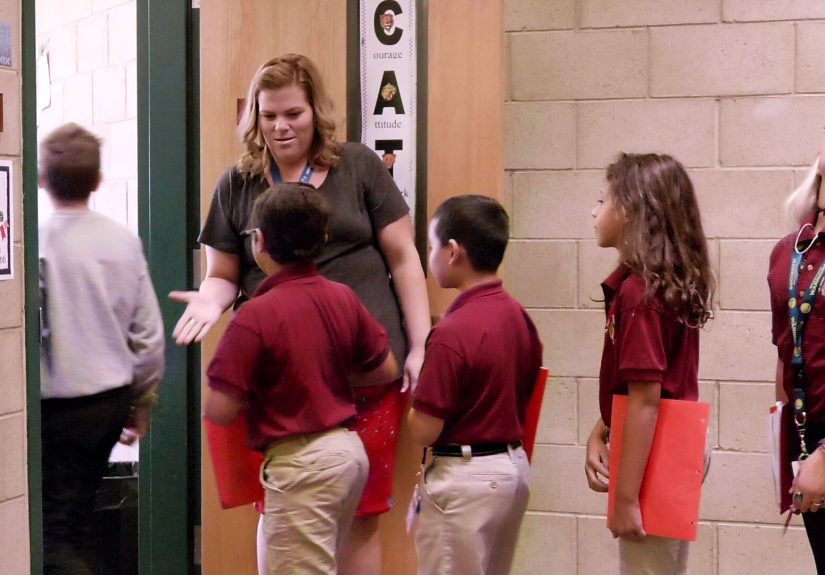
show up at the door (or the “start line” of your space) and greet students individually as they enter.
The Four-Part Greeting (Simple, Not Scripted)
- Name: Use the student’s name (and pronounce it correctly).
- Noticing: Offer a small, genuine observation (“Glad you’re here,” “Nice job yesterday,” “You made it!”).
- Choice: Provide a no-pressure greeting option (wave, nod, fist bump, “good morning,” etc.).
- Next step: Point them toward the starter (“Warm-up is on the board,” “Grab your lab sheet,” “Do Now is in Canvas”).
This routine does double duty: it communicates care and reduces confusion. Students enter with momentum instead of wandering
and wondering what to do. That alone can prevent a surprising amount of off-task behavior.
Examples That Don’t Sound Like a Robot in a Hallway
- “Morning, Maya. Glad you’re here. Want a wave or a fist bump today? Do Now’s on the screen.”
- “Hey, Jordangood to see you. You’re on my ‘people who showed up’ leaderboard. Warm-up’s in your notebook.”
- “Hi, Alex. Thanks for being on time. Quiet hello today? Cooltake your seat and start question one.”
- “Good morning, everybody. If you want a quick check-in, I’m at the door. If not, grab your materials and begin.”
Notice what’s missing: a long conversation, public praise that might embarrass a student, or any “Okay, tell me everything that happened on the bus.”
You’re building a bridge, not hosting a talk show.
First Week Power Moves: Names, Safety, and “I Belong Here” Signals
The first week is when students decide what kind of place your room is. You don’t have to be flashy. You just have to be consistent.
Here are high-impact welcomes that work across grade levels.
Get Names Right (Yes, It’s Worth the Effort)
Names carry identity. Mispronouncing a name repeatedly can send the message, even unintentionally, that a student is an inconvenience.
Practical strategies:
- Name tents for the first two weeks (big letters, readable from across the room).
- Phonetic notes on your seating chart (and ask, “Did I say it right?” with genuine openness).
- Quick audio practice on your own time if families provide pronunciations or students share them.
- Don’t “Americanize” automatically; ask what they prefer and use it consistently.
Teach the Entry Routine Like It’s a Lab Procedure
A welcoming classroom is also a predictable classroom. Students feel safer when they know what happens next. Post (and practice) a simple entry routine:
where to put backpacks, how to get supplies, how to start the warm-up, and what “ready” looks like.
Bonus: when you greet at the door, you can quietly redirect before a problem grows legs. A quick, calm “Phones away as you enter, thanks”
is more effective than a mid-lesson showdown.
Welcoming Without Making It Weird: Boundaries, Consent, and Culture
A smile should feel safe, not invasive. Students have different comfort levels with eye contact, physical touch, humor, and attention.
A few guidelines keep your welcome warm and respectful:
- Offer choices: wave, nod, “good morning,” fist bump, or simply “hello.” No one should be forced to touch.
- Keep it private when needed: avoid calling out sensitive things (“Rough morning?”) in front of peers.
- Respect cultural differences: some students may prefer less direct interaction at first. A calm, consistent greeting builds trust.
- Watch your jokes: sarcasm can land as rejection, especially early in the year.
If you teach older students, remember: many teens crave respect more than pep. A simple “Good to see you” can be more powerful than an
overly enthusiastic greeting that makes them feel like they’re starring in an awkward commercial.
Inclusion: Make “Welcome” True for Every Student
Welcoming students with a smile is strongest when it’s paired with inclusive classroom practicesbecause students notice the difference between
“I smiled at you” and “I made room for you.”
Small Inclusion Signals That Speak Loudly
- Language access: learn a few greetings in students’ home languages (and invite students to teach you).
- Representation: include texts, examples, and visuals that reflect your students’ cultures and communities.
- Respect identity: use correct names and pronouns; avoid assumptions about families, holidays, or background.
- Clear norms: explicitly teach respectful discussion and intervene when bias shows up.
The welcome is also a daily chance to communicate “you’re part of this.” Even something as quick as “Good morning, Anayour group is at table three today”
reinforces belonging and clarity at the same time.
Trauma-Informed Welcoming: Smiles, Predictability, and Calm
For some students, school is the most predictable place they have. For others, school can feel like a threat if they’ve experienced instability,
conflict, or past harm. A trauma-informed welcome doesn’t mean you diagnose students or act like a therapist. It means you use routines that promote
regulation and relational safety.
What This Looks Like in Real Life
- Predictable start: the first 3–5 minutes are the same structure each day (greeting, warm-up, quick agenda).
- Quiet option: allow a “quiet hello” without penalty.
- Private check-in system: students can indicate “need a minute” with a card, digital form, or a quick signal.
- Neutral tone: warm, not loud; steady, not performative.
A smile here is less “big energy!” and more “steady presence.” The message is: Nothing bad is waiting for you when you walk in.
Welcoming Students Beyond Your Door: A Whole-School Smile Culture
Students experience school as a chain of moments: bus → hallway → office → classroom → cafeteria → gym. When multiple adults greet students warmly,
the entire building feels safer and more connected.
Schools that build a welcoming culture often align around a few shared practices:
- Adults in visible places during transitions.
- Consistent greetings and expectations (students shouldn’t get whiplash from “warm” in one room and “cold” in the next).
- Staff language that emphasizes respect, not intimidation.
- Systems that help adults learn names quickly (photos, pronunciation guides, advisory structures).
If you’re in a leadership role, consider a simple staff norm: “We greet students before we correct them.” It doesn’t remove accountability.
It improves the relationship that makes accountability possible.
Welcoming Students Online Still Counts
In digital or hybrid spaces, “the door” is the first minute of the meeting or the first interaction in the platform. A welcoming routine might include:
- Starting with a brief hello and agenda so students know what’s coming.
- A low-pressure check-in prompt (“One word for how you’re arriving today”).
- Greeting a few students by name as they join (without forcing camera use).
- Using chat, polls, or reactions as greeting choices.
The principle stays the same: belonging drives engagement. When students feel like anonymous squares on a screen, participation drops. When they feel seen,
they show up more fullyeven if they’re showing up in sweatpants and existential dread.
When You Don’t Feel Like Smiling: Authentic Welcoming on Hard Days
Teachers are human. Some mornings you’re juggling your own stress, grief, illness, or a to-do list that has grown sentient and started emailing you.
The good news: welcoming students doesn’t require constant sunshine. It requires steadiness.
Try “Warm and Neutral”
- Use a gentle tone: “Good morning. I’m glad you’re here.”
- Lean on the routine: name + choice + next step.
- Keep your face relaxed, your voice calm, and your directions clear.
Students often respond well to honesty that’s age-appropriate: “I’m a little low-energy today, but I’m happy to see you and we’re going to have a solid class.”
That communicates care and models emotional regulation.
How to Tell If Your Welcome Is Working
You don’t need a complicated data dashboard to know whether “welcoming students with a smile” is helping. Look for shifts in:
- Time to start: are students beginning the warm-up faster?
- Disruptions: do you see fewer minor behaviors at the start of class?
- Student tone: are greetings returned more often over time?
- Attendance and tardies: do students seem more willing to walk in?
You can also ask students directly with two quick questions:
“Do you feel welcomed when you come into this class?” and “What would make the start of class feel better?” Then actually use their feedback.
That’s not just welcomingit’s empowering.
Common Mistakes (So You Can Skip the Trial-and-Error Season)
- Generic greetings only: “Hi” is fine, but names and small personal touches build real connection.
- Public interrogation: avoid doorway questions that invite private stories in public space.
- Forced touch: choices matter; consent matters.
- Weaponized cheer: “Smile! It’s a great day!” can feel dismissive to a student who’s struggling.
- Inconsistency: the routine works because it’s reliableespecially for students who need stability.
Stories From the Doorway: Real-World Experiences That Make the Strategy Stick
The research is helpful, but what makes “welcoming students with a smile” feel real is the way it plays out in everyday moments.
Here are experience-based snapshots (the kind educators share in hallways, not the kind you find on laminated posters).
1) The Student Who Never Answered
A middle school teacher greeted a student every day with the usual “Good morninghow are you?” and got the same response: nothing. No eye contact,
no words, just a quiet slide into the seat. Instead of escalating, the teacher changed one detail: they asked a question that didn’t demand emotion.
“Heyare you team waffles or team pancakes today?” The student paused, shrugged, and whispered, “Waffles.” It wasn’t a dramatic breakthrough,
but it was the first thread of connection. Over the next weeks, those tiny, low-stakes interactions became trust. The student didn’t become chatty,
but the shutdown softened. The welcome was doing its job: creating a safer start.
2) The Office Smile That Lowered the Temperature
At one school, the front office was the emotional weather station. If the welcome there felt cold, the whole building felt colder.
A receptionist decided to treat every arrival like a fresh startespecially late arrivals who already felt embarrassed. Instead of a sigh and a clipboard,
students heard, “Good morning. I’m glad you made it. Let’s get you checked in.” Teachers noticed fewer defensive attitudes in first period,
because students weren’t walking in with the “I’m already in trouble” mindset. The smile didn’t remove consequences; it removed shame.
3) The “Quiet Hello” Card That Helped a Newcomer Student
A high school teacher had a newcomer student who looked overwhelmed every morningcrowded hallways, new language, new routines.
The teacher created a tiny card students could place on the corner of their desk: green meant “I’m good,” yellow meant “I’m okay but tired,”
and blue meant “I need a little patience today.” The student used blue frequently at first. The teacher responded with a calm smile and predictable entry steps:
point to the warm-up, show where materials were, and check in privately later. The student’s confidence grew. Over time, blue became yellow, then green.
The welcome wasn’t loudbut it was steady, which made it powerful.
4) The Substitute Who Won the Room in Two Minutes
A substitute teacher walked into a class known for “testing limits” and did something disarmingly simple: stood at the door, smiled, and greeted students by name
using the seating chart photos. “Hey, Malikthanks for being here. Good morning, Priya.” Students did a double take: Wait, you know my name?
The sub pointed to the starter activity and thanked students who began quickly. The class didn’t become magically perfect, but the opening minutes were calmer,
and the substitute spent more time teaching and less time negotiating. The welcome signaled professionalism and caretwo things students often respond to faster than lectures.
5) The Teacher Who Stopped Trying to Be “Fun” and Became Effective
An elementary teacher realized her “big personality” welcome was exhausting her and overstimulating some students. She redesigned the start:
softer lights, calm music, a gentle smile, a consistent greeting at the door, and one clear instruction: “Take your seat and begin the warm-up.”
She still built relationshipsjust without turning the doorway into a pep rally. Students who needed calm settled faster. Students who wanted connection still got it,
because the teacher used names, noticing, and brief personal check-ins. The class ran smoother, and the teacher had more energy for teachingnot just managing.
The lesson: welcoming doesn’t have to be loud to be real.
Conclusion
Welcoming students with a smile is a small practice with outsized impact. It builds belonging, reduces friction at the start of class,
and gives students a consistent message: “You’re seen here.” The best welcomes aren’t perfect or performativethey’re genuine, predictable,
and inclusive. Start with a simple doorway routine, use names, offer choices, and keep your welcome steady even on hard days. When students walk in feeling
respected and safe, learning doesn’t just begin soonerit goes deeper.