Table of Contents >> Show >> Hide
- Why Dumb Workplace Rules Hit Such a Nerve
- 30 Dumbest Rules People Have Had To Follow At Work
- 1. “No Drinking Water Unless You Have a Doctor’s Note”
- 2. Bathroom Breaks Had To Be Approved Like Bank Loans
- 3. Employees Could Not Sit, Even When No Customers Were Around
- 4. Nobody Could Leave Before the Boss Left
- 5. “No Talking,” Even During Slow Periods
- 6. Dress Codes That Made No Practical Sense
- 7. No Phones, Even For Emergencies
- 8. Scripts That Employees Had To Repeat Word-for-Word
- 9. Breaks That Existed Only On Paper
- 10. Employees Had To Smile Constantly
- 11. No Personal Items At Desks
- 12. Remote Workers Could Not Have Normal Home Interruptions
- 13. No Coats Indoors, Even When It Was Cold
- 14. Employees Could Not Eat Visible Food, Even On Long Shifts
- 15. Time-Off Requests Were Treated Like Personal Betrayals
- 16. Employees Had To Arrive Early But Could Not Clock In
- 17. “Don’t Ask Questions” During Training
- 18. No Music, Even In Isolated Work Areas
- 19. Approval Required For Every Tiny Decision
- 20. Employees Could Not Discuss Pay
- 21. Mandatory Fun After Hours
- 22. “Clean Desk” Rules Applied During Active Work
- 23. No Using the Front Door
- 24. Punishing Everyone Because One Person Messed Up
- 25. Workers Had To Look Busy At All Times
- 26. No Headphones, Even For Focus Work
- 27. Employees Could Not Say “I Don’t Know”
- 28. Overly Strict Parking Rules
- 29. No Decorations During Holidays
- 30. “Because I Said So” Policies
- What These Rules Reveal About Bad Management
- Why Employees Leave Shortly After Dumb Rules Appear
- How Smart Companies Write Better Workplace Rules
- Personal-Style Experiences: What It Feels Like To Work Under Dumb Rules
- Conclusion
Every workplace needs rules. Nobody wants the office microwave to become a crime scene, the warehouse forklift to be driven like a go-kart, or the group chat to turn into a 47-message debate about who stole Brad’s yogurt. Good rules protect people, clarify expectations, and keep work moving. Bad rules, however, do something very different: they turn grown adults into suspiciously monitored toddlers with email addresses.
The title “I Left Shortly After” captures a feeling many workers know too well. Sometimes the dumbest workplace rule is not just annoying; it becomes the final tiny paper cut in a long stack of frustrations. Maybe it is a manager who bans water bottles at the register. Maybe it is a company that requires employees to ask permission to use the bathroom. Maybe it is the classic “you may not leave before the owner leaves,” even when the owner is on a phone call that could outlive the Roman Empire.
This article looks at the kinds of ridiculous workplace rules employees have shared online and connects them with a bigger truth about management: when policies are built on distrust, they usually create exactly what employers claim they are trying to prevent. People disengage. They stop giving extra effort. And sometimes, yes, they leave shortly after.
Why Dumb Workplace Rules Hit Such a Nerve
A silly rule can seem harmless from the outside. “So what if employees can only use blue pens?” “So what if staff have to stand for eight hours?” “So what if everyone has to smile at customers like they just won a cruise?” But inside the workplace, these policies often carry a deeper message: we do not trust you.
That is why dumb work rules are rarely about the rule itself. They are about control, respect, fairness, and common sense. A reasonable policy says, “Here is how we keep everyone safe and productive.” A dumb rule says, “Someone in management panicked once, and now everyone must suffer forever.”
Workplace research has repeatedly shown that employees value autonomy, psychological safety, fair treatment, and a sense that their work matters. The U.S. Surgeon General’s workplace well-being framework highlights essentials such as protection from harm, work-life harmony, connection, growth, and mattering at work. Meanwhile, employee experience studies from organizations such as Gallup and the American Psychological Association have connected poor culture, burnout, and low engagement with turnover. In plain English: people do better work when they are treated like capable adults, not suspicious raccoons wearing name tags.
30 Dumbest Rules People Have Had To Follow At Work
The following examples are inspired by common workplace stories shared by employees in public discussions, forums, and viral workplace roundups. They are rewritten and grouped for clarity, but they reflect very real patterns workers complain about every day.
1. “No Drinking Water Unless You Have a Doctor’s Note”
One of the most ridiculous rules workers mention is being banned from drinking water while on duty, especially in retail, grocery, food service, or warehouse jobs. Some employees have reported being told they needed a doctor’s note to keep a water bottle nearby. Unless the bottle is filled with glitter glue and bad decisions, this is hard to defend.
2. Bathroom Breaks Had To Be Approved Like Bank Loans
Bathroom policies are a greatest-hits album of workplace foolishness. Some employees have had to sign out, ask a manager, wait for coverage that never comes, or explain why they needed to go. OSHA guidance emphasizes access to sanitary and available restroom facilities, and most people with a functioning soul understand why. Treating bathroom use as a privilege is not “efficiency.” It is weird.
3. Employees Could Not Sit, Even When No Customers Were Around
The “if you have time to lean, you have time to clean” philosophy has exhausted generations of workers. Some jobs require standing for safety or visibility, but many sitting bans are pure performance theater. A cashier sitting on a stool is still a cashier. A receptionist sitting at a desk is not betraying the company mission.
4. Nobody Could Leave Before the Boss Left
This rule turns the office into a hostage situation with fluorescent lighting. Workers have described being expected to stay until the owner or manager went home, regardless of their own scheduled hours. It rewards presenteeism instead of productivity. It also teaches employees that the fastest way to freedom is finding a job where adults own clocks.
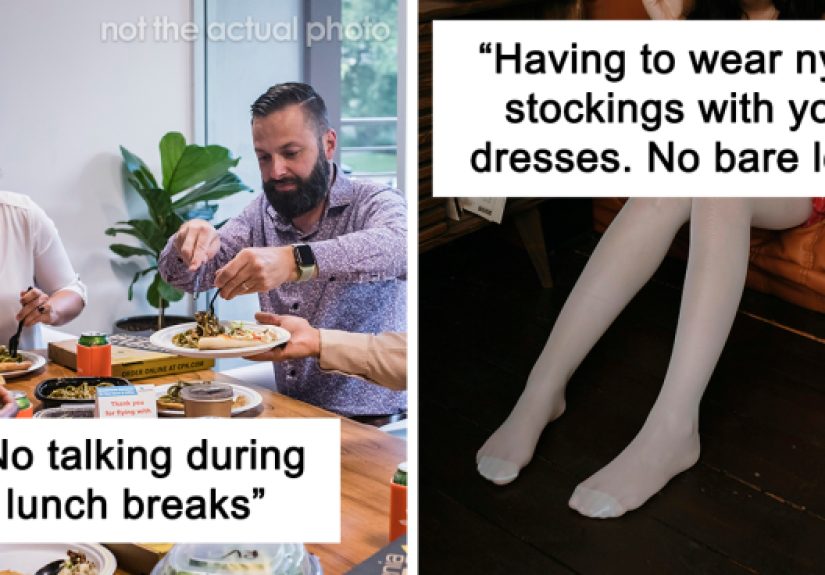
5. “No Talking,” Even During Slow Periods
Some managers view employee conversation as an emergency. But banning all casual talk can backfire. Friendly interaction builds teamwork, reduces stress, and makes long shifts more bearable. Obviously, people should not ignore customers or safety procedures, but a total silence rule makes the workplace feel less like a business and more like a library run by a haunted stapler.
6. Dress Codes That Made No Practical Sense
Dress codes can be valid when they support safety, brand standards, or professionalism. But workers often complain about uneven or arbitrary appearance rules: no comfortable shoes, no jackets even when the store is freezing, no visible tattoos in a back-room role, or gendered grooming standards that feel outdated. EEOC guidance has long noted that dress and grooming policies should be applied fairly and should not discriminate.
7. No Phones, Even For Emergencies
Reasonable phone policies make sense. Nobody wants a forklift driver filming a dance challenge mid-turn. But some workplaces ban phones so aggressively that employees cannot be reached for family emergencies. A better policy distinguishes between distraction and basic human reality.
8. Scripts That Employees Had To Repeat Word-for-Word
Customer service scripts can help new employees, but forcing every interaction into the same robotic wording can make both workers and customers miserable. People can tell when a greeting has been polished into lifeless corporate oatmeal. A useful script guides; a dumb script replaces human judgment.
9. Breaks That Existed Only On Paper
Many workers know the mythical scheduled break: printed on a policy sheet, praised during orientation, and never seen again in the wild. Some employees are technically allowed breaks but punished socially or operationally for taking them. That kind of rule creates resentment fast.
10. Employees Had To Smile Constantly
“Smile more” rules are especially common in customer-facing jobs. Friendliness matters, but forced cheerfulness can become emotional surveillance. Employees are not animatronic mascots at a theme park. A worker can be respectful and helpful without grinning through a migraine.
11. No Personal Items At Desks
Some offices ban photos, mugs, small plants, or other personal items in the name of “professionalism.” A clean workspace is reasonable. A desk so sterile it looks like a witness protection program is not automatically more productive.
12. Remote Workers Could Not Have Normal Home Interruptions
One especially frustrating type of rule appeared during remote-work years: managers expecting home offices to function like sealed corporate pods. Employees have been criticized for children, pets, doorbells, or household noises appearing briefly on calls. Professionalism matters, but punishing ordinary life can feel hypocritical when managers experience the same interruptions.
13. No Coats Indoors, Even When It Was Cold
Workers in stores, offices, and warehouses have complained about being told not to wear coats or hoodies while freezing. Sometimes this is tied to uniform policy, but when indoor temperatures are uncomfortable, the policy should adapt. Hypothermia is not a brand identity.
14. Employees Could Not Eat Visible Food, Even On Long Shifts
Food policies are tricky in customer-facing or sanitary environments. Still, some workers report rules so strict they could not have a snack during long shifts, even away from customers. This is how morale falls into a vending machine and never comes back.
15. Time-Off Requests Were Treated Like Personal Betrayals
Some workplaces technically allow vacation, sick days, or personal time but guilt employees for using them. A benefit that causes punishment is not a benefit; it is decorative paperwork.
16. Employees Had To Arrive Early But Could Not Clock In
This rule deserves a special seat in the Hall of Nonsense. If an employer requires workers to be present and ready before the shift, that time may raise wage-and-hour concerns depending on the circumstances. At minimum, it is a giant red flag wearing a tiny manager badge.
17. “Don’t Ask Questions” During Training
Training without questions is not training. It is a monologue with payroll implications. New workers need space to clarify procedures, especially in jobs involving safety, money, customers, or compliance. A workplace that discourages questions should not be shocked when mistakes multiply.
18. No Music, Even In Isolated Work Areas
In some environments, music can be distracting or unsafe. In others, employees doing repetitive solo tasks may find quiet background music helpful. A blanket ban often ignores the actual work being done.
19. Approval Required For Every Tiny Decision
Micromanagement rules are among the most common complaints: ask before sending an email, ask before moving a chair, ask before refunding one dollar, ask before breathing in a nonstandard rhythm. When every small decision needs permission, managers become bottlenecks and employees stop thinking independently.
20. Employees Could Not Discuss Pay
Some workers say they were told not to discuss wages. In the United States, many private-sector employees have legal protections under the National Labor Relations Act when discussing pay and working conditions. Employers who discourage these conversations may create distrust and legal risk.
21. Mandatory Fun After Hours
Team bonding can be great. Mandatory unpaid fun after work? Less great. Employees may have families, second jobs, school, health needs, or a powerful desire to sit quietly in sweatpants. A pizza party is not culture if attendance feels compulsory.
22. “Clean Desk” Rules Applied During Active Work
Organization matters, especially in regulated industries. But some clean-desk policies become absurd when employees are actively using documents, tools, or notes. A desk can be busy because work is happening. Shocking, but true.
23. No Using the Front Door
Some employees have reported being required to enter through inconvenient back doors or service entrances even when it made no safety difference. In certain businesses, separate entrances may have security reasons. In others, it simply sends a message: customers are guests; employees are equipment.
24. Punishing Everyone Because One Person Messed Up
This is the origin story of many dumb rules. One employee abuses a privilege, so management bans it for everybody. One person leaves dishes in the sink; now mugs are illegal. One person takes a long break; now everyone needs a hall pass. Collective punishment is easy to write and hard on morale.
25. Workers Had To Look Busy At All Times
“Looking busy” is the enemy of actual productivity. Employees may finish tasks efficiently, then be forced to rearrange shelves, wipe already-clean counters, or pretend to type. A results-focused manager asks what needs to be done. A bad manager asks why your hands are not theatrically moving.
26. No Headphones, Even For Focus Work
In collaborative or safety-sensitive roles, headphones may be a problem. But for focused office work, coding, writing, data entry, or design, a no-headphones rule can reduce concentration. Again, context is everything. Rules that ignore context become office folklore.
27. Employees Could Not Say “I Don’t Know”
Some customer service workers are told never to admit uncertainty. That sounds confident until it produces wrong answers. A better standard is: “I’m not sure, but I’ll find out.” Honesty plus follow-through beats confident nonsense every time.
28. Overly Strict Parking Rules
Parking policies can quickly become workplace drama. Employees describe being barred from empty spaces near the building while executives enjoy reserved spots the size of small kingdoms. When workers have late shifts, safety concerns, or mobility needs, rigid parking rules can feel especially disrespectful.
29. No Decorations During Holidays
Some workplaces ban all seasonal decorations to avoid clutter or conflict. That can be understandable in some settings. But when the rule extends to one small snowman on a cubicle or a harmless string of lights, it starts to feel like the company’s real mission is defeating joy.
30. “Because I Said So” Policies
The dumbest rule of all may be the one nobody can explain. When employees ask why a rule exists and the only answer is “because that’s the policy,” trust erodes. Good rules have reasons. Bad rules have vibes, ego, and sometimes a laminated sign.
What These Rules Reveal About Bad Management
Ridiculous workplace rules usually come from one of four places: fear, laziness, control, or a single bad incident. A manager fears losing control, so they monitor every minute. A company wants consistency, so it removes judgment. Someone abuses flexibility, so leadership bans flexibility. A customer complains once, so employees live forever under the shadow of that one complaint.
The problem is that rigid rules often solve the wrong issue. If one person is repeatedly late, address that person. If a break system is being abused, improve scheduling and accountability. If customers complain about unprofessional behavior, train employees and coach the specific behavior. Do not create a sweeping rule that punishes your best workers along with your worst.
Bad rules also create hidden costs. Employees spend energy navigating policies instead of serving customers, solving problems, or improving the business. Managers spend time enforcing tiny rules instead of leading. Eventually, the best employees may decide their talents are better used elsewhere, preferably somewhere they can drink water without a medical affidavit.
Why Employees Leave Shortly After Dumb Rules Appear
Most people do not quit over one silly rule. They quit because the silly rule confirms what they already suspected: leadership is out of touch. The water bottle rule is not just about water. The bathroom rule is not just about bathrooms. The “no leaving before the boss” rule is not just about time. These policies become symbols of a workplace where power matters more than respect.
That is why stories about dumb workplace rules go viral. They are funny, but they are also familiar. Readers laugh because the examples are absurd, then wince because they have lived through something similar. A rule that sounds unbelievable to outsiders can feel completely normal inside a dysfunctional workplace.
How Smart Companies Write Better Workplace Rules
Smart companies do not avoid rules. They write better ones. A useful workplace policy should be clear, fair, legal, practical, and connected to a real business need. It should explain the “why,” not just bark the “what.” It should leave room for reasonable judgment. And most importantly, it should not create more problems than it solves.
For example, instead of banning all water bottles, a company can require spill-proof containers in approved areas. Instead of banning sitting, it can allow stools when safety and service are not affected. Instead of forcing employees to ask permission for every break, it can create coverage systems that protect both workers and operations. Instead of punishing everyone for one person’s behavior, it can manage that individual directly.
Good rules also involve employee feedback. The people doing the job usually know which policies are helping and which ones are making everyone silently update their résumés during lunch. Asking workers for input is not weakness. It is basic operational intelligence.
Personal-Style Experiences: What It Feels Like To Work Under Dumb Rules
If you have ever worked under a truly dumb rule, you know the experience has a special flavor. It is part frustration, part comedy, and part “Am I being tested by a hidden camera crew?” The first time a manager explains the rule, you assume there must be a reasonable backstory. By the third explanation, you realize the backstory is probably “someone powerful dislikes chairs.”
Imagine starting a retail shift during a summer heat wave. The store doors open every thirty seconds, the air conditioning is losing a battle with the sun, and your manager tells you that water bottles are not allowed at the register because they “look unprofessional.” Meanwhile, customers are walking in wearing flip-flops and buying cheese puffs. Nothing about the scene suggests a museum-level standard of elegance. Still, the rule stands. So employees sneak tiny sips in the stockroom like they are participating in an underground hydration ring.
Or picture an office where the work is done, the inbox is clear, and the clock says 5:00 p.m. But nobody moves because the department head is still in his office. He is not speaking to anyone. He is not reviewing urgent documents. He may, for all anyone knows, be reading grill reviews. Yet the social rule is clear: leaving on time is suspicious. So everyone performs the ancient ritual of fake busyness. One person opens a spreadsheet. Another shuffles papers. Someone clicks randomly with the confidence of a concert pianist. Productivity is over, but theater has begun.
The strangest part is how quickly workers adapt. Humans are flexible creatures. We can normalize almost anything if the paycheck arrives on Friday. You learn which manager enforces which rule. You learn where to stand so the camera cannot see you sitting for thirty seconds. You learn that the official break room is too far away to use during an actual break. You learn that “open-door policy” means the door is open, but consequences may enter with you.
Over time, dumb rules change the way employees feel about work. At first, people joke about them. Then they complain. Then they stop suggesting improvements because suggestions go nowhere. Finally, they detach. They do the job, avoid trouble, and invest their real energy somewhere else. That is the danger employers often miss. A ridiculous rule may not cause a dramatic walkout. It may cause something quieter: the slow disappearance of effort.
The best workplaces feel different. They still have standards, but the standards make sense. Employees know why policies exist. Managers explain decisions without treating questions as rebellion. People can use the bathroom, drink water, take breaks, and solve small problems without filing a verbal permit. In those workplaces, rules support the work instead of becoming the work.
That is the lesson behind all these “I left shortly after” stories. Employees are not demanding a rule-free playground with unlimited snacks and a company llama, although morale would probably improve. They are asking for common sense. They want policies that protect people, serve customers, and respect the fact that workers are adults. When companies forget that, even the smallest rule can become the moment someone decides, “That’s enough.”
Conclusion
Dumb workplace rules are funny because they are absurd, but they are important because they reveal how organizations think about people. A company that bans water, bathroom breaks, sitting, questions, or basic flexibility may believe it is maintaining discipline. In reality, it may be training employees to distrust leadership, disengage from the mission, and leave when a better opportunity appears.
The smartest employers understand that rules should make work safer, clearer, and more effective. They should not exist to satisfy a manager’s anxiety or preserve a tradition nobody can explain. If a workplace rule cannot survive one honest question “What problem does this solve?” it probably deserves retirement.
And if the answer is “because we’ve always done it this way,” well, that may be the dumbest rule of all.
Note: This article is based on publicly discussed workplace experiences and widely recognized U.S. workplace guidance and research on employee well-being, management practices, restroom access, dress codes, engagement, and toxic workplace culture. Examples have been rewritten and synthesized for originality, clarity, and SEO-friendly publishing.