Table of Contents >> Show >> Hide
- The Big Idea: Moon First, Mars Next
- Why the Moon Matters in the Trump NASA Plan
- SLS and Orion: The Original Backbone
- The Lunar Gateway: Useful Outpost or Expensive Detour?
- Commercial Space: The Not-So-Secret Engine
- The Budget Reality: Dreams Meet Spreadsheets
- Artemis Gets a Course Correction
- The Moon Base Vision
- What Happens to NASA Science?
- The China Factor
- What the Plan Gets Right
- Where the Plan Could Go Wrong
- Experiences and Lessons From Watching NASA’s Plan Unfold
- Conclusion
Note: This article is based on public reporting and official U.S. government/NASA materials available as of April 26, 2026, including NASA policy pages, NASA budget releases, GAO oversight work, and reputable space-policy reporting.
NASA has never been short on ambition. It is, after all, the agency that looked at the Moon and said, “Nice place for a road trip.” But the Trump transition team’s big plan for NASA was not simply “go farther.” It was a major philosophical reset: return human spaceflight to the Moon, build a lasting presence there, use commercial companies more aggressively, and treat the lunar neighborhood as a proving ground for Mars.
The plan began taking shape during Donald Trump’s first term, when advisers such as astrophysicist Jack Burns argued that NASA had drifted after the Space Shuttle era and needed a sharper human exploration mission. In 2017, Burns described a NASA that had been “stuck” for years, with American astronauts still relying on Russian Soyuz spacecraft after the Shuttle’s retirement. The transition team’s answer was to speed up deep-space exploration using the Space Launch System, Orion, lunar infrastructure, private industry, and a renewed national space-policy structure.
The Big Idea: Moon First, Mars Next
The central idea was simple enough to fit on a bumper sticker: go back to the Moon, stay there, and use that experience to reach Mars. In December 2017, Space Policy Directive-1 formally called for NASA to lead an “innovative and sustainable” exploration program with commercial and international partners, returning humans to the Moon and laying the foundation for eventual human missions to Mars.
This was a major shift from the Obama-era asteroid-redirection focus. Instead of sending astronauts to visit a captured asteroid fragment, the new policy pointed NASA back toward the lunar surface. The Moon became more than a destination; it became a training camp, construction site, science lab, and future gas stationassuming engineers can make lunar resources practical without turning the budget into a black hole with a flag on it.
Why the Moon Matters in the Trump NASA Plan
For the Trump transition team, the Moon was not just Apollo nostalgia with better cameras. It was a strategic location. The lunar poles may contain water ice, which could support astronauts and potentially be converted into oxygen and rocket propellant. NASA’s own Moon-to-Mars materials have emphasized that lunar ice represents power, fuel, science, and the possibility of using local resources instead of hauling everything from Earth.
That is the heart of the plan’s long-term logic. If NASA and its partners can learn how to live and work on the Moon, they can test power systems, habitats, rovers, communications, mining concepts, cryogenic fuel storage, surface operations, and human endurance beyond Earth. Mars is the glamorous goal, but the Moon is the rehearsal room where everybody learns not to trip over the cables.
SLS and Orion: The Original Backbone
At the start of the Trump transition period, the Space Launch System and Orion spacecraft were treated as NASA’s deep-space backbone. SLS was the heavy-lift rocket, and Orion was the crew vehicle designed to carry astronauts beyond low Earth orbit. NASA’s Artemis materials still describe Orion as the spacecraft that carries and sustains crew on missions to the Moon, while SLS provides the power to send Orion, astronauts, and cargo directly toward lunar space in a single launch.
The transition team even explored whether astronauts could fly on the first SLS-Orion mission, then known as Exploration Mission-1. NASA studied the idea but ultimately did not crew that first flight. Artemis I finally launched uncrewed in 2022. The larger point, however, survived: the transition team wanted faster momentum, fewer pauses, and a visible human-spaceflight goal that could rally NASA, Congress, industry, and the public.
The Lunar Gateway: Useful Outpost or Expensive Detour?
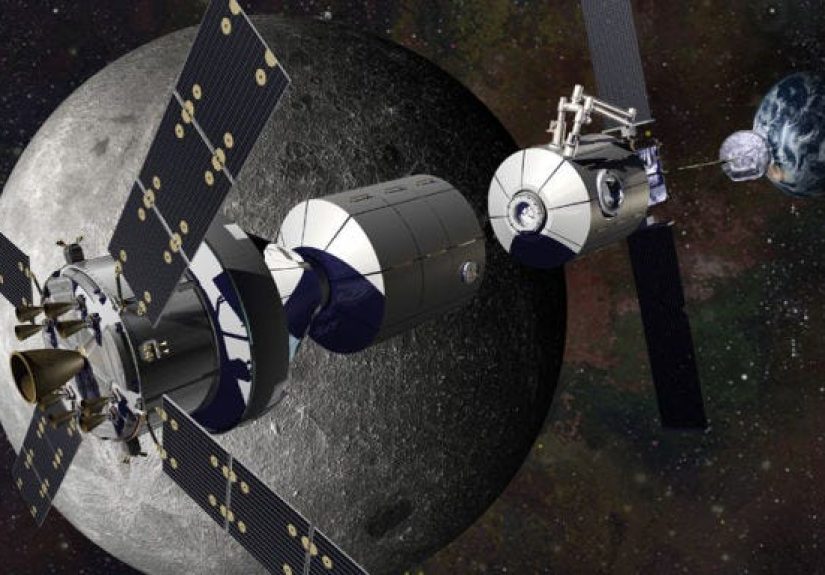
Another big piece of the original plan was a habitat in lunar orbit, often discussed as the Deep Space Gateway and later known as Gateway. The idea was to build a small station around the Moon where astronauts could dock, operate surface missions, test systems, and prepare for Mars-class journeys. Jack Burns and others saw such a habitat as a practical stepping stone, not a luxury space hotel with worse room service.
But Gateway became one of the most debated parts of the plan. Supporters saw it as infrastructure for reusable lunar landers, international partnerships, and Mars preparation. Critics saw it as a costly stopover that could slow down the main objective: landing astronauts on the Moon. That debate intensified during Trump’s second term, when the FY2026 budget proposal called for ending Gateway while seeking to transition later lunar missions toward commercial systems. NASA’s own FY2026 budget messaging said the budget would retire SLS and Orion after Artemis III and end Gateway, with possible reuse of already produced components.
Commercial Space: The Not-So-Secret Engine
The Trump transition team’s NASA plan leaned heavily on commercial space companies. The idea was not that NASA would stop exploring. It was that NASA should stop doing everything itself when private companies could provide transportation, landers, cargo delivery, communications, Earth-observation data, or infrastructure more efficiently.
This approach built on earlier NASA successes such as commercial cargo and commercial crew. Under Artemis, NASA selected SpaceX to develop Starship as a Human Landing System for early Moon landing missions and later selected Blue Origin for a competing Blue Moon lander. NASA says the Human Landing System program works with SpaceX for Artemis III and IV and Blue Origin for Artemis V, with the goal of carrying astronauts from lunar orbit to the surface and back.
That competition matters. If NASA relies on one provider, delays can ripple through the entire Moon program. If two providers mature, NASA gains redundancy, leverage, and possibly lower long-term costs. In normal human language: it is better to have two taxis to the Moon than one very expensive taxi that is still in the shop.
The Budget Reality: Dreams Meet Spreadsheets
No NASA plan survives contact with the appropriations process unchanged. The Trump team’s space ambitions ran into the classic NASA problem: the goals are cinematic, but the budget is written in committee. Oversight bodies have repeatedly warned that Artemis is expensive and schedule-challenged. The Government Accountability Office reported that Exploration Ground Systems estimated about $3.7 billion in operations costs through fiscal year 2029. NASA’s Inspector General previously projected very high Artemis costs, including a roughly $4.1 billion production and operations cost for a single SLS/Orion system across early Artemis missions.
That is why the newer Trump-era budget strategy became more aggressive about retiring legacy systems after early missions. Reuters reported in 2025 that the administration’s FY2026 proposal sought a roughly $6 billion NASA cut while ending major pieces of the Moon program as previously designed and boosting Mars-oriented priorities.
Supporters of the shift argue that NASA must escape the cycle of slow, custom-built, government-owned systems that fly rarely and cost billions. Critics argue that deep cuts could damage science, workforce stability, international partnerships, and the very exploration goals the administration claims to support. Both arguments can be true at the same time, which is why NASA policy often feels like watching a rocket launch through a fog machine.
Artemis Gets a Course Correction
By 2026, NASA leadership under Administrator Jared Isaacman began reframing Artemis around faster cadence, risk reduction, and a more phased lunar architecture. SpacePolicyOnline reported that Isaacman announced a “course correction” that would add an Earth-orbit test flight before a lunar surface return and preserve the goal of landing astronauts on the Moon in 2028.
This is important because Artemis had developed a long gap between major crewed missions. Long gaps are bad for complex human-spaceflight programs. Teams lose rhythm, suppliers cool down, training cycles stretch, and every mission begins to feel like a one-off national exam. NASA’s revised plan aims to create more repetition, more testing, and more operational muscle memory.
In March 2026, NASA also announced agencywide initiatives tied to President Trump’s National Space Policy, including a push to return to the Moon before the end of Trump’s term, build a Moon base, and align the agency around national space leadership. NASA described a focused, phased lunar architecture that would build capability “landing by landing.”
The Moon Base Vision
The clearest modern version of the plan is the Moon base concept. Spaceflight Now reported that NASA outlined an ambitious plan that would expand lunar landings, deliver rovers and instruments, test mobility and power systems, improve communications and navigation, and build toward a sustained presence.
That turns Artemis from a sequence of prestige missions into an infrastructure campaign. Instead of “go, plant, leave,” the new model is “land, learn, build, repeat.” Early cargo missions could deliver science payloads and technology demonstrations. Human missions could test habitats, rovers, life-support systems, surface power, and construction techniques. Later missions could support longer stays and more ambitious science.
What Happens to NASA Science?
The most controversial part of the Trump NASA plan is not the Moon. Almost everyone likes the Moon. It is photogenic, conveniently nearby, and never posts bad takes online. The bigger fight is over science funding, especially Earth science, planetary science, astrophysics, and Mars Sample Return.
During both Trump administrations, budget proposals targeted some NASA science programs for cuts or cancellation. Critics warned that reducing science funding could weaken U.S. leadership, disrupt missions already in development, and waste years of work. The Planetary Society reported that Congress restored near-full NASA science funding for 2026 after proposed cuts threatened dozens of missions.
This tension is not new. Human exploration is expensive and politically powerful. Science missions are often less flashy but produce enormous long-term value. A rover, telescope, or Earth-observing satellite may not make the same prime-time splash as astronauts walking on the Moon, but it can transform our understanding of climate, planets, galaxies, and life itself. A strong NASA plan needs both the boots and the brains.
The China Factor
Another driver behind the Trump NASA plan is strategic competition. The United States is no longer the only nation with serious lunar ambitions. China has advanced robotic Moon missions and has publicly aimed for human lunar exploration around the end of the decade. In Washington, that creates urgency. Nobody wants the United States to spend decades building PowerPoint slides while another country builds actual lunar infrastructure.
This competition explains the repeated emphasis on speed, commercial partnerships, and national leadership. The Moon is not just science; it is geopolitics, technology development, industrial policy, and soft power. In that sense, the Trump transition team’s plan treats NASA as part of a broader national strategy, not merely a research agency with great patches.
What the Plan Gets Right
The strongest part of the plan is its insistence on direction. NASA performs best when it has a clear mission, stable political support, and enough money to match the schedule. Returning to the Moon, developing commercial landers, testing lunar infrastructure, and preparing for Mars provide a coherent story. It is easier for engineers, contractors, international partners, and the public to follow than a constantly changing destination list.
The commercial strategy also makes sense when used carefully. SpaceX transformed cargo and crew transportation to the International Space Station. Commercial Lunar Payload Services has created a pipeline for smaller robotic lunar deliveries. Human Landing System contracts push industry to develop capabilities NASA does not have to own from top to bottom. If managed well, this can reduce costs and increase innovation.
Where the Plan Could Go Wrong
The risk is overcorrection. If NASA cancels too much too quickly, it can create gaps instead of savings. Retiring SLS, Orion, or Gateway may reduce long-term costs, but only if commercial replacements are ready, safe, funded, and politically supported. If they are not, NASA could end up with fewer missions, not better missions.
The science cuts are another danger. NASA’s reputation is built not only on astronauts but also on Hubble, Webb, Voyager, Mars rovers, Earth-observing satellites, planetary probes, and heliophysics missions. A NASA that reaches the Moon while gutting science would be like building a luxury observatory and forgetting to bring the telescope.
Experiences and Lessons From Watching NASA’s Plan Unfold
Following the Trump transition team’s big plan for NASA feels a bit like watching a crew assemble a rocket while arguing about the instruction manual. The ambition is exciting. The politics are messy. The engineering is unforgiving. And somewhere in the middle, thousands of scientists, technicians, welders, software engineers, mission planners, astronauts, and contractors are trying to turn slogans into hardware.
One experience that stands out is how quickly public excitement returns when NASA has a clear human destination. The Moon still works. Say “lunar base,” and people lean forward. Say “water ice at the south pole,” and suddenly the Moon becomes less like a gray museum piece and more like a frontier with resources, risks, and mysteries. The Trump plan understood that emotional power. It gave NASA a story ordinary readers could understand: America is going back to the Moon, and this time the goal is to stay.
Another lesson is that space policy is never just about rockets. It is about budgets, supply chains, congressional districts, international promises, private investment, safety culture, and national identity. A plan can sound bold in a speech but become fragile when one lander is late, one mobile launcher overruns its cost, one budget proposal angers Congress, or one partner worries that its contribution may be stranded. Space exploration requires patience, and patience is not always Washington’s favorite hobby.
The commercial-space experience is especially fascinating. A decade ago, many people doubted whether private companies should carry astronauts at all. Now NASA depends on commercial providers for crew transport, lunar payload delivery, and future Moon landers. That is a historic shift. It brings speed and creativity, but also new questions. What happens when a private company’s business priorities do not match NASA’s schedule? How much risk should the government accept? How does NASA keep enough in-house expertise to judge the work it buys?
For readers, the best way to understand the Trump NASA plan is not to ask whether it is “pro-space” or “anti-science” in a simple way. The reality is more complicated. The plan is strongly pro-human exploration, strongly pro-commercial partnership, skeptical of expensive legacy systems, and willing to challenge existing NASA structures. At the same time, its budget approach has raised serious concerns about science missions, workforce stability, and whether the agency can do more with less without quietly doing less with less.
The human experience behind all this is inspiring. Imagine being a young engineer working on a lunar rover, a student tracking Artemis milestones, or an astronaut training for a mission that may shape the next century of exploration. The plan’s promise is enormous: regular Moon landings, surface habitats, commercial landers, resource use, and eventually Mars. But the promise only matters if it survives the hard parts: funding, testing, failures, redesigns, delays, and political turnover.
In the end, the Trump transition team’s big NASA plan is best understood as a push to make the Moon operational again. Not symbolic. Not occasional. Operational. If NASA can turn that idea into a steady campaign while protecting science and safety, the result could be one of the most important eras in American spaceflight since Apollo. If not, the plan may become another grand space vision parked in the warehouse next to old mission patches and abandoned timelines.
Conclusion
The Trump transition team’s big plan for NASA is a bold mix of old dreams and new methods: return to the Moon, build a lasting presence, rely more on commercial space, prepare for Mars, and reshape NASA around speed and strategic competition. Its best feature is clarity. Its biggest weakness is the risk that budget cuts and program cancellations could undercut the very future it promises.
If the plan succeeds, NASA could move from rare lunar visits to a steady Moon-to-Mars campaign. If it fails, the agency could face more delays, thinner science programs, and another cycle of changing goals. The next few years will decide whether this is a true turning pointor just another dramatic trailer for a movie that never gets released.