Table of Contents >> Show >> Hide
- Why NASA Needs a New Lunar Rover
- The Commercial Twist: NASA Is Buying Rover Services
- Inside NASA’s Testing Playground at Johnson Space Center
- Testing With Spacesuits: The Moon Rover Meets the Marshmallow Problem
- ARGOS: Simulating Lunar Gravity Without Moving to the Moon
- The Ground Test Unit: NASA’s Rover That Will Never Leave Earth
- What Engineers Are Really Testing
- Why Lunar Dust Is a Villain With Excellent Branding
- The Three Commercial Rover Concepts
- The Science Instruments Riding Along
- How Testing Protects Astronaut Time
- Behind-the-Scenes Experience: What Testing a Moon Rover Feels Like
- Conclusion
Note: This article is written for publication and synthesizes verified information from NASA and official lunar rover program sources. It contains no inserted source-link clutter, citation placeholders, or unnecessary publishing artifacts.
NASA’s next Moon car is not exactly the kind of vehicle you parallel park outside a grocery store. It does not need cup holders, Bluetooth, or a “new car smell” air freshener shaped like a pine tree. It needs to survive brutal temperature swings, carry astronauts in bulky spacesuits, haul science equipment, drive across sharp lunar dust, work remotely when no humans are around, and avoid turning a historic Artemis mission into the most expensive roadside assistance call in history.
That is why NASA is testing its new lunar rover with the seriousness of a space agency and the patience of a mechanic who knows the customer is going to be 240,000 miles away. The vehicle is called the Lunar Terrain Vehicle, or LTV, and it is being developed for NASA’s Artemis campaign to help astronauts explore the Moon’s South Pole region. Unlike the Apollo-era lunar roving vehicle, this new generation of Moon rover is expected to be smarter, more durable, more autonomous, and more deeply integrated with modern science operations.
The testing work happening behind the scenes is not just about asking, “Does it drive?” That would be too easy. NASA is asking much harder questions: Can suited astronauts climb in and out without fighting the vehicle like an angry folding chair? Can they reach tools? Can they store samples? Can the rover be operated remotely? Can it survive the lunar environment? Can it become a true science platform instead of just a very expensive golf cart with excellent career prospects?
Why NASA Needs a New Lunar Rover
The Artemis program is designed to do more than plant flags and take heroic photos. NASA wants astronauts to live, work, and conduct science on and around the Moon in a more sustained way. The Moon’s South Pole is especially important because it may contain water ice in permanently shadowed regions. That water could support future science, life-support systems, and even fuel production for deeper space missions.
But the South Pole is not a friendly parking lot. It is a rugged landscape of craters, slopes, shadows, extreme cold, and lighting conditions that can make navigation complicated. Walking everywhere in a spacesuit would limit how far astronauts can travel, how much equipment they can carry, and how many samples they can collect. A lunar terrain vehicle changes the equation. It extends astronaut range, saves crew energy, supports payloads, and allows NASA to gather more science from more places.
NASA’s LTV is planned as a human-rated, unpressurized rover. That means astronauts will drive it while wearing spacesuits, rather than riding inside a sealed cabin. Think of it less like a lunar RV and more like an off-road expedition vehicle designed for people who happen to be dressed like very determined marshmallows.
The Commercial Twist: NASA Is Buying Rover Services
One of the most interesting parts of the Lunar Terrain Vehicle program is that NASA does not simply plan to build and own one rover in the traditional way. Instead, NASA is using a services model. The agency selected three commercial teams to advance LTV designs: Intuitive Machines, Lunar Outpost, and Venturi Astrolab. These companies are developing rover concepts that must meet NASA’s requirements for crew safety, science support, mobility, power, communications, and lunar survivability.
This model is important because NASA wants commercial partners to help build a broader lunar economy. When NASA is not using the rover, the vehicle could potentially support commercial or scientific customers. In simple terms, NASA is encouraging industry to build Moon mobility as a service, not just a single government-owned machine that sits around waiting for the next mission.
The three rover concepts have their own personalities. Intuitive Machines’ concept is known as Moon RACER. Lunar Outpost’s vehicle is called Eagle. Astrolab’s rover is called FLEX. Each design is aimed at the same big challenge: help astronauts move farther, work smarter, and bring back better science from the lunar surface.
Inside NASA’s Testing Playground at Johnson Space Center
Much of the behind-the-scenes testing has taken place at NASA’s Johnson Space Center in Houston. That location is not random. Johnson is home to astronaut training, human spaceflight expertise, spacesuit work, mission operations knowledge, and the kind of engineering culture where someone can look at a rover mockup and calmly say, “Yes, but can a suited astronaut reach that handle while standing in one-sixth gravity?”
NASA completed an early round of testing with static mockups from the three commercial rover teams. A static mockup is not a full flight-ready rover. It is a physical test article that lets engineers and astronauts evaluate layout, ergonomics, tool placement, visibility, seats, controls, access points, payload storage, and how the rover fits into real mission operations.
That may sound basic, but it is absolutely essential. On Earth, a poorly placed glove box is annoying. On the Moon, a poorly placed science container can waste astronaut time, increase fatigue, and complicate a mission timeline. Every handle, screen, latch, seat, step, and storage area has to make sense for someone wearing a pressurized spacesuit with limited mobility.
Testing With Spacesuits: The Moon Rover Meets the Marshmallow Problem
Human-centered testing is one of the most fascinating parts of NASA’s lunar rover work. Astronauts and engineers evaluate whether the rover can actually be used by suited crew members. That includes climbing on, climbing off, sitting, standing, reaching, driving, loading equipment, collecting samples, operating displays, and accessing science payloads.
This is harder than it sounds. A spacesuit changes nearly everything about how a person moves. Gloves reduce dexterity. The suit adds bulk. Visibility is limited. Bending, twisting, and reaching require more effort. NASA cannot simply design a rover that works for a person in jeans and sneakers, then hope for the best. Hope is not a testing strategy, especially when the nearest repair shop is Earth.
During testing, astronauts evaluated seat configurations, display interfaces, geology tool racks, payload access, sample storage, and the overall flow of tasks. NASA astronaut Joe Acaba, for example, was shown preparing to climb onto Intuitive Machines’ Moon RACER to access a science payload. Jessica Meir evaluated tool access and sample storage. Frank Rubio and spacesuit engineer Zach Tejral evaluated Astrolab’s FLEX display interfaces. These are not glamorous Hollywood scenes, but they are the exact kind of practical work that turns a cool concept into a reliable exploration system.
ARGOS: Simulating Lunar Gravity Without Moving to the Moon
One of NASA’s most useful test facilities for rover and spacesuit work is the Active Response Gravity Offload System, better known as ARGOS. The name sounds like either a secret robot or a very serious gym machine. In reality, ARGOS is a reduced-gravity simulation system at Johnson Space Center that can help mimic lunar, Martian, or microgravity conditions.
The Moon has about one-sixth of Earth’s gravity. That means an astronaut and spacesuit behave differently there than they do in Houston. ARGOS helps by using an overhead robotic system and harness setup to offload part of a person’s weight. This allows NASA to study how suited astronauts may move, climb, reach, and operate equipment in a lunar-like gravity environment.
For the lunar rover, this matters because movement in partial gravity affects everything. How high should a step be? How much force is needed to climb onto the vehicle? Can a crew member safely reach a payload? Does a seat position work when body motion changes? Can astronauts recover balance while handling tools? ARGOS gives NASA a way to test those questions on Earth before sending hardware to the Moon, where “let’s just try it and see” becomes a very expensive sentence.
The Ground Test Unit: NASA’s Rover That Will Never Leave Earth
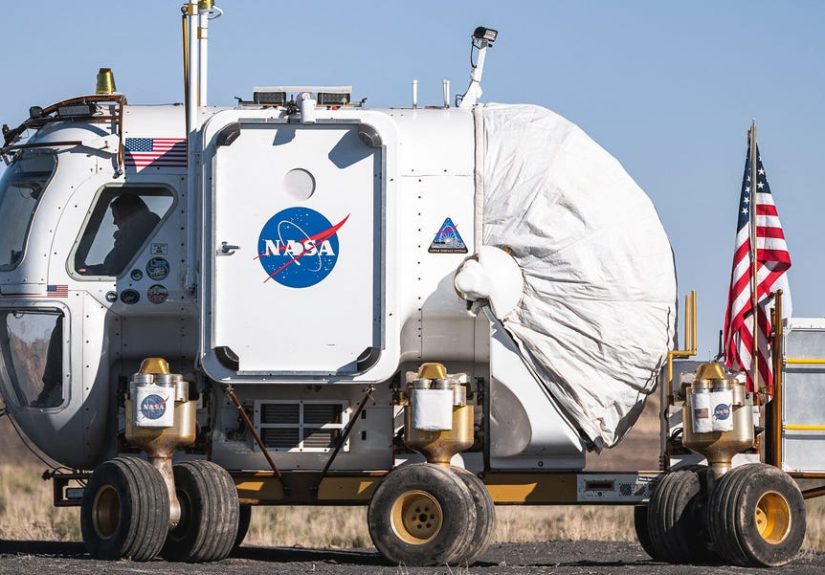
NASA is also developing a rover prototype called the Ground Test Unit, or GTU. This vehicle is not meant to fly to the Moon. Its job is to stay on Earth and help NASA learn. It is a flexible engineering testbed that allows teams to evaluate rover operations, crew compartment layouts, maintenance concepts, payload integration, and other design choices.
The GTU helps NASA act as what agency engineers call a “smart buyer.” In plain English, that means NASA wants to deeply understand the technology it is purchasing from industry. By running its own tests and simulations, NASA can better evaluate commercial designs, ask sharper questions, identify operational risks, and make sure the final lunar terrain vehicle will support real mission needs.
This is especially valuable because NASA is working with multiple commercial providers. Each company may solve problems differently, but NASA still needs to compare safety, usability, science value, and mission readiness across the designs. The Ground Test Unit gives NASA a common reference point for understanding how rover operations might unfold on the lunar surface.
What Engineers Are Really Testing
When most people imagine rover testing, they picture wheels rolling over fake Moon rocks. That is part of the story, but it is only one slice of the engineering pizza. NASA’s lunar rover testing includes a wide range of practical questions.
1. Crew Access and Ergonomics
Astronauts must be able to board and exit the rover safely while wearing spacesuits. The seat height, handholds, foot restraints, control layout, and display visibility all matter. If a task is awkward on Earth, it may become mission-limiting on the Moon.
2. Science Payload Integration
The LTV is not just transportation. It is a mobile science platform. NASA is evaluating how instruments, sample containers, geology tools, cameras, sensors, and other payloads can be attached, accessed, powered, and operated. A rover that drives beautifully but makes science work clumsy would miss the point.
3. Remote and Autonomous Operations
NASA expects the LTV to operate remotely when astronauts are not present. That means the rover may continue science activities between crewed missions. It may be driven or commanded from Earth, depending on mission needs and system capability. Autonomy, navigation, communications, and hazard awareness are therefore central to the vehicle’s value.
4. Power and Thermal Survival
The lunar South Pole is harsh. Temperatures can swing dramatically, sunlight can be tricky, and shadowed regions can be brutally cold. The rover must manage power carefully and protect batteries, electronics, sensors, and mechanical systems. A Moon rover that cannot survive the environment is not a rover; it is a future museum exhibit with regret attached.
5. Maintenance and Reliability
NASA must think about what astronauts can realistically inspect, adjust, or repair while wearing spacesuits. Tools need to be accessible. Components need to be robust. The rover has to keep working through dust, vibration, thermal stress, and repeated mission cycles.
Why Lunar Dust Is a Villain With Excellent Branding
No article about lunar rover testing is complete without mentioning lunar dust. It is not fluffy beach sand. Lunar regolith is sharp, abrasive, clingy, and electrostatically annoying. It can stick to suits, scratch surfaces, interfere with seals, affect thermal control, and get into mechanisms. If lunar dust had a résumé, it would simply say: “Experienced in causing problems.”
NASA learned during Apollo that dust is one of the Moon’s most persistent engineering challenges. For Artemis, the rover must be designed with dust tolerance in mind. Wheel systems, joints, storage boxes, instrument covers, displays, connectors, and crew interfaces all need to withstand a dusty environment. Testing on Earth cannot perfectly reproduce the Moon, but engineers can use simulants, analog terrain, laboratory evaluations, and lessons from past missions to reduce risk.
The Three Commercial Rover Concepts
Intuitive Machines: Moon RACER
Intuitive Machines is developing Moon RACER as part of its LTV work. The company brings lunar delivery experience through NASA’s Commercial Lunar Payload Services program and has worked on technologies related to landing, surface operations, and payload delivery. Moon RACER is designed to support crew mobility and lunar science while fitting into the broader commercial lunar services model.
Lunar Outpost: Eagle
Lunar Outpost’s Eagle rover is part of the Lunar Dawn team, which includes major aerospace and automotive partners such as Lockheed Martin, General Motors, Goodyear, and MDA Space. The design emphasizes crewed and cargo transport, surface mobility, and support for Artemis science. Its development reflects how lunar mobility is borrowing knowledge from both space systems and rugged vehicle engineering on Earth.
Venturi Astrolab: FLEX
Astrolab’s FLEX rover is designed to carry two suited astronauts, support robotic cargo logistics, accommodate a robotic arm, and operate remotely from Earth when astronauts are not present. The company highlights features such as specialized lunar wheels, thermal resilience, and flexible payload handling. FLEX is built around the idea that a lunar rover should be useful not only during astronaut excursions but also during uncrewed operations.
The Science Instruments Riding Along
NASA has also selected instruments connected to future Artemis lunar mobility and science. These instruments are designed to help study the Moon’s surface and subsurface. Some technologies include tools for measuring temperature, density, and underground structures. That matters because the Moon is not just a destination; it is a scientific archive. Its rocks, dust, craters, and shadowed regions preserve clues about solar system history, volatile materials, and the future of human exploration.
A rover gives those instruments mobility. Instead of studying only one landing site, astronauts and mission teams can move across different terrain types, compare regions, collect samples, and follow scientific clues. On Earth, a geologist can drive a truck from one outcrop to another. On the Moon, the LTV is that truckexcept it needs to work in a vacuum, handle radiation, and never complain about parking.
How Testing Protects Astronaut Time
Astronaut time on the lunar surface is precious. Every minute outside a lander involves planning, suit resources, communications, safety rules, and mission priorities. A good rover saves time by making tasks smoother. A bad interface wastes time. A tool mounted six inches too far away may not sound serious until a suited astronaut has to perform the same awkward motion repeatedly while standing on uneven terrain.
That is why NASA’s testing pays close attention to tiny details. Engineers observe how astronauts move, where they hesitate, what they cannot reach, what feels natural, and what creates unnecessary effort. They gather feedback, compare designs, and turn human reactions into engineering data. The goal is not just to build a rover that can survive the Moon. The goal is to build one that helps astronauts do excellent work there.
Behind-the-Scenes Experience: What Testing a Moon Rover Feels Like
Imagine walking into a huge test facility at Johnson Space Center and seeing three futuristic rover mockups lined up like contestants in the strangest car show in America. There are no sales balloons, no free hot dogs, and no salesperson asking what monthly payment you had in mind. Instead, there are astronauts, engineers, test leads, safety specialists, spacesuit experts, photographers, checklists, and enough careful observation to make a clipboard feel important.
The atmosphere is probably a mix of excitement and brutal practicality. Everyone knows the mission is inspiring, but inspiration alone does not make a latch easier to open in pressurized gloves. So the work becomes beautifully specific. An astronaut climbs into a seat. Someone watches the angle of the knee. Another person notes whether the helmet blocks a display. A test lead asks whether the tool rack is reachable. A spacesuit engineer watches body mechanics. A rover designer silently hopes the answer is not, “This handle is terrible.”
That is the real behind-the-scenes magic of NASA testing: it turns small annoyances into design improvements before they become big problems. Maybe a step needs to be moved. Maybe a display should be tilted. Maybe a storage box needs a larger grip. Maybe the astronaut can reach a payload, but only with a motion that would get old quickly during a six-hour moonwalk. These details sound humble, but they are the difference between a rover that merely looks good and a rover that earns trust.
The testing also shows how teamwork actually works in space exploration. The rover companies bring their designs. NASA brings decades of human spaceflight experience. Astronauts bring practical feedback that no computer model can fully replace. Engineers bring data, discipline, and the ability to worry professionally. Each test becomes a conversation between hardware and humans.
There is also a sense of history in the room. The Apollo astronauts drove on the Moon more than 50 years ago. Their lunar roving vehicle expanded exploration dramatically, letting crews travel farther and carry more equipment than they could on foot. The Artemis LTV is the next chapter, but it is not a nostalgia project. It is not NASA saying, “Remember the Moon buggy? Let’s do that again, but shinier.” It is NASA asking what lunar mobility should look like for a new era of sustained exploration, commercial partnerships, remote operations, and deeper science.
From an observer’s point of view, the most impressive part may be how unglamorous the work looks in the moment. Real testing is rarely cinematic. It involves repetition. Climb in. Climb out. Reach the tool. Store the sample. Check the display. Adjust the harness. Repeat. Discuss. Measure. Revise. Try again. Space exploration may end with dramatic launch footage, but it begins with people patiently discovering that a box lid should open the other way.
And that is why the LTV testing process is so compelling. It reminds us that the future of lunar exploration depends not only on rockets and landers, but also on practical design choices made in test facilities on Earth. A rover that works well will help astronauts move across unfamiliar terrain, collect better samples, deploy instruments, and extend human presence on the Moon. It will turn the lunar surface from a place astronauts briefly visit into a place they can actively investigate.
So behind the scenes, NASA is not merely testing a new lunar rover. It is rehearsing a new way of exploring. Every seat check, every simulated climb, every tool reach, every display review, and every reduced-gravity test is part of a larger promise: when astronauts return to the Moon with Artemis, they will not just stand there. They will drive, work, study, and push farther into the lunar frontier.
Conclusion
NASA’s new Lunar Terrain Vehicle represents far more than transportation. It is a mobile science platform, a commercial partnership experiment, a human-factors puzzle, and a key tool for Artemis exploration. The behind-the-scenes testing at Johnson Space Center shows how seriously NASA is preparing for the Moon’s practical realities: partial gravity, spacesuit limitations, dust, darkness, thermal extremes, communications needs, and astronaut safety.
By working with Intuitive Machines, Lunar Outpost, and Venturi Astrolab, NASA is encouraging a new generation of lunar mobility. By testing mockups, building the Ground Test Unit, using ARGOS, and gathering astronaut feedback, the agency is turning ambitious rover concepts into systems that may one day carry humans across the Moon’s South Pole. It may look like a Moon car, but it is really a bridge between Apollo’s legacy and the next era of human exploration.