Table of Contents >> Show >> Hide
- What Is a Negative Exponent?
- Why Negative Exponents Work
- How to Calculate Negative Exponents: Step by Step
- Worked Examples of Negative Exponents
- Example 1: A basic whole-number base
- Example 2: A base of 10
- Example 3: A negative number in parentheses
- Example 4: No parentheses, very different meaning
- Example 5: A fraction with a negative exponent
- Example 6: A variable expression
- Example 7: Only one factor has the negative exponent
- Example 8: Parentheses change everything
- How to Simplify Expressions With Negative Exponents
- Common Mistakes to Avoid
- Negative Exponents and Scientific Notation
- Quick Practice Problems
- Best Strategy for Solving Negative Exponent Problems Fast
- Conclusion
- Real-World Learning Experiences With Negative Exponents
- SEO Tags
If negative exponents make your brain do that spinning-wheel thing, you are not alone. A lot of students see a minus sign in the exponent and immediately assume the answer must be negative. Nope. That little minus sign is not there to ruin your day. It is there to tell you to take a reciprocal. Once you understand that one idea, negative exponents go from “math villain” to “mild inconvenience.”
In this guide, you will learn exactly how to calculate negative exponents step by step, how to simplify expressions with variables, how to handle fractions, and how to avoid the sneaky mistakes that show up on homework, quizzes, and late-night study sessions. We will also look at how negative exponents appear in scientific notation, because math loves crossovers.
What Is a Negative Exponent?
A negative exponent tells you to take the reciprocal of the base raised to the matching positive exponent. In plain English, that means you flip the number or expression and make the exponent positive.
The main rule is:
a-n = 1 / an, as long as a ≠ 0.
So if you see 2-3, you do not make the answer negative. You rewrite it as 1 / 23, which becomes 1/8.
That is the heart of the negative exponent rule. Everything else is basically that rule wearing a different outfit.
Why Negative Exponents Work
Negative exponents are not random. They come from the regular laws of exponents. Look at this pattern:
- 23 = 8
- 22 = 4
- 21 = 2
- 20 = 1
Every time the exponent drops by 1, the value gets divided by 2. So if you keep going:
- 2-1 = 1/2
- 2-2 = 1/4
- 2-3 = 1/8
That is why a negative exponent means “divide instead of multiply.” It keeps exponent patterns consistent, which is one of math’s favorite hobbies.
How to Calculate Negative Exponents: Step by Step
Step 1: Identify the base and the exponent
The base is the number or expression being raised to a power. The exponent tells you how many times that base is used in multiplication.
In 5-2, the base is 5 and the exponent is -2.
Step 2: Rewrite using the reciprocal
Change the negative exponent to a positive exponent by flipping the base into the denominator or numerator.
5-2 = 1 / 52
Step 3: Evaluate the positive exponent
Now calculate the power as usual.
52 = 25
Step 4: Simplify the result
1 / 25 is already simplified.
So the final answer is:
5-2 = 1/25
Worked Examples of Negative Exponents
Example 1: A basic whole-number base
Simplify 3-4.
- Rewrite with a positive exponent: 3-4 = 1 / 34
- Evaluate the power: 34 = 81
- Final answer: 1/81
Example 2: A base of 10
Simplify 10-3.
- Rewrite: 10-3 = 1 / 103
- Evaluate: 103 = 1000
- Final answer: 1/1000 = 0.001
Example 3: A negative number in parentheses
Simplify (-2)-3.
- Rewrite: (-2)-3 = 1 / (-2)3
- Evaluate: (-2)3 = -8
- Final answer: -1/8
The parentheses matter here. They tell you the base is -2, not just 2.
Example 4: No parentheses, very different meaning
Simplify -2-3.
This means the opposite of 2-3, not the power of -2.
- Rewrite the exponent part: 2-3 = 1/8
- Apply the negative sign in front: -(1/8) = -1/8
In this case, the answer happens to match the previous example, but that will not always happen. Parentheses are not decoration. They are legal documents for numbers.
Example 5: A fraction with a negative exponent
Simplify (2/5)-2.
- Flip the fraction: (2/5)-2 = (5/2)2
- Square both numerator and denominator: 25/4
Final answer: 25/4
Example 6: A variable expression
Simplify x-4.
Rewrite it using the reciprocal:
x-4 = 1 / x4
Example 7: Only one factor has the negative exponent
Simplify 5x-1.
Only the x moves:
5x-1 = 5 / x
The 5 stays exactly where it is. It did not sign up for the move.
Example 8: Parentheses change everything
Simplify (5x)-1.
Now the entire quantity 5x is the base, so the whole thing flips:
(5x)-1 = 1 / 5x
How to Simplify Expressions With Negative Exponents
When you simplify expressions with negative exponents, the goal is usually to write the final answer using only positive exponents. That means moving factors across the fraction bar as needed.
Example 1
Simplify x3 / x5.
Subtract the exponents:
x3-5 = x-2
Now rewrite with a positive exponent:
x-2 = 1 / x2
Example 2
Simplify (2x-2y3) / y.
- Simplify the y terms: y3 / y = y2
- Keep the negative exponent on x for the moment: 2x-2y2
- Rewrite with positive exponents: 2y2 / x2
Example 3
Simplify x-2y-3.
Think of the whole expression as being over 1:
x-2y-3 = 1 / (x2y3)
Common Mistakes to Avoid
- Mistake 1: Thinking a negative exponent makes the answer negative.
It does not. It means take the reciprocal. - Mistake 2: Forgetting the denominator can be 1.
If you see x-2, think of it as x-2/1 before rewriting. - Mistake 3: Moving the wrong factor.
In 5x-1, only the x moves. In (5x)-1, the entire quantity moves. - Mistake 4: Ignoring parentheses.
(-3)-2 is not the same thing as -3-2. - Mistake 5: Leaving negative exponents in the final answer.
In many algebra classes, simplest form means using only positive exponents. - Mistake 6: Using zero as a base carelessly.
0-2 is undefined because it would mean 1 / 02, and division by zero is not allowed.
Negative Exponents and Scientific Notation
Negative exponents show up all the time in scientific notation. When the exponent on 10 is negative, the number is very small.
For example:
- 10-1 = 0.1
- 10-2 = 0.01
- 10-6 = 0.000001
So if you see 4.5 × 10⁻³, that means:
4.5 × 0.001 = 0.0045
This is why negative exponents matter in science, engineering, chemistry, and technology. Tiny measurements love powers of ten with negative exponents.
Quick Practice Problems
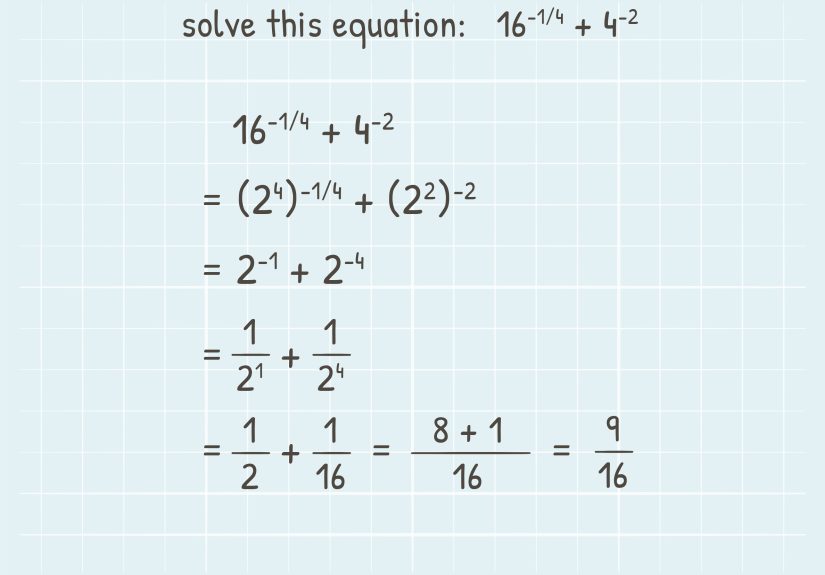
- 4-2 = 1/16
- 7-1 = 1/7
- (3/8)-1 = 8/3
- x-5 = 1/x5
- 2x-3 = 2/x3
- (ab)-2 = 1/(a2b2)
- 10-4 = 0.0001
- x2/x6 = 1/x4
If you can do those without dramatically staring at the ceiling, you are in good shape.
Best Strategy for Solving Negative Exponent Problems Fast
If you want a reliable shortcut, use this simple checklist every time:
- Find the base.
- Check whether the negative sign is in the exponent or in front of the base.
- Rewrite using the reciprocal.
- Make all exponents positive.
- Simplify completely.
This method works for numbers, variables, fractions, and algebraic expressions. It also helps you avoid the classic mistakes that happen when students rush and let the minus sign bully them.
Conclusion
Learning how to calculate negative exponents is really about learning one powerful rule: flip the base, change the exponent to positive, and simplify. Once that clicks, expressions like 2-3, x-4, and (3/5)-2 stop looking mysterious. They become predictable.
The key is to stay alert for parentheses, remember that the base cannot be zero, and write final answers with positive exponents when required. Do that consistently, and negative exponents will stop feeling negative at all.
Real-World Learning Experiences With Negative Exponents
One of the most common experiences students have with negative exponents is confusion during the first few problems, followed by a weirdly satisfying moment when the rule finally makes sense. At first, many learners assume a negative exponent should create a negative answer. That seems reasonable for about five seconds, and then math politely says, “Actually, no.” Once students see that 2-1 becomes 1/2 and 2-2 becomes 1/4, the pattern starts to feel less like a trap and more like a system.
Another very real experience happens when students move from arithmetic to algebra. A problem like 4-2 may seem manageable, but 5x-1 or (5x)-1 can suddenly turn into a mess. Many learners discover that the hardest part is not the exponent rule itself. It is identifying the base correctly. If the exponent belongs only to x, then only x moves. If the exponent belongs to (5x), then the whole quantity flips. That tiny difference has caused a truly heroic number of homework mistakes.
Test situations create their own kind of drama. Students often know the rule when they practice slowly at home, but on quizzes they forget to rewrite the final answer with positive exponents. A teacher may mark x-3 as incomplete because the expected answer is 1/x3. That can feel annoying, but it also teaches precision. In algebra, “basically right” and “fully simplified” are not always the same thing.
Science classes add another layer of experience because negative exponents show up in scientific notation. Students working with tiny measurements in chemistry or physics often realize that negative powers of ten are not just classroom decoration. They describe real values, like very small distances, masses, or concentrations. Suddenly 10-6 is not just another exponent problem. It is part of how scientists describe the world without writing a ridiculous number of zeros.
There is also the calculator experience, which deserves a small support group. Many students type negative exponents incorrectly and get errors or strange outputs. Others forget parentheses around a negative base and end up evaluating a different expression. This leads to the valuable lesson that calculators are helpful, but they are not mind readers. If your input is sloppy, your answer will be too.
Over time, the most successful learners usually build confidence by practicing short sets of mixed problems: whole numbers, fractions, variables, and scientific notation. That variety trains the brain to focus on structure instead of panic. And that is the real turning point. Negative exponents stop feeling like random punishment and start feeling like a familiar pattern. Once students reach that stage, they often look back and wonder why this topic seemed so intimidating in the first place. The answer, of course, is simple: math always looks scarier before the pattern shows up.