Table of Contents >> Show >> Hide
- What Is Betelgeuse?
- Why the Betelgeuse High Resolution Image Became Famous
- How ALMA Captured Betelgeuse in Such Detail
- The “Orange Blob” Is Actually a Scientific Treasure
- Betelgeuse Before ALMA: Hubble’s Historic First
- The Great Dimming: When Betelgeuse Got Dramatic
- Is Betelgeuse Going to Explode?
- Why High-Resolution Images of Stars Matter
- Betelgeuse in the Night Sky: How to Find It
- Common Misunderstandings About the Betelgeuse Image
- What Makes Betelgeuse a Perfect Target for Astronomers?
- Experience Section: What It Feels Like to Study the Betelgeuse High Resolution Image
- Conclusion
Some stars politely twinkle in the background. Betelgeuse does not. Betelgeuse enters the night sky like a celebrity late to a red-carpet event: huge, red, dramatic, and surrounded by rumors that it may explode “any minute,” which in astronomy can mean tomorrow or sometime in the next 100,000 years. Relax. The star is not sending Earth an eviction notice.
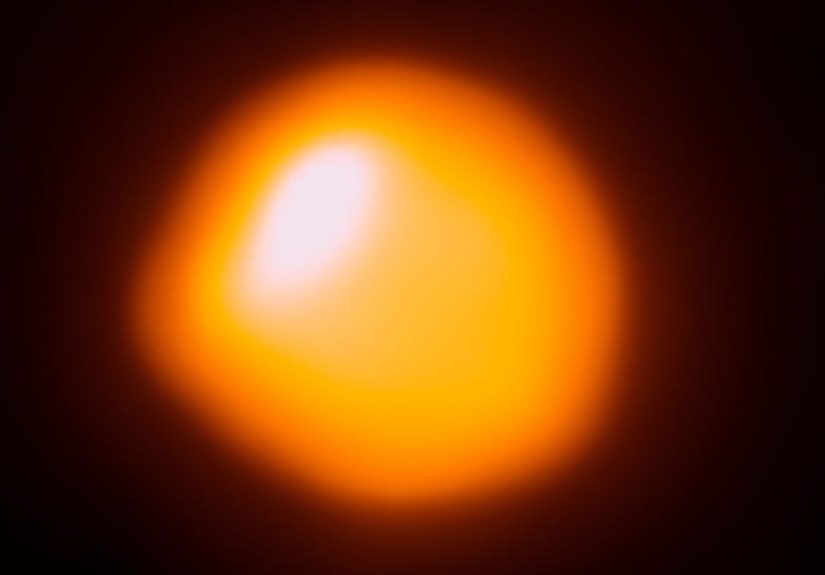
The famous Betelgeuse high resolution image captured by the Atacama Large Millimeter/submillimeter Array, better known as ALMA, gave astronomers one of the sharpest looks ever at the surface of a star beyond our Sun. Released in 2017, the image may look like an orange blob with a bright patch, but that “blob” is a red supergiant star so enormous that ordinary adjectives start sweating. It is one of the rare stars outside our solar system whose surface can be directly resolved, making it a superstar in both the scientific and “wow, space is ridiculous” sense.
This article explores why the image matters, what it actually shows, how astronomers captured it, and why Betelgeuse remains one of the best natural laboratories for studying massive stars near the end of their lives.
What Is Betelgeuse?
Betelgeuse, also called Alpha Orionis, is a red supergiant star located in the constellation Orion. In the familiar outline of Orion the Hunter, Betelgeuse marks one of the hunter’s shoulders. It is easy to spot in winter skies from many parts of the Northern Hemisphere because of its warm reddish-orange color. While many stars look white or blue-white to the eye, Betelgeuse glows like a coal ember at the edge of a cosmic fireplace.
The star is located roughly 650 to 700 light-years from Earth, depending on the measurement method used. That means the light we see tonight left Betelgeuse centuries ago. When you look at it, you are not just stargazing; you are time-traveling without needing a questionable movie plot.
Betelgeuse is much younger than the Sun, but it is also far more massive. Massive stars live fast, burn hot, swell dramatically, and leave spectacular endings. While the Sun is about 4.6 billion years old and comfortably middle-aged, Betelgeuse is only around 10 million years old and already in a late evolutionary stage. In stellar terms, Betelgeuse is the friend who finished the whole buffet before everyone else found a plate.
Why the Betelgeuse High Resolution Image Became Famous
The most detailed image of a star that’s not the Sun became famous because stars are usually too far away to appear as anything more than points of light. Even powerful telescopes often see stars as bright dots, not disks with visible surface features. The Sun is the obvious exception because it is close enough for us to observe sunspots, granules, flares, and coronal loops in detail.
Betelgeuse is different. Its enormous size and relative closeness make it one of the few stars whose surface can be studied directly. The ALMA image showed the star in submillimeter wavelengths, a type of light invisible to human eyes. The image was colorized to help viewers interpret the data, so it is not what Betelgeuse would look like through a backyard telescope. Still, the science behind it is very real.
In the ALMA image, Betelgeuse appears as a glowing orange disk with a brighter region on one side. That bright patch is important because it suggests the star’s atmosphere is uneven. Instead of being a smooth, perfectly round ball, Betelgeuse behaves like a boiling, turbulent monster soup of plasma, convection cells, gas flows, and temperature differences.
How ALMA Captured Betelgeuse in Such Detail
ALMA is a collection of radio antennas located in Chile’s Atacama Desert, one of the driest places on Earth. That dryness matters because water vapor can interfere with millimeter and submillimeter observations. By placing dozens of antennas high in the desert, astronomers can observe faint cosmic signals with extraordinary precision.
ALMA Works Like a Giant Virtual Telescope
ALMA does not work like a single traditional telescope. Instead, its antennas operate together using a technique called interferometry. When the signals from widely separated antennas are combined, they act like one giant telescope with a much larger effective diameter. The farther apart the antennas are placed, the sharper the potential resolution.
This is how astronomers turned Betelgeuse from a vague point into a resolved stellar disk. The 2017 image showed details at an angular scale tiny enough to make everyday comparisons sound silly. Think of trying to see fine detail on an object hundreds of light-years away. Now think of your phone camera complaining because the restaurant is “a little dim.” Astronomy is playing a different sport.
What Wavelengths Reveal
The image was made using submillimeter light, which traces cooler material and atmospheric layers differently than visible light. That is one reason Betelgeuse can look different depending on the telescope and wavelength used. Visible light, ultraviolet light, infrared light, and radio wavelengths each tell a different part of the story.
At submillimeter wavelengths, ALMA revealed structure in Betelgeuse’s extended atmosphere. The bright region in the image likely points to an area of hotter or denser material. Astronomers have used these kinds of observations to study convection, mass loss, and the complicated behavior of red supergiants.
The “Orange Blob” Is Actually a Scientific Treasure
To the casual viewer, the Betelgeuse image may not look as glamorous as a Hubble nebula or a James Webb galaxy field. There are no glittering spiral arms, no cosmic pillars, no dramatic star nursery glowing like a fantasy wallpaper. Instead, we get an orange disk. But that disk is a direct look at the surface and atmosphere of a star outside our solar system. That is a big deal.
Most stars are so distant that even our best instruments cannot resolve their surfaces. Betelgeuse gives scientists a rare chance to test theories about how massive stars move material from their interiors into space. This is not just about taking a pretty picture. It is about understanding how stars enrich the universe with heavy elements.
Massive stars manufacture elements in their cores, lose material through stellar winds and eruptions, and eventually explode as supernovae. The carbon in living things, the oxygen we breathe, and many heavier elements are tied to stellar life cycles. Studying Betelgeuse is not cosmic gossip; it is family history, written in plasma.
Betelgeuse Before ALMA: Hubble’s Historic First
ALMA’s image built on decades of work. In the 1990s, NASA’s Hubble Space Telescope produced the first direct image of the surface of a star other than the Sun, and that star was also Betelgeuse. The Hubble observation revealed a large ultraviolet bright spot, showing that Betelgeuse had surface activity and atmospheric complexity.
That early direct image was a milestone. It proved that Betelgeuse was not merely a bright reddish point in Orion. It was a star with structure, change, and personality. Hubble opened the door; ALMA walked through it wearing radio-astronomy boots.
The Great Dimming: When Betelgeuse Got Dramatic
Betelgeuse became even more famous during the Great Dimming of late 2019 and early 2020. The star faded so dramatically that many people wondered whether it was about to explode. Social media, naturally, handled this calmly and responsibly. Just kidding. Everyone stared at Orion like it owed them breaking news.
Astronomers later found that the dimming was most likely caused by material ejected from the star that cooled and formed dust, blocking part of Betelgeuse’s light from our point of view. High-resolution observations from instruments such as the Very Large Telescope helped show that the southern part of the star had become unusually dark. Hubble observations also supported the idea of a major surface outburst followed by dust formation.
The key lesson: Betelgeuse was not necessarily on the edge of immediate supernova doom. It had, in plain English, coughed out a huge amount of material. For a human, that would be a medical emergency. For a red supergiant, it is Tuesday with extra drama.
Is Betelgeuse Going to Explode?
Yes, Betelgeuse will eventually explode as a supernova. No, astronomers do not know exactly when. The likely timescale is somewhere within the next 100,000 years, which is soon for a star but not especially convenient for anyone planning a weekend viewing party.
When Betelgeuse finally does explode, it should be spectacular from Earth, but it is far enough away that it is not expected to harm our planet. It may become extremely bright in the sky for weeks or months. It could even be visible during the day. That would be one of the most extraordinary astronomical events in human history, but we may not be the generation that gets the cosmic fireworks.
For now, Betelgeuse is valuable because it lets scientists watch a massive star in its unstable late stage. Every high-resolution image, brightness measurement, and spectroscopic observation adds a piece to the puzzle.
Why High-Resolution Images of Stars Matter
High-resolution images help astronomers move from theory to direct evidence. Computer models can predict how red supergiants behave, but images let researchers compare those models with reality. Betelgeuse challenges simple ideas because its surface is not calm or uniform. It has enormous convection cells, changing brightness patterns, extended atmospheric layers, and episodes of mass loss.
They Reveal Stellar Weather
On Earth, weather includes clouds, storms, wind, and temperature changes. On Betelgeuse, “weather” means giant bubbles of hot gas rising and falling, clouds of dust forming near the star, and plasma movements on scales larger than the orbit of planets. It is weather, but with the thermostat ripped off the wall.
They Improve Supernova Models
Understanding how Betelgeuse loses mass before its explosion matters because the material around a star can affect the appearance of the eventual supernova. If a massive star is surrounded by gas and dust, the explosion interacts with that material. That interaction changes the light astronomers observe.
They Help Explain Cosmic Recycling
Stars like Betelgeuse return processed material to space. That material can later become part of new stars, planets, and possibly living worlds. High-resolution imaging helps scientists understand how this recycling begins before the final explosion.
Betelgeuse in the Night Sky: How to Find It
Finding Betelgeuse is simple if Orion is visible from your location. Look for the three bright stars of Orion’s Belt. Betelgeuse is the reddish star above and to one side of the belt, marking Orion’s shoulder. Rigel, a blue-white supergiant, marks the opposite foot or knee area depending on the sky map you use.
The color contrast between Betelgeuse and Rigel is one of the easiest ways to appreciate stellar temperature with your own eyes. Rigel looks blue-white because it is hotter at its visible surface. Betelgeuse looks red-orange because it is cooler at its visible surface, even though it is vastly larger and incredibly luminous.
You do not need expensive equipment to enjoy Betelgeuse. A clear winter night and a bit of patience are enough. Binoculars can make Orion richer, but Betelgeuse itself is visible to the naked eye under ordinary sky conditions.
Common Misunderstandings About the Betelgeuse Image
Misunderstanding 1: The Image Shows Natural Color
The ALMA image is not a natural-color photograph. It represents radio-wavelength data translated into visible colors. The orange and white tones help communicate intensity differences, not what your eyes would see up close.
Misunderstanding 2: Betelgeuse Is on Fire
Stars are not burning like campfires. They shine because of nuclear fusion and the release of energy from their hot interiors. Calling Betelgeuse “on fire” is poetic, but scientifically it is more like a gravitationally compressed fusion furnace with attitude.
Misunderstanding 3: The Great Dimming Meant Immediate Explosion
The Great Dimming was exciting, but it was not proof that a supernova was imminent. The best-supported explanation involves surface activity, material ejection, cooling gas, and dust blocking part of the star’s light.
What Makes Betelgeuse a Perfect Target for Astronomers?
Betelgeuse is bright, huge, relatively nearby, and unstable enough to be interesting. That combination makes it a dream target. It is close enough for advanced telescopes to resolve its surface, large enough to show measurable features, and active enough to change over time.
Modern astronomy thrives on time-domain observations: watching how objects change. Betelgeuse is not static. It pulses, fades, brightens, ejects material, and rearranges its atmosphere. In recent years, astronomers have also investigated evidence for a possible companion star influencing some of Betelgeuse’s behavior. The story is still developing, which is part of the fun.
In other words, Betelgeuse is not just a star. It is a long-running science series with seasonal plot twists.
Experience Section: What It Feels Like to Study the Betelgeuse High Resolution Image
Looking at the Betelgeuse high resolution image for the first time can be oddly underwhelming and overwhelming at the same time. Underwhelming, because the image does not look like a glossy space poster. Overwhelming, because once you understand what you are seeing, your brain quietly drops its coffee. That small orange disk is not a planet, not a moon, not a cloud in our solar system. It is a star hundreds of light-years away, resolved well enough for scientists to see uneven structure across its surface.
One of the best ways to appreciate the image is to compare it with the stars you see at night. Step outside, find Orion, and look at Betelgeuse with your unaided eyes. It appears as a reddish point. Then remember that professional observatories turned that point into a disk with visible structure. The gap between those two experiences is where modern astronomy becomes magical. It is not magic in the fake sense; it is magic made of engineering, mathematics, cold electronics, dry desert air, and patient scientists who probably drink heroic amounts of coffee.
The image also teaches humility. In daily life, “high resolution” usually means a sharper phone screen or a better streaming setting. In astronomy, high resolution can mean separating details across a star so distant that its light began traveling before many modern nations existed. That changes your sense of scale. A tiny bright patch in the image may represent a region larger than the orbit of Earth. Suddenly, the phrase “small detail” needs a lawyer.
For students, writers, and curious readers, Betelgeuse is a perfect gateway into serious astronomy because it is both visible and mysterious. You can point to it in the sky, learn its name, read about its Great Dimming, compare Hubble and ALMA observations, and understand why different wavelengths matter. It connects backyard stargazing to frontline astrophysics. That is rare. Many famous cosmic objects require a telescope or a long explanation; Betelgeuse shows up plainly and says, “Yes, I am the red one.”
There is also something emotionally satisfying about the fact that the image is not polished into artificial perfection. It looks raw, strange, and scientific. That makes it more powerful. Real discovery often does not arrive as a cinematic explosion. Sometimes it arrives as an orange radio map with a bright spot, and then astronomers spend years asking why that spot exists, what it means, and how it fits into the life story of a dying star.
When writing or thinking about the image, the most useful perspective is this: the picture is not the end of the story. It is a doorway. Behind it are questions about stellar convection, atmospheric heating, dust formation, mass loss, and supernova preparation. Betelgeuse reminds us that stars are not decorative lights pinned to the sky. They are changing physical worlds, enormous and alive with motion. The fact that we can study one in this much detail from Earth is, frankly, showing off in the best possible way.
Conclusion
The most detailed image of a star that’s not the Sun is more than a famous astronomy picture. The Betelgeuse high resolution image captured by ALMA is a rare direct look at the surface and atmosphere of a red supergiant star. It shows that Betelgeuse is uneven, active, and constantly changing. Combined with Hubble observations, Very Large Telescope images, and later studies of the Great Dimming, the image helps astronomers understand how massive stars age, lose material, and prepare for their final supernova stage.
Betelgeuse may not explode tomorrow, but it does not need to. It is already giving science a spectacular show. Every new observation turns that reddish point in Orion into something richer: a turbulent giant, a cosmic factory, and one of the most fascinating stars humans can see with the naked eye.
Note: This article synthesizes real astronomy information from authoritative public sources including NASA Science, HubbleSite, ESO, ALMA Observatory, NRAO, Nature, Astronomy & Astrophysics, NOIRLab, Sky & Telescope, Space.com, Popular Mechanics, American Museum of Natural History, EarthSky, ScienceDaily, and the Museum of Science.