Table of Contents >> Show >> Hide
- Why the Cult of Mithras Still Fascinates Historians
- 10 Myths And Mysteries From The Cult Of Mithras
- 1. Myth: Mithraism Was Simply a Persian Religion Dropped into Rome
- 2. Mystery: Why Is Mithras Always Shown Killing a Bull?
- 3. Myth: Mithraic Temples Were Grand Public Buildings
- 4. Myth: Mithraism Was Only for Soldiers
- 5. Mystery: What Happened During Mithraic Initiation?
- 6. Myth: Women Took Part Equally in the Cult
- 7. Mystery: What Did the Sacred Meal Mean?
- 8. Myth: Mithras Was Definitely Born on December 25
- 9. Myth: Mithraism Was Christianity’s One Clear Rival
- 10. Mystery: Why Did the Cult of Mithras Disappear?
- What These Mithras Myths Actually Reveal
- Experiences Related to the Topic: What It Feels Like to Encounter Mithraism Today
- Conclusion
The Cult of Mithras is one of those ancient topics that seems built in a laboratory for curiosity. It has underground temples, secret initiations, a god in a jaunty Phrygian cap, and a dramatic bull-slaying scene that looks like it belongs on the world’s most intense movie poster. Yet for all its fame, Mithraism remains a puzzle box. The Romans left behind shrines, reliefs, inscriptions, and ritual spaces, but not a neat little handbook titled Mithras for Beginners. So historians have had to piece the religion together from archaeology, iconography, and the occasional literary remark from outsiders who were usually not exactly taking notes with scholarly calm.
That is why the cult inspires both serious research and some wonderfully stubborn myths. Was Mithras just a Persian import with a Roman makeover? Was it the religion of every soldier with a sword and a grudge? Did initiates really climb seven spiritual levels like an ancient version of a cosmic video game? And why, exactly, is the poor bull always having such a bad day?
In this guide, we will unpack ten of the biggest myths and mysteries from the Cult of Mithras. The goal is not to flatten the mystery into boredom. Quite the opposite. The real story is more fascinating than the clickbait version because Roman Mithraism sat at the crossroads of religion, empire, secrecy, symbolism, and identity. In other words, it was complicated, dramatic, and just mysterious enough to keep scholars arguing in perfectly respectable footnotes for generations.
Why the Cult of Mithras Still Fascinates Historians
Mithraism flourished in the Roman Empire, especially in the second and third centuries CE. It spread through cities, ports, military zones, and frontier regions, and it was practiced in small sanctuaries called mithraea, which were often built to resemble caves. These spaces were intimate rather than gigantic. That detail matters. Mithraism was not the kind of religion that aimed for a stadium crowd. It worked through small communities, shared meals, symbolic grades, and a visual language packed with cosmic imagery.
That mix of secrecy and surviving evidence makes Mithraic religion irresistible for readers searching for ancient mystery religions, Roman cult practices, and Mithras myths explained. The cult feels close enough to study and far enough away to remain eerie. It is the ancient world’s equivalent of finding a locked room with dramatic wall art and realizing the owners never left the instruction manual.
10 Myths And Mysteries From The Cult Of Mithras
1. Myth: Mithraism Was Simply a Persian Religion Dropped into Rome
This is the first trap, and it is a classic one. The name Mithras clearly connects to the older Indo-Iranian god Mithra, so it is tempting to imagine the Roman version as a straight import with the label still attached. But Roman Mithraism was not just “Persia: Temple Edition.” It borrowed eastern prestige and divine associations, yet the religion that spread through the Roman Empire was shaped by Roman social life, Roman art, Roman architecture, and Roman ideas about hierarchy and salvation.
In short, Roman Mithraism had eastern roots but developed into something distinct. That is why scholars are careful not to flatten the Roman cult into a simple photocopy of Iranian religion. The connection is real, but the Roman version was its own creature. Think less “exact translation” and more “ancient remix with expensive symbolism.”
2. Mystery: Why Is Mithras Always Shown Killing a Bull?
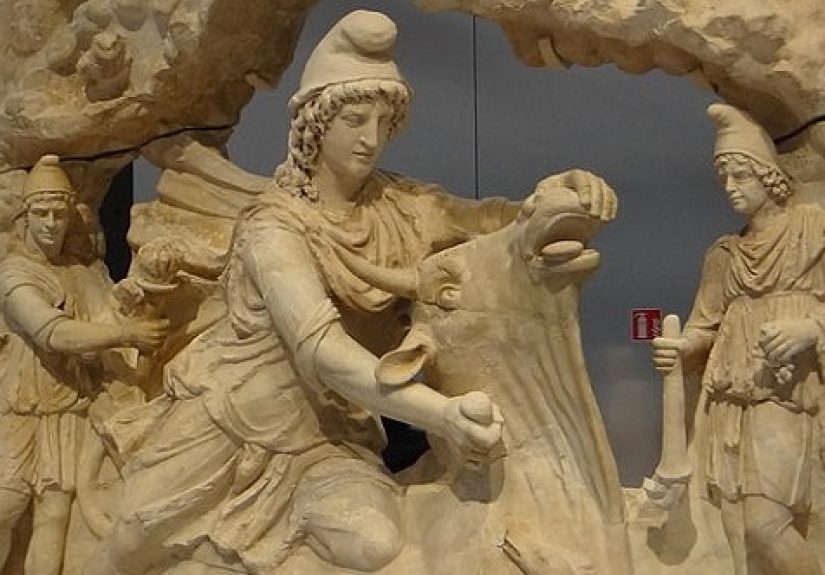
If you know one image from the Cult of Mithras, it is probably the tauroctony, the famous scene of Mithras slaying a bull. This image appeared again and again in Mithraic shrines. Mithras grabs the bull, drives in the blade, and around the scene gather creatures such as a dog, a snake, a scorpion, and often celestial figures. It is dramatic, strange, and clearly central.
The mystery is what it ultimately meant. Ancient worshippers likely understood the scene through a mythic framework involving creation, cosmic renewal, and the birth of life. Some interpretations emphasize fertility and rebirth, since plants and life emerge from the bull’s death in later explanations of the myth. Others stress astronomy and cosmology, because zodiac signs, Sol, Luna, and planetary symbolism often surround the scene. The safest conclusion is that the bull-killing was not random violence for theatrical effect. It was the visual heart of Mithraic theology.
So no, the cult was not centered on “bull hatred.” The bull scene symbolized a cosmic act. That is more profound, though admittedly much less catchy on a souvenir mug.
3. Myth: Mithraic Temples Were Grand Public Buildings
Quite the opposite. A mithraeum was usually compact, enclosed, and cave-like. Many were underground or built to feel subterranean. They typically featured a long central aisle with raised benches on both sides, creating a space where a small group could recline, gather, and focus on the sacred image at the far end. This was not public religion performed in a giant civic plaza. It was controlled access, ritual atmosphere, and carefully staged symbolism.
The cave design mattered because Mithraic religion used architecture to reinforce mystery. The temple was not just a meeting hall; it was a model of the cosmos, a dramatic setting for initiation, and a place where darkness, torchlight, and imagery could work together. Imagine entering a narrow sacred space, lit by artificial light, with the bull-slaying image glowing at the end. Roman religion could be very theatrical when it wanted to be, and Mithraism definitely wanted to be.
4. Myth: Mithraism Was Only for Soldiers
This idea survives because Mithraism really was popular in military environments. Archaeological finds near forts and frontiers helped cement the “soldier religion” label. Add in the cult’s emphasis on loyalty, hierarchy, and brotherhood, and the stereotype practically writes itself.
But the full picture is broader. Mithraism also attracted merchants, imperial officials, freedmen, and urban residents. The cult spread through trade routes and city networks as well as military ones. Ports and commercial centers played an important role, which makes sense for a religion that moved along the arteries of empire. Soldiers mattered, yes, but they were not the entire cast. The cult had more range than the stereotype suggests.
So the more accurate version is this: Mithraism appealed strongly to soldiers, but it was not a members-only club for men who smelled like leather, campfire smoke, and unpaid imperial overtime.
5. Mystery: What Happened During Mithraic Initiation?
Now we get to the fun part: the section where historians would love a complete ritual transcript and instead get fragments, inscriptions, and suggestive material clues. Mithraic initiation is known to have involved grades, symbolism, and ritual progression, but the exact sequence remains partly hidden. That secrecy was not an accident. Mystery religions earned the title honestly.
We do know the famous seven grades traditionally associated with Mithraism: Raven, Bridegroom, Soldier, Lion, Persian, Sun-Runner, and Father. These titles were not decorative flair. They seem to have reflected symbolic advancement and may have linked to cosmology, planetary ascent, or moral-spiritual development. Some evidence suggests costume, masks, and role-based participation in ritual meals. In other words, initiates did not just sign a form and receive a welcome candle. They entered a symbolic ladder of belonging.
The mystery, however, lies in the details. How exactly were candidates tested? What prayers were spoken? What emotional experience did the rites create? Archaeology gives hints, but the full dramatic script remains just out of reach.
6. Myth: Women Took Part Equally in the Cult
This is one of the clearest areas where the evidence leans strongly in one direction. Roman Mithraism appears to have been a male-only cult. Excavated evidence and inscriptions consistently point toward male participation, and scholars generally treat exclusion of women as a defining characteristic of the cult’s organization.
That matters because it shaped the social feel of Mithraic communities. A mithraeum was not merely a chapel; it was a brotherhood space. Shared meals, initiation grades, and ritual identity all reinforced a male communal structure. That may help explain part of the cult’s appeal in military and administrative circles, where male bonding and hierarchy were already culturally powerful.
Of course, this opens another mystery. Why exclude women? Was the cult designed around masculine roles, or did the exclusion emerge from social custom rather than formal theology? The evidence gives us the fact more clearly than the motive. Ancient religions, much like modern group chats, were sometimes excellent at preserving membership patterns and terrible at explaining themselves.
7. Mystery: What Did the Sacred Meal Mean?
Mithraic communities held ritual meals, and these were clearly important. Artistic scenes show Mithras dining with the sun god Sol after the bull sacrifice, and archaeological spaces within mithraea were built to accommodate communal dining. Bread, drink, and shared participation appear to have mattered deeply.
But what did the meal signify? It may have re-enacted the divine banquet. It may also have affirmed belonging, hierarchy, and the hope of salvation. In a world where religion was often enacted physically rather than merely believed internally, eating together in a sacred setting could be theology in action. The meal was not just dinner with good branding. It was ritual identity served in portions.
Because Mithraism left so much unsaid in surviving texts, the sacred meal remains one of the cult’s most tantalizing mysteries. It sat somewhere between fellowship, reenactment, and spiritual drama, which is a very efficient way to make historians hungry and frustrated at the same time.
8. Myth: Mithras Was Definitely Born on December 25
This claim shows up constantly in popular articles, often with the confidence of a fact that has just won a spelling bee. The problem is that the evidence is more tangled than popular summaries suggest. Mithras was associated with light, cosmic order, and the sun god Sol, and the Roman world certainly loved winter solar symbolism. But the neat statement “Mithras was born on December 25, case closed” oversimplifies a messy religious landscape.
What we can say is that Roman solar cults, imperial symbolism, and seasonal festivals overlapped in ways that later writers often compress into one tidy sentence. The famous motif of Mithras being born from a rock also complicates the issue, because his “birth” in Mithraic iconography is already unusual before anyone even opens a calendar. So the December 25 claim survives because it is memorable, not because the evidence is perfectly clean.
Ancient religion rarely behaves like a modern spreadsheet. It behaves more like a drawer full of labeled cords that somehow still end in mystery.
9. Myth: Mithraism Was Christianity’s One Clear Rival
This idea has a dramatic ring to it, and for that reason it never really dies. Yes, Mithraism and Christianity coexisted in parts of the Roman world. Yes, both offered forms of belonging, sacred meals, and interest in salvation. And yes, later Christian writers sometimes treated competing cults as serious alternatives. But the rivalry was not a simple two-team playoff bracket.
The Roman religious world was crowded. Isis, Cybele, local gods, imperial cult practices, traditional civic religion, philosophical monotheism, and countless regional cults all shared space. Mithraism was one important competitor in that environment, but not the only one. It also differed from Christianity in major structural ways. Mithraism was secretive, small-scale, and exclusive. Christianity eventually developed a public, expansive, missionary structure with family and community appeal that reached far beyond elite male ritual circles.
So Mithraism was important, but it was not simply “the religion that almost beat Christianity.” History is usually less cinematic and more crowded.
10. Mystery: Why Did the Cult of Mithras Disappear?
Here is the final great puzzle. Mithraism spread impressively, left striking archaeological remains, and then faded. Why? The short answer is that religious change in late antiquity was massive, uneven, and often political. As Christianity gained institutional support and pagan cults lost imperial protection, small mystery religions became harder to sustain. A religion centered on intimate male groups, hidden spaces, and restricted access was vulnerable when public conditions shifted.
There may not have been one single reason. Some communities probably dwindled gradually. Some sanctuaries were abandoned. Others may have been repurposed or destroyed. The cult’s very secrecy, which once gave it power, may have made it less adaptable in a transforming empire. When the social ecosystem changed, Mithraism seems to have lost the conditions that helped it thrive.
And so the cult vanished, leaving behind stone benches, sacred imagery, inscriptions, and a very effective long-term strategy for keeping graduate students awake at night.
What These Mithras Myths Actually Reveal
Once you move beyond the headline myths, the Cult of Mithras becomes even more interesting. It was not just an exotic Roman side story. It reveals how religion worked in an empire full of mobility, anxiety, status competition, and spiritual experimentation. Mithraism offered belonging in a fragmented world. It gave initiates a ritual map of the cosmos, a hierarchy of advancement, and a dramatic sacred setting that turned belief into experience.
That is why the myths surrounding Mithras endure. The cult gives modern readers exactly what they crave from ancient mystery religions: secrecy, symbolism, brotherhood, subterranean temples, and unanswered questions. Yet the real importance of Mithraism lies in how it shows religion adapting to empire. It fused imagery, architecture, loyalty, and cosmic hope into a system that felt intimate and powerful at the same time.
So when people ask why the Cult of Mithras still matters, the answer is simple. It matters because it reminds us that history is not only preserved in books. Sometimes it survives in stone reliefs, hidden rooms, ritual leftovers, and a handful of symbols that refuse to stop whispering.
Experiences Related to the Topic: What It Feels Like to Encounter Mithraism Today
One of the most compelling experiences related to the topic of the Cult of Mithras is the strange mix of closeness and distance you feel when studying it. Unlike some ancient religions that left long texts, named theologians, and detailed official histories, Mithraism confronts you through spaces and images. You walk into photographs of mithraea or look at museum pieces showing Mithras slaying the bull, and the first reaction is visual rather than verbal. The religion meets you as atmosphere. It is dark, enclosed, and symbol-heavy. Even from a laptop screen, the cult feels like it wants you to lower your voice.
That experience changes the way modern readers imagine religion in the Roman Empire. Many people picture Roman religion as open-air sacrifice, grand marble temples, and public civic ceremony. Mithraism interrupts that picture. It invites you into a narrower room, onto side benches, into lamplight, into a place where a small group might gather for a sacred meal and initiation drama. You begin to sense how powerful architecture can be in shaping emotion. The cave-like design was not background decoration. It was part of the spiritual technology of the cult.
There is also a very human experience of frustration that comes with Mithraic studies, and oddly enough, that frustration is part of the appeal. You can identify the symbols, count the grades, compare the shrines, and still end up with a long list of “probably,” “perhaps,” and “we cannot be certain.” For modern readers used to searchable certainty, that can feel maddening. But it also makes the subject exciting. Mithraism reminds us that the ancient world does not always explain itself on demand. Sometimes it leaves us with clues and expects humility.
Museum encounters deepen that experience. A relief of the tauroctony is more unsettling in person than in a casual online image. The composition is crowded with meaning: the bull, the knife, the scorpion, the dog, the snake, the celestial companions, the intense stillness of a scene that is somehow violent and orderly at once. You realize that ancient worshippers were not just looking at decoration. They were looking at a theological diagram, a cosmic event frozen in stone. The experience can feel less like viewing art and more like eavesdropping on a religion that never fully invited outsiders in.
Perhaps the strongest modern experience related to Mithras is the recognition that mystery itself can be historically meaningful. We do not need every missing answer for the cult to matter. In fact, the gaps are part of the story. They reveal how secrecy functioned, how initiation shaped identity, and how ritual communities could preserve intensity without leaving behind a tidy explanation for the future. Studying Mithraism today becomes an exercise in disciplined imagination: not inventing fantasies, but standing at the edge of the evidence and admitting that some ancient experiences were designed to be transformative precisely because they were hard to translate into ordinary speech.
That may be the most lasting lesson of all. The Cult of Mithras survives not as a complete script, but as a set of encounters: with images, with architecture, with silence, and with the stubborn feeling that some doors in history open only partway. Oddly enough, that is exactly why people keep returning to it.
Conclusion
The myths and mysteries of Mithraism continue to attract readers because the cult sits at the perfect intersection of secrecy and evidence. We know enough to see its outlines clearly: a Roman mystery religion centered on Mithras, cave-like sanctuaries, initiation grades, ritual meals, and the unforgettable image of the bull sacrifice. But we do not know enough to turn it into something easy. That tension keeps the cult alive in both scholarship and popular curiosity.
If there is one takeaway from these ten myths and mysteries, it is that the Cult of Mithras was not a historical footnote with a dramatic hat. It :was a serious religious system that offered meaning, brotherhood, hierarchy, and cosmic hope to communities across the Roman Empire. The unanswered questions are not a weakness in the story. They are part of what makes it unforgettable.