Table of Contents >> Show >> Hide
- Why Monthly Investor Updates Matter More Than Founders Expect
- What Makes a Good Monthly Investor Update?
- The Best Structure for a Monthly Investor Update
- A Good Example of a Monthly Investor Update
- Why This Investor Update Example Works
- Common Mistakes That Ruin Investor Updates
- Email, Memo, or Deck?
- How Monthly Updates Help the Next Fundraise
- What Should Be Included Every Single Month?
- Field Notes: What Founders Commonly Experience After Sending Monthly Updates for a Year
- Final Takeaway
- SEO Tags
A monthly investor update is not a novel, a therapy session, or a magic trick where the bad numbers disappear behind a cloud of optimism. It is a simple operating habit. Done well, it keeps investors informed, helps founders spot patterns faster, and quietly makes the next fundraise less painful. Done badly, it becomes a fluffy email full of adjectives, missing metrics, and vague promises that read like a startup wrote it while hiding under a desk.
So what does a good monthly investor update actually look like? In plain American English: it is short, consistent, metric-driven, honest, and useful. It tells investors what changed, what matters, what is broken, and where they can help. That is it. No smoke machine required.
Why Monthly Investor Updates Matter More Than Founders Expect
Founders often treat investor communication like flossing. Everyone agrees it is a good idea, and then suddenly six months have passed and everyone is pretending that is normal. The problem is that silence creates friction. Investors get less context, founders get less help, and the business loses one of the cheapest leverage tools it has.
A strong startup investor update does three jobs at once. First, it builds trust because investors can see progress over time instead of getting surprise fireworks right before a round. Second, it creates internal accountability. When you know you have to report the same metrics every month, you stop hiding behind random vanity stats and start paying attention to what actually drives the company. Third, it unlocks help. Investors are usually much more useful when you give them a clear problem to solve instead of a generic “let me know if you have thoughts.”
The best part is that a monthly update does not need to be fancy. In fact, fancy is often the enemy. Investors do not need a Broadway production. They need clarity. A plain email with the right structure will usually beat a beautiful deck with no point.
What Makes a Good Monthly Investor Update?
If you want the simplest answer possible, here it is: a good investor update should help someone understand your company in under five minutes. If it takes twenty minutes to read, you did not write an update. You wrote a short hostage memoir.
1. Start With the Headline, Not the Drumroll
The opening should tell investors what kind of month it was. Good month, mixed month, rough month, momentum building, one major miss, one major win. Put the signal first. Investors should not have to excavate the truth from paragraph four like startup archaeologists.
2. Track the Same Core Metrics Every Month
This is where many updates go off the rails. Founders switch metrics whenever the old ones stop looking cute. Resist that urge. A solid monthly investor update example keeps the same core KPIs month after month so trends become obvious.
For SaaS companies, common metrics include MRR or ARR, growth rate, paying customers, pipeline, churn, burn rate, runway, and sometimes NPS or retention. For consumer or marketplace startups, it may be active users, conversion, retention, repeat usage, gross merchandise volume, contribution margin, or engagement. The exact stack changes by stage, but the rule does not: be consistent.
3. Share Wins, Losses, and What Changed
Good updates do not pretend every month was heroic. They include progress and friction. New logo? Great. Senior hire closed? Great. Enterprise cycle slipped? Say that too. Roadmap delayed? Include it. Investors do not expect perfection. They do expect honesty.
4. Include Burn and Runway Without Drama
If investors have to guess how much cash is left, you are making life harder for everyone. Burn rate and runway belong in the update, especially for early-stage startups. They do not need to be wrapped in suspense. Just state the numbers and what changed.
5. End With Specific Asks
This is the part founders skip and then complain that investors are not helpful. A vague ask gets vague help. A specific ask gets intros, referrals, candidates, feedback, and sometimes capital. Ask for exactly what you need: an intro to three target customers, a VP Sales candidate, feedback on pricing, a banking contact, or help with the next round.
The Best Structure for a Monthly Investor Update
There is no single sacred template, but the strongest ones usually follow a predictable flow:
Overview
One or two short paragraphs summarizing the month. Think headline plus context.
Key Metrics
A tight list of your repeatable KPIs. No metric confetti. Just the numbers that matter most.
Highlights and Lowlights
What went well, what did not, and why it matters.
Team and Product
Important hires, departures, launches, delays, or operational milestones.
Financial Snapshot
Burn, runway, revenue movement, and any major shifts in forecast.
Asks
Specific ways investors can help this month.
Next Month Priorities
What the company is focused on now, so investors know what success should look like in the next email.
A Good Example of a Monthly Investor Update
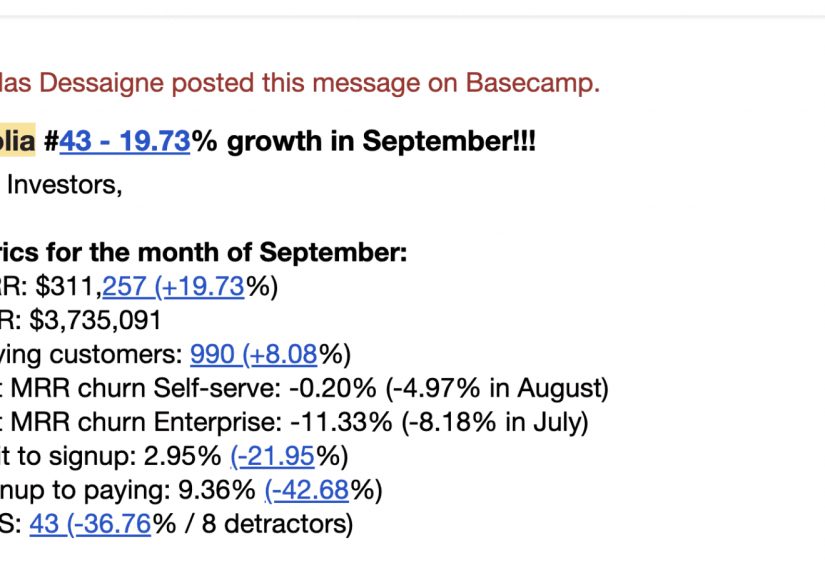
Below is an original example for a SaaS startup. It is not trying to be flashy. That is the point. It gives investors a fast read on traction, cash, risk, and what help is needed.
Why This Investor Update Example Works
First, the email opens with a clean summary: solid month, good progress, one clear problem. That gives investors immediate context. Second, the metrics are concrete and comparable. You can tell whether the company is improving without reading tea leaves. Third, it includes both wins and misses. That is important because credibility compounds. Founders who only send sunshine eventually make every sentence sound suspicious.
Most importantly, the asks are actionable. They are not “we welcome any ideas.” They are specific requests tied to current bottlenecks. That is how investor communication becomes useful instead of ceremonial.
Common Mistakes That Ruin Investor Updates
The “Everything Is Amazing” Email
Nothing damages trust faster than fake smoothness. If a key deal slipped, say so. If churn spiked, explain it. If hiring is stuck, put it in the update. Investors can handle reality. They cannot help with fiction.
The Deck That Ate Tuesday
If your update takes two days to produce, your process is broken. Monthly updates should be lightweight. Save the deep strategy deck for board meetings and major financing moments.
Vanity Metrics in a Fancy Trench Coat
Website visits, impressions, and social applause may be interesting, but they are rarely the headline. Lead with the metrics that show business health, customer behavior, and cash position.
Changing KPIs Every Month
This is the startup version of moving the goalposts and then acting surprised nobody brought cleats. Pick a small metric set and stick with it.
No Ask Section
If you forget the ask, you are wasting the best part of the email. Investors often have useful networks, pattern recognition, and operator knowledge. But they are not mind readers.
Email, Memo, or Deck?
For most early-stage companies, plain email wins. It is easier to send, easier to skim, and easier to keep consistent. A lightweight chart or screenshot is fine when it adds clarity, but the default should still be readability. Monthly updates are operational. They are not auditions for a design award.
A memo or short deck can work when the business is more complex, the stakeholder group is larger, or the company is later stage. But even then, the spirit should remain the same: concise, repeatable, and useful.
How Monthly Updates Help the Next Fundraise
Here is the sneaky advantage founders underestimate: regular updates make fundraising warmer before fundraising starts. Investors and prospective investors can watch the story unfold over time. They see the pace of execution, the quality of decisions, and how the company handles bad months. That context matters.
A founder who sends disciplined updates is effectively building a running diligence trail. When the next round opens, the company is not introducing itself from scratch. It is continuing a conversation. That can shorten the credibility gap and reduce the number of “wait, can you walk me through the last nine months?” meetings that mysteriously eat your calendar alive.
What Should Be Included Every Single Month?
If you want the bare-minimum checklist for a monthly investor update template, use this:
- A one-paragraph summary of the month
- Three to seven consistent KPIs
- One to three wins
- One to three challenges
- Burn rate and runway
- Important team or product updates
- Two or three specific asks
- Priorities for next month
If that information is present and clear, you are already ahead of a surprising number of startups.
Field Notes: What Founders Commonly Experience After Sending Monthly Updates for a Year
Once founders get into the habit of sending updates every month, they usually notice something funny: the update stops being just an investor tool and becomes a management tool. Teams become more aware of the handful of numbers that actually matter. Meetings get cleaner because there is already a monthly cadence for reviewing what changed. Patterns become easier to spot. One bad month feels less like chaos and more like data. That shift is powerful.
Another common experience is that honesty gets easier with repetition. The first rough update feels awkward. Founders worry they will look weak, dramatic, or unprepared. Then they send it and discover the opposite. Good investors usually respond better to directness than to spin. A founder who says, “Pipeline grew, but close rates fell because implementation is still clunky,” sounds more credible than one who writes three cheerful paragraphs and quietly avoids the metric section. Over time, this builds a reputation for discipline. That reputation matters when the company hits a hard patch, because investors are more likely to trust both the diagnosis and the recovery plan.
Founders also learn that a clear ask section changes the quality of responses. When updates are purely informational, investors may reply with a thumbs-up, a congratulations, or total silence. When the email includes concrete asks, the response quality improves. Intros happen faster. Candidates appear. Advice becomes more relevant. You stop getting broad motivational speeches and start getting useful tactical help. In other words, specificity turns passive readers into participants.
There is also a quieter psychological benefit. Monthly updates force founders to close the books on the month, at least mentally. That matters because startups can feel like one long Tuesday. Without a rhythm, everything blurs together. A recurring investor update creates a checkpoint. What did we say we would do? What actually happened? What changed? What is the next priority? This rhythm can reduce reactive decision-making because it nudges leaders to zoom out regularly rather than sprint from fire to fire with a laptop in one hand and cold coffee in the other.
Perhaps the most useful experience of all is seeing the company’s story accumulate. A single monthly update may feel small. Twelve of them tell a narrative. They show momentum, resilience, mistakes, and learning. They make it easier for current investors to advocate internally and easier for future investors to understand how the business evolved. That accumulated narrative is often more persuasive than one polished fundraising deck because it is grounded in time, consistency, and evidence. Founders who stick with the habit rarely say, “I wish I had sent fewer updates.” They usually say the opposite: “I wish I had started sooner.”
Final Takeaway
A good monthly investor update example is not complicated. It is clear enough to read quickly, honest enough to trust, and specific enough to trigger help. Start with the headline. Track the same KPIs. Include wins, losses, burn, runway, and asks. Send it on a predictable cadence. Then do the hardest part of all: keep doing it when the month is messy.
Because in startup land, the companies that communicate well are not just being polite. They are building leverage, credibility, and a much better paper trail than “Sorry for the delay, it’s been a busy quarter.”