Table of Contents >> Show >> Hide
- Why “Two Suns” Isn’t Just Sci-Fi Anymore
- Two Ways Planets Live in Binary Systems
- Circumbinary Planets: What Kepler and TESS Already Proved
- Habitability in a Double-Star Neighborhood
- Why Binary Systems Are Sneakily Great for Finding Aliens
- How We’d Actually Search: Missions, Methods, and Signals
- What Makes a Binary System a Great “Alien-Hunting” Target?
- The Plot Twists and Dealbreakers
- What’s Next: Better Telescopes, Smarter Searches, and a Wider Net
- Field Notes: Real-World Experiences That Make This Topic Feel Alive (Even Before We Find Life)
If you’ve ever watched Star Wars and thought, “Two suns? Sure, why not,” astronomy has some good news:
the universe didn’t just steal that aestheticit mass-produced it. Binary star systems (two stars gravitationally bound and orbiting a shared center)
are common in our galaxy, and we now know planets can live in those double-star neighborhoods too. The fun twist is that these “two-sun” systems might
be especially useful for finding lifeor at least the kind of life that leaves a suspiciously non-natural calling card.
“Aliens” is a loaded word. In science, it usually means one of two things: biosignatures (chemical hints of life, like certain gases in an atmosphere)
or technosignatures (evidence of technology, like radio signals, laser pulses, or waste heat). Binary star systems could help with both.
Not because aliens prefer dramatic sunsetsthough honestly, who wouldn’tbut because binaries can give us cleaner measurements, better timing cues,
and a wider “search strategy” playground than we get with single-star systems.
Why “Two Suns” Isn’t Just Sci-Fi Anymore
The exoplanet era ended the old assumption that planetary systems have to look like ours. We’ve found hot Jupiters, lava worlds, planets around pulsars,
and planets that shouldn’t exist on paper but apparently didn’t read the paper. Binary stars were once seen as rough real estate for planetstoo chaotic,
too gravitationally messy. Then the data started showing: planets can form and survive there, sometimes in stable, long-term orbits.
And when planets exist in binary systems, they don’t just add “more planets.” They add more geometry, more periodic events, more ways to cross-check what we see.
If you’re trying to detect something as faint as a planetor as subtle as a sign of lifeextra “built-in calibration” is a big deal.
Two Ways Planets Live in Binary Systems
Planets in binary star systems generally fall into two categories. Think of it like living arrangements: do you rent a place near one star, or do you get a
“shared custody” orbit around both?
S-type (Circumprimary) Orbits: The “One-Star Household”
In an S-type orbit, a planet circles one star while the other star is a distant companion. This looks a bit like a normal planetary system,
except there’s a second sun occasionally brightening the sky and complicating the climate. The key is distance: if the companion star is far enough away,
the planet’s orbit can remain stable for a long time.
P-type (Circumbinary) Orbits: The “Two-Sun Package Deal”
In a P-type orbit, also called a circumbinary orbit, a planet goes around both stars. The stars orbit each other inside
the planet’s larger loop, like a cosmic ballroom dance inside a racetrack. These are the systems that earn the “Tatooine” nickname, and they’re the ones
most people picture when they hear “binary planet.”
Circumbinary planets are harder to detect than planets around single stars because their transits (the tiny dips in starlight when the planet passes in front)
don’t happen like clockwork. The stars are moving. The planet is moving. Everyone is moving. It’s basically a traffic circle with no turn signals.
But when we do catch them, we get a goldmine of information.
Circumbinary Planets: What Kepler and TESS Already Proved
NASA’s planet-hunting missions showed that “planets with two suns” aren’t just possiblethey’re real, measurable, and diverse.
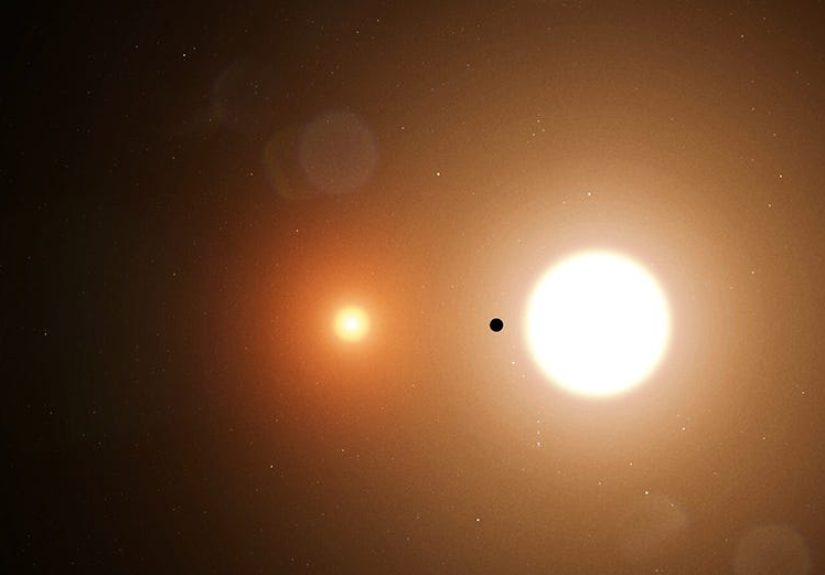
One landmark example is Kepler-16b, a circumbinary planet famously compared to Tatooine because it orbits a pair of stars.
Then there’s Kepler-47, a system with multiple planets orbiting two starsproof that circumbinary systems can host complex planetary families.
More recently, TESS joined the party with its first transiting circumbinary planet discovery, demonstrating that we can find these worlds with newer surveys too.
Even when the known circumbinary planets themselves aren’t Earth-like (many are gas giants or Neptune-ish), they tell us something critical:
planet formation works in binary environments. And where giant planets exist, smaller planets or moons may exist toosometimes in regions where liquid water could,
at least in theory, survive.
Habitability in a Double-Star Neighborhood
Habitability is not a vibe. It’s a physics problem with a public-relations department. The core question is: can a planet maintain conditions suitable for liquid water?
That usually means it needs to sit in a habitable zonenot too hot, not too coldwhile keeping a stable orbit and a not-totally-hostile radiation environment.
The Stability Problem: The “No-Planet Zone” Near the Binary
Binary stars create a region close to the pair where planetary orbits tend to be unstable. Too close, and gravitational nudges accumulate until the planet’s orbit becomes eccentric,
collides with something, or gets flung into deep space like it missed a rent payment.
For circumbinary planets, stable orbits typically begin beyond a certain distance from the binary pair.
That stability boundary matters because it can overlap (or not) with the habitable zone depending on the stars’ masses and separation.
Climate Quirks: Eclipses, Seasons, and Light That Won’t Sit Still
In a circumbinary system, the planet doesn’t just get sunlightit gets sunlight choreography.
As the two stars orbit each other, the combined illumination changes. Sometimes one star partially eclipses the other, creating predictable dips.
Sometimes the angle shifts just enough to tweak the planet’s seasons in ways that would make Earth’s weather look calm and emotionally stable.
But here’s the surprise: variability isn’t automatically bad. Life on Earth survived ice ages, volcanism, asteroid impacts, and reality TV.
What matters is whether conditions remain within survivable ranges over long timescalesand whether the planet retains an atmosphere and water.
Why Close Binaries Might Be Kinder Than You Think
Some research suggests that certain close binary configurations can produce more consistent overall radiation at the location of a circumbinary habitable zone.
The combined “sunlight budget” can average out in useful ways, and in some setups the habitable zone can be broad enough to accommodate stable orbits.
Translation: not every two-sun world is doomed to be a frozen wasteland or a barbecue.
Why Binary Systems Are Sneakily Great for Finding Aliens
Now we get to the good stuff: why binary star systems might help us find life faster or more confidently.
The best search strategies aren’t just about having more targetsthey’re about having targets that give clearer signals and fewer false positives.
1) More Targets Than You Think (and Many Are Nearby)
Binary stars are common. If we ignore them, we potentially ignore a huge fraction of places where planetsand lifecould exist.
Even a modest boost in “searchable real estate” matters when the thing you’re hunting might be rare.
2) Built-In “Cosmic Calendars” for SETI
SETI (the Search for Extraterrestrial Intelligence) has a coordination problem: if an alien civilization wants to be found, when should they transmit?
Binary systems provide natural timing markerseclipses, orbital alignments, predictable eventsthat could serve as universally recognizable “broadcast moments.”
If two civilizations both understand orbital mechanics, they can synchronize attention without exchanging a prior email. (Which is good, because interstellar Outlook invites are a nightmare.)
3) Better Planet Characterization Through Extra Geometry
In eclipsing binaries, the stars periodically block each other’s light. That regular pattern lets astronomers measure stellar properties with high precision.
When a planet is added to the system, the geometry can provide multiple independent constraints on sizes, masses, and orbital parameters.
Better stellar measurements mean better planet measurements, and better planet measurements mean fewer “maybe it’s habitable?” shrug emojis.
4) Stronger Filters Against False Positives
Exoplanet detection is full of impostors: starspots, stellar flares, background eclipsing binaries, instrumental noise, and other cosmic pranksters.
The richer dynamics of binary systems can sometimes help rule out alternatives. If your model has to explain not one star’s behavior but twoand their eclipsesand a planet’s transits
a fake signal has fewer places to hide.
5) Technosignatures Might Stand Out More
Technosignature searches look for patterns that are hard to explain naturally: narrowband radio signals, repeating laser pulses, unusual light-curve anomalies,
or excess infrared heat that might suggest massive energy use. The key is context. Binary systems, especially well-characterized ones, give more context:
more predictable variability to subtract out, more precise timing to test for synchronization, and more robust physical models.
How We’d Actually Search: Missions, Methods, and Signals
Transit Surveys: Catch the Shadow, Then Interrogate the Planet
Transit detection remains one of the most productive tools we have. Missions like Kepler and TESS monitor stellar brightness, looking for repeating dips.
Circumbinary planets are trickier because the “schedule” of transits varies, but with enough data and careful modeling, those patterns can be recognized.
Once a planet is confirmed, follow-up observations can constrain its temperature, orbit, and in some cases atmospheric properties.
Radial Velocity, Eclipse Timing, and Other Ways to Weigh Worlds
Radial velocity measures the tiny wobble of a star caused by a planet’s gravity. In binaries it’s more complex, but also potentially richer:
you can track motion within the binary and look for additional perturbations. Eclipse timing variations can also hint at planets by measuring subtle shifts
in when eclipses occur.
Atmospheres, Spectroscopy, and the “Is There Air?” Question
If the dream is life, the practical step is atmosphere. Spectroscopysplitting light into its component wavelengthslets scientists infer what gases exist around a planet.
That’s how we look for biosignature candidates (always with caution and alternative explanations in mind).
The next generation of telescopes and surveys aims to make these measurements more routine, especially for nearby worlds.
SETI and Technosignature Programs: Listening, Looking, and Getting Weird on Purpose
Modern technosignature work isn’t limited to “listening for radio.” It includes optical searches (laser pulses), infrared studies (waste heat),
and anomaly-hunting in big datasets. Programs like Breakthrough Listen have expanded systematic searches, and NASA has also increased its visible engagement
in technosignature research through workshops and study groups.
What Makes a Binary System a Great “Alien-Hunting” Target?
Not all binaries are equally helpful. If you want a short list of traits that make astronomers lean forward in their chairs, here you go:
- Nearby: Distance matters because signal strength and atmospheric measurements get harder the farther you go.
- Quiet stars: Lower stellar activity reduces noise and improves habitability prospects.
- Well-characterized eclipses: Eclipsing binaries can yield excellent stellar constraints.
- Stable habitable zone alignment: The habitable zone needs to fall outside the instability region for circumbinary planets.
- Existing planets (even big ones): Giant planets can be signposts of planet formationand possible hosts for moons.
The ideal scenario is a nearby eclipsing binary with a stable region in or near the habitable zone, where we can detect planets and then do atmospheric follow-up.
That’s not commonbut it’s also not zero. And in science, “not zero” is where all the magic happens.
The Plot Twists and Dealbreakers
Binary systems can also be terrible for life, depending on the configuration. Some binaries are too close, too active, or too gravitationally chaotic.
Planets can be ejected. Orbits can become highly eccentric, creating extreme temperature swings.
And if the stars are flare-happy, they can strip atmospheres or batter surfaces with radiation.
There’s also a sociological plot twist: our detection methods are biased. We’ve historically found the easiest-to-detect planets first,
and binaries add detection complexity, meaning the catalog of known circumbinary planets is likely an undercount.
As methods improve, the “two-sun” population could expand quickly.
What’s Next: Better Telescopes, Smarter Searches, and a Wider Net
The near future of exoplanet science is about moving from “planet discovery” to “planet diagnosis.” That includes larger surveys to find more candidates,
improved modeling for complex systems (like binaries), and better instruments for atmospheric spectroscopy and direct imaging.
NASA’s upcoming missions and mission concepts are designed to widen the discovery spacefinding more planets and improving our ability to detect
signatures of life or technology.
If binary systems really do offer cleaner timing cues, richer geometry, and a big slice of habitable real estate, they won’t stay a niche topic.
They’ll become part of the main strategy: find nearby binaries, identify stable habitable zones, search for planets (and moons),
then scan for biosignatures and technosignatures with the best tools we have.
Field Notes: Real-World Experiences That Make This Topic Feel Alive (Even Before We Find Life)
One of the most underrated parts of the “binary stars and aliens” conversation is how hands-on it already iswithout anyone needing to
build a backyard space telescope the size of a basketball court. The modern search is increasingly driven by big datasets, public tools,
and a mix of professionals and passionate non-professionals who know how to spot something odd and refuse to let it go.
For example, citizen science has repeatedly shown it can help find exoplanets hiding in plain sight. When you’re dealing with circumbinary systems,
transit patterns can look irregular and easy to miss. That’s exactly the kind of puzzle where extra human attention can matter:
people notice “weird,” even when “weird” doesn’t match a neat algorithmic expectation. The result is a real sense of participation
not in a vague “space is cool” way, but in a “my eyeballs helped flag this curve” way.
The same goes for educational and internship pathways. Some of the most talked-about circumbinary discoveries became famous not only for the science
but for the human story behind themstudents and early-career researchers combing through data, spotting anomalies, and then watching a small curiosity
turn into a published result. It’s a reminder that space discovery isn’t a closed club; it’s more like an open puzzle night where the universe supplies
the riddles and we supply increasingly clever ways to solve them.
If you’ve ever tried to explain circumbinary dynamics to a friend, you know the experience usually goes like this:
you draw two circles, then you draw a bigger circle, then you realize you’ve accidentally invented modern art.
But that struggle is part of why binaries are compellingthese systems force us to think in motion. Many researchers actually build simulations
(even simple ones) to visualize how light changes over time, how eclipses line up, and how a planet’s “year” might feel. That modeling mindset
carries directly into alien-hunting: the better you can predict the natural patterns, the faster you can notice something that doesn’t belong.
Technosignature searching also has an oddly relatable “experience” layer: listening. Not literally with your earsradio telescopes don’t pipe the cosmos
into Spotifybut conceptually. You choose a target list, decide what “interesting” means, run analyses, and then deal with the emotional rollercoaster of
false alarms. A suspicious signal appears, everyone gets excited, and then it turns out to be interference or an instrumental artifact.
That cycle can sound disappointing, but it’s actually healthy: the discipline of eliminating mundane explanations is what makes the eventual “this is real”
moment credible.
And binaries add a fun twist to that experience. The systems themselves provide repeating eventseclipses and orbital phasesthat can act like timestamps.
Researchers can ask sharper questions: “Does anything unusual happen at the same orbital phase repeatedly?” “Does a signal appear during an eclipse window
as if someone is using the system’s geometry as a beacon?” Even without an alien answer, you end up with a richer scientific process,
because the target gives you more structure to test ideas against.
So even before we find life, binary star systems offer something valuable: a search that feels more like a detective story than a lottery ticket.
There are more clues, more cross-checks, and more ways to turn “maybe” into “we’re sure.” And if we ever do confirm a real technosignature from a two-sun world,
we’ll have earned itwith math, patience, and probably a few desperate jokes along the way.