Table of Contents >> Show >> Hide
- Why French Numbers 1–10 Matter More Than You Think
- Way #1: The Classic Classroom Count (Spelling + Clean Pronunciation)
- Way #2: Count Like a Local (Rhythm + Liaisons + “Context Pronunciation”)
- Way #3: Count with Your Hands and Your Life (Fingers + Micro-Scenes)
- Common Mistakes When Learning to Count to Ten in French
- Conclusion: Pick Your Favorite Method (or Use All Three)
- Extra: of Real-World Practice Experiences (So You Don’t Freeze at “Deux”)
If you can count to ten in French, you can survive (and thrive) in a shocking number of real-life situations:
ordering pastries, giving your phone number, catching the right bus, or confidently telling someone “no, I did not just pay nine euros for water.”
This guide gives you three practical, fun ways to master French numbers 1–10with pronunciation tips, “native-speed” linking, and hands-on memory tricks.
By the end, you’ll know how to say un, deux, trois… dix clearly, quickly, and without sounding like you’re reading off a menu at a French-themed restaurant in Ohio.
Why French Numbers 1–10 Matter More Than You Think
Learning French counting starts with 1–10 because this mini set shows up everywhere:
prices, time, dates, addresses, floors in buildings, sports scores, classroom exercises, and “how many croissants?” (a question that deserves an accurate answer).
Also, French has a few pronunciation “gotchas” that show up earlylike silent letters and “liaisons” (when a hidden consonant pops out to connect words).
If you can handle those with 1–10, bigger numbers feel less scary later.
Way #1: The Classic Classroom Count (Spelling + Clean Pronunciation)
This is the foundation: memorize the list, learn the most common pronunciation, and get comfortable seeing the words on the page.
Think of it as learning the “default settings” for how to count in French.
French numbers 1–10 (with easy pronunciation cues)
| Number | French | Say it like (approx.) | Quick note |
|---|---|---|---|
| 1 | un | uh(n) (nasal) | The “n” isn’t fully pronounced; it’s more of a nasal vowel. |
| 2 | deux | duh / deuh | Often ends quietlyno big “ks” sound. |
| 3 | trois | twah | The “r” is French-style (throaty), but don’t panicclarity beats perfection. |
| 4 | quatre | kat-ruh | In fast speech, it often sounds closer to “katr.” |
| 5 | cinq | sank / sa(n)k | Nasal vowel + a crisp “k” at the end. |
| 6 | six | sees (sometimes “see”) | It changes depending on what comes next (we’ll fix that in Way #2). |
| 7 | sept | set | Many learners swallow the “p”that’s normal. |
| 8 | huit | weet | The “h” is silent; the end is a clear “t.” |
| 9 | neuf | nuhf | The ending can shift before vowels (Way #2 again!). |
| 10 | dix | dees (sometimes “dee”) | Like “six,” it changes depending on context. |
Two tiny grammar notes that save you later
1) “One” can be un or une.
When counting objects, French matches gender: un livre (a book, masculine) but une table (a table, feminine).
If you’re just reciting a listun, deux, troisyou’ll usually stick with un.
2) Don’t over-pronounce the last letters.
French spelling loves silent letters the way cats love ignoring you: enthusiastically and with no explanation.
The “x” in deux and dix, for example, often disappears… until it doesn’t (hello, liaison).
Quick practice (60 seconds, no drama)
- Read the table once slowly.
- Cover the “Say it like” column and try again.
- Point to random numbers and say them out loud: 8, 3, 10, 5, 1…
If you can do that without whispering “sorry” to yourself, you’re ready for the upgrade.
Way #2: Count Like a Local (Rhythm + Liaisons + “Context Pronunciation”)
Here’s the truth nobody tells beginners: in French, some numbers have multiple pronunciations depending on what comes next.
That’s not the language being mean. It’s the language trying to flow smoothlylike a river, except the river occasionally throws a surprise “z” at you.
What is “liaison” (and why should you care)?
A liaison happens when a normally silent final consonant is pronounced because the next word starts with a vowel sound.
In everyday French, this makes speech smoother and faster.
For counting, it explains why some numbers sound different in a list versus in a sentence.
The “shape-shifter” numbers in 1–10
Not every number changes, but these do it often enough to matter:
-
trois: usually “twah,” but before a vowel it often links like “twahz…”
trois amis ≈ “twah-zah-mee” -
six: can sound like “sees,” “see,” or “seez…” depending on what follows.
six (alone) ≈ “sees”
six personnes (before consonant) ≈ “see”
six amis (before vowel) ≈ “see-zah-mee” -
dix: similar to sixit can be “dees,” “dee,” or “deez…”
dix (alone) ≈ “dees”
dix minutes (before consonant) ≈ “dee”
dix amis (before vowel) ≈ “dee-zah-mee” -
neuf: often stays “nuhf,” but before a vowel it can link to a “v” sound.
neuf ans ≈ “nuh-vahn” -
sept: many speakers keep the “t” sound, especially when counting; in casual speech it may soften in some contexts,
but for learners, “set” is a safe, clear default.
Counting to ten like a human (not like a spreadsheet)
When French speakers count quickly, they group sounds and keep rhythm. Try these three passes:
- Slow & clean: un / deux / trois / quatre / cinq / six / sept / huit / neuf / dix
- Medium (smooth the edges): un-deux-trois-quatre / cinq-six-sept / huit-neuf-dix
- Fast (keep it musical): un-deux-trois-quatre-cinq / six-sept-huit / neuf-dix
Tip: record yourself on your phone. If you cringe, congratulationsyou are officially learning a language.
Re-record after two days and enjoy the plot twist where you suddenly sound 35% more confident.
Mini drill: “vowel test” (the liaison workout)
Say the number, then add a vowel-starting word. Don’t overthink itjust aim for smooth.
- trois + amis → “twah-zah-mee”
- six + heures → “see-zur” (approx.)
- dix + ans → “dee-zahn”
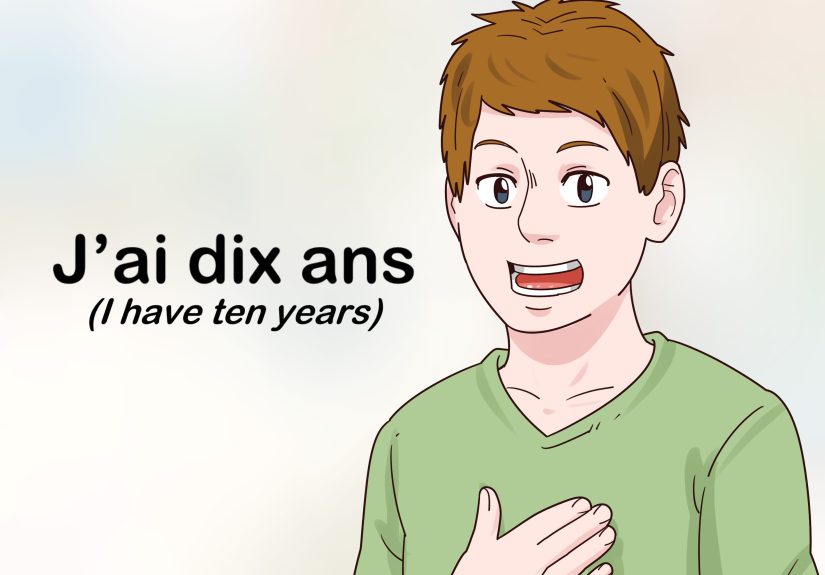
- neuf + ans → “nuh-vahn”
This is the quickest path to sounding natural when you use French numbers in real sentences.
Way #3: Count with Your Hands and Your Life (Fingers + Micro-Scenes)
If Way #1 is “know it” and Way #2 is “sound like it,” Way #3 is “own it.”
You’ll anchor French numbers 1–10 to movement and situationsbecause your brain loves meaning more than it loves memorizing lists.
Use French-style finger counting (thumb-first)
In the U.S., many people start counting on fingers with the index finger.
In France (and several other European cultures), it’s common to start with the thumb as “one.”
Learning this gives you a memory hook and helps you understand gestures in conversation.
- 1 = thumb
- 2 = thumb + index
- 3 = thumb + index + middle
- 4 = add ring
- 5 = add pinky
- 6–10 = continue on the other hand
Practice: say each number while showing it. Your hands become flashcards you can’t accidentally leave at home. Convenient.
Micro-scenes: the fastest way to make numbers “stick”
Here are bite-size scenarios where you’ll actually use numbersperfect for beginners learning how to count to ten in French.
Scene 1: The bakery order
You: J’en prends deux, s’il vous plaît. (I’ll take two, please.)
Upgrade: swap the numbertrois, quatre, cinqand repeat.
Scene 2: Telling time (the 1–10 version)
Il est huit heures. (It’s eight o’clock.)
Il est dix heures. (It’s ten o’clock.)
Even if you can’t say “eleven” yet, you can still sound like someone with places to be.
Scene 3: Elevator confidence
If someone asks which floor: Le quatrième. (The fourth.)
Or just point at the button and say: Quatre. (Four.)
Minimal vocabulary, maximum success.
A silly mnemonic chain (because your brain loves weird)
Create vivid images for each number. Example chain:
- un → a one-eyed unicorn (“uh(n)-icorn”)
- deux → a duo doing a synchronized dance
- trois → a tiny troy castle yelling “twah!”
- quatre → a cat with four tiny hats (“kat-ruh”)
- cinq → a sink that says “sank” when you turn it on
- six → a seal doing a “sees” pose
- sept → a set of seven spoons (“set”)
- huit → wheat falling like confetti (“weet”)
- neuf → “nuhf” sounds like “enough!” (when you’ve had enough homework)
- dix → “dees” like a DJ saying “these are my top ten”
Are these images ridiculous? Yes. Will you remember them? Also yes. That’s the deal.
Common Mistakes When Learning to Count to Ten in French
Mistake 1: Pronouncing every last letter
French spelling is not a pronunciation transcript. When in doubt, listen-and-repeat patterns beat “reading the letters.”
(If French were perfectly phonetic, it would lose at least 30% of its mystery, and nobody wants that.)
Mistake 2: Ignoring the context changes (six/dix/trois/neuf)
If you only learn “sees” for six and “dees” for dix, you’ll still be understood.
But if you want that smooth, confident sound, practice the vowel-link versions too.
Mistake 3: Practicing only in order
Real life doesn’t ask numbers in a neat row. Mix it up:
9 → 2 → 7 → 10 → 4. If you can do that, you genuinely know the set.
Conclusion: Pick Your Favorite Method (or Use All Three)
The fastest way to master counting to ten in French is to combine:
(1) a clean memorized base, (2) the “native” rhythm with liaisons, and (3) a real-world hook like finger counting and micro-scenes.
Do a little every day: one minute of the list, one minute of the liaison drill, and one minute of real-life sentences.
In a week, you’ll be surprised how quickly French numbers 1–10 stop feeling like a quiz and start feeling like a tool.
Extra: of Real-World Practice Experiences (So You Don’t Freeze at “Deux”)
Most people don’t forget how to count to ten in French because the numbers are “hard.” They forget because they only practiced in a quiet moment,
and real life is rarely quiet. The good news: you can rehearse realistic moments before they happenkind of like a movie montage,
except you’re the main character and the soundtrack is you whispering “huit… neuf… dix” in the cereal aisle.
Imagine you’re traveling and you step into a bakery. The smell is unfairly good. The line is moving fast. The person behind the counter smiles and says something,
and suddenly your brain becomes a Windows update. This is where the micro-scene method shines: you’ve already practiced “J’en prends deux, s’il vous plaît.”
You don’t need a perfect accentyou need a number that comes out without negotiation. If you can reliably produce deux, you can walk out with two croissants
and the confidence of someone who absolutely didn’t panic internally.
Another common experience: paying for something small. A cashier says a price with a number you know, and you want to confirm you heard it correctly.
You can keep it simple: Neuf? (Nine?) with a questioning tone. French speakers do this all the timerepeating the key number as confirmation.
It’s a tiny conversational move that saves you from accidental overpaying and makes you sound engaged rather than lost.
Then there’s the “phone number moment,” where your listener expects you to say digits clearly, not poetically. Even if you only know 0–10 right now,
you can practice clarity by speaking each number cleanly, with small pauses. This also trains your mouth for the tricky onestrois, cinq, neuf.
People often discover that the real challenge isn’t remembering the numberit’s producing it under mild pressure while making eye contact like a functional adult.
Practice helps. So does pretending you’re announcing lottery numbers on live TV.
Finally, try “environmental counting” at home: count ten steps while walking, count ten sips of water, count ten push-ups (or ten stretches, no judgment),
count ten items while unloading groceries. Each time you attach French numbers to a physical action, you create a stronger memory trace.
It’s the difference between recognizing a word on paper and being able to use it when your hands are full and your brain is busy.
If you want a simple weekly challenge, do this: Day 1–2, master the list. Day 3–4, add the vowel-link drill for trois/six/dix/neuf.
Day 5–7, act out one micro-scene per day (bakery, time, elevator). You’ll stop “knowing the numbers” and start having themready on demand,
like a tiny French superpower that fits in your pocket.