Table of Contents >> Show >> Hide
- What Is the Clutter-Free Countdown?
- Before You Start: The 5 Rules That Make This Decluttering Plan Easy
- The 7-Day Clutter-Free Countdown
- Day 7: Start With the Visual Noise
- Day 6: Tackle the Bathroom and Linen Closet
- Day 5: Declutter the Kitchen Hotspots
- Day 4: Clean Up the Bedroom and Closet
- Day 3: Reset the Living Room and Paper Piles
- Day 2: Hit the Entryway, Laundry Area, and Hidden Trouble Spots
- Day 1: Do the Whole-House Lightness Sweep
- How to Keep the Clutter From Sneaking Back
- Why This Decluttering Method Works So Well
- Common Decluttering Mistakes to Avoid
- A 500-Word Look at the Real Experience of the Clutter-Free Countdown
- Conclusion
- SEO Tags
If your house feels a little too “lived in” and a little not enough “I can find the scissors without entering a side quest,” you are very much not alone. Most homes do not become cluttered in one dramatic afternoon. They get that way the slow, sneaky way: one unopened mail stack, three too-many water bottles, a mystery charger collection that could probably power a small moon mission, and a chair in the bedroom that has quietly become a full-time clothing employee.
The good news is that you do not need an all-weekend purge, a label maker addiction, or the emotional stamina of a game show contestant to fix it. What you need is a realistic decluttering plan that feels doable on a regular Tuesday. That is where the Clutter-Free Countdown comes in.
This easy decluttering plan is built around short, focused sessions that move from the most visible clutter to the sneakiest mess zones. Instead of trying to organize your entire life before lunch, you work through your home in a countdown format. Each day has a clear mission, a short checklist, and a finish line you can actually see. The result is a clutter-free home that feels calmer, works better, and stops fighting you every time you open a drawer.
Think of it as room-by-room decluttering without the drama. No perfection. No fake “minimalist museum” energy. Just practical progress that makes your whole house feel lighter.
What Is the Clutter-Free Countdown?
The Clutter-Free Countdown is a simple declutter home method that combines three ideas that organizing experts recommend again and again: start small, make fast decisions, and focus on function over perfection. Instead of asking yourself to tackle everything at once, you count down through your home in manageable stages.
Here is the basic idea: you spend seven days decluttering, and each day targets one category of chaos. You begin with the easiest wins, like visible surfaces and “drop zones,” then move toward rooms that tend to collect more emotional or decision-heavy clutter, such as bedrooms, closets, and storage areas. By the final day, your home looks better, flows better, and feels noticeably less heavy.
It works because momentum matters. When you clear one shelf, one counter, or one basket and see the payoff immediately, your brain stops viewing decluttering as punishment and starts seeing it as relief. That tiny shift is huge.
Before You Start: The 5 Rules That Make This Decluttering Plan Easy
1. Use a timer
Set a timer for 15 to 30 minutes. That is long enough to make progress and short enough that your brain cannot stage a rebellion. If you feel like continuing, great. If not, you still did the job.
2. Use four containers
Grab four bins, bags, or boxes labeled: Keep, Donate, Trash, and Relocate. This keeps you from creating ten tiny piles that somehow become tomorrow’s clutter.
3. Ask three quick questions
For each item, ask: Do I use it? Do I like it? Would I buy it again today? If the answer is no, it may be time to let it go.
4. Finish the space, not the fantasy
You are not auditioning for a home magazine spread. You are building a house that functions better for your real life. Organized enough to work beats beautiful but impossible every single time.
5. Remove donations fast
Do not let your “donate” bag become a long-term resident of the hallway. Schedule a drop-off, put the bag in your car, or arrange a pickup. Clutter with good intentions is still clutter.
The 7-Day Clutter-Free Countdown
Day 7: Start With the Visual Noise
Your first mission is simple: clear the spots your eyes trip over every day. Think kitchen counters, coffee tables, bathroom counters, nightstands, dining tables, and the top of the dresser that currently looks like an evidence board.
Visual clutter makes a home feel busier than it is. Clearing these surfaces gives you an instant win, and that matters. Keep only what belongs there and earns the space. A tray for daily essentials? Sure. Twelve random receipts, a dried pen, and a candle with no wick? Not so much.
Quick example: On a kitchen counter, keep the coffee maker, fruit bowl, and maybe one utensil crock. Relocate the mail, extra mugs, coupon pile, and mystery charger that definitely does not belong next to the toaster.
Day 6: Tackle the Bathroom and Linen Closet
Bathrooms are one of the easiest places to declutter because expired, empty, and duplicate items are everywhere. Toss old makeup, dried-up nail polish, hotel lotions you will never use, and half-empty products you actively dislike but keep out of guilt.
In the linen closet, keep what fits your household. You do not need seventeen towels for three people unless your family runs a water park out of the guest room. Match sets, fold what you actually use, and donate the extras in good condition.
Decluttering tip: Store backstock together in one labeled bin. When everything has a home, you stop buying your fourth bottle of body wash because you forgot you already had three.
Day 5: Declutter the Kitchen Hotspots
The kitchen is where useful items and weirdly emotional items like to mingle. This is how you end up keeping a chipped mug from 2014 and three avocado slicers, despite not particularly trusting avocados.
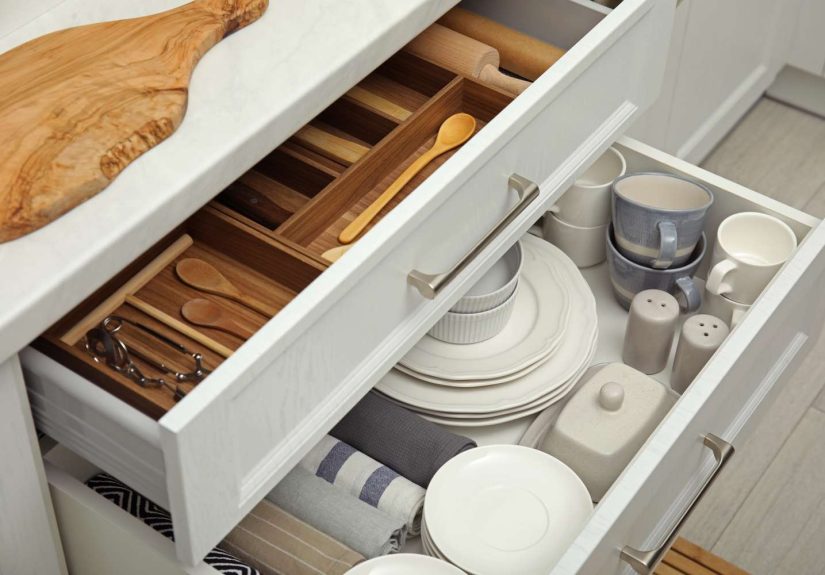
Focus on the biggest clutter magnets: the junk drawer, food storage containers, pantry snacks, water bottles, travel cups, and duplicate utensils. Match containers with lids. Recycle cracked plastic. Toss expired food. Donate small appliances you never use.
Rule of thumb: Keep the tools that support the way you cook now, not the version of you who was definitely going to start making homemade pasta every Sunday.
Day 4: Clean Up the Bedroom and Closet
If you want your whole house to feel lighter, your bedroom matters more than people think. A crowded bedroom can make the day feel unfinished, even when you are technically off the clock.
Start with the obvious: clothes on chairs, shoes on the floor, and items that wandered in from other rooms. Then move to your closet. Remove anything that does not fit, does not feel good, is damaged beyond repair, or belongs to a different version of your life.
That “I might wear this someday” category is where clutter likes to rent a penthouse. Be honest. If you have not worn it in a year and it does not serve a specific purpose, it may be taking up prime real estate for no reason.
Easy closet trick: Group by category first: jeans, tees, workwear, activewear, outerwear. Categories reveal duplicates fast. It is harder to pretend you need eight nearly identical black sweaters when they are all hanging together like a choir.
Day 3: Reset the Living Room and Paper Piles
The living room should feel like a place to relax, not a storage unit with throw pillows. Remove anything that belongs elsewhere, especially paperwork, kids’ items, shopping bags, and electronics accessories.
Then deal with paper clutter. Sort it into four categories: Action, File, Recycle, and Shred. Most paper mess grows because nothing has a destination. Once it does, the mountain shrinks fast.
Example: A bill that needs payment goes into Action. Tax records go into File. Grocery flyers go into Recycle. Old statements with personal details go into Shred. Congratulations, your coffee table is no longer a low-budget office.
Day 2: Hit the Entryway, Laundry Area, and Hidden Trouble Spots
Now it is time for the sneaky zones: the entry table, shoe pile, laundry room shelves, mudroom hooks, under-stair storage, and that cabinet where all random objects go to lose their identity.
These spaces affect daily friction more than people realize. A chaotic entryway can make every morning feel rushed. A crowded laundry area turns one basic chore into a mood. Declutter what you use first, then create simple limits. One basket for hats and gloves. One tray for keys and sunglasses. One hook per person for daily outerwear.
This is where systems matter: If a space collects clutter every day, it needs less stuff and better containment, not prettier bins alone.
Day 1: Do the Whole-House Lightness Sweep
On the final day, take a bag and walk through your home for a 20-minute sweep. Look for leftover items that now stand out because the rest of the house is calmer. This is the fun part. Once the major clutter is gone, the random leftovers become easier to spot.
Check floors, stairs, hallways, doorways, and corners. Remove anything blocking movement or making the space feel crowded. Replace full donation bags. Return relocate items to their actual homes. Wipe down the cleared surfaces. Suddenly, your house does not just look less cluttered. It feels easier to live in.
How to Keep the Clutter From Sneaking Back
Create one daily reset
Pick one five- to ten-minute reset at the same time each day. Maybe it is after dinner. Maybe it is before bed. Put things away, clear the counters, and reset the entryway. Small resets prevent giant catch-up sessions.
Use the one-in, one-out rule
New sweater in, old sweater out. New mug in, old mug out. This rule is not about being strict. It is about preventing your storage from silently becoming overbooked.
Give your frequent clutter a landing zone
Mail needs a tray. Keys need a hook. Reusable bags need a basket. The less often you ask yourself “Where should this go?” the less likely your stuff is to settle on the nearest flat surface forever.
Stop organizing things you do not need
This might be the most important home organization tip of all. Fancy storage cannot rescue excess. If you own too much for the space, your real problem is volume, not baskets.
Why This Decluttering Method Works So Well
The Clutter-Free Countdown works because it lowers resistance. It does not demand an extreme makeover or a perfect personality transplant. It asks for short decisions, visible wins, and repeatable habits. That is exactly why it feels realistic.
It also respects how people actually live. Families have backpacks. Remote workers have cords and papers. Small apartments have limited storage. Busy households need systems that are easy to maintain, not routines so complicated they collapse by Thursday.
Most of all, this method helps you separate useful belongings from background noise. Once your space has less visual overload, it becomes easier to cook, clean, rest, host, and find what you need without muttering under your breath. That is the real goal of a decluttering checklist: not emptiness, but ease.
Common Decluttering Mistakes to Avoid
Starting with sentimental items
Do not begin with baby keepsakes, inherited china, or the prom ticket stub you have preserved like a museum artifact. Start with low-emotion zones first so you can build confidence.
Buying storage before you declutter
Storage products are fun. Very fun. Dangerously fun. But if you buy containers before you reduce the volume, you may just end up organizing clutter more attractively.
Making “maybe” piles too big
A tiny maybe pile is normal. A maybe pile large enough to apply for its own zip code is not. Set a limit. Revisit it once, then decide.
Trying to do the whole house in one shot
That usually leads to exhaustion, second-guessing, and eating crackers over a pile of half-sorted socks. The countdown method is better because it gives every session a clear boundary.
A 500-Word Look at the Real Experience of the Clutter-Free Countdown
The most interesting thing about a decluttering plan is that the biggest changes are often not dramatic at all. They are quiet. They show up in everyday moments. The first sign the Clutter-Free Countdown is working is usually not that your house suddenly looks like a catalog. It is that your morning feels less annoying.
You walk into the kitchen and the counter is open enough to make coffee without first moving three unrelated objects. You get dressed without digging through a chair mountain. You find your keys where your keys are supposed to be, which feels embarrassingly luxurious for something so ordinary. Your house starts cooperating with you instead of negotiating.
Many people also notice that clutter has been costing them energy in ways they never fully counted. A messy entryway can make leaving the house feel stressful. A jammed junk drawer can turn one simple task into a mini irritation. A crowded bedroom can make it harder to wind down at night because the room still looks like a to-do list. Once those areas are lighter, daily routines become smoother in a way that feels almost out of proportion to the amount of stuff removed.
There is also a strong emotional shift that happens during the countdown. At first, you may feel resistance. Every item seems to ask for a tiny courtroom trial: What if I need this? What if I regret it? What if this one tangled cord is somehow the chosen cord? But after a few sessions, your decision-making gets faster. You start trusting yourself. You stop treating every object like it has a legal team.
Another common experience is that decluttering makes your home feel larger without adding a single square foot. That is because space is not only about size. It is about function, movement, and visual rest. A room with fewer unnecessary items is easier to clean, easier to maintain, and easier to enjoy. Even a small apartment can feel more open when surfaces are clear, walkways are free, and storage is not packed with things you forgot you owned.
People are often surprised by how motivating the final sweep feels, too. By the last day, you notice leftover clutter much faster because the background noise is gone. One extra bag on the floor, one pile of paper, or one overloaded shelf suddenly stands out. That awareness is useful. It means your home has crossed the line from chaotic to manageable.
Perhaps the best part of the experience is that decluttering stops feeling like a punishment and starts feeling like maintenance. You realize you do not need a giant seasonal meltdown every time your house gets off track. You just need a simple reset, a few solid habits, and less stuff competing for your attention. That is the real magic of the Clutter-Free Countdown. It does not just help you clean up your house. It helps your home feel easier to live in every single day.
Conclusion
If you have been waiting for the perfect weekend, the perfect mood, or the perfect organizing playlist to start decluttering, consider this your sign to stop waiting. The Clutter-Free Countdown works because it is practical, flexible, and refreshingly low-drama. Start with one timer, one bag, and one small space. Then keep counting down.
By the end of the week, your home may not be flawless, but it will almost certainly feel calmer, clearer, and easier to manage. And honestly, that is better than flawless. Flawless is exhausting. Lighter is sustainable.