Table of Contents >> Show >> Hide
- Why America Needed a Giant Disguise
- The Man Behind the Magic: Colonel John F. Ohmer Jr.
- Hollywood Joins the Army
- Boeing Plant 2: The Crown Jewel of the Cover-Up
- Engineering a Fake Town in the Sky
- Lockheed, Douglas, and the Wider Camouflage Network
- Did the Greatest Army Cover-Up Actually Work?
- Why This WWII Engineering Marvel Still Matters
- The Human Side Beneath the Fake Streets
- Experiences Related to the Topic: Seeing the Cover-Up Through Modern Eyes
- Conclusion
During World War II, America pulled off a cover-up so large, so strange, and so brilliantly practical that it sounds like a rejected movie pitch: hide an aircraft factory by building a fake neighborhood on top of it. Not a sign. Not a tarp tossed over a roof like a picnic blanket. An entire pretend towncomplete with streets, houses, trees, lawns, sidewalks, cars, garages, and even tiny neighborhood detailswas constructed above one of the most important bomber plants in the United States.
The project was part military defense, part stagecraft, part engineering stunt, and part national panic attack after Pearl Harbor. The most famous example was Boeing Plant 2 in Seattle, where thousands of workers built B-17 Flying Fortress bombers under a rooftop suburb nicknamed “Boeing Wonderland.” From the ground, it looked like an absurd theater set. From the air, where enemy pilots or reconnaissance cameras might be watching, it was designed to look like ordinary American suburbia. In other words, the U.S. Army tried to make a massive war machine vanish by giving it a lawn.
And here is the wild part: the idea was not as silly as it sounds. It was an elegant answer to a terrifying problem. Aircraft factories were huge, visually distinctive, and strategically priceless. If an enemy attack damaged one major plant, bomber production could slow dramatically. In the industrial mathematics of WWII, losing a factory meant losing time, aircraft, crews, missions, and possibly lives. So the Army Corps of Engineers, Hollywood designers, architects, artists, carpenters, and camouflage specialists joined forces to create one of the most fascinating deceptions of the war.
Why America Needed a Giant Disguise
After Japan attacked Pearl Harbor on December 7, 1941, the American West Coast felt suddenly exposed. Cities from San Diego to Seattle feared submarine attacks, air raids, sabotage, and reconnaissance flights. Some fears were exaggerated; others were rooted in real wartime uncertainty. Japanese submarines did operate off the Pacific Coast, and the Aleutian Islands campaign in Alaska made the threat feel close enough to rattle nerves.
At the center of that anxiety stood the aircraft industry. Southern California and the Pacific Northwest were loaded with critical facilities: Lockheed in Burbank, Douglas in Santa Monica and Long Beach, North American Aviation in Inglewood, Northrop in Hawthorne, Boeing in Seattle, and many others. These were not ordinary factories producing kitchen utensils and lunch boxes. They were building fighters, bombers, transports, and parts that fed the Allied air war.
Boeing Plant 2 was especially valuable. Located along the Duwamish River near Boeing Field, the plant helped produce the B-17 Flying Fortress, one of the iconic heavy bombers of the war. At peak wartime production, Boeing’s output climbed to hundreds of aircraft per month. The National WWII Museum notes that Boeing and its wartime partners produced nearly 99,000 aircraft during World War II, representing a major share of America’s total aircraft production. That kind of industrial power was exactly what the Axis wanted to disrupt.
The Man Behind the Magic: Colonel John F. Ohmer Jr.
The great camouflage campaign owed much to Colonel John F. Ohmer Jr., an Army engineer with an unusual combination of skills. Ohmer understood military engineering, but he also had interests in photography, illusion, and magic. That mattered because camouflage was not simply a matter of painting things green and hoping for the best. It required understanding how the eye sees, how cameras flatten images, how shadows reveal shapes, and how a pilot under pressure identifies a target.
Ohmer had studied camouflage before the United States fully entered the war. He was impressed by British efforts during the Battle of Britain, where deception and visual disruption helped protect airfields and military infrastructure. Before Pearl Harbor, his ideas often seemed too expensive or too theatrical. After Pearl Harbor, “too theatrical” suddenly became “please begin immediately.”
His solution was visual misinformation. Instead of merely hiding buildings, he wanted to change what they appeared to be. A runway could become a field. A roof could become a neighborhood. A parking lot could become farmland. A factory could become a sleepy suburb where absolutely no one was secretly manufacturing bombers below the begonias.
Hollywood Joins the Army
Ohmer’s greatest advantage was geography. He was working near Hollywood, the world capital of convincing fake places. If anyone knew how to turn plywood, paint, wire, canvas, and imagination into a believable environment, it was the movie industry.
Studios supplied set designers, art directors, scenic painters, carpenters, prop makers, landscape artists, lighting experts, and other specialists. These were people who could build ancient Rome before lunch and a moonlit Paris street before dinner. Now their audience was not a theater full of moviegoers. It was a hypothetical enemy pilot flying thousands of feet above a target.
The Army used Hollywood talent to disguise major facilities across California, Oregon, and Washington. Lockheed’s Burbank plant, for example, became a showcase of “Operation Camouflage.” The factory and airfield were covered with netting, canvas, fake trees, painted streets, false houses, and carefully arranged details meant to resemble a peaceful semi-rural neighborhood. Runways and parking areas were painted green to resemble fields. Rubber cars, fake shrubs, and clotheslines helped create the illusion of daily life. Imagine a bomber pilot squinting down and seeing not a military target, but Aunt Mildred’s suspiciously flat subdivision.
Boeing Plant 2: The Crown Jewel of the Cover-Up
The most spectacular version of this wartime illusion was Boeing Plant 2 in Seattle. In 1942, the Army Corps of Engineers brought in John Stewart Detlie, a Hollywood art director and architect who had worked at MGM and had been nominated for an Academy Award. Detlie’s job was wonderfully strange: make a giant aircraft factory disappear.
Plant 2 was not a polite little building that could hide behind a shrub. It covered a huge industrial footprint, operated around the clock, and employed tens of thousands of workers. Its roofline, airfield, ramps, and surrounding infrastructure made it easy to identify from above. That meant the camouflage had to extend beyond a simple cover. The fake roofscape needed to blend with the real neighborhoods, roads, hillsides, and field patterns around it.
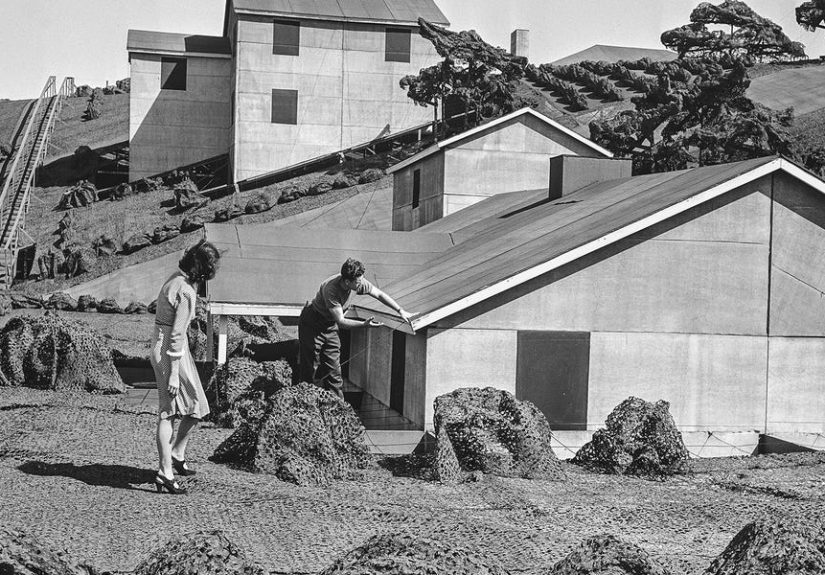
The result became known as Boeing Wonderland, a 26-acre artificial town built on top of the plant. The project used enormous amounts of material: lumber, steel supports, wire, chicken wire, burlap, canvas, paint, and support cables. Boeing’s archival records describe a make-believe village with painted canvas cottages, wire-and-feather trees, green burlap lawns, dummy streets, and artificial structures. It was less “camouflage net” and more “subdivision assembled by people who had definitely skipped normal neighborhood zoning.”
Engineering a Fake Town in the Sky
The engineering challenge was serious. Boeing Plant 2 had a sawtooth roof, meaning it was uneven and full of height changes. To create a convincing town from the air, crews had to build platforms, scaffolding, support wires, and cable systems that could create the illusion of a continuous landscape. The fake neighborhood could not collapse into the factory below. It also could not block essential operations, create uncontrollable fire hazards, or interfere with defense installations.
The builders used wooden framing and steel structures to support the artificial landscape. Streets were laid out as if they connected naturally with surrounding roads. Some of the fake roads continued visually across Boeing Field and toward nearby slopes, helping the illusion stretch beyond the factory roof. From above, the fake grid softened the plant’s industrial outline and made the whole area look less like a target and more like a quiet neighborhood where nothing dramatic was happening, except perhaps a very committed homeowners association.
The houses were usually not full-size. They did not need to be. The deception was designed for aerial viewing, where perspective compresses height and detail. A small house, properly painted and positioned, could appear convincing from thousands of feet up. Fake cars could be only a couple of feet high. Trees could be made from chicken wire and feathers. Lawns could be burlap. The point was not to fool someone standing nearby. The point was to fool a camera, a map reader, or a bombardier for the few critical seconds when recognition mattered.
Why Chicken Feathers Became Military Technology
One of the funniest and most oddly brilliant details was the use of chicken feathers to simulate foliage. Artists coated wire frameworks with adhesive or tar, attached feathers, and painted them in greens and browns. From the ground, this might have looked like a craft project staged by a deeply patriotic farmer. From the air, however, the texture helped break up flat surfaces and suggested trees, shrubs, and vegetation.
The technique was clever, but not glamorous. Painted feathers could smell terrible when wet. In warm weather, sticky bits could drift around and attach themselves to newly built aircraft. This is the kind of detail that makes wartime engineering feel wonderfully human. The grand strategy was “defend America’s aircraft production.” The daily reality was “why does this fake tree smell like a barnyard wearing paint?”
Lockheed, Douglas, and the Wider Camouflage Network
Boeing Wonderland was not alone. Lockheed’s Burbank facility became another legendary example of WWII camouflage. Its huge plant and airfield were transformed into a disguised landscape with netting, painted canvas, fake buildings, rubber cars, artificial trees, and altered runways. The goal was to make a vital aircraft manufacturing complex look like harmless countryside and residential space.
Douglas Aircraft facilities in Southern California also received elaborate disguises. Some projects used painted runways, false neighborhoods, and carefully designed patterns that connected visually with nearby real streets. These camouflage efforts were part of a larger defensive program across the West Coast. Some sites received simpler “tone-downs,” using paint and netting to blur outlines. Others received full theatrical treatment, complete with prop towns and false terrain.
This approach reveals a key truth about WWII innovation: victory depended not only on tanks, ships, and planes, but also on imagination. The same country that mass-produced bombers also mass-produced illusions. The assembly line and the movie set briefly became partners. Rosie the Riveter worked below; Hollywood’s scenic magicians worked above.
Did the Greatest Army Cover-Up Actually Work?
The simplest answer is that no major Japanese air raid struck Boeing Plant 2, Lockheed Burbank, or the other disguised West Coast aircraft factories. That does not prove camouflage alone saved them. The logistical difficulty of launching sustained air attacks against the continental United States was enormous. Japan had submarines and long-range capabilities in limited forms, but it did not have a practical way to mount a Pearl Harbor-style carrier raid on Seattle or Los Angeles after the early phase of the Pacific War.
Still, judging the project only by whether bombs fell misses the point. The camouflage reduced risk at a time when uncertainty was high. It also protected morale. Thousands of workers entered these plants every day knowing they were part of the enemy’s dream target list. A visible defense effort mattered. It told workers, managers, and city residents that the government understood the danger and was acting creatively to reduce it.
The camouflage also had value as a deception system. If reconnaissance photographs had been taken, the fake roads, roofs, trees, and neighborhoods could have complicated target identification. Even a short delay in recognition could help defenders. Military camouflage does not always need to be perfect. Sometimes it only needs to create doubt, waste time, or make the attacker choose the wrong aiming point.
Why This WWII Engineering Marvel Still Matters
The Boeing Plant 2 camouflage project remains fascinating because it sits at the intersection of engineering, psychology, art, and industrial warfare. It was not merely a big costume draped over a building. It was a designed environment built around how aerial observation works. It considered scale, shadow, texture, perspective, color, movement, and context.
Modern camouflage and deception still rely on the same basic principle: do not just hide the object; control the story the observer thinks they are seeing. During WWII, that story was “ordinary neighborhood.” Today, deception might involve electronic signals, satellite imagery, decoys, heat signatures, radar profiles, or digital misinformation. The tools have changed, but the logic is familiar. Make the enemy hesitate. Make the obvious look ordinary. Make the target disappear into the background.
There is also a cultural lesson. The greatest army cover-up of WWII was successful because it ignored the wall between “serious” military expertise and “creative” civilian talent. Engineers needed artists. Soldiers needed set painters. Architects needed prop makers. The Army needed Hollywood. In a crisis, unusual collaborations can produce unusually effective solutions.
The Human Side Beneath the Fake Streets
Under the artificial lawns and miniature houses, real workers built real aircraft in exhausting conditions. Riveters, machinists, inspectors, engineers, clerks, guards, and supervisors kept production moving through long shifts. Many were women entering industrial jobs in historic numbers. They were not living in a movie. They were working in a noisy, high-pressure factory while the world was at war.
That contrast gives Boeing Wonderland its emotional power. Above: a fake calm world of tiny houses and pretend trees. Below: the thunder of production, metalwork, urgency, and national mobilization. The roof said “quiet suburb.” The factory floor said “global war.” Few images capture the Home Front better than that layered reality.
The project was also an open secret. Many local people knew something strange was happening, and workers obviously understood they were laboring beneath a disguise. But wartime censorship and the culture of “loose lips sink ships” kept the story out of broad public discussion until late in the war. When the public finally saw photographs, the reaction was amazement. The Army had not just covered a factory. It had built a sky-facing fiction.
Experiences Related to the Topic: Seeing the Cover-Up Through Modern Eyes
One of the most powerful ways to experience the story of Boeing Wonderland is to look at archival aerial photographs and then pause for a moment before judging them. At first glance, the images can seem almost cute: little houses, tiny streets, fake lawns, and toy-like cars perched on a roof. It is easy to smile. The whole thing has the energy of a model train layout designed by someone with access to military funding.
But the longer you look, the more serious it becomes. The fake neighborhood was not built for entertainment. It was built because people believed an air raid might come. The illusion was designed for a world where factories were targets and workers were part of the battle. That shift changes the experience. What first appears whimsical becomes a physical expression of fear, urgency, and ingenuity.
Imagine being a Boeing worker in 1943, walking into Plant 2 before dawn. Outside, the city is under wartime restrictions. Inside, the factory is alive with noise: drills, rivet guns, engines, shouted instructions, carts moving parts, and aircraft frames inching toward completion. Somewhere above your head is a fake neighborhood that exists to keep you alive and keep production moving. You might joke about it with coworkers. You might call it ridiculous. But you would also understand why it was there.
There is an oddly comforting quality to that thought. The workers below were not passive targets. Their government, engineers, and civilian artists had built a shieldnot an invisible force field, but a practical illusion. It said, “We cannot remove the danger, but we can make the target harder to find.” In wartime, that may have been enough to steady nerves.
For modern readers, the experience also raises questions about what counts as engineering. Many people think engineering is only bridges, engines, circuits, or skyscrapers. Boeing Wonderland reminds us that engineering can also mean solving a perception problem with materials, geometry, and human behavior. The fake suburb had to stand up physically, read correctly visually, resist weather, avoid fire, and coexist with an operating aircraft plant. That is not decoration. That is applied problem-solving with a theatrical grin.
The story also makes museum visits and historical photo collections feel more alive. When you see a B-17 Flying Fortress today, polished and preserved, it is easy to focus on the aircraft alone. But every bomber came from a network of people, places, machines, and risks. Behind the aircraft was a factory. Above the factory was a fake town. Around the fake town was a nervous city. Behind the nervous city was a country learning how to turn fear into production.
That is why this cover-up still captures attention. It is not just a military curiosity. It is a reminder that humans become brilliantly strange under pressure. Give them a crisis, and they may answer with steel, strategy, and, apparently, chicken-feather trees. The greatest army cover-up of WWII was a marvel of engineering because it understood something timeless: sometimes the best way to protect reality is to build a convincing illusion on top of it.
Conclusion
The greatest army cover-up of WWII was not hidden in a filing cabinet or buried in a classified memo. It stood in plain sight, spread across rooftops and airfields, disguised as peaceful American life. Boeing Wonderland and similar Operation Camouflage projects turned aircraft factories into fake neighborhoods, using engineering, Hollywood illusion, and military urgency to protect the industrial heart of the war effort.
These projects were funny in their details, serious in their purpose, and brilliant in their execution. They remind us that WWII was fought not only by soldiers overseas, but also by workers, designers, engineers, artists, and ordinary citizens at home. Their battlefield included factory floors, drafting tables, paint shops, and rooftops covered in pretend lawns. In the end, the fake town above Boeing Plant 2 tells a very real story: when survival depends on production, even a rooftop suburb made of burlap, plywood, wire, and feathers can become a weapon.
Note: This article is based on verified historical information about Boeing Plant 2, Operation Camouflage, Lockheed Burbank, the U.S. Army Corps of Engineers, and WWII aircraft production. It has been fully rewritten for original web publication and contains no source-link markup or citation placeholders.