Table of Contents >> Show >> Hide
- What Made Mr. Holmes Bakehouse a Viral San Francisco Bakery?
- The Interior: Designed Like a Photoshoot Set
- A Short Timeline of Mr. Holmes Bakehouse’s Rise and Drama
- Why Mr. Holmes Was So Perfect for the Instagram Age
- What the Mr. Holmes Story Teaches Modern Bakeries
- Conclusion: A Legendary SF Bakery, Frozen in the Camera Roll
- Experience Section: What It Felt Like to Visit Mr. Holmes Bakehouse (and What That Says About Food Culture)
Mr. Holmes Bakehouse didn’t just sell pastries in San Franciscoit sold a moment in time. Picture mid-2010s SF: phones held high, lines wrapped around the block, and a bakery interior that looked like it had been designed by a graphic designer who moonlights as a set decorator for a stylish indie film. If you wanted a laminated-dough sugar rush and proof you were there, this was the place.
Remodelista framed Mr. Holmes Bakehouse as an “Instagram sensation,” and that description still lands because the shop understood a new rule of modern food culture: people eat with their eyes first, and their camera roll second. The bakery’s rise wasn’t an accidentit was a masterclass in product, branding, and space design working together like perfectly folded butter layers.
What Made Mr. Holmes Bakehouse a Viral San Francisco Bakery?
Plenty of bakeries make excellent croissants. Mr. Holmes made an event out of buying them. Its signature pastrythe cruffinbecame a social-media magnet, and the shop wrapped the whole experience in design choices that practically begged for a photo.
The Cruffin: A Croissant-Muffin Hybrid Built for Buzz
The cruffin is the bakery’s claim to internet fame: croissant dough baked in a muffin tin, then filled with flavored cream. It’s flaky, tall, dramatic, and (crucially) photogenic. It also has the kind of name that sounds like it was invented in a brainstorm session with a whiteboard and an espresso IV.
Part of the cruffin’s appeal is the contradiction it pulls off: it looks indulgent and chaotic, but it’s made with obsessive technique. Laminated dough is precision work. The fact that something so tidy in craft could look so wildly over-the-top in final form was a perfect match for the Instagram era.
Scarcity, Timing, and the Power of the Line
Mr. Holmes leaned into limited availability. It wasn’t just that items sold outit was that you were meant to feel the ticking clock of pastry destiny. People showed up early, because the “best stuff” (especially cruffins) didn’t wait for late risers.
That line wasn’t a problem to solve; it became part of the brand. A queue outside a bakery signals demand, quality, and hype. It also signals: “Something is happening here.” In the attention economy, that’s free advertisingrepeated daily.
The Interior: Designed Like a Photoshoot Set
Remodelista’s coverage zeroed in on what design people noticed immediately: Mr. Holmes looked curated. Not cozy-cottage curated. More like “minimal, graphic, and ready for a magazine spread” curated.
The Neon Sign That Became a Landmark
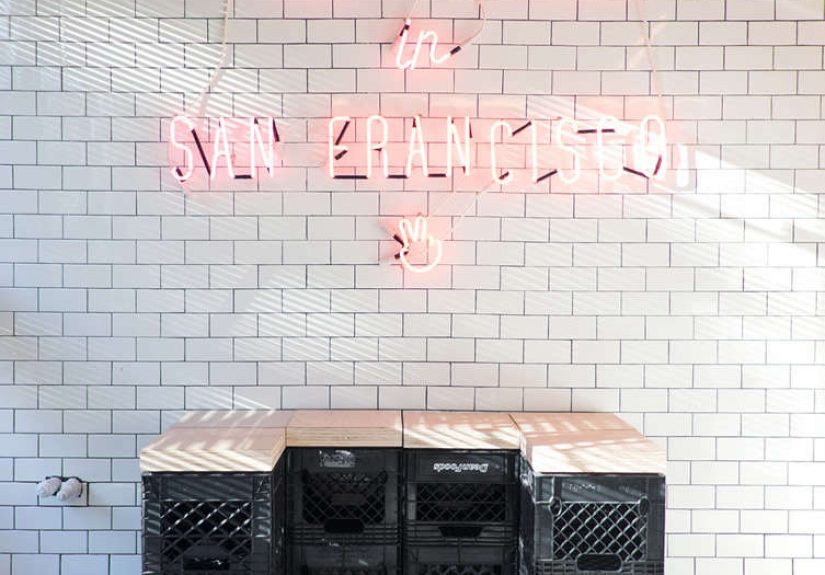
The shop’s neon slogan“I Got Baked in San Francisco”was more than a funny pun. It functioned like a selfie mural before “selfie mural” became a travel category. The line between advertising and décor disappeared: the sign was a brand asset, a photo backdrop, and a souvenirwithout you ever buying a postcard.
Tiles, Typography, and a Wink of Humor
Inside, the design language was deliberate: crisp tilework, bold graphic touches, and a sense that every surface had been considered. Remodelista noted ceramic tiles in multiple shapes and sizes and a floor message that read “Holmes Sweet Holmes.” It’s the kind of detail that makes people look downthen immediately look back up to take a picture.
“Sit Here, But Not Too Long” Seating
The lounging area was famously minimalmore “perch” than “linger.” There were plastic milk crates topped with wood seats, which are equal parts clever, slightly uncomfortable, and extremely on-brand. In other words: you could rest long enough to admire your pastry and snap a photo, but not so long that the shop turned into a coworking space with croissants.
Packaging That Looked Like a Gift
Mr. Holmes packaging became part of the obsession. Remodelista highlighted that the retro-mod look drew inspiration from the fictional Mendl’s Bakery in The Grand Budapest Hotel. That’s a telling choice: not “classic French bakery,” but “stylized, cinematic bakery you wish existed in real life.”
When your pastry box looks like it belongs in a movie, it doesn’t go straight into the trash. It goes onto your counter. Then into your Instagram story. Then into the world as a tiny traveling billboard.
A Short Timeline of Mr. Holmes Bakehouse’s Rise and Drama
2014: The Opening on Larkin Street
Mr. Holmes Bakehouse opened on Larkin Street in San Francisco and quickly became a “hot new bakery” in the neighborhoodpart of a wave of newer, design-aware food spots pushing into unexpected corners of the city.
2015: The Great Recipe Heist
Then came the story that sounds like it was written by a screenwriter with a pastry fixation: a thief reportedly broke in and stole recipe bindershundreds of recipeswhile leaving cash and equipment behind. If you’re going to commit a crime, at least have a brand strategy, right?
The whole episode amplified the mystique. It suggested the pastries were so valuable that someone risked legal consequences not for money, but for laminated-dough secrets. Even skeptics who rolled their eyes at food hype couldn’t ignore how bizarrely specific the theft was.
Founder Changes and the Mythology of Talent
Remodelista noted that two of the three founders departed: founding baker Ry Stephen and branding force Aron Tzimas. In the food world, founder shifts often change the story people tell themselves about a place. Is it still “the original vision” if the original creative minds move on?
Mr. Holmes kept pushing forward, and the brand remained strong enough that the cruffin stayed a symbol of the shop. But those departures became part of the legend: a reminder that viral success doesn’t always mean internal calm.
Expansion, Then the Pandemic-Era Cliff
The bakery expanded beyond SFat one point with outposts and franchise locations in other cities and countries. But later, the business faced serious disruption. By 2021, reporting described Chapter 7 bankruptcy and the permanent closure of the original Larkin Street location (and other operations). The story shifted from “Instagram darling” to a cautionary tale about growth, overhead, and what happens when real-world economics collide with the hype machine.
Why Mr. Holmes Was So Perfect for the Instagram Age
1) A Product With Instant Visual Identity
The cruffin is recognizable in a half-second scroll: tall spiral layers, sugar sparkle, cream filling. It reads as “special” even to someone who’s never heard of laminated dough. In the social era, that matters as much as flavor.
2) A Space That Turned Customers Into Marketers
Mr. Holmes didn’t need influencers as much as it needed customers with phones. The neon sign, the graphic branding, the packagingthese were built-in prompts for people to post. The shop didn’t just serve pastries; it served content.
3) Controlled Chaos: Limited Drops, Big Hype
Scarcity creates urgency. Urgency creates lines. Lines create credibility. Credibility creates more urgency. That loop powered Mr. Holmes for years. It also created a kind of “pastry lottery” feelinglike you were lucky if you scored the flavor you wanted.
4) The Blend of Old-World Technique and New-World Branding
At its core, Mr. Holmes was still a bakery doing serious work: mixing dough, proofing, laminating, baking, filling. But the shop wrapped that craft in modern design language and pop-culture savvy. It made classic technique feel new, not dusty.
What the Mr. Holmes Story Teaches Modern Bakeries
Even if you never plan to sell a croissant-muffin hybrid, there are lessons here for anyone building a food brand in 2025 and beyond:
- Make one signature item unmistakable. If people can’t describe what you’re known for, the internet will pick something for youand you may not like what it picks.
- Design your space like it will be photographed. Because it will be.
- Use humor strategically. A good pun can be marketing, personality, and memory all at once.
- Don’t confuse hype with resilience. Viral fame can spike demand, but it doesn’t automatically stabilize operations when the world changes.
Conclusion: A Legendary SF Bakery, Frozen in the Camera Roll
Mr. Holmes Bakehouse became an icon not just because it made craveable pastries, but because it understood the era it lived in. It didn’t fight social mediait baked for it. The cruffin, the neon, the tiles, the packaging: it all worked together to create a bakery that felt like a destination.
And while the business ultimately faced a harsh realityclosures and bankruptcythe cultural footprint remains. Mr. Holmes helped define a modern bakery blueprint: create a signature item, build a visual world around it, and let customers broadcast the experience. For better or worse, that’s what it means to be a bakery for the Instagram age.
Experience Section: What It Felt Like to Visit Mr. Holmes Bakehouse (and What That Says About Food Culture)
If you visited Mr. Holmes Bakehouse during its peak, the experience started before you even reached the door. You’d turn onto Larkin Street and notice the line firstpeople clutching coffee cups, checking phones, and doing that universal “I hope I’m not too late” glance at the front window. It felt less like running an errand and more like joining a small event that happened every morning, like a pastry pop-up that never bothered to call itself a pop-up.
The line had its own mood. Some people were there for the taste, genuinely; others were clearly there for the photo; most were there for both, because modern cravings are complicated. You could overhear quick negotiations: “We’ll split one,” “Get two flavors,” “No, we need the one with the cream that looks like a sunset.” In a normal bakery, that might sound ridiculous. At Mr. Holmes, it sounded perfectly rational, like discussing the setlist before a concert.
Then you’d step inside and feel the contrast: outside was noisy and chaotic; inside felt bright, graphic, and controlled. The design was doing its job. It made you slow down for half a secondthe way a well-designed store makes you notice the details even if you didn’t come to “notice design.” The tile, the typography, the clean surfaces: it all suggested precision, which primed your brain to assume the pastry was precise too. (Your taste buds were basically being marketed to by architecture.)
And yes, the neon sign worked like gravity. You might tell yourself you’re above it. You might even make a joke about it. But the truth is, you’d still look. And if you were with a friend, you’d still say, “Okay, finejust one picture.” The phrase “I Got Baked in San Francisco” wasn’t subtle, and that was the point. It gave you a line to repeat, a caption to use, a small piece of identity to borrow for a day. It’s hard to overstate how powerful that is in a city full of visitors and locals alike, all collecting proof of where they’ve been.
When you finally got the pastryespecially a cruffinyou understood why the object itself mattered. The layers were the first thing you saw. The sugar on the surface caught the light. The filling promised mess, but the neat swirl promised craft. The first bite did what great pastries do: it shattered. Flakes fell onto your clothes like edible confetti, and suddenly you were doing the awkward pastry danceleaning forward, trying not to drip cream, pretending this was dignified. It wasn’t dignified. It was delightful.
And that’s the bigger point: Mr. Holmes Bakehouse turned an ordinary act (buying breakfast) into a small performance. You waited, you photographed, you tasted, you posted. Even if you didn’t post, you experienced the place as if you might. That’s what the Instagram age really meansnot that everything becomes fake, but that everything becomes framed. Mr. Holmes framed pastries as trophies and the bakery as a backdrop, and people happily stepped into the picture.
Today, even with the SF shop closed, the influence lingers. You can walk into countless modern bakeries and see echoes: the signature item with a catchy name, the statement wall, the packaging designed like a gift, the limited-drop urgency. Mr. Holmes didn’t invent all of that, but it proved the formula at scale. And for anyone writing about food, design, or internet culture, it remains a delicious case study in how a bakery can become a brand, a destination, and a memeall at the same time.