Table of Contents >> Show >> Hide
- Why Nikon Small World 2020 Mattered
- The Top 20 Winners of Nikon Small World 2020
- 1st Place: Juvenile Zebrafish
- 2nd Place: Clownfish Embryonic Development
- 3rd Place: Freshwater Snail Tongue
- 4th Place: Soil Fungus Spores and Hyphae
- 5th Place: Bogong Moth
- 6th Place: Hebe Plant Anther With Pollen
- 7th Place: Microtubules Inside a Cell
- 8th Place: Chameleon Embryo
- 9th Place: Hippocampal Neuron Connections
- 10th Place: Daphnia magna
- 11th Place: Red Algae
- 12th Place: Human Hair
- 13th Place: Amino Acid Crystals
- 14th Place: Leaf Roller Weevil
- 15th Place: Asexually Reproducing Annelid
- 16th Place: Nylon Stockings
- 17th Place: Immature Water Boatman
- 18th Place: Atlas Moth Wing
- 19th Place: Marine Diatom Cell Wall
- 20th Place: Short-Tailed Fruit Bat Embryo Skeleton
- What the 2020 Winners Tell Us About Microscopic Photography
- Why the First-Place Zebrafish Deserved the Crown
- The Experience of Looking at Nikon Small World 2020
- Final Thoughts
If you ever needed proof that the universe has impeccable interior design at the microscopic level, Nikon Small World 2020 delivered it in neon, crystal, fur, scales, pollen, and the occasional gloriously dramatic worm. The famous photomicrography competition turned invisible subjects into gallery-worthy art once again, and the results were not merely pretty. They were scientific, weird, elegant, and occasionally the kind of beautiful that makes you whisper, “Wait, that’s a fish?”
The 2020 edition marked the 46th year of Nikon’s Small World competition, a long-running showcase for images made through the light microscope. That year’s contest drew more than 2,000 entries from 90 countries, and Nikon ultimately recognized 88 images across the Top 20, honorable mentions, and images of distinction. In other words, the judges had the enviable job of sifting through a mountain of tiny wonders and deciding which ones made the biggest impact.
Why Nikon Small World 2020 Mattered
What makes Nikon Small World such a standout photography competition is that it lives at the sweet spot between science and art. These are not images created just to be decorative, though many of them could absolutely get away with hanging in a minimalist living room next to a very expensive lamp. They are also records of structure, biology, chemistry, and development. A winning image can be visually dazzling while still helping researchers explain how organisms grow, how tissues connect, or how microscopic materials behave.
The 2020 winners captured that double identity perfectly. Some images looked like stained glass from another galaxy. Others resembled abstract paintings, textile designs, or alien architecture. But underneath the wow factor, the Top 20 revealed genuine biological stories: embryonic development, neural connections, fungal structures, insect anatomy, plant reproduction, and even evidence that helped expand what scientists knew about zebrafish lymphatic systems.
That last point is a big one. The first-place image did not win because it was merely colorful. It also supported research showing zebrafish have lymphatic vessels inside the skull, a finding with real value for brain-disease research. Nikon Small World loves a pretty picture, sure, but it especially loves a pretty picture that does something useful. Frankly, same.
The Top 20 Winners of Nikon Small World 2020
Here is the official Top 20 lineup from the 2020 Nikon Small World Photomicrography Competition, with a little context on why each image earned its place.
-
1st Place: Juvenile Zebrafish
Daniel Castranova, Dr. Brant M. Weinstein, and Bakary Samasa won with a dorsal view of a juvenile zebrafish showing bones and scales in blue and lymphatic vessels in orange. Created from more than 350 stitched images using confocal microscopy and image stacking, it was both technically impressive and scientifically meaningful.
-
2nd Place: Clownfish Embryonic Development
Daniel Knop’s composite of clownfish embryos across several developmental stages was a brilliant reminder that life’s early growth can look like a cinematic time-lapse storyboard when seen through a microscope.
-
3rd Place: Freshwater Snail Tongue
Igor Siwanowicz took third with the radula of a freshwater snail. It looked like a rainbow weapon forged by a tiny sea wizard, but it was really a feeding structure rendered in glorious microscopic detail.
-
4th Place: Soil Fungus Spores and Hyphae
Vasileios Kokkoris, Franck Stefani, and Nicolas Corradi captured multi-nucleate spores and hyphae of an arbuscular mycorrhizal fungus. The image turned underground ecology into something that looked surprisingly luxurious.
-
5th Place: Bogong Moth
Ahmad Fauzan’s close view of a bogong moth proved that even a familiar insect can become a high-fashion editorial once magnified. Texture, symmetry, and color carried this one.
-
6th Place: Hebe Plant Anther With Pollen
Robert Markus and Zsuzsa Markus transformed plant reproductive anatomy into an image packed with electric color and crisp structure. It was a reminder that botany can absolutely bring the drama.
-
7th Place: Microtubules Inside a Cell
Jason Kirk’s image of orange microtubules and a cyan nucleus showed the inner framework of a cell with all the polish of a digital artwork and all the seriousness of real cell biology.
-
8th Place: Chameleon Embryo
Allan Carrillo-Baltodano and David Salamanca captured an autofluorescent chameleon embryo that looked curled, delicate, and slightly mythical. It was one of the most instantly memorable images in the set.
-
9th Place: Hippocampal Neuron Connections
Jason Kirk and Quynh Nguyen visualized connections between hippocampal neurons, turning the architecture of the brain into a luminous network that felt both intimate and enormous.
-
10th Place: Daphnia magna
Ahmad Fauzan appeared again with a beautifully stacked image of Daphnia magna, a small planktonic crustacean. It was crisp, layered, and proof that tiny freshwater life does not need a publicist.
-
11th Place: Red Algae
Tagide deCarvalho’s confocal image of red algae showcased branching forms that looked almost skeletal. It was a strong example of how microscopy can reveal pattern, complexity, and structure at once.
-
12th Place: Human Hair
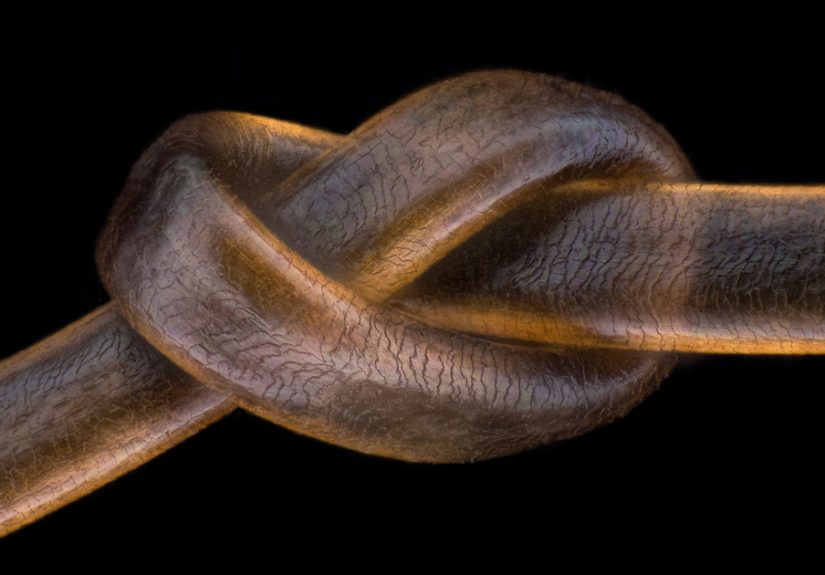
Robert Vierthaler took an everyday subject and made it strange again. A single strand of human hair became an abstract landscape, which is honestly rude to every expensive abstract painting out there.
-
13th Place: Amino Acid Crystals
Justin Zoll photographed crystals formed from an ethanol-and-water solution containing L-glutamine and beta-alanine. Under polarized light, chemistry turned into something resembling a festival of glowing geometry.
-
14th Place: Leaf Roller Weevil
Özgür Kerem Bulur’s lateral view of a leaf roller weevil delivered texture and form in a way that made the insect look equal parts armored vehicle and tiny sculpture.
-
15th Place: Asexually Reproducing Annelid
Eduardo Zattara and Alexa Bely captured a chain of daughter individuals from the annelid species Chaetogaster diaphanus. It was one of the most biologically fascinating images in the ranking.
-
16th Place: Nylon Stockings
Alexander Klepnev’s image of nylon stockings was a reminder that nonliving subjects can compete with biology on pure visual appeal. The woven structure looked like engineered lace from another dimension.
-
17th Place: Immature Water Boatman
Anne Algar’s ventral view of an immature water boatman was wonderfully crisp and a little eerie in the best way. It had that classic “nature is beautiful and slightly intense” energy.
-
18th Place: Atlas Moth Wing
Chris Perani highlighted the scale and pattern of an Atlas moth wing, creating an image rich in texture, repetition, and velvety detail. If microscopic fashion week were a thing, this would headline it.
-
19th Place: Marine Diatom Cell Wall
Jan Michels earned 19th with the silica cell wall of the marine diatom Arachnoidiscus sp. It looked architectural, precise, and almost impossible to believe came from a single-celled organism.
-
20th Place: Short-Tailed Fruit Bat Embryo Skeleton
Dorit Hockman and Vanessa Chong-Morrison rounded out the Top 20 with a skeleton preparation of a short-tailed fruit bat embryo. It was spooky, elegant, and exactly the kind of image that sticks in your brain.
What the 2020 Winners Tell Us About Microscopic Photography
The Nikon Small World 2020 winners were not dominated by a single style. That is part of what made the collection so rich. Some images leaned heavily on fluorescence, where scientific labeling and optical technique created surreal color. Others used image stacking to pull impossible amounts of detail into focus. Polarized light entries made crystals and textiles glow like stained glass. Brightfield and darkfield images proved that older, simpler methods still have enormous visual power in the right hands.
The subject matter was equally broad. The Top 20 moved from fish and fungi to insects, algae, neurons, crystals, cloth, and hair without ever feeling random. Instead, it felt like a guided tour through a hidden universe, one where biology, materials science, and visual storytelling all speak the same language. That breadth is one reason the competition remains so compelling year after year. It does not just celebrate microscope photography. It celebrates curiosity itself.
It also helps that the judges were not choosing images in a vacuum. Nikon’s Small World has long positioned itself as a forum for showcasing the beauty and complexity of life through the light microscope. In 2020, that mission came through loud and clear. The best entries did not just magnify objects. They magnified wonder.
Why the First-Place Zebrafish Deserved the Crown
Let’s give the zebrafish its flowers, or at least its fluorescent orange and blue confetti. The first-place image won because it did nearly everything a Small World champion should do. It was visually arresting on first glance, technically sophisticated under inspection, and scientifically important once you understood what it showed.
The image revealed the fish’s skeleton and scales in blue and lymphatic vessels in orange, producing a composition that was instantly readable and deeply layered. It also emerged from research that helped identify skull-associated lymphatic vessels in zebrafish, structures once thought to be exclusive to mammals. That matters because zebrafish are easier to raise and image than mammalian models, giving researchers a powerful new route for studying disease processes related to the brain.
In plain English, the image was not just beautiful enough to win a contest. It was useful enough to help push science forward. That combination is practically the Michelin star of photomicrography.
The Experience of Looking at Nikon Small World 2020
Spending time with the Nikon Small World 2020 winners feels a little like wandering into an art museum where every label quietly informs you that the masterpiece in front of you is actually algae, moth scales, a fish skull, or a strand of somebody’s hair. Your brain has to keep recalibrating. First you react to color, balance, texture, and shape. Then you read the caption and realize you were emotionally moved by pollen. It is humbling.
That experience is part of the competition’s magic. Microscope photography has a sneaky way of reminding viewers that beauty is not reserved for mountains, sunsets, or glamorous city skylines. It is also hiding in pond life, neural tissue, fungal spores, and the fibers of ordinary fabric. The world is not only bigger than we think; it is also much smaller, stranger, and more stylish.
Looking through the 2020 winners in order is especially satisfying because the sequence keeps changing the mood. The zebrafish opener feels grand and almost cinematic. The clownfish development panel has the rhythm of a biological coming-of-age story. The snail tongue arrives like a psychedelic surprise. Then come fungi, moths, pollen, neurons, crystals, a bat embryo skeleton, and more, each one shifting the emotional tone just when you think you have figured the gallery out.
There is also something deeply comforting about how these images blend rigor and delight. Many of the winning entrants are scientists, imaging specialists, or serious microscopy enthusiasts. They are not just chasing a cool visual. They are often documenting real processes, structures, and specimens with care. Yet the final images can still feel playful, dreamy, and wildly imaginative. That tension makes Nikon Small World accessible to everyone. A researcher can admire the technique. A casual reader can simply say, “Whoa.” Both reactions are valid, and both are welcome.
For photographers, the competition is a reminder that equipment and scale do not determine whether an image has emotional impact. For science lovers, it is a vivid argument for better visual communication. For everyone else, it is proof that the microscopic world is putting on a full-time performance and most of us have just been too busy to buy tickets.
And maybe that is the real legacy of Nikon Small World 2020. It invited people to slow down and look closer at a year when much of the world was already thinking hard about what could not be seen with the naked eye. In that context, the contest felt especially resonant. Here were tiny structures, hidden systems, and miniature lives presented not as distant abstractions, but as astonishing realities. The winners made the invisible visible, the scientific emotional, and the tiny unforgettable. Not bad for a contest built around things most of us would walk past, swim past, or shed from our heads without a second thought.