Table of Contents >> Show >> Hide
- What Modern Angels Usually Look Like
- What Biblical Angels Actually Look Like
- Where the Modern Angel Image Came From
- The Internet Meme Gets One Big Thing Rightand One Big Thing Wrong
- Modern Angels vs. Biblical Angels: The Deepest Difference
- Why This Comparison Still Fascinates People
- Common Experiences People Describe When They First Compare Modern and Biblical Angels
- Conclusion
Note: This article is based on real biblical passages and mainstream reference material, but it is written in a lively comparison style for online readers.
If you ask most people to picture an angel, they will probably imagine a glowing human with soft white robes, feathered wings, excellent posture, and a face that says, “Do not worry, I brought chamomile tea.” That modern image is everywhere: Christmas cards, sympathy art, pop songs, children’s books, tattoos, movies, and enough home décor to fill a craft superstore.
Open the Bible, though, and the angel situation gets a lot more complicated. Yes, some angels look human enough to hold a conversation without causing an immediate fainting spell. But the Bible’s heavenly world also includes beings that are far stranger than the polished greeting-card version. There are seraphim with six wings. There are cherubim tied to God’s throne and sacred space. There are living creatures with multiple faces. And in Ezekiel’s vision, there are wheels within wheels covered in eyes, which is not exactly what most people mean when they say they want “a guardian angel aesthetic.”
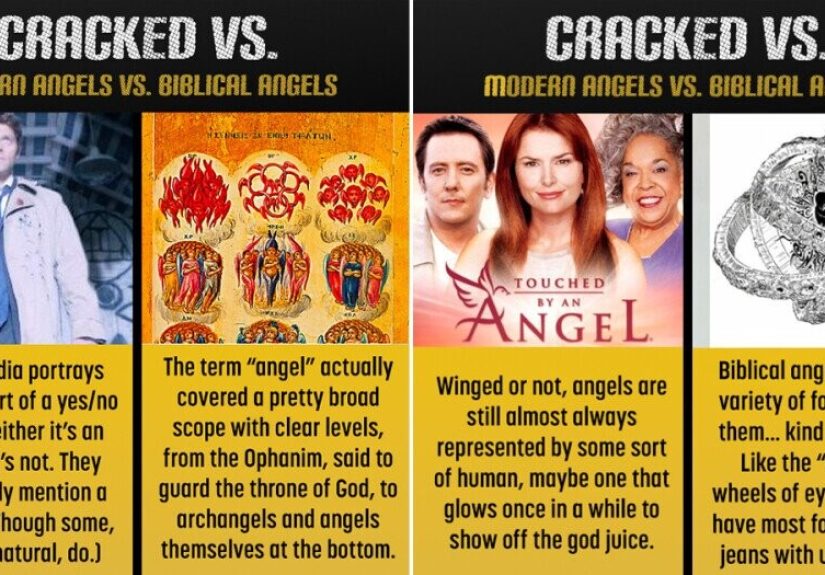
That is the real tension in modern angels vs. biblical angels: the modern version is streamlined, sentimental, and heavily shaped by centuries of art, while the biblical version is symbolic, layered, and at times gloriously unsettling. The internet loves calling these creatures “biblically accurate angels,” usually with the energy of someone revealing a cosmic plot twist. The truth is more interesting than the meme. Some biblical angels are humanlike messengers. Some heavenly beings are wild throne-room creatures. And modern culture has blended all of that into one tidy winged package.
So let’s crack this comparison open and see what survives.
What Modern Angels Usually Look Like
The modern angel is basically the PR department’s version of heaven. This figure is usually beautiful, calm, symmetrical, and easy to recognize from across the room. The standard features tend to include a human body, two large feathered wings, flowing garments, and a peaceful expression. In popular culture, angels are often guardians, comforters, or romantic symbols. They hover at hospital beds, appear in dream sequences, protect children crossing streets, and occasionally star in movies where they fall in love, solve family problems, or teach overworked adults to believe in magic again.
This image is emotionally effective because it is readable. A modern angel communicates safety in about half a second. No one sees a watercolor angel on a bookmark and thinks, “Ah yes, the terrifying mystery of divine holiness.” They think, “This would look nice near a candle.”
Modern “cherubs” make the contrast even sharper. In everyday speech, a cherub is often a cute baby with wings, chubby cheeks, and the general energy of decorative frosting. That image feels ancient, but it is largely the product of later artistic traditions that merged Christian visual language with the classical putto or Cupid-like child figure. In other words, the little winged toddler floating around Valentine’s Day décor has much more to do with art history than with Ezekiel’s visions.
Modern depictions also flatten the variety of heavenly beings into one category. Messenger angels, cherubim, seraphim, archangels, and symbolic living creatures often get blended into a single image: one attractive celestial person, add wings, done. It is visually convenient. It is also the theological equivalent of labeling every sea creature “fish” and moving on with your day.
What Biblical Angels Actually Look Like
The first thing to know is that the Bible does not always use “angel” as a catch-all term for every heavenly being. The Hebrew word mal’akh means “messenger,” which helps explain why many biblical angels are defined more by function than by flashy anatomy. In several narratives, angels appear in recognizably human form. They speak, travel, deliver warnings, and sometimes are not immediately identified as supernatural. That matters because it means the Bible’s most famous weird imagery does not describe every angel in every passage.
Still, when the Bible decides to get visually dramatic, it absolutely commits to the bit.
Seraphim: Not Cute, Not Casual, Very Much on Fire Vibes
In Isaiah 6, seraphim appear above God’s throne. Each has six wings: two cover the face, two cover the feet, and two are used for flight. Their job in that vision is not to look approachable. They are part of a scene built around divine holiness, awe, and the overwhelming otherness of God. They call to one another in praise, and the entire setting shakes with the force of the moment.
This is a long way from the modern angel who gently supervises a cottage garden. Biblical seraphim are not decorative. They are liturgical thunder. Their wings are not fashion accessories. Their whole presentation signals that the throne room of God is not a cozy living room with clouds. It is holy territory, and Isaiah reacts accordingly: not with a smile, but with fear and self-awareness.
Cherubim: Guardians, Throne Bearers, and Nothing Like Baby Cupids
Cherubim may be the most misunderstood heavenly beings in Western imagination. In the Bible, cherubim are associated with God’s presence, sacred space, and divine kingship. They guard Eden after humanity’s expulsion. They appear in connection with the Ark of the Covenant. They are linked to the throne imagery of God. They are not presented as adorable infants in midair, and they are definitely not floating around shooting love arrows at people who just wanted to buy groceries in peace.
In Ezekiel, the imagery becomes even more intense. The living creatures later identified with cherubim have multiple faces, multiple wings, human hands under their wings, and a movement pattern that is more “cosmic machinery of glory” than “bird with excellent skincare.” One face is human, while the others include lion, ox, and eagle imagery. The point is not zoological realism. The point is symbolic fullness, power, motion, and nearness to the divine throne.
That is why the modern cherub image is so misleading. The biblical cherub is not a sweet little baby. It is a throne-associated guardian creature with hybrid features and a role in marking sacred space. If modern culture turned that into a nursery mural, that says more about us than it does about Scripture.
The Wheels Within Wheels Problem
No comparison of biblical angels vs. modern angels is complete without addressing the internet’s favorite nightmare carousel: the wheels within wheels full of eyes from Ezekiel’s vision. This imagery is often treated as the definitive look of all biblical angels, which is catchy but inaccurate. Ezekiel’s vision is part of a throne-chariot scene involving living creatures and wheel imagery connected to divine movement and presence. It is not a universal angel uniform.
Still, it is unforgettable. The wheels move in coordination with the living creatures. They can move without turning. Their rims are full of eyes. Later passages again describe the wheels as covered with eyes. Symbolically, the whole scene suggests awareness, mobility, sovereignty, and supernatural order. Artistically, it suggests that Ezekiel was not interested in helping future illustrators sleep better at night.
Where the Modern Angel Image Came From
If the Bible gives us messengers, seraphim, cherubim, living creatures, and dazzling throne imagery, how did we end up with the standard winged human angel? The answer is history, art, and the human tendency to simplify whatever scares us.
Over time, Jewish and Christian interpretation, late antique visual traditions, medieval theology, and Renaissance art all contributed to the angel image many people recognize today. Artists needed forms that could communicate “heavenly being” quickly and clearly. Human figures worked well because they were intelligible. Wings signaled transcendence, mobility, and otherworldly status. The result was a more uniform visual language: angels became increasingly human in form, even when the biblical source material was more varied.
Then came the cherub confusion. The winged infant figure known as the putto entered religious art through classical and Renaissance traditions. These figures were associated with Cupid and decorative love imagery, but in Christian art they were often absorbed into representations of heavenly innocence or spiritual beauty. Eventually, many viewers began calling these child figures “cherubs,” even though biblical cherubim are something else entirely. It is one of the great rebranding efforts in visual culture. Somewhere, Ezekiel is probably still blinking.
Modern media finished the simplification. Television, novels, fantasy art, and greeting-card spirituality favored angels that could speak, emote, comfort, and look good in soft lighting. The result is the contemporary angel: elegant, humanoid, and accessible. In branding terms, biblical angels are the unfiltered original release; modern angels are the sleek reboot with friendlier lighting and fewer eyes.
The Internet Meme Gets One Big Thing Rightand One Big Thing Wrong
The “biblically accurate angel” meme became popular because it pushes back against the shallow assumption that all angels in the Bible are basically dreamy humans with wings. On that point, the meme is useful. It reminds people that the Bible contains symbols and visions far stranger than modern pop culture usually admits.
But the meme often goes too far in the opposite direction. It implies that every biblical angel looks like a flaming geometric horror made of wings, eyeballs, and existential dread. That is not quite right either. Many biblical angels appear as humanlike messengers. The wildest imagery is attached to particular classes of heavenly beings or specific visionary scenes, especially around God’s throne.
So the most accurate conclusion is not “modern angels are fake and biblical angels are all nightmare wheels.” The better conclusion is this: the Bible presents a diverse heavenly world, and later culture compressed that diversity into a single polished icon. The meme noticed the compression. It just sometimes forgets the diversity.
Modern Angels vs. Biblical Angels: The Deepest Difference
The biggest difference is not merely appearance. It is emphasis.
Modern angels are usually built around comfort. They reassure, protect, inspire, and soften the edges of spiritual belief. Their visual job is emotional accessibility.
Biblical angels and heavenly beings, by contrast, often emphasize message, holiness, judgment, worship, and the nearness of divine power. Even when they bring good news, people often respond with fear first. That recurring pattern matters. The Bible is not primarily trying to make heavenly beings cute. It is trying to communicate that the boundary between heaven and earth is serious, powerful, and not under human control.
That is why the biblical response to angels is so often shock, confusion, or terror. The encounter is not “Aww, how lovely.” It is “I may need a moment, a robe, and possibly a new understanding of reality.” The biblical world assumes that contact with the divine order is destabilizing before it becomes comforting.
Modern culture, meanwhile, usually wants spiritual imagery without the destabilization. We want transcendence, but in a frame that matches our furniture. That is how a guardian of sacred space becomes a nursery decal, and a throne-bearing cherub becomes a Valentine’s Day side character.
Why This Comparison Still Fascinates People
People keep searching for modern angels vs. biblical angels because the contrast feels like a cultural reveal. It shows how religion, art, and pop imagination remix one another across time. It also taps into a deeper question: do we want the divine to be understandable, or do we want it to remain genuinely other?
Modern angel imagery answers with familiarity. Biblical imagery often answers with mystery. Both have power, but they do different work. One comforts the imagination. The other disrupts it.
That is why the comparison keeps circulating online, in sermons, in classrooms, and in conversations that begin with, “Wait, hold onangels in the Bible looked like what?” It is not just trivia. It is a case study in how symbols evolve, how art shapes theology in everyday life, and how quickly human beings turn the terrifying into the tasteful.
Common Experiences People Describe When They First Compare Modern and Biblical Angels
One of the most interesting things about this topic is not only the theology or the art history, but the very human experience of discovering the gap for the first time. A lot of people meet the idea through a meme, a podcast clip, a Bible study, a museum visit, or a late-night scroll that starts with a joke and ends with a mild spiritual identity crisis. They expect a simple comparison between “nice angels” and “scary angels,” but what they actually experience is something more layered.
The first reaction is often surprise. People realize they have been carrying around a visual version of angels that came from paintings, films, and holiday decorations more than from the text itself. That surprise can be funny. Someone opens Ezekiel, reads about wheels full of eyes, and suddenly every porcelain angel figurine in the house looks like it has been hiding important information.
The second reaction is usually curiosity. Once readers learn that cherubim are not baby cupids and that seraphim are not just “extra fancy angels,” they start noticing categories they had never separated before. Messenger angels, throne guardians, living creatures, symbolic visions, and later artistic traditions all begin to untangle. For many people, that feels oddly satisfying, like cleaning out a junk drawer and discovering the instructions were there the whole time.
Then comes the emotional shift. Some people feel amused. Some feel fascinated. Some feel unsettled in a good way. The Bible’s heavenly imagery can restore a sense of scale. It reminds readers that ancient religious texts were not always trying to be cute, therapeutic, or marketable. Sometimes they were trying to express holiness so intense that ordinary language had to break into symbols. For modern readers used to polished spiritual branding, that can feel fresh and even bracing.
There is also a common artistic experience. People start noticing modern angels everywhere once they know the difference. They see the feathered human in a film poster, the tiny cherub in a garden fountain, the winged infant on a greeting card, and the graceful archangel in a painting, and they begin asking, “Which tradition is this coming from?” That question can make the world more interesting. Suddenly, art history is no longer a dusty side note. It becomes the missing chapter in why heaven looks the way it does on coffee mugs.
For some readers, the experience becomes personal in a deeper way. The biblical imagery makes the divine feel bigger, stranger, and less domesticated. It can challenge the habit of turning spiritual realities into sentimental wallpaper. That does not mean modern images are worthless. They can still communicate comfort, hope, and beauty. But once someone has seen the difference, they often cannot fully unsee it. The sweet modern angel may still feel meaningful, yet it now sits beside a more awe-filled picture of heavenone with wings, thunder, eyes, fire, and the reminder that God’s world is not obligated to fit neatly inside human taste.
Conclusion
So who wins in Cracked VS: Modern Angels vs. Biblical Angels? Honestly, both reveal something important. Modern angels show how art and culture translate spiritual ideas into familiar emotional language. Biblical angels reveal a far more complex and sometimes startling universe of messengers, guardians, worshipers, and throne-room beings.
The real lesson is not that one image must completely erase the other. It is that they are not the same thing, and treating them as identical makes us miss the richness of both. Modern angels are the softened public face of heaven. Biblical angels are the untamed source material. One is easier to print on a candle label. The other makes you understand why so many encounters in Scripture begin with fear.
And maybe that is the best takeaway. The Bible’s heavenly beings are not less beautiful because they are strange. They are more memorable because they refuse to be reduced to spiritual wallpaper. Modern angels may soothe us, but biblical angels remind us that the sacred is not always tidy, and definitely not always wearing pastel robes.