Table of Contents >> Show >> Hide
- Start With Age First, Because Age Changes Everything
- Next, Identify the Species Group
- How to Judge a Baby Bird’s Health
- What to Do Based on What You Found
- Quick Field Examples
- Mistakes to Avoid When Identifying a Baby Bird
- Conclusion
- Common Real-World Experiences People Have With Baby Birds
- SEO Tags
Finding a baby bird can turn an ordinary walk to the mailbox into a full-blown emotional event. One minute you are thinking about iced coffee, and the next you are staring at a tiny, fuzzy creature that looks like a feathered walnut with trust issues. The good news is that identifying a baby bird is not magic. The better news is that once you know what to look for, you can tell a lot about a young bird’s age, likely species group, and health without accidentally making the situation worse.
If you want to identify a baby bird correctly, start with the same three questions wildlife experts use: How old is it? What kind of bird is it? Does it actually need help? Get those three right, and you will avoid the classic mistake people make every spring: “rescuing” a healthy fledgling that was simply having an awkward teenage phase in public.
This guide breaks the process down in plain English, with practical examples, common species clues, and safe next steps. Whether you found a robin under a shrub, a duckling near a storm drain, or a mystery bird that looks like a tiny dinosaur wearing static electricity, here is how to identify a baby bird by age, species, and health.
Start With Age First, Because Age Changes Everything
The fastest way to identify a baby bird is by its stage of development. In bird-world terms, age matters more than personality, and that is saying something.
| Stage | What It Looks Like | What It Usually Means |
|---|---|---|
| Hatchling | Naked or nearly naked, eyes closed or barely open, very weak | Needs the nest and parents immediately |
| Nestling | Some down or pin feathers, not fully feathered, cannot hop well | Still belongs in the nest |
| Fledgling | Mostly feathered, short tail, can hop or flutter, looks adorably unfinished | Usually normal and still being fed by parents |
| Juvenile | Fully feathered, stronger posture, can perch better, may still beg | More independent but still learning |
Hatchlings: Tiny, Pink, and Extremely Not Ready for Life
A hatchling is the newborn stage. These birds are often featherless, helpless, and frankly built like they were rushed through production. They cannot regulate body temperature well, cannot move effectively, and cannot survive on the ground for long. If the bird is bare-skinned, wobbly, and looks like it just arrived from another planet, it is a hatchling.
Most backyard songbirds hatch in this state. A hatchling needs warmth, protection, and parent care. In practical terms, that means the correct place for an uninjured hatchling is usually back in the nest or in a nearby substitute nest.
Nestlings: Still in the Nest Club
Nestlings are slightly older. They may have tufts of fluff, rows of pin feathers, or partly opened eyes. They still do not move around like competent little birds. A nestling may lift its head to beg, but it usually cannot perch, hop confidently, or escape danger.
If a nestling is on the ground, that is usually a problem. It may have fallen, the nest may have broken, or a predator may have disturbed it. Either way, a healthy nestling belongs back in the nest if possible. This is also the stage where many people panic about touching the bird. Relax. Parent birds generally do not abandon a baby because a human touched it. That old myth has survived far longer than it deserved.
Fledglings: The Awkward Teenagers of the Bird World
Fledglings are where most confusion happens. These birds are mostly feathered, can hop, flutter, or perch a little, and often have very short tails that make them look unfinished, as if nature hit “save draft” instead of “publish.” They may sit on the ground, under bushes, or on low branches and call loudly for food.
That behavior is usually normal. Fledglings leave the nest before they are strong fliers. Their parents keep feeding them while they learn the basics of being a bird, which includes hopping badly, landing badly, and making you think an emergency is happening. If the bird is fully feathered, alert, and able to hop, it is probably a fledgling and often does not need rescue.
Precocial vs. Altricial: Why Some Baby Birds Look Ready on Day One
Not all baby birds hatch helpless. Songbirds, woodpeckers, owls, and many raptors are usually altricial, meaning they hatch blind, weak, and dependent. Ducks, geese, quail, shorebirds, and similar species are often precocial, meaning they hatch with down, open eyes, and surprising confidence.
So if you find a fluffy down-covered duckling or quail chick that can already walk, do not compare it to a baby robin. Different bird groups develop on different schedules. In other words, bird childhood is not one-size-fits-all.
Next, Identify the Species Group
Once you know the bird’s age, narrow down the species or at least the bird family. You do not always need the exact Latin name to make a smart decision. Often, identifying the type of bird is enough.
Use the Four Big Clues
- Size and shape: Is it sparrow-sized, robin-sized, pigeon-sized, or duck-sized?
- Bill shape: Thick seed-cracker, slim insect-picker, hooked raptor bill, flat duck bill, or wide swallow gape?
- Feet and legs: Long wader legs, webbed feet, grasping talons, or average little perching feet?
- Behavior and habitat: Found on a lawn, in reeds, on pavement, near water, in a cavity, or under the eaves?
These clues work surprisingly well, especially when baby plumage is confusing. Young birds often look duller and scruffier than adults, so structure matters more than color at first.
Common Baby Bird Species Clues
Robin-Type Babies
Young robins are often medium-sized, with longish legs, upright posture, and a slim yellowish bill. Juveniles may show a speckled or spotted breast before they develop the cleaner adult look. If the baby bird seems built for lawn drama and worm hunting, robin is a good guess.
Sparrows and Finches
These birds are usually small and compact with thick, conical bills made for seeds. Baby sparrows and finches can look frustratingly similar, like the same bird copied and pasted in slightly different shades of brown. Focus on the bill. A stout, triangular beak usually points you toward a seed-eating bird.
Starlings
Juvenile starlings are often plain brown or gray-brown with a straight, pointed bill and a slightly chunky body. They can look smoother and less striped than many young sparrows. If the bird has a long pointed bill and seems like it might grow into a sidewalk strutter with opinions, starling is possible.
Doves and Pigeons
Baby doves and pigeons tend to look chunky, soft, and oddly serious. They often have a larger body, small head, and thick neck area. Their feathers can look scaly or shaggy while they grow in. If the baby bird seems built like a potato with wings, think dove or pigeon.
Swallows and Swifts
These young birds have tiny bills but very wide mouths, because catching insects on the wing is the family business. They often have long wings relative to body size. If you find one near a porch, barn, bridge, or roofline, that habitat clue matters.
Ducks, Geese, Quail, and Shorebirds
These babies are usually downy and mobile early. If the bird is fluffy, walking well, and found near water or open ground, it may be precocial. A lone duckling is not automatically abandoned. In many cases, getting it near the mother or family group is the right move.
Owls, Hawks, and Other Raptors
These birds have hooked bills and stronger feet with noticeable talons. Young raptors can end up on the ground before they fly well, especially owls. Because raptors are powerful and species-specific in their care needs, they are best handled cautiously and referred quickly to a wildlife rehabilitator if injured or truly orphaned.
How to Judge a Baby Bird’s Health
Now for the important question: is the baby bird healthy, mildly disheveled, or in real trouble? Baby birds do not always look polished, so health assessment should be based on signs, not vibes.
Signs the Bird May Be Healthy
- Bright, alert eyes
- Strong grip with the feet
- Able to sit upright or hop
- Feathered fledgling on the ground with no visible injuries
- Calling or begging while parents are likely nearby
- No bleeding, no drooping wing, no obvious asymmetry
A healthy fledgling may still look goofy. That is not a diagnosis. That is simply youth.
Signs the Bird Needs Help Right Away
- Featherless or nearly featherless and on the ground
- Bleeding or visible wounds
- One wing drooping lower than the other
- Broken leg, twisted posture, or inability to stand
- Closed, swollen, or crusted eyes
- Shivering, cold body, weakness, or collapse
- Labored breathing
- Bird was caught by a cat or dog
- Dead parent found nearby
Cat contact is especially serious. A baby bird may look “fine” after a cat grab and still be in danger because tiny punctures and bacteria can cause rapid decline. If a cat had the bird in its mouth or paws, treat that as a real emergency.
What to Do Based on What You Found
If It Is a Healthy Nestling
- Look for the nest nearby.
- If you can reach it, gently place the baby back.
- If the original nest is gone, make a substitute nest using a small basket or container with drainage holes and soft natural material.
- Attach it near where the bird was found.
- Watch from a distance for about an hour.
Parents can be sneaky for safety reasons, so “I did not see them in 90 seconds” is not a reliable scientific finding.
If It Is a Healthy Fledgling
- Leave it where it is if the area is safe.
- If it is in immediate danger, move it a short distance to a nearby shrub or low branch.
- Keep pets and kids away.
- Observe quietly from a distance.
Most healthy fledglings should stay outdoors with their parents. A living room is not a bird finishing school.
If It Is Injured, Cold, or Cat-Caught
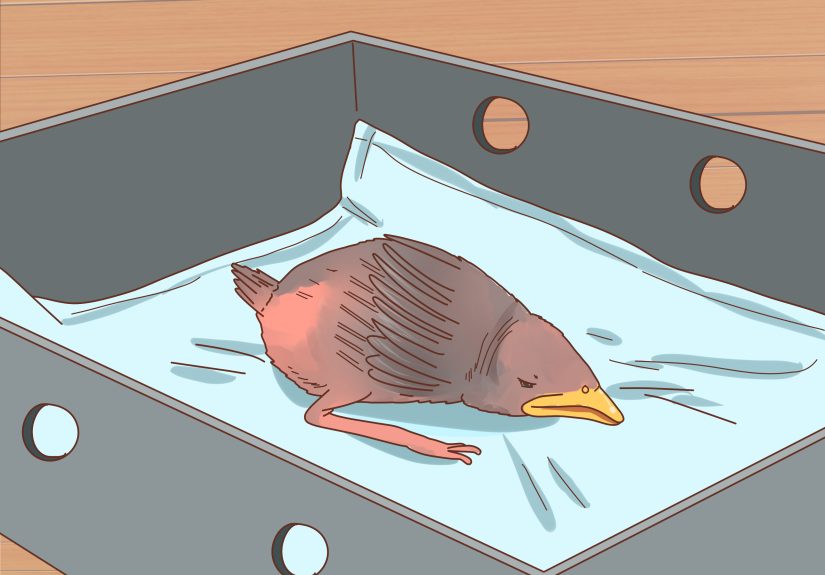
- Place the bird in a ventilated box lined with a towel or paper towels.
- Keep it warm, dark, and quiet.
- Do not feed it.
- Do not give it water directly.
- Contact a licensed wildlife rehabilitator as soon as possible.
Do not improvise a menu from your kitchen. Bread, milk, random seeds, or an enthusiastic eye dropper are not heroic. They are how good intentions become very bad bird care.
Quick Field Examples
Example 1: Baby Bird Under a Shrub
The bird is fully feathered, has a very short tail, hops when approached, and chirps loudly. That is probably a fledgling songbird, not an orphan. Leave it nearby, reduce danger, and let the parents do their job.
Example 2: Naked Bird on Sidewalk
The bird is pink, mostly featherless, and cannot lift itself well. That is a hatchling or very young nestling. It needs the nest or a substitute nest right away.
Example 3: Fluffy Duckling Alone in a Parking Lot
A downy duckling is precocial, so it may already walk well. Try to locate the mother or brood and reunite it safely if possible. If the mother is known to be dead or the duckling is injured, contact wildlife rescue.
Example 4: Brown Bird in Cat’s Mouth
Species can wait. Emergency care comes first. Box the bird, keep it warm and quiet, and contact a rehabilitator immediately.
Mistakes to Avoid When Identifying a Baby Bird
- Assuming every ground bird is abandoned
- Judging health only by whether it can fly
- Ignoring bill shape and feet when guessing species
- Giving food or water without expert advice
- Keeping a wild baby bird “just overnight” and turning one night into a very illegal sitcom
- Forgetting that parents may be nearby but staying hidden
Conclusion
If you want to identify a baby bird accurately, follow the correct order: age first, species clues second, health check third. A featherless bird on the ground is a nestling problem. A feathered hopper with a short tail is often a fledgling doing normal bird things. A downy walker near water may be precocial. A hooked bill or webbed feet can change your species guess fast. And visible injury, coldness, shivering, asymmetry, or cat contact means the bird needs professional help.
The secret is not becoming a bird wizard in five minutes. The secret is noticing the right clues and not panicking. Most of the time, baby birds need their parents more than they need a human rescue montage. But when they truly are injured or orphaned, recognizing the signs quickly can make all the difference.
Common Real-World Experiences People Have With Baby Birds
One of the most common experiences people describe is the “backyard robin emergency” that turns out not to be an emergency at all. Someone sees a speckled young robin on the lawn, notices that it cannot really fly, and assumes the poor thing has been abandoned by civilization. Then they watch from inside the window for ten or fifteen minutes and discover the parents are still bringing food. This moment is eye-opening because it teaches the biggest lesson in baby bird identification: a bird can look inexperienced without being in danger. In fact, looking confused is practically part of the fledgling uniform.
Another common experience happens after wind or rain knocks a nest loose. A homeowner finds one or two nestlings under a tree and feels the immediate urge to become a full-time avian parent by lunchtime. What usually helps most, though, is much simpler: putting the babies back into the original nest if it is intact, or creating a substitute nest nearby. People are often shocked when the parents return. It feels dramatic, but it is really just good wildlife triage. The babies get the correct food, correct temperature, correct feeding schedule, and the correct social upbringing, which is something no cardboard box in a kitchen can truly replicate.
Then there is the classic porch-light swallow story. People find a small baby bird with a tiny bill and enormous mouth, usually under an eave or near a garage. At first it does not look like much more than a squeaking feather project. But once they notice the location, the long wings, and the wide gape, the species group becomes clearer. This kind of experience shows why habitat matters so much. Where you found the bird is often half the identification puzzle.
Wildlife rehabilitators also hear countless stories involving cats. A person says, “The bird looks okay, but my cat only had it for a second.” Unfortunately, that “just a second” can still be serious. Many people later describe how surprising it was to learn that a bird can have almost invisible puncture wounds or dangerous bacterial exposure from cat saliva. This is one of the most important real-world lessons because it reminds people that visible drama is not the only sign of a medical problem.
Finally, many bird lovers talk about how identifying baby birds changes the way they see spring and summer. Instead of assuming every peeping fluff-ball needs rescuing, they start noticing stages: nestling, fledgling, juvenile. They notice bill shapes, leg length, and behavior. They learn that some babies are born helpless, while others hatch ready to march around like they own the wetland. And once you understand that, every yard, sidewalk, and park becomes a little more readable. You are no longer just seeing a baby bird. You are seeing a life stage, a species clue, and a health story all at once.