Table of Contents >> Show >> Hide
- Why NBC Turned on Norm in the First Place
- Why Letterman Was the Worst Possible Place for NBC to Lose Control of the Story
- Did NBC Actually Try to Stop the Letterman Appearance?
- The Bigger Problem for NBC: The Letterman Hit Was Not the End
- Why the Letterman Appearance Still Matters
- What the Experience Meant for Viewers, Comics, and Late-Night Culture
- Conclusion
Some celebrity feuds are glamorous. This one involved a deadpan Canadian, a network boss with very little patience, a murder-trial punchline that refused to die, and David Letterman sitting at his desk like a man who had just been handed a fresh plate of executive dysfunction. In other words: perfect late-night television.
Norm Macdonald’s 1998 exit from Saturday Night Live has never felt like a routine cast shake-up. It felt personal, political, petty, and weirdly revealing about how television power really worked in the 1990s. Officially, Macdonald was removed from the Weekend Update desk because NBC executive Don Ohlmeyer did not think he was funny and believed the segment had slipped. Unofficially, just about everybody in comedy heard the same explanation: Norm kept making savage O.J. Simpson jokes, Ohlmeyer was close friends with Simpson, and eventually the network’s patience snapped.
Then came the fun part, at least for viewers. Macdonald did what comedians often do when corporate authority tells them to sit quietly and accept the memo: he went somewhere funnier. That somewhere was Late Show with David Letterman, where a bad TV-management decision instantly turned into great television. The result was not just a memorable interview. It became one of the clearest examples of how comedy can expose power by refusing to act embarrassed in front of it.
Why NBC Turned on Norm in the First Place
To understand why the Letterman appearance mattered, you have to start at the Weekend Update desk, where Macdonald delivered jokes like a man reading wire copy from a parallel universe. He was never cuddly. He was never eager to wink at the audience and reassure them that everybody was having a nice time. He sounded amused by the news, suspicious of the news, and occasionally bored by the idea that television should be warm at all.
That style made him brilliant, but it also made him a lousy fit for executives who prefer comedians to behave like upholstery. Macdonald kept returning to O.J. Simpson material with a kind of blunt-force persistence that felt outrageous even by the standards of the era. The jokes were not delicate little satirical soufflés. They were more like a guy repeatedly banging a gong labeled “Didn’t O.J. obviously do it?” until somebody backstage started sweating.
In early 1998, NBC removed him from Weekend Update and replaced him with Colin Quinn. Contemporary coverage framed the move as abrupt and baffling, especially because Macdonald was still widely seen as one of the sharpest voices on the show. Macdonald said Ohlmeyer told him he simply was not funny. But even at the time, that explanation landed with the soft thud of a fake alibi in a detective movie. Too many people around the show believed the real issue was the Simpson material. Writer Jim Downey later said outright that Ohlmeyer, a longtime Simpson friend, had had enough.
That is the key to the entire saga. Macdonald was not fired for bombing. He was fired, or at the very least demoted in a way that felt indistinguishable from firing, because he would not stop being Norm Macdonald when it became professionally inconvenient.
Why Letterman Was the Worst Possible Place for NBC to Lose Control of the Story
If NBC wanted a quiet transition, David Letterman was the last person on Earth who was going to help. Letterman had his own long, messy history with network politics, especially after NBC passed him over for The Tonight Show. By the time Macdonald landed on CBS, Letterman did not merely understand executive meddling. He had practically turned it into a recurring character.
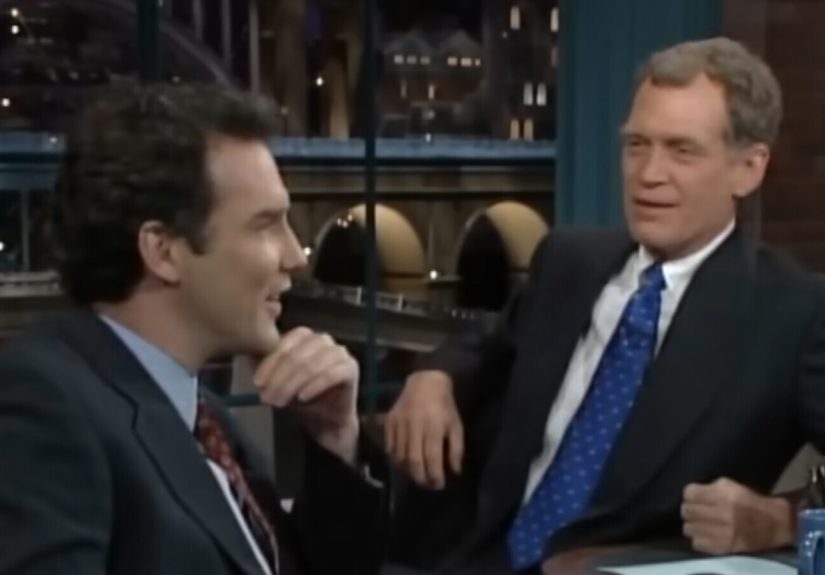
So when Macdonald appeared on Late Show on January 7, 1998, just days after being bumped from Weekend Update, the interview did not feel like a standard promotional stop. It felt like a pressure valve exploding in public. Macdonald sat there with his usual half-shrugging calm, talking about Ohlmeyer as if he were discussing a slightly disappointing golf partner. Letterman, meanwhile, reacted the way a man reacts when someone tells him a raccoon has taken over the pantry and is now giving orders.
That contrast made the segment unforgettable. Macdonald was detached, funny, and weirdly gracious. Letterman was openly appalled and delighted to have a target. He attacked Ohlmeyer in the gleeful tone of someone rediscovering an old hobby. The interview turned a private network decision into a public humiliation ritual for TV management, and it did so without ever losing its comic rhythm.
Just as important, the appearance made Macdonald look strong. He did not come off as defeated. He came off as a comic so stubbornly himself that even getting shoved off a flagship sketch show could not make him talk like a crisis consultant. Instead of sounding bitter, he sounded amused by the absurdity of the whole thing. That may have been the most infuriating outcome for NBC: the guy they had tried to sideline suddenly looked cooler, freer, and funnier off their turf.
Did NBC Actually Try to Stop the Letterman Appearance?
The headline version of this story is irresistible: NBC tried to stop Norm Macdonald from going on Letterman after firing him. The fuller truth is slightly messier, which usually means it is more interesting.
There is no neat little public memo saying, “Do not allow the Canadian to sit on Dave’s couch.” What the record does show is a pattern that points in the same direction. Macdonald indicated at the time that after being removed from Weekend Update, he was told he could not just wander onto competing shows and do whatever he wanted. Yet he did go on Letterman, and once he did, NBC’s anger plainly escalated.
In practical terms, that means the network either failed to stop the appearance or failed to control what followed from it. The result was the same: Macdonald got on national television, said his piece, and let Letterman torch the adults in the room. For a network that had tried to frame the move as a sober quality decision, this was a disaster. The public conversation was no longer about ratings or tone. It was about wounded executives, friendship with O.J. Simpson, and whether TV bosses were using their clout to settle personal scores.
That is why the “tried to prevent” framing persists. Even where the documentary trail is stronger on retaliation than on the initial block, the overall intent is hard to miss. NBC wanted containment. Macdonald gave them spectacle instead.
The Bigger Problem for NBC: The Letterman Hit Was Not the End
If the Letterman appearance had been a one-night embarrassment, maybe the story would have faded into TV gossip. Instead, the feud kept growing legs.
By June 1998, the conflict had spilled into advertising. NBC confirmed it had banned ads for Macdonald’s movie Dirty Work because of the ongoing dispute. That move made the whole mess look even smaller and meaner. Whatever had started as a programming or talent disagreement now looked like old-fashioned retaliation. You did not have to be a card-carrying Norm fanatic to see the problem. Once a network starts refusing ad business because an executive is mad at a comedian, the network stops looking professional and starts looking like the world’s most expensive grudge diary.
Macdonald, naturally, did not respond with polished corporate sorrow. He escalated. He took shots at Ohlmeyer and made the feud part of the story around Dirty Work, which was fitting in a way that almost feels scripted now. A revenge comedy was being promoted through an actual revenge subplot. Sometimes reality is lazy, but occasionally it has terrific instincts.
Then, years later, the picture got even clearer. After Macdonald’s death in 2021, Conan O’Brien revealed that the word had come down from the top at NBC that Norm should no longer be booked on Late Night. O’Brien pushed back and won, which is why Macdonald went on to become one of Conan’s greatest and strangest guests. But the revelation mattered because it showed the network’s impulse was not confined to one decision about SNL. According to Conan, somebody at the top wanted Macdonald contained across NBC late night.
That detail changes how the Letterman moment reads in retrospect. It was not merely a post-firing interview. It was the opening breach in a larger effort to limit where Norm Macdonald could be Norm Macdonald on television.
Why the Letterman Appearance Still Matters
People do not still talk about this moment because they enjoy nostalgia for old media feuds, though that certainly helps. They talk about it because the interview revealed something timeless about comedy and institutions.
Macdonald’s strength was that he did not seem built for institutional obedience. He could work inside a giant platform like SNL, but he never fully belonged to the logic of it. He was too odd, too stubborn, and too uninterested in smoothing out his rough edges for executive comfort. When that friction finally produced an explosion, Letterman offered the perfect stage for the aftermath because his late-night sensibility was also built on puncturing official nonsense.
Together, they turned a personnel dispute into a miniature referendum on whether funny people are supposed to obey network feelings. Viewers instinctively understood the imbalance. On one side was a comedian who kept making jokes he believed in. On the other was a system of prestige, ratings talk, personal alliances, and image management. The system had the power. Norm had the better segment.
And that is usually what lasts. Not the talking points. Not the executive explanation. Not the carefully arranged story. What lasts is the clip where the supposedly weakened comic walks onto a rival show, stays calm, and somehow makes the people with all the authority look panicked, thin-skinned, and just a little ridiculous.
What the Experience Meant for Viewers, Comics, and Late-Night Culture
There is also a more emotional side to this story, and that is why it keeps resurfacing whenever people talk about Macdonald’s legacy. For viewers, the experience of watching that Letterman appearance was not simply “ha, got him.” It was the peculiar thrill of seeing television briefly stop pretending that corporations are neutral machines. Usually, when a star leaves a major show, the language is polished beyond recognition. Everyone wishes everyone else well. Doors remain open. Statements are issued with all the flavor of unsalted drywall. None of that happened here.
Instead, audiences got something messy and recognizably human. Macdonald looked like a guy who had been shoved out of a dream job and had decided, somehow, to remain both funny and eerily unbothered. Letterman looked like a guy who had been waiting for an excuse to throw elbows at NBC all over again. The chemistry between those two moods created an experience that still feels electric. It was funny, yes, but it was also clarifying. You could see how much of television is built on unofficial rules: know who matters, know who is protected, know when to stop joking. Norm kept violating that last rule, and millions of people respected him for it.
For comedians, the episode became a kind of cautionary tale and aspirational myth at the same time. The cautionary part was obvious: networks can absolutely make your life difficult if they decide you are a problem. The aspirational part was better: if you are truly singular, they may not be able to erase you. Macdonald lost the chair, but he kept the legend. In some ways, the removal from Weekend Update made him more iconic, not less, because it framed him as the rare comic who would rather lose status than trim the joke.
That idea has had a long shelf life. You can see echoes of it any time fans celebrate a performer for being “too funny for TV” or “too weird for the room.” Those phrases are overused, but in Macdonald’s case they fit. His comedy was built on anti-polish. He liked awkward silences, crooked logic, fake sincerity, and punchlines that seemed to saunter into the room late and unannounced. Trying to manage a comic like that with traditional TV authority was a little like trying to store lightning in a filing cabinet.
The experience also says something important about late night itself. Talk shows are often dismissed as promotional factories, but the best ones have always doubled as refuge. That is exactly what Letterman became for Macdonald in that moment: not a place to rehabilitate his image, but a place to let the real story breathe. Later, Conan would play a similar role by insisting that Norm remain bookable even after pressure from above. In both cases, late night worked the way fans romantically imagine it works. It protected comedy from management long enough for comedy to fight back.
And maybe that is the strangest twist of all. NBC had the institutional muscle. It had the show, the executives, the messaging, and the power to squeeze a comedian’s opportunities. But the lasting experience people remember is not one of control. It is one of escape. Norm Macdonald got off the leash for ten minutes on Letterman, and the television machine never really recovered the narrative after that. The network won the internal battle. Norm won the story. In comedy, that can be the bigger victory.
Conclusion
So yes, the saga of NBC, Norm Macdonald, and Letterman remains catnip for comedy fans because it has everything: network politics, personal grudges, O.J. jokes, wounded executives, and a host on a rival network who could smell blood in the water from three boroughs away. But what keeps it alive is simpler than that. It is the image of a comedian refusing to act corrected.
NBC may have succeeded in taking Norm Macdonald off Weekend Update. It may have tried to limit where he could pop up next, and later reporting strongly suggests the impulse to blacklist him stretched beyond one show. But once Macdonald walked onto Letterman and turned a network embarrassment into a comic event, the damage was done. The story no longer belonged to the executives. It belonged to the audience, the comedians, and the clip that still plays like a master class in making power look silly.
Note: This feature synthesizes historical reporting, retrospectives, and archival late-night material from multiple reputable U.S. outlets to create a clean publication-ready article without inline source links.