Table of Contents >> Show >> Hide
- What Is the Egyptian Zodiac?
- Egyptian Zodiac Signs by Date
- The 12 Egyptian Zodiac Signs and Their Meanings
- 1. The Nile: The Sign of Peace and Renewal
- 2. Amon-Ra: The Sign of Leadership and Creation
- 3. Mut: The Sign of Protection and Inner Wisdom
- 4. Geb: The Sign of Earth, Loyalty, and Sensitivity
- 5. Osiris: The Sign of Transformation and Rebirth
- 6. Isis: The Sign of Healing and Devotion
- 7. Thoth: The Sign of Wisdom and Communication
- 8. Horus: The Sign of Vision and Courage
- 9. Anubis: The Sign of Mystery and Guidance
- 10. Seth: The Sign of Change and Intensity
- 11. Bastet: The Sign of Grace and Protection
- 12. Sekhmet: The Sign of Power and Discipline
- How to Use Egyptian Zodiac Meanings in Real Life
- Egyptian Zodiac Compatibility: A Simple Way to Think About It
- Personal Experiences and Reflections on the Egyptian Zodiac
- Conclusion: What Your Egyptian Zodiac Sign Can Teach You
If you already know your Western zodiac sign, your Chinese zodiac animal, your birthstone, and possibly which sandwich best represents your personality, congratulations: you are officially well-rounded. But there is another mystical personality system that has fascinated astrology lovers for years: the Egyptian zodiac.
The 12 Egyptian zodiac signs are commonly linked with Egyptian gods, goddesses, and one very important river: the Nile. Each sign is assigned to specific birth dates and is said to reflect certain personality traits, emotional patterns, strengths, weaknesses, and life themes. Unlike the Western zodiac, which runs in one continuous cycle from Aries to Pisces, Egyptian astrology often gives each sign several date ranges across the calendar year.
Before we sail down this symbolic Nile, one important note: the Egyptian zodiac as discussed today is best understood as a modern spiritual and astrological interpretation inspired by ancient Egyptian mythology, astronomy, and sacred symbolism. Ancient Egyptians did study the stars, used decans, honored celestial cycles, and connected deities with cosmic order. However, the neat 12-sign personality system popular online today is not the same as a fully preserved ancient horoscope manual found in a pharaoh’s sock drawer.
Still, it is a fascinating way to explore mythology, personality, and self-reflection. So grab your metaphorical linen robe, adjust your imaginary gold collar, and let’s uncover the meanings of the 12 Egyptian zodiac signs.
What Is the Egyptian Zodiac?
The Egyptian zodiac is a personality-based astrology system that assigns people a sign according to their birth date. Each sign is associated with a major Egyptian deity or sacred symbol. These signs represent qualities such as leadership, wisdom, protection, transformation, intuition, courage, and balance.
In many modern versions, the 12 Egyptian zodiac signs are:
- The Nile
- Amon-Ra
- Mut
- Geb
- Osiris
- Isis
- Thoth
- Horus
- Anubis
- Seth
- Bastet
- Sekhmet
While Western astrology focuses heavily on planets, houses, and the twelve constellations of the zodiac, Egyptian astrology leans into divine archetypes. In other words, instead of asking, “What planet rules your chart?” Egyptian zodiac symbolism asks, “Which ancient force best reflects your inner nature?” That sounds dramatic, but let’s be honest, it is more fun than checking your email.
Egyptian Zodiac Signs by Date
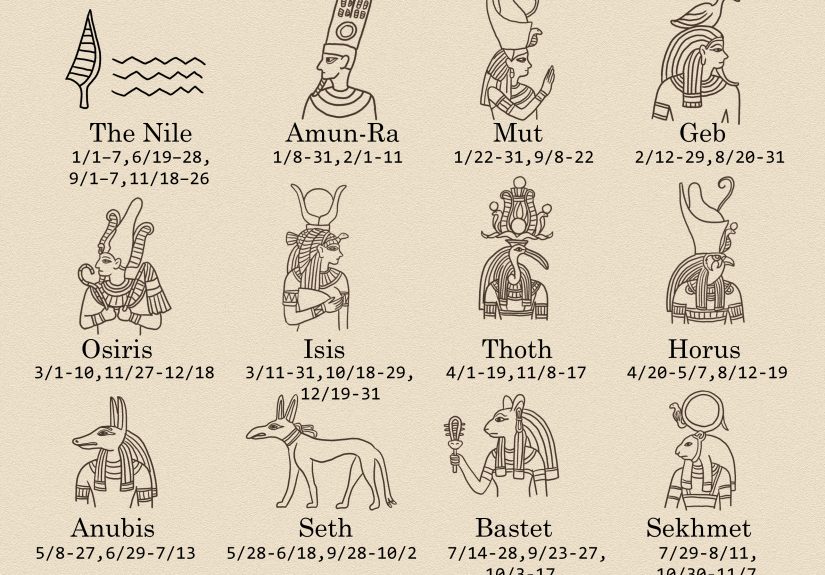
Here is a commonly used Egyptian zodiac date chart. Because different sources sometimes list slightly different dates, the ranges below reflect one of the most popular modern interpretations.
| Egyptian Zodiac Sign | Common Birth Dates | Core Meaning |
|---|---|---|
| The Nile | Jan 1–7, Jun 19–28, Sep 1–7, Nov 18–26 | Peace, wisdom, adaptability |
| Amon-Ra | Jan 8–21, Feb 1–11 | Leadership, confidence, creation |
| Mut | Jan 22–31, Sep 8–22 | Nurturing, protection, inner strength |
| Geb | Feb 12–29, Aug 20–31 | Earthiness, loyalty, sensitivity |
| Osiris | Mar 1–10, Nov 27–Dec 18 | Renewal, resilience, transformation |
| Isis | Mar 11–31, Oct 18–29, Dec 19–31 | Healing, devotion, magic |
| Thoth | Apr 1–19, Nov 8–17 | Wisdom, communication, learning |
| Horus | Apr 20–May 7, Aug 12–19 | Vision, courage, justice |
| Anubis | May 8–27, Jun 29–Jul 13 | Intuition, mystery, guidance |
| Seth | May 28–Jun 18, Sep 28–Oct 2 | Change, intensity, independence |
| Bastet | Jul 14–28, Sep 23–27, Oct 3–17 | Protection, pleasure, grace |
| Sekhmet | Jul 29–Aug 11, Oct 30–Nov 7 | Power, passion, discipline |
The 12 Egyptian Zodiac Signs and Their Meanings
1. The Nile: The Sign of Peace and Renewal
Dates: January 1–7, June 19–28, September 1–7, November 18–26
The Nile is the only Egyptian zodiac sign not named after a god or goddess, but that does not make it any less powerful. In ancient Egypt, the Nile was life itself. It watered crops, supported trade, shaped the calendar, and gave civilization its rhythm. People born under the Nile sign are often described as calm, practical, peaceful, and adaptable.
Nile personalities tend to be natural problem-solvers. They may not enter a room with fireworks, but they often become the person everyone quietly relies on. They are steady without being boring, emotional without being chaotic, and wise without needing to announce, “I am wise,” which is usually a strong sign someone is not.
Strengths: patience, emotional balance, practicality, compassion.
Challenges: avoiding conflict too often, holding feelings inside, resisting necessary change.
2. Amon-Ra: The Sign of Leadership and Creation
Dates: January 8–21, February 1–11
Amon-Ra combines the creative power of Amun with the solar force of Ra, making this sign one of authority, confidence, and vision. People born under Amon-Ra are often seen as natural leaders. They like progress, clarity, and results. If a group project is falling apart, an Amon-Ra person is the one building a spreadsheet while everyone else is still “brainstorming vibes.”
This sign is associated with charisma, ambition, and strong decision-making. Amon-Ra personalities often inspire others because they radiate purpose. They do best when they use their influence generously rather than turning every conversation into a royal decree.
Strengths: leadership, optimism, courage, creativity.
Challenges: impatience, pride, difficulty accepting criticism.
3. Mut: The Sign of Protection and Inner Wisdom
Dates: January 22–31, September 8–22
Mut is a mother goddess associated with protection, divine femininity, and quiet strength. Those born under Mut are often nurturing, thoughtful, and emotionally perceptive. They can sense when something is wrong before anyone says a word, which is wonderful unless you are trying to hide the fact that you ate the last cookie.
Mut personalities are not weak just because they are caring. In fact, their softness often hides remarkable endurance. They are the people who hold families, teams, and friendships together. Their challenge is learning to protect themselves as fiercely as they protect everyone else.
Strengths: empathy, patience, loyalty, emotional intelligence.
Challenges: overgiving, worrying too much, neglecting personal needs.
4. Geb: The Sign of Earth, Loyalty, and Sensitivity
Dates: February 12–29, August 20–31
Geb is the Egyptian god of the Earth, and his sign reflects groundedness, dependability, and connection to nature. Geb people tend to be loyal friends, thoughtful partners, and careful decision-makers. They do not usually jump into things without checking the emotional weather, the practical details, and possibly the snack situation.
This Egyptian zodiac sign is deeply sensitive. Geb personalities often feel the moods around them and may need peaceful environments to stay balanced. They thrive when they have routines, honest relationships, and work that feels meaningful rather than rushed.
Strengths: reliability, kindness, patience, stability.
Challenges: stubbornness, moodiness, fear of taking risks.
5. Osiris: The Sign of Transformation and Rebirth
Dates: March 1–10, November 27–December 18
Osiris is connected with death, rebirth, renewal, and the afterlife. As an Egyptian zodiac sign, Osiris represents people who are resilient, insightful, and often shaped by powerful life changes. These individuals may go through intense chapters, but they have a remarkable ability to rise again with more wisdom than before.
Osiris people are often independent thinkers. They may be drawn to leadership, spiritual growth, psychology, research, or anything that reveals what is hidden beneath the surface. They are not afraid of deep conversations. In fact, small talk may make them look for the nearest symbolic sarcophagus to hide in.
Strengths: resilience, insight, determination, emotional depth.
Challenges: intensity, control issues, difficulty letting go of the past.
6. Isis: The Sign of Healing and Devotion
Dates: March 11–31, October 18–29, December 19–31
Isis is one of the most beloved goddesses in Egyptian mythology, associated with magic, motherhood, healing, devotion, and protection. People born under the Isis sign are often compassionate, persuasive, and emotionally generous. They have a gift for making others feel seen and supported.
Isis personalities may be drawn to caregiving, teaching, creative work, counseling, or community-building. They are often excellent at turning emotional chaos into something meaningful. Their challenge is remembering that healing others does not mean signing a lifetime contract to fix everyone’s drama.
Strengths: compassion, intuition, loyalty, creativity.
Challenges: emotional exhaustion, rescuing others, taking things personally.
7. Thoth: The Sign of Wisdom and Communication
Dates: April 1–19, November 8–17
Thoth is associated with writing, wisdom, knowledge, measurement, and magic. People born under Thoth are often curious, intelligent, expressive, and analytical. They enjoy learning new things and may have a talent for explaining complicated ideas in a way that does not make everyone want to fake a phone call.
Thoth personalities are natural communicators. They may shine as writers, teachers, strategists, researchers, speakers, or problem-solvers. Their minds move quickly, which can be a blessing and a curse. The blessing: brilliant ideas. The curse: overthinking one text message for forty-three minutes.
Strengths: intelligence, communication, adaptability, curiosity.
Challenges: nervous energy, overanalysis, emotional distance.
8. Horus: The Sign of Vision and Courage
Dates: April 20–May 7, August 12–19
Horus, often represented as a falcon or falcon-headed god, is linked with kingship, protection, the sky, and the famous Eye of Horus. As a zodiac sign, Horus represents clear vision, bravery, and the desire to do what is right. Horus people tend to be ambitious, direct, and protective of those they love.
These individuals often see possibilities others miss. They can be excellent planners and bold decision-makers, especially when they trust their instincts. However, they may need to watch out for becoming too competitive or assuming they are the only person in the room with a working compass.
Strengths: courage, focus, leadership, loyalty.
Challenges: impatience, competitiveness, emotional guardedness.
9. Anubis: The Sign of Mystery and Guidance
Dates: May 8–27, June 29–July 13
Anubis is associated with mummification, the afterlife, and guiding souls through transition. People born under Anubis are often introspective, intuitive, private, and deeply observant. They notice what others miss, especially emotional undercurrents and unspoken truths.
Anubis personalities may be drawn to mystery, spirituality, psychology, history, investigation, or healing work. They often need solitude to recharge. Their inner world is rich, but they may not reveal it quickly. Getting to know an Anubis person can feel like entering a beautifully guarded temple: worth it, but do not expect the doors to swing open on the first knock.
Strengths: intuition, depth, patience, wisdom.
Challenges: secrecy, melancholy, emotional withdrawal.
10. Seth: The Sign of Change and Intensity
Dates: May 28–June 18, September 28–October 2
Seth is often associated with chaos, storms, conflict, and desert power. That may sound alarming, but in symbolic terms, Seth represents disruption that forces growth. People born under Seth are usually strong-willed, independent, intense, and allergic to being controlled.
Seth personalities are not here for a beige life. They question rules, challenge assumptions, and push through obstacles. They may be excellent entrepreneurs, reformers, innovators, or crisis managers. Their challenge is learning that not every situation requires a thunderstorm. Sometimes a calm email will do.
Strengths: independence, courage, originality, determination.
Challenges: impulsiveness, rebellion, emotional volatility.
11. Bastet: The Sign of Grace and Protection
Dates: July 14–28, September 23–27, October 3–17
Bastet is associated with cats, protection, music, pleasure, fertility, and the home. As an Egyptian zodiac sign, Bastet represents charm, sensitivity, elegance, and emotional intelligence. Bastet people often have a soothing presence, but they also know when to extend the claws.
This sign blends softness with alertness. Bastet personalities can be playful, affectionate, artistic, and graceful, yet fiercely protective of their boundaries. They usually appreciate beauty, comfort, and harmony. Their challenge is not hiding behind charm when direct communication would solve the problem faster.
Strengths: charm, intuition, creativity, protectiveness.
Challenges: avoidance, mood changes, sensitivity to criticism.
12. Sekhmet: The Sign of Power and Discipline
Dates: July 29–August 11, October 30–November 7
Sekhmet is a lioness goddess associated with power, war, healing, and fierce divine justice. People born under Sekhmet are often passionate, disciplined, confident, and intense. They can be warm and loyal, but they are not usually the type to tolerate nonsense for long. Their patience has a password, and not everyone gets access.
Sekhmet personalities often perform well in high-pressure situations. They may be drawn to leadership, advocacy, medicine, athletics, law, entrepreneurship, or any field requiring courage and stamina. Their growth path involves balancing strength with gentleness, because true power does not need to roar every five minutes.
Strengths: courage, discipline, passion, protection.
Challenges: anger, perfectionism, dominance, burnout.
How to Use Egyptian Zodiac Meanings in Real Life
The Egyptian zodiac is most useful when treated as a self-reflection tool rather than a strict rulebook. Your sign does not trap you inside a personality pyramid. Instead, it offers symbolic language for understanding your strengths, emotional habits, and growth opportunities.
For example, if you are a Thoth sign, you might ask yourself whether you are using your communication skills to build understanding or simply winning arguments for sport. If you are a Mut sign, you might reflect on whether your nurturing nature includes yourself. If you are a Seth sign, you might consider whether your desire for change is creating freedom or just rearranging the furniture during every emotional thunderstorm.
Egyptian zodiac meanings can also be fun in relationships. A Bastet person may crave affection, beauty, and emotional safety, while a Horus person may need shared goals and mutual respect. An Anubis person may require quiet trust before opening up, while an Amon-Ra person may feel most alive when pursuing a purpose. These differences can help people understand each other with more humor and less “Why are you like this?” energy.
Egyptian Zodiac Compatibility: A Simple Way to Think About It
Compatibility in Egyptian astrology is usually interpreted through shared values, emotional rhythm, and symbolic balance. Water-like signs such as the Nile and Isis may connect through empathy and healing. Earthy Geb may feel comfortable with nurturing Mut or graceful Bastet. Visionary Horus may admire the confidence of Amon-Ra, while intense Seth may find grounding through steady signs that do not panic at a little chaos.
That said, compatibility is never just about signs. A relationship between two people is shaped by communication, maturity, timing, honesty, and whether both people know how to load a dishwasher without turning it into a courtroom drama. Use Egyptian zodiac compatibility as a playful guide, not a verdict from the gods.
Personal Experiences and Reflections on the Egyptian Zodiac
Exploring the 12 Egyptian zodiac signs can feel surprisingly personal, even if you approach astrology with one eyebrow raised. Many readers first come to this topic out of curiosity. Maybe they already know they are a Taurus, Leo, Scorpio, or Capricorn and want to see whether an Egyptian sign adds another layer to the personality puzzle. The experience is a little like trying on a different style of jacket: it may not replace your whole wardrobe, but it can reveal something interesting about how you see yourself.
One enjoyable way to use the Egyptian zodiac is to read your sign and notice what immediately feels accurate. A Nile person might laugh at the description of being the calm one in a crisis because they have spent years being everyone’s unofficial emotional support river. A Thoth person might recognize the habit of researching a simple question until they have seventeen browser tabs open and a new respect for ancient scribes. A Sekhmet person may feel very seen by the phrase “fierce but protective,” especially if they have ever defended a friend with the energy of a lioness guarding a sacred temple.
Another useful experience is comparing your Egyptian zodiac sign with your Western zodiac sign. Sometimes they reinforce each other. A Western Aries with a Horus or Sekhmet sign may feel extra aligned with courage, action, and bold leadership. A Cancer with an Isis or Mut sign may strongly identify with caregiving, emotional intelligence, and loyalty. Other times, the signs create contrast. A practical Virgo with a Seth sign might discover an inner rebel beneath all that careful planning. A free-spirited Sagittarius with a Geb sign might notice a hidden need for stability, nature, and emotional grounding.
The Egyptian zodiac can also become a fun conversation starter. Instead of asking the same predictable small-talk questions, you can ask friends, “Do you want to know your Egyptian zodiac sign?” People usually say yes, because humans are naturally curious about themselves. Then the room suddenly becomes a tiny mystical workshop. Someone finds out they are Bastet and immediately claims elegant cat energy. Someone else discovers they are Anubis and starts nodding mysteriously, as if they have always suspected they were spiritually wearing black linen. It is harmless, memorable, and much better than discussing the weather for the fifth time.
On a deeper level, these signs can encourage self-awareness. The best use of any symbolic system is not to excuse behavior but to understand it. Seth does not get a free pass to create chaos. Mut does not have to become everyone’s unpaid therapist. Amon-Ra does not need to lead every group dinner like a board meeting. Each sign contains both a gift and a growth edge. When read thoughtfully, the Egyptian zodiac becomes less about prediction and more about personal development.
Many people also enjoy the mythological richness behind the signs. Learning about Isis, Osiris, Horus, Anubis, Bastet, and Sekhmet opens the door to ancient Egyptian stories about love, loss, power, protection, justice, and renewal. These myths have lasted for thousands of years because they speak to patterns that still feel human today. We still face change. We still seek wisdom. We still want protection, purpose, healing, and courage. The names may be ancient, but the themes are very current.
In that sense, the Egyptian zodiac works best as a mirror. It reflects qualities you may already know, qualities you are developing, and qualities you might want to balance. Whether you take it seriously, lightly, or somewhere in the middle, it offers a creative way to think about personality through the dramatic and beautiful language of Egyptian symbolism. And honestly, any self-discovery system that lets you say, “I’m ruled by Bastet,” is already winning the branding game.
Conclusion: What Your Egyptian Zodiac Sign Can Teach You
The 12 Egyptian zodiac signs and their meanings offer a rich blend of mythology, symbolism, and personality insight. From the peaceful wisdom of the Nile to the fierce discipline of Sekhmet, each sign highlights a different way of moving through the world. Some signs are nurturing, some are bold, some are mysterious, and some arrive with enough storm energy to reorganize your entire life before breakfast.
While the Egyptian zodiac should not be treated as a guaranteed destiny map, it can be a meaningful and entertaining tool for reflection. It invites you to ask better questions: What are my natural strengths? What patterns do I repeat? Where do I need more balance? Which ancient deity would most likely judge my calendar habits?
Whether your sign is Amon-Ra, Isis, Thoth, Anubis, Bastet, or another Egyptian archetype, the real value lies in using the symbolism wisely. Let it inspire curiosity, self-awareness, and maybe a little well-earned dramatic flair. After all, if you are going to explore your personality, you might as well do it with pyramids, gods, goddesses, sacred cats, and cosmic mystery.