Table of Contents >> Show >> Hide
- 1. Banqiao Dam Failure (China, 1975)
- 2. Chernobyl Reactor No. 4 (Ukraine, 1986)
- 3. Bhopal Gas Tragedy (India, 1984)
- 4. Deepwater Horizon (Gulf of Mexico, 2010)
- 5. Sampoong Department Store Collapse (South Korea, 1995)
- 6. Hyatt Regency Walkway Collapse (United States, 1981)
- 7. Space Shuttle Challenger (United States, 1986)
- 8. Quebec Bridge Collapse (Canada, 1907 and 1916)
- 9. St. Francis Dam Disaster (United States, 1928)
- 10. Tacoma Narrows Bridge Collapse (United States, 1940)
- What These Engineering Disasters Have in Common
- Experience and Lessons: Why These Failures Still Feel Uncomfortably Current
- Conclusion
Note: Clean publication-ready body HTML only; placeholder citation artifacts have been omitted.
Engineering is supposed to be the grown-up in the room. It does the math, checks the load path, respects the weather, and remembers that gravity is never “just brainstorming.” Yet history is packed with moments when design flaws, bad assumptions, ignored warnings, weak oversight, or plain old organizational arrogance turned impressive projects into unforgettable engineering disasters.
This list of the top 10 worst engineering disasters is not just about body counts or headlines. It is about scale, preventability, technical failure, and the lessons that reshaped modern structural engineering, safety culture, risk management, and forensic engineering. Some of these failures happened in bridges, some in buildings, some in dams, and some in high-tech systems that were supposed to represent the future. Together, they tell one brutal truth: when engineering discipline disappears, consequences show up fast.
So here are ten disasters that still haunt classrooms, design reviews, and safety meetings everywhere. It is a grim hall of fame, but also a useful one.
1. Banqiao Dam Failure (China, 1975)
If “worst” includes catastrophic human impact, the Banqiao Dam failure belongs near the top of any list. Built to support flood control and power generation, the dam was designed for what was considered a “once-in-a-thousand-years” flood. Then nature arrived with the subtlety of a wrecking ball. Typhoon Nina dumped rainfall beyond the design assumptions, Banqiao failed, and dozens of other dams failed with it.
What makes this disaster such a defining engineering failure is not only the scale of the flooding, but the system-level collapse behind it. Design assumptions proved inadequate, resilience planning was not enough, and the absence of an early-warning system and evacuation plan made a terrible situation much worse. In engineering terms, this was not a single bad bolt or cracked beam. It was a failure of infrastructure, planning, communication, and emergency preparation all at once.
Banqiao is the kind of case that forces engineers to confront an uncomfortable reality: a structure can be “designed to spec” and still fail catastrophically if the spec is too optimistic for the real world.
2. Chernobyl Reactor No. 4 (Ukraine, 1986)
Chernobyl remains the most infamous nuclear engineering disaster in history, and for good reason. A safety test turned into the exact opposite of safety after operators disabled key protection systems, pushed the reactor into an unstable state, and triggered a power surge that led to explosions and a massive release of radiation.
This was not merely a machine breaking. It was the collision of flawed reactor design, weak safety culture, poor operator preparation, and a command structure that rewarded procedure-bending until the laws of physics finally filed a formal complaint. Chernobyl showed that in high-risk engineering, “routine test” can be one of the most dangerous phrases in the language.
Its legacy changed global nuclear oversight. It also changed how engineers discuss human factors. The lesson was not that technology is inherently evil. The lesson was that dangerous systems become deadly when design weaknesses and management blindness start enabling each other.
3. Bhopal Gas Tragedy (India, 1984)
The Bhopal disaster stands as one of the worst industrial and chemical engineering failures ever recorded. A leak of methyl isocyanate gas at a pesticide plant exposed hundreds of thousands of people. Safety systems were offline or ineffective, maintenance had slipped, and dangerous conditions were allowed to build until the situation crossed from preventable to historic.
What makes Bhopal especially horrifying from an engineering perspective is how many layers of protection appear to have been weakened at once. Hazardous material storage, instrumentation, emergency systems, operating discipline, and community preparedness all failed in overlapping ways. That is the nightmare scenario in process engineering: not one problem, but a lineup of problems all showing up for work on the same shift.
Bhopal permanently changed discussions around industrial safety, environmental justice, emergency planning, and international standards. It is now a textbook reminder that cost-cutting in hazardous operations is never really “saving money.” It is just borrowing disaster on terrible terms.
4. Deepwater Horizon (Gulf of Mexico, 2010)
Deepwater Horizon was a modern engineering disaster in every sense: advanced drilling technology, complex offshore systems, multiple contractors, high pressure, and catastrophic failure. The explosion killed workers, sank the rig, and led to the largest offshore oil spill in U.S. history.
Engineers studying the case often focus on the blowout preventer, the device that sounds like it should absolutely prevent a blowout because, well, it is literally named that. Investigations later found that the blind shear ram could not fully seal because the drill pipe had buckled and shifted off-center. That detail matters because it reveals a classic engineering trap: building a safety device for ideal conditions and then meeting real conditions instead.
Deepwater Horizon also exposed organizational failure on a grand scale. Well integrity decisions, testing interpretation, equipment limitations, and safety management all became part of the disaster story. The event pushed major reforms in offshore safety and remains a landmark case in systems engineering, human factors, and disaster prevention.
5. Sampoong Department Store Collapse (South Korea, 1995)
The Sampoong Department Store collapse was the kind of structural failure that makes every engineer’s jaw tighten. The building was seriously overloaded, constructed with inferior concrete, and compromised by unsafe modifications. In other words, it was not ambushed by mystery. It was sabotaged by negligence.
One of the ugliest lessons from Sampoong is that warning signs existed. Cracks appeared. Distress was visible. But when business pressure outruns engineering judgment, people sometimes keep the doors open and hope reality becomes optional. It does not.
This disaster is often taught as a case study in what happens when structural design is altered without proper analysis and when obvious red flags are treated like minor inconveniences. Buildings do not usually collapse because concrete suddenly gets moody. They collapse because decisions stack up for years until the structure cannot negotiate anymore.
6. Hyatt Regency Walkway Collapse (United States, 1981)
The Hyatt Regency walkway collapse in Kansas City is one of the most taught structural engineering failures in the United States, and it deserves that grim honor. Two suspended walkways failed during a crowded event, killing 114 people and injuring many more.
The technical story is almost absurd in its simplicity, which is what makes it so chilling. A design change in the hanger rod system altered the load path and dramatically weakened the connection. Investigators found that with the change, the capacity was only about 60 percent of what the local code expected. That is not a small oversight. That is the sort of number that should make every review process in the building pause and scream.
The Hyatt disaster transformed the teaching of engineering ethics and shop drawing review. It showed that technical failure is often also a communication failure. When everyone assumes someone else checked the math, nobody checks the math. And then the math checks everyone.
7. Space Shuttle Challenger (United States, 1986)
Challenger was not just a space tragedy. It was a management and engineering cautionary tale launched live on television. The immediate technical problem involved the solid rocket booster field joint and O-rings whose sealing performance was vulnerable in cold conditions. Engineers had seen warning signs before, yet the launch proceeded under unusually low temperatures.
The deeper problem was cultural. Challenger became the classic example of normalization of deviance: when repeated near-misses slowly start to feel normal, acceptable, and survivable, right up until they are not. That phrase still gets used in engineering, medicine, aviation, and manufacturing because it names a very human habit: if disaster does not happen today, people start acting like it cannot happen tomorrow.
Challenger changed NASA, but it also changed how every serious industry talks about dissent, escalation, and technical risk. An engineering organization that cannot hear bad news is already designing its next failure.
8. Quebec Bridge Collapse (Canada, 1907 and 1916)
The Quebec Bridge project earns its place on this list because it did not fail once. It failed twice. The first collapse in 1907 resulted from design flaws and management errors during the construction of what was then one of the world’s most ambitious bridges. A later attempt also suffered a disastrous failure during erection.
Engineers still study Quebec because it exposed the danger of pushing scale without adequate recalculation, oversight, and respect for changing loads. Big projects love ambition. Physics loves receipts. The bridge collapse reminded the profession that design assumptions must be tested relentlessly, especially when a project is breaking new ground.
The aftermath helped drive better research, better testing, and better coordination between designers and constructors. It also became part of engineering folklore for a reason: prestige does not protect a project from arithmetic.
9. St. Francis Dam Disaster (United States, 1928)
The St. Francis Dam disaster remains one of the worst civil engineering failures in American history. Cracks and leaks had been observed, but they were brushed aside as normal. Then, just before midnight, the dam collapsed and billions of gallons of water surged downstream.
Investigations later pointed to the unsuitability of the rock foundation and surrounding geology for supporting the structure and reservoir. This is a classic geotechnical lesson: a beautiful design on bad ground is still a bad design. Civil engineering is never just about concrete and steel. It is also about the earth beneath them, and the earth does not care about a project schedule.
St. Francis helped shape modern dam safety practice by showing how dangerous it is to dismiss field evidence. If a structure is talking to you through seepage, cracking, or deformation, it is not being dramatic. It is sending the engineering equivalent of a medical alarm.
10. Tacoma Narrows Bridge Collapse (United States, 1940)
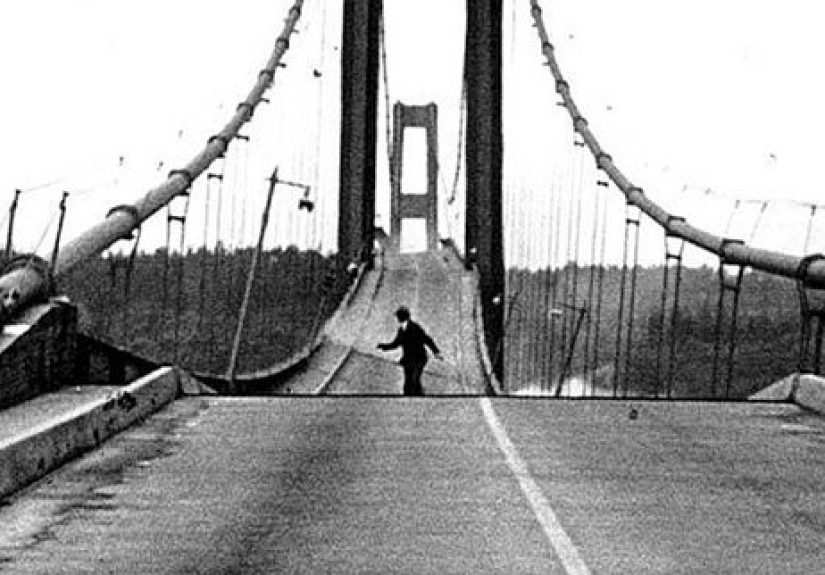
Tacoma Narrows is probably the most famous “looked fine on paper” failure in bridge engineering. The bridge opened in July 1940 and collapsed just months later after wind-induced oscillations and torsional motion took over. It was elegant, slender, modern, and spectacularly vulnerable.
The real value of Tacoma Narrows is what it taught the profession. Investigators recognized excessive flexibility, aerodynamic drag and lift effects, and the need for wind tunnel testing and better aerodynamic analysis. In short, the bridge failed because designers had not fully accounted for how wind and structure could start dancing together in exactly the worst way.
That legacy changed suspension bridge design permanently. Today, aerodynamic testing is routine for major bridges, and that is one reason why “Galloping Gertie” still shows up in engineering lectures. It is the bridge that taught modern designers not to treat wind as background decoration.
What These Engineering Disasters Have in Common
For all their differences, these disasters rhyme. Again and again, the same themes appear: underestimated loads, misunderstood physics, ignored warnings, weak review processes, and leadership that confused confidence with competence. The specific hardware changes from bridges to reactors to rigs, but the pattern is stubbornly familiar.
The biggest shared lesson is that engineering failure is rarely one dramatic mistake made in total isolation. More often, it is a chain. A bad assumption survives review. A warning gets downgraded. A safety margin gets treated like spare room. A schedule gets priority over caution. A temporary workaround becomes permanent. Then one day the system runs out of luck.
That is why the best modern engineering is not just about stronger materials or smarter software. It is also about stronger cultures: peer review, inspection, documentation, independent testing, operational discipline, and the courage to stop when something feels wrong. Good engineering is not glamorous all the time. Often it is just stubborn, careful, slightly paranoid professionalism. Thankfully, that turns out to be a wonderful habit.
Experience and Lessons: Why These Failures Still Feel Uncomfortably Current
One reason these worst engineering disasters still matter is that they do not feel old. The technology changes, the software gets prettier, the dashboards become more colorful, and everyone suddenly has a digital twin, a predictive model, or a very confident slide deck. But the emotional and organizational experience behind these failures is still painfully familiar.
Anyone who has worked around design, construction, operations, or maintenance knows the atmosphere that often appears before trouble. A team starts normalizing weird behavior in a system because “it has done that before.” An inspection note gets postponed because the schedule is packed. Someone says a crack is probably cosmetic. A manager asks whether a shutdown is really necessary. A contractor assumes the owner reviewed the revision. The owner assumes the engineer reviewed it. The engineer assumes the fabricator understood the intent. Suddenly, responsibility is everywhere, which means it is nowhere.
The experience of studying these disasters also changes how people look at ordinary structures. After learning about Hyatt Regency, a suspended walkway does not seem decorative anymore; it looks like a load path waiting to be respected. After Tacoma Narrows, a windy bridge is not just scenic; it becomes a moving lesson in aeroelastic behavior. After Bhopal and Deepwater Horizon, “backup safety system” stops sounding comforting if maintenance, testing, and operating conditions are not equally robust.
There is also a personal side to these cases. Engineers, inspectors, operators, and even nontechnical readers often come away with the same uncomfortable realization: many of these disasters were not unimaginable. They were imaginable, visible, and in some cases openly discussed before they happened. That is what makes them so haunting. They were often less like lightning strikes and more like alarms with the volume turned down.
In practical terms, the experience-based lesson is simple. Respect small warnings. Document concerns clearly. Review changes like they matter, because they do. Design for ugly real-world conditions, not fantasy conditions. Assume people will misunderstand something and build processes that catch it. Most of all, create a culture in which someone can say, “Stop, this does not look safe,” without being treated like the enemy of progress.
That may be the most important takeaway from the top engineering disasters in history. The goal of studying them is not to collect terrifying trivia. It is to get better at noticing the moment when a manageable problem is trying to become a catastrophe. In that sense, these failures are not just stories from the past. They are rehearsal notes for the future, and smart teams would be wise to keep them close.