Table of Contents >> Show >> Hide
- The Exam Room Has a Third Guest: The Screen
- Why Doctors Spend So Much Time Looking at Screens
- What Patients Feel When the Doctor Looks Away
- How Screen-Focused Care Can Affect Trust
- The Physician Side: Burnout Behind the Keyboard
- When Screens Help Patients
- Common Mistakes That Make Screen Use Feel Worse
- How Physicians Can Reclaim the Patient Relationship
- How Healthcare Organizations Can Fix the System
- What Patients Can Do During a Screen-Heavy Visit
- The Future: More Digital, More Human
- Additional Experiences: What It Feels Like When the Screen Takes Over
- Conclusion: Put the Patient Back in the Center of Digital Care
Note: This article is written for web publication in standard American English and synthesizes current, reputable U.S. healthcare research and expert guidance on electronic health records, patient communication, clinician burnout, documentation burden, and digital health workflow design.
The Exam Room Has a Third Guest: The Screen
There was a time when a doctor’s most recognizable tools were a stethoscope, a clipboard, and the mysterious ability to write prescriptions in handwriting that looked like it had survived a tornado. Today, the modern exam room has a new star: the screen. It glows from the corner, sits on a rolling cart, or waits patiently on a tablet. It holds lab results, medication lists, specialist notes, allergy warnings, imaging reports, insurance details, patient messages, and a thousand tiny checkboxes that seem to multiply when nobody is looking.
Electronic health records, commonly called EHRs, were created with good intentions. They can make medical information easier to access, reduce duplicate tests, improve coordination between clinicians, and help patients see parts of their own health history through online portals. In the best cases, health technology helps physicians make safer, faster, better-informed decisions. That is the dream.
But in many clinics, the dream comes with a very loud keyboard. Patients sometimes feel as if they are competing with a computer for their doctor’s attention. The physician may be physically in the room, but mentally split between the person speaking and the blinking cursor demanding a complete note, billing code, refill decision, preventive screening reminder, and response to an inbox message that arrived 38 seconds ago. The result is a strange modern tension: healthcare is more digitally connected than ever, yet some patients feel less personally seen.
Why Doctors Spend So Much Time Looking at Screens
To understand the problem, it helps to avoid the easy villain. Most physicians do not wake up excited to ignore patients and romance a desktop monitor. The screen often represents a pile of obligations that have been pushed into the clinical visit: documentation, regulatory requirements, medication reconciliation, quality reporting, prior authorization details, referral tracking, patient portal messages, and billing-related data entry.
In many outpatient settings, a physician is expected to listen carefully, diagnose accurately, counsel compassionately, document thoroughly, order correctly, prescribe safely, satisfy legal standards, meet quality metrics, and keep the schedule moving. That is a lot to accomplish in a visit that may last 15 to 30 minutes. The EHR becomes the place where all of those demands collide.
The EHR Is Not Just a Chart
A paper chart was mostly a record. A modern EHR is a record, communication hub, order system, safety alert machine, billing engine, scheduling tool, analytics database, compliance tracker, and inbox. It can help clinicians catch drug interactions, track preventive care, share notes with specialists, and monitor population health. But because it is asked to serve so many masters, it can also become cluttered and exhausting.
Many physicians describe “pajama time,” the after-hours work spent finishing notes, answering messages, reviewing results, and closing charts from home. The phrase sounds cozy, as if someone is sipping cocoa while writing a novel. In reality, it often means a tired clinician completing documentation at night instead of resting, exercising, spending time with family, or recovering from a long day of decision-making.
More Clicks Do Not Always Mean Better Care
Digital documentation can create a false sense of productivity. A note can be long, detailed, and beautifully formatted while still failing to capture the patient’s real concern. A physician can click every required box and still miss the small pause before a patient says, “Actually, there is something else.” Medicine depends on information, but healing also depends on attention.
What Patients Feel When the Doctor Looks Away
Patients rarely judge screen use only by the number of minutes a physician spends typing. They judge it by how the visit feels. Did the doctor greet them warmly? Did the physician make eye contact before opening the chart? Did the doctor explain what was being typed? Did the screen support the conversation, or did it swallow the conversation whole?
A patient with chest discomfort may feel nervous when a doctor silently types for several minutes. A parent describing a child’s symptoms may wonder whether the physician is listening or simply entering data. A person receiving a difficult diagnosis may remember not just the words spoken, but whether the physician turned away at the most vulnerable moment.
This is where screen behavior becomes communication. Looking at a computer is not automatically rude. In fact, patients often appreciate when physicians check medication interactions, review lab trends, or pull up imaging results. The problem appears when the screen is used without explanation, when silence stretches too long, or when the patient becomes an accessory to the chart instead of the center of the visit.
The “Invisible Wall” Effect
A poorly positioned computer can create an invisible wall. If the monitor faces only the doctor, the patient may feel excluded from their own information. If the physician’s back is turned while typing, the conversation becomes awkward. If the doctor repeatedly interrupts the patient to satisfy a pop-up alert, the visit can feel more like a software troubleshooting session than a medical encounter.
Small details matter. A chair angled toward the patient, a screen that can be shared, and a simple explanation such as “I’m going to check your medication list while you tell me about the dizziness” can transform the mood of a visit. The technology may be the same, but the human experience changes dramatically.
How Screen-Focused Care Can Affect Trust
Trust is not built only through medical accuracy. It is built through presence. Patients need to believe that their physician understands the problem, respects their concerns, and sees them as a whole person rather than a collection of fields in a database.
When physicians focus too much on screens, patients may become less likely to share sensitive details. Someone struggling with medication costs, anxiety, family stress, or symptoms they find embarrassing may hold back if the doctor appears rushed or distracted. Those missing details can matter. A patient’s story often contains clues that no lab value can provide.
Communication research has long shown that listening, empathy, open-ended questions, and patient-centered conversation improve the quality of clinical encounters. Digital tools should strengthen those skills, not replace them. A brilliant EHR cannot notice a patient’s worried expression unless the physician looks up.
Patients Want Technology, But They Want Humanity More
Most patients are not asking doctors to abandon technology. They want accurate records, fast test results, safer prescriptions, and coordinated care. They also want a physician who remembers that the body attached to the data has fears, preferences, work schedules, family responsibilities, and sometimes a very creative Google search history.
The goal is not screen-free medicine. That would be unrealistic and, in many ways, unsafe. The goal is screen-smart medicine: using digital systems in ways that support the relationship rather than crowd it out.
The Physician Side: Burnout Behind the Keyboard
It is easy for frustrated patients to blame doctors for staring at screens, but physicians are often frustrated too. Many clinicians entered medicine to diagnose, counsel, comfort, and treat people. Few dreamed of becoming full-time documentation athletes. Yet administrative burden has become a major driver of professional dissatisfaction.
Physician burnout is not simply being tired after a hard week. It can involve emotional exhaustion, cynicism, reduced sense of accomplishment, and the feeling that the work has become disconnected from its purpose. When doctors spend large portions of their day on clerical tasks, the work can feel less like medicine and more like feeding a very hungry computer.
The Inbox Never Sleeps
The patient portal has improved access in many ways. Patients can ask questions, request refills, view results, and communicate with the care team without waiting on hold. That is valuable. But the volume of messages can become overwhelming, especially when every message requires review, documentation, triage, or follow-up. A simple question may be medically important. A refill request may require checking labs. A lab result may trigger a cascade of new decisions.
From the patient’s side, sending a message feels efficient. From the physician’s side, hundreds of messages can create a second clinic day hidden inside the first one. This does not mean patients should stop using portals. It means healthcare organizations need smarter systems for routing, staffing, and compensating digital care work.
When Screens Help Patients
It would be unfair to treat screens as the enemy. Digital records have real benefits. A physician can quickly review a patient’s history, see allergies, compare lab results over time, check whether a colon cancer screening is overdue, and coordinate with specialists. During emergencies, access to medication lists and prior diagnoses can be extremely important.
Patient portals can also empower people to understand their care. Many patients now read visit notes, track test results, and prepare better questions for follow-up appointments. Digital access can make healthcare less mysterious. That is a major improvement over the old days when records lived in filing cabinets and patients had to request copies as if they were asking to borrow a national treasure.
The Best Use of the Screen Is Collaborative
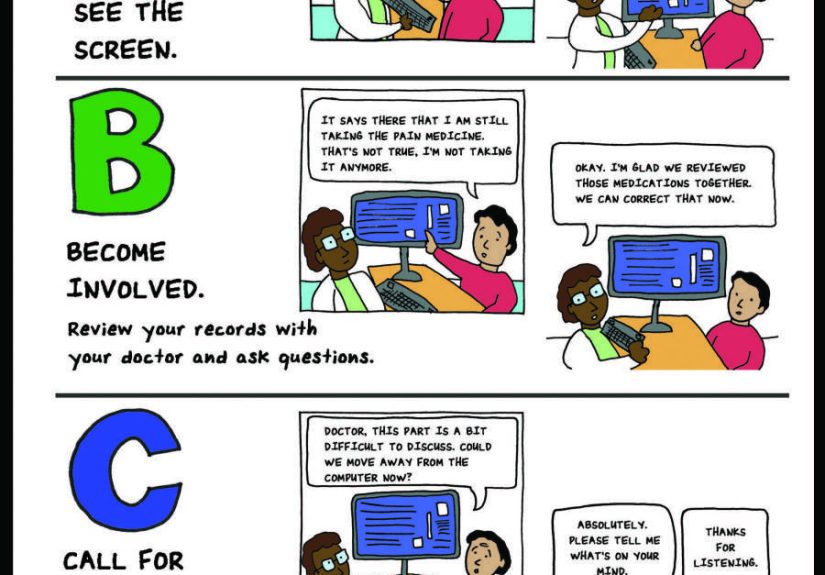
One of the most effective approaches is “shared screen” communication. Instead of hiding the monitor, the physician turns it slightly toward the patient and says, “Let’s look at your cholesterol trend together,” or “Here is the X-ray report, and I’ll explain what this language means.” Suddenly the screen becomes a teaching tool, not a barrier.
Shared screen use can also improve accuracy. Patients may notice an outdated medication, a wrong pharmacy, or a missing allergy. They may better understand why a treatment plan is recommended. When patients participate in reviewing information, the EHR becomes part of the conversation rather than a silent competitor.
Common Mistakes That Make Screen Use Feel Worse
Some screen habits are especially damaging to the patient experience. The first is beginning the visit with the chart instead of the person. A physician who enters the room, says hello without looking up, and immediately starts typing sends an unfortunate message: the computer is first in line.
The second mistake is silent typing. Patients are usually more comfortable when they know what is happening. A short explanation can make a big difference: “I’m entering this now so the referral is correct,” or “I’m checking your last kidney test before we adjust the medication.” Silence invites suspicion; explanation creates partnership.
The third mistake is letting alerts dominate the visit. EHR reminders can be helpful, but too many pop-ups can fracture attention. If a physician constantly pauses to respond to low-value alerts, the patient may feel like the appointment has been hijacked by a very needy software program.
The Copy-and-Paste Problem
Another issue is documentation bloat. Notes can become packed with copied text, outdated information, and repeated phrases. Long notes are not always better notes. In fact, excessive documentation can make it harder for clinicians to find what matters. A cleaner, more purposeful note can improve both patient care and physician sanity.
How Physicians Can Reclaim the Patient Relationship
Physicians do not need to choose between accurate documentation and human connection. The best clinical communication often comes from intentional habits that make technology visible, understandable, and secondary to the patient.
Start With the Patient, Not the Password
The first minute matters. A physician can begin by making eye contact, greeting the patient by name, and asking an open-ended question before turning to the computer. That small ritual tells the patient, “You are the reason I’m here.” Even in a busy clinic, presence can be established quickly.
Narrate Screen Use
When physicians explain why they are using the computer, patients are less likely to feel ignored. For example: “I’m going to review your last blood pressure readings while you tell me how you’ve been feeling.” This keeps the patient inside the process.
Use the Screen as a Teaching Tool
Graphs, medication lists, imaging results, and after-visit summaries can be powerful when shared. A patient who sees their blood sugar trend may understand the treatment plan better than one who simply hears, “Your numbers are high.” Visual information can support motivation, especially when explained clearly.
Create Screen-Free Moments
Certain moments deserve undivided attention: discussing a new diagnosis, responding to fear, asking about goals of care, or exploring mental health concerns. In those moments, closing the laptop or turning away from the monitor can communicate respect more powerfully than any scripted empathy phrase.
How Healthcare Organizations Can Fix the System
Individual physician habits matter, but this is not only an individual problem. Healthcare organizations must redesign workflows so clinicians are not forced to choose between being good doctors and being excellent data-entry workers.
Reduce Low-Value Documentation
Clinics and health systems should examine which documentation requirements truly improve care and which exist mainly because “we have always done it this way, but now with more clicking.” Reducing unnecessary fields, simplifying templates, and removing redundant data entry can free time for patient care.
Improve EHR Usability
Good design matters. EHR screens should help clinicians find relevant information quickly, place key patient data in logical locations, reduce alert fatigue, and support team-based workflows. A confusing interface is not just annoying; it can increase cognitive burden and raise the risk of mistakes.
Use Team-Based Documentation
Medical assistants, nurses, pharmacists, scribes, and care coordinators can help distribute work appropriately. Team-based care allows physicians to focus more on diagnosis, decision-making, and patient communication. Human scribes and virtual scribes can also reduce the documentation load in some settings, though they require careful privacy, training, and quality oversight.
Explore Ambient Documentation Carefully
Ambient clinical documentation tools, including AI-supported scribes, are gaining attention because they can draft notes from the conversation. Used responsibly, they may help physicians maintain eye contact and reduce after-hours charting. However, these tools must be checked for accuracy, bias, privacy protection, and patient consent. A bad note written faster is still a bad note. Technology should reduce burden without creating new risks.
What Patients Can Do During a Screen-Heavy Visit
Patients do not control the clinic’s software, but they can still advocate for better communication. If a doctor seems absorbed by the screen, a patient can politely ask, “Could you explain what you’re looking at?” or “Can we review that result together?” These questions are reasonable, not rude.
Patients can also bring a concise list of concerns, medications, allergies, and questions. This helps the physician focus the visit and reduces time spent hunting for basic information. For complex issues, patients may say at the beginning, “I have three things I want to cover today. The most important is the chest tightness.” That gives the physician a clear roadmap.
Another useful strategy is to ask for a summary before the visit ends: “Can we go over the plan one more time?” This helps confirm understanding and gives the physician a chance to correct anything that may have been lost in the typing storm.
The Future: More Digital, More Human
Healthcare will not become less digital. Records, test results, remote monitoring, patient portals, telehealth, clinical decision support, and AI tools will continue to expand. The question is not whether screens belong in medicine. They do. The question is whether healthcare can design digital systems that protect the human relationship at the center of care.
The best future is not one where doctors ignore technology. It is one where technology becomes quieter, smarter, and less intrusive. It should gather routine information before the visit, display the right data at the right time, reduce duplicate work, automate low-value tasks, and help patients understand their health. Most importantly, it should give physicians more room to do what only humans can do: listen deeply, interpret uncertainty, comfort fear, and build trust.
Additional Experiences: What It Feels Like When the Screen Takes Over
Imagine a patient named Linda visiting her primary care physician for fatigue. She has rehearsed her symptoms in the car because she does not want to forget anything. She wants to explain that the tiredness is not normal tiredness. It is the kind that makes grocery shopping feel like climbing a mountain while carrying a piano. When the doctor enters, he is kind but rushed. He asks questions while clicking through lab panels, medication lists, and health maintenance reminders.
Linda answers, but she starts trimming her story. She leaves out that she has been feeling unusually sad. She does not mention that she stopped taking one medication because it made her dizzy. The doctor is not uncaring; he is simply managing too many streams of information at once. By the end of the visit, Linda gets lab orders, but not the conversation she needed. The chart is complete, yet the story is incomplete.
Now imagine the same visit handled differently. The physician enters, sits down, and spends the first minute fully facing Linda. “Tell me what worries you most about this fatigue,” he says. After listening, he explains, “I’m going to look at your last labs and medications while you keep talking, because some of these can contribute to tiredness.” He turns the screen slightly so Linda can see. When he notices a medication that may cause dizziness, he asks directly about side effects. Linda feels invited into the process, so she shares more.
The difference is not the absence of technology. The difference is how the technology is introduced. In the second version, the screen supports the relationship. It helps the physician think with the patient instead of away from the patient.
Many patients have similar experiences in specialty care. A cardiology patient may watch a physician scroll through years of test results and feel grateful that the doctor has access to the full history. But if the physician never explains what the numbers mean, the patient may leave more confused than reassured. A dermatologist may type while documenting a rash, but if they pause to show the patient photos, explain warning signs, and confirm the treatment plan, the screen becomes part of education. In pediatrics, a parent may feel ignored if the clinician types through the entire visit, but included if the doctor says, “Let’s look at your child’s growth chart together.”
There are also experiences from the physician side that patients rarely see. A doctor may finish a packed clinic day and still have dozens of charts open. Each unfinished note is not just paperwork; it is a memory test. What exactly did the patient say about the headache? Which pharmacy did they prefer? Did the specialist recommend six-week follow-up or eight? The longer documentation waits, the more mental energy it takes. This is one reason physicians may type during the visit: they are trying to preserve accuracy while the information is fresh.
Still, patients are not wrong to want attention. A person who has waited weeks for an appointment should not feel like an interruption to a data-entry process. The emotional truth matters: when someone is sick, scared, or uncertain, eye contact can feel like medicine. A thoughtful pause can lower anxiety. A clear explanation can make complicated care feel manageable.
The most memorable clinical encounters often involve simple human moments. A physician closes the laptop before delivering serious news. A nurse notices confusion and says, “Let me explain that another way.” A specialist prints a diagram and draws on it. A doctor admits, “The computer is being difficult, but I’m listening.” These moments do not require expensive technology. They require awareness.
For healthcare leaders, these experiences should be treated as design evidence. If patients feel ignored and physicians feel overwhelmed, the workflow is sending a message: the system needs repair. Better training can help, but training alone cannot fix impossible schedules, cluttered EHR interfaces, understaffed inbox management, or documentation rules that reward volume over clarity.
For patients, the practical lesson is to stay engaged. Ask to see the screen. Ask what the doctor is typing. Ask for the plan in plain English. Bring a short list of priorities. Speak up if something important has not been addressed. A respectful partnership can help both sides navigate the digital exam room.
For physicians, the lesson is equally practical: make the screen visible, explain its purpose, and protect moments of full attention. Patients can forgive typing. They can understand documentation. What they struggle to forgive is feeling unseen. The best doctors are not the ones who pretend computers do not exist. They are the ones who use computers without letting the computer become the main character.
Conclusion: Put the Patient Back in the Center of Digital Care
When physicians focus more on screens than patients, the problem is rarely a lack of compassion. More often, it is a symptom of a healthcare system that has loaded too much administrative work into the clinical encounter. EHRs can improve safety, coordination, and access to information, but they can also create distraction, documentation burden, and emotional distance.
The solution is not to throw the computer out of the exam room. The solution is to design better systems and practice better communication. Physicians can begin visits with eye contact, narrate screen use, share information visually, and create screen-free moments for sensitive conversations. Healthcare organizations can reduce unnecessary documentation, improve EHR usability, support team-based care, and evaluate new tools like virtual scribes and ambient documentation with care.
Medicine has always depended on information, but it has never been only about information. Patients need accuracy, but they also need attention. They need records, but they also need relationships. In the digital age, the best healthcare will belong to clinics that understand a simple truth: the screen should serve the visit, not steal it.