Table of Contents >> Show >> Hide
- What Is Mass?
- Mass vs. Weight: The Mistake Everyone Makes
- Way 1: Calculate Mass Using Density and Volume
- Way 2: Calculate Mass Using Force and Acceleration
- Way 3: Calculate Mass Using Weight and Gravity
- Which Method Should You Use?
- Quick Comparison Table
- Common Mistakes When Calculating Mass
- Real-Life Uses of Calculating Mass
- Practical Experience: What Calculating Mass Feels Like in Real Life
- Conclusion
- SEO Tags
Mass may sound like one of those science words that only appears in textbooks, lab coats, and dramatic space documentaries, but it shows up everywhere. Your backpack has mass. A bowling ball has mass. A marshmallow has mass, even if it behaves like a tiny edible pillow. In science, mass tells us how much matter an object contains. It is not the same as weight, even though everyday language often treats them like twins who borrowed each other’s clothes.
Weight depends on gravity. Mass does not. A 10-kilogram object has a mass of 10 kilograms on Earth, on the Moon, or floating in space. Its weight changes because gravity changes, but the amount of matter in the object stays the same. That distinction is the key to understanding how to calculate the mass of an object correctly.
The good news: you do not need to be a rocket scientist to calculate mass. You only need the right formula, the right units, and a little patience. The slightly less glamorous news: you do need to avoid mixing up kilograms, grams, newtons, cubic centimeters, and “whatever number came out of the calculator after I panicked.” This guide breaks down three practical ways to calculate mass using density and volume, force and acceleration, and weight and gravity.
What Is Mass?
Mass is the amount of matter in an object. In the International System of Units, the standard unit of mass is the kilogram, written as kg. Smaller objects are often measured in grams, while very tiny quantities may be measured in milligrams. In school labs, kitchens, engineering work, medicine, manufacturing, and physics problems, mass is one of the most important measurements because it helps describe how objects behave.
Mass also relates to inertia. Inertia is an object’s resistance to changes in motion. A tennis ball is easy to throw because it has relatively little mass. A refrigerator is harder to push because it has much more mass and, frankly, because refrigerators have strong opinions about staying where they are.
Mass vs. Weight: The Mistake Everyone Makes
Before calculating mass, it helps to clear up the classic confusion: mass and weight are not identical. Mass measures matter. Weight measures the force of gravity pulling on that matter. On Earth, we often use the word “weight” casually when we really mean mass. For example, when someone says a bag of rice “weighs 5 kilograms,” they usually mean its mass is 5 kilograms. Technically, weight is measured in newtons, not kilograms.
The relationship between weight and mass is:
Weight = mass × gravitational acceleration
In formula form, that is:
W = m × g
On Earth, gravitational acceleration is commonly estimated as 9.8 m/s². So, if an object has a mass of 10 kg, its weight on Earth is about 98 newtons. On the Moon, that same object still has 10 kg of mass, but it weighs much less because the Moon’s gravity is weaker. This is why astronauts can bounce around up there like enthusiastic kangaroos in expensive suits.
Way 1: Calculate Mass Using Density and Volume
The Formula
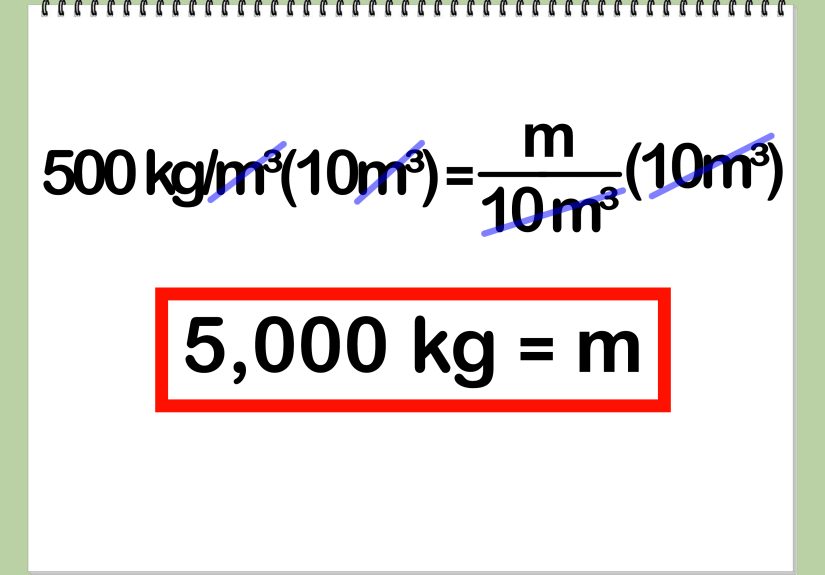
One of the most common ways to calculate the mass of an object is to use density and volume. Density tells you how much mass is packed into a certain amount of space. The formula for density is:
Density = mass ÷ volume
To calculate mass, rearrange the formula:
Mass = density × volume
Or:
m = ρ × V
In this formula, m is mass, ρ is density, and V is volume.
When to Use This Method
Use the density and volume method when you know what material the object is made of and you can find or measure its volume. This method works well for objects such as metal blocks, wood pieces, liquids, stones, cubes, cylinders, and other materials with known density values.
For example, if you know an object is made of aluminum and you know its volume, you can estimate its mass by multiplying aluminum’s density by the object’s volume. This is especially useful in chemistry, physics, engineering, construction, and materials science.
Example: Calculating Mass from Density and Volume
Imagine you have a small metal cube with a volume of 20 cm³. The metal has a density of 7.8 g/cm³. To find the mass, multiply density by volume:
Mass = 7.8 g/cm³ × 20 cm³
Mass = 156 g
The cube has a mass of 156 grams. Notice how the cm³ units cancel out, leaving grams. Units are not decoration. They are the breadcrumbs that help you avoid getting lost in the math forest.
How to Find Volume
For a regular-shaped object, volume can be calculated using geometry. A rectangular block has a volume of length × width × height. A cube has a volume of side × side × side. A cylinder has a volume of π × radius² × height.
For an irregular object, such as a rock, volume can be measured using water displacement. Fill a graduated cylinder with water and record the starting volume. Carefully place the object in the water and record the new volume. The difference between the two readings is the object’s volume. If the water rises from 50 mL to 65 mL, the object’s volume is 15 mL, which is equal to 15 cm³.
Common Unit Tips
If density is in g/cm³ and volume is in cm³, mass will be in grams. If density is in kg/m³ and volume is in m³, mass will be in kilograms. Always match your units before multiplying. A correct formula with mismatched units is like wearing one sneaker and one roller skate: technically possible, but not recommended.
Way 2: Calculate Mass Using Force and Acceleration
The Formula
Another powerful way to calculate mass comes from Newton’s second law of motion. This law explains the relationship between force, mass, and acceleration:
Force = mass × acceleration
In formula form:
F = m × a
To calculate mass, rearrange the formula:
Mass = force ÷ acceleration
Or:
m = F ÷ a
When to Use This Method
Use the force and acceleration method when you know the net force acting on an object and the acceleration produced by that force. This method is common in physics problems involving motion, machines, vehicles, carts, rockets, sports equipment, and experimental setups.
The key word is net force. If several forces are acting on an object, you need the overall force after combining them. For example, if you push a box forward while friction pulls backward, the net force is your push minus the friction force.
Example: Calculating Mass from Force and Acceleration
Suppose a force of 40 newtons causes a cart to accelerate at 5 m/s². To calculate the mass:
Mass = force ÷ acceleration
Mass = 40 N ÷ 5 m/s²
Mass = 8 kg
The cart has a mass of 8 kilograms.
Why the Units Work
A newton is defined as the amount of force needed to accelerate 1 kilogram of mass at 1 meter per second squared. In other words:
1 N = 1 kg·m/s²
So when you divide newtons by m/s², the acceleration units cancel, and you are left with kilograms. The math is tidy. Science enjoys a clean desk.
Important Warning About Acceleration
This method only works when the acceleration is not zero. If an object is not accelerating, dividing by zero is impossible. Also, make sure the force you use is the net force, not just one of several forces acting on the object. If you forget friction, air resistance, or another opposing force, your answer may be wrong.
Way 3: Calculate Mass Using Weight and Gravity
The Formula
The third method uses weight and gravitational acceleration. Since weight is the gravitational force acting on mass, the formula is:
Weight = mass × gravity
Or:
W = m × g
To calculate mass, rearrange the formula:
Mass = weight ÷ gravity
Or:
m = W ÷ g
When to Use This Method
Use this method when you know an object’s weight in newtons and the gravitational acceleration where the object is located. On Earth, use about 9.8 m/s² unless your teacher, lab manual, or problem gives a different value. Some problems use 9.81 m/s² for more precision or 10 m/s² for quick estimation.
Example: Calculating Mass from Weight
Imagine an object has a weight of 196 newtons on Earth. To calculate its mass:
Mass = weight ÷ gravity
Mass = 196 N ÷ 9.8 m/s²
Mass = 20 kg
The object has a mass of 20 kilograms.
What About Bathroom Scales?
A bathroom scale is designed for Earth, so it usually displays a mass-like reading in pounds or kilograms even though it responds to force. In everyday life, this is convenient. In physics, it is important to remember that the scale is connected to weight and gravity. If you took the same bathroom scale to the Moon, it would not give the same reading unless it were recalibrated for lunar gravity.
Earth, Moon, and Space Example
Suppose an object has a mass of 10 kg. On Earth, its weight is:
Weight = 10 kg × 9.8 m/s² = 98 N
On the Moon, where gravity is much weaker, the same 10 kg object would weigh much less. Its mass, however, remains 10 kg. That is why mass is a more universal measurement than weight.
Which Method Should You Use?
The best method depends on the information you already have. If you know density and volume, use m = ρ × V. If you know force and acceleration, use m = F ÷ a. If you know weight and gravitational acceleration, use m = W ÷ g.
Here is a simple way to choose:
- Use density and volume for materials, liquids, solids, and objects with measurable volume.
- Use force and acceleration for motion problems involving pushes, pulls, and net force.
- Use weight and gravity when weight is given in newtons or when gravity is part of the problem.
Quick Comparison Table
| Method | Formula | Best For | Common Units |
|---|---|---|---|
| Density and Volume | m = ρ × V | Objects with known density and volume | g, kg, cm³, m³ |
| Force and Acceleration | m = F ÷ a | Physics motion problems | N, m/s², kg |
| Weight and Gravity | m = W ÷ g | Weight-based calculations | N, m/s², kg |
Common Mistakes When Calculating Mass
Using Weight as Mass Without Converting
If a problem gives weight in newtons, do not treat that number as kilograms. A weight of 98 N does not mean 98 kg. On Earth, 98 N corresponds to about 10 kg of mass.
Forgetting to Match Units
If density is in g/cm³ but volume is in m³, you need to convert one of the units before calculating. Otherwise, your answer may be wildly wrong, and the calculator will not apologize.
Using the Wrong Gravity Value
Use 9.8 m/s² for Earth unless a different value is given. Do not use Earth gravity for Moon or Mars problems. Gravity is location-dependent, and physics teachers love checking whether you noticed.
Ignoring Net Force
In Newton’s second law, force means net force. If two people push a cart in opposite directions, you must combine those forces first. A 50 N push forward and a 20 N force backward produce a net force of 30 N forward.
Real-Life Uses of Calculating Mass
Calculating mass is not just homework camouflage. It matters in real life. Engineers calculate mass when designing bridges, vehicles, aircraft, and machines. Scientists calculate mass when studying materials, chemicals, planets, and particles. Doctors and pharmacists use mass-based measurements for medicine. Manufacturers use mass to control product quality. Even cooking involves mass when recipes use grams instead of cups, which is often more accurate and less likely to create a cake with the personality of a brick.
In shipping and logistics, mass affects transportation costs and safety limits. In sports science, mass influences momentum, impact, and performance. In environmental science, mass helps researchers measure pollutants, water samples, soil composition, and biological materials. Once you understand how mass works, you begin seeing it everywhere.
Practical Experience: What Calculating Mass Feels Like in Real Life
One of the best ways to understand mass is to stop thinking of it as a formula trapped on a whiteboard and start treating it as a measurement you can experience. In a classroom or home experiment, the density and volume method is usually the easiest place to begin. Take a small rectangular object, such as a wooden block, measure its length, width, and height, and calculate its volume. Then look up or estimate the density of the material. When you multiply density by volume, the result feels less mysterious because you can hold the object in your hand. You are not just solving for m; you are connecting a number to something real.
Water displacement is even more satisfying, especially with irregular objects. Drop a clean stone into a graduated cylinder and watch the water rise. That little rise is the object quietly announcing its volume. From there, if you know the density or can compare it with known materials, you can calculate mass or check whether your measurement makes sense. It is simple, visual, and slightly magical in the way good science often is.
The force and acceleration method feels different because it is about motion. A low-friction cart, a spring scale, and a smooth track can show how force creates acceleration. If the same force makes one cart accelerate quickly and another cart accelerate slowly, the slower cart likely has more mass. This is mass as resistance to motion. You can feel the same principle when pushing an empty shopping cart versus one loaded with groceries. The full cart is not being dramatic; it has more mass.
The weight and gravity method is the one people meet most often in everyday life. Step on a scale, and you get a number that is treated as mass because the scale is calibrated for Earth’s gravity. In a physics setting, though, it is helpful to imagine what would happen somewhere else. On the Moon, your mass would stay the same, but your weight would drop. You would not become less “you”; gravity would simply pull on you less strongly. That idea makes the difference between mass and weight much easier to remember.
From experience, the biggest challenge is not the formulas themselves. The formulas are short. The challenge is choosing the correct formula and keeping units under control. Students often know that density, mass, and volume are related, but they may divide when they should multiply. Others use force and acceleration correctly but forget that force must be in newtons. The best habit is to write the known values first, include units, choose the formula second, and calculate last. That small routine prevents many mistakes.
Another useful habit is estimating before calculating. If a metal cube is small but very dense, you should expect a moderate mass. If a foam block has a large volume but low density, you should expect a surprisingly low mass. If your final answer says a paperclip has the mass of a refrigerator, the math has probably gone on a little vacation.
In short, calculating mass becomes easier when you connect formulas to physical experience. Measure, observe, estimate, calculate, and then ask whether the answer makes sense. That final reality check is one of the most underrated skills in science.
Conclusion
Learning how to calculate the mass of an object gives you a practical tool for understanding matter, motion, gravity, and measurement. The three main methods are straightforward once you know what information you have. Use density and volume when working with materials and space. Use force and acceleration when studying motion. Use weight and gravity when weight is given as a force. Each method leads to the same goal: finding how much matter an object contains.
The most important rules are simple: do not confuse mass with weight, always check your units, and choose the formula that matches the problem. With those habits, mass calculations become far less intimidating and much more useful. Science may still wear a lab coat, but at least now it is speaking your language.
SEO Tags
Note: This article is written for educational web publishing and is based on standard physics concepts used in reputable science, measurement, and education references.