Table of Contents >> Show >> Hide
- From “Neat Prototype” to “Real Trail Machine”
- The Timeline Behind the Tech Leap
- Material Evolution: The Real Performance Story
- Design Evolution: CAD Became the Differential Lock for Creativity
- Electronics and Powertrain: Printed Chassis, Real Torque
- Suspension Tuning: Where 3D Printing Meets Dirt Physics
- Manufacturing Evolution: Print Strategy Now Decides Whether You Finish the Run
- A Modern Build Blueprint for a 3D Printed Off-Road R/C Car
- Common Mistakes That Still Break Great Ideas
- What Comes Next: The Next Era of Off-Road 3D Printed R/C
- Conclusion
- Builder Experience Add-On (): Field Notes From the Dirt
If you’ve ever launched an R/C car off a dirt mound and watched a suspension arm exit the chat, you already know the hobby has two constants: speed and broken parts.
What changed everything is this: builders no longer have to wait for replacement parts, compromise on geometry, or beg a parts bin for mercy.
With 3D printing, the off-road R/C car went from “whatever came in the box” to “whatever you can design before dinner.”
The evolution of a 3D printed off-road R/C car is not a straight lineit’s a series of leaps. First came simple replacement parts.
Then came printable chassis experiments. Then came stronger materials, smarter CAD workflows, better suspension tuning, and hybrid builds that combine printed parts with proven hardware.
Today, a serious builder can iterate in days, not months, and tune a rig for crawling, bashing, or high-speed dirt runs with surprising precision.
From “Neat Prototype” to “Real Trail Machine”
Stage 1: Printing as a backup plan
Early hobbyists mostly printed what they broke: body mounts, servo horns, battery trays, wheel hex tools, and cosmetic bits.
This was the “replacement era.” Parts were often printed in PLA because it was cheap, easy, and available everywhere.
It workeduntil summer heat, hard impacts, or repetitive stress reminded everyone that “printable” and “durable” are two very different achievements.
Stage 2: Printing as a design advantage
Next came the shift from replacement to custom performance. Builders started designing parts that never existed in OEM catalogs:
adjustable shock towers, modular skid plates, gearbox adapters, and wheelbase conversion systems.
This era introduced the core insight that still drives modern builds: off-road performance is less about owning expensive parts and more about controlling geometry, weight distribution, and serviceability.
Stage 3: Hybrid architecture wins
Full-print builds looked cool, but the off-road world is brutal. Dirt, vibration, repeated impacts, and torque spikes punish weak links.
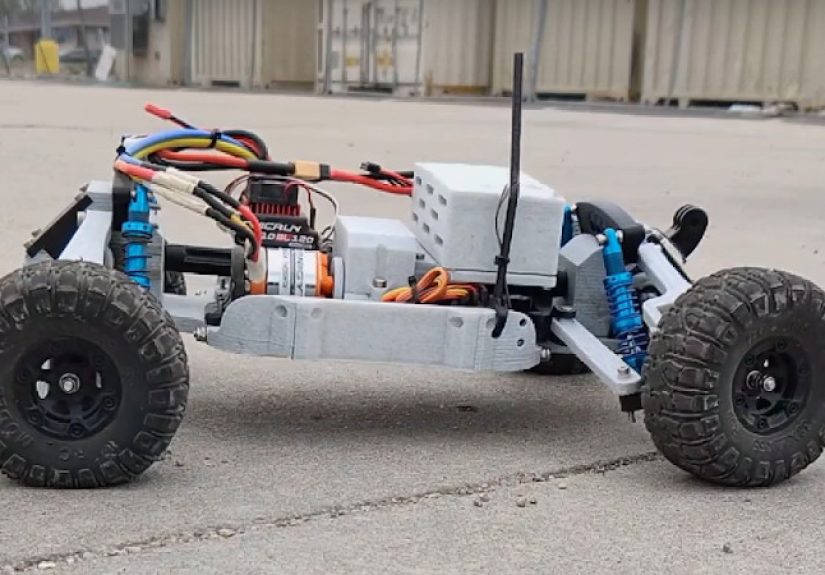
The most successful modern platforms are now hybrid: printed chassis systems and protective structures paired with metal driveline components, quality bearings, standard electronics, and proven suspension hardware.
In other words, print what benefits from customizationand buy what benefits from metallurgy.
The Timeline Behind the Tech Leap
The 3D printing side of this story began with industrial innovation and gradually filtered into garages and hobby benches.
As material extrusion methods matured and desktop workflows became easier, R/C builders gained access to design tools previously limited to professional prototyping environments.
Over time, slicers improved, printers became faster and more stable, and community knowledge exploded.
For off-road R/C specifically, three shifts accelerated evolution:
- Reliable desktop FDM workflows: more consistent layer adhesion and dimensional control.
- Better filaments: PETG, nylon blends, and fiber-reinforced options became more practical.
- Community engineering: open design iteration normalized test-print-crash-redesign loops.
Material Evolution: The Real Performance Story
PLA: the gateway material
PLA taught a generation to prototype quickly, but off-road conditions expose its limits.
It can produce accurate parts and is perfect for fit checks, mockups, and body accessories.
But for high-load suspension pivots or motor-adjacent components, PLA is usually a stepping stone, not the destination.
PETG: the practical workhorse
PETG became the “daily driver” material for many builders because it balances printability, impact tolerance, and layer bonding.
It handles mild flex better than brittle options and is forgiving enough for iterative mechanical parts.
If your build philosophy is “I want to bash this, not frame it,” PETG often becomes your baseline.
Nylon and reinforced nylon: serious off-road territory
Nylon-based filaments pushed the hobby into a new bracket.
Their toughness and fatigue behavior make them attractive for load-bearing brackets, chassis rails, and structural mounts.
Carbon-fiber-filled nylons add stiffness and print stability, but they also demand hardened nozzles, moisture control, and tighter process discipline.
This is where 3D printed R/C transitions from weekend craft to lightweight manufacturing.
TPU and flexible materials: strategic flexibility
Not every part should be rigid. Flexible materials are useful for bumpers, cable protection, mud guards, anti-rattle interfaces, and impact buffers.
Smart builds mix stiffness and compliance intentionallybecause off-road driving is basically controlled violence with a steering wheel.
Design Evolution: CAD Became the Differential Lock for Creativity
From static parts to parametric systems
Early prints were one-off objects. Modern builders increasingly use parametric design:
change wheelbase, track width, shock angle, or battery placement and regenerate parts with minimal manual rework.
That turns a “model” into a platform.
Geometry is performance
In off-road dynamics, suspension geometry determines how confidently a car corners, absorbs bumps, and maintains traction on uneven surfaces.
Caster, camber behavior, roll center tendencies, and anti-squat geometry all influence handling.
Printed parts now let builders explore these variables fasteroften between weekend runs.
Designing for fast repair
A great 3D printed off-road R/C car is not just fast. It is fixable in minutes.
New-generation designs emphasize:
- Accessible fasteners and tool paths
- Replaceable sacrificial components
- Symmetric part reuse (left/right where possible)
- Embedded nut traps and standardized hardware sizes
If your post-crash repair takes longer than your battery charge, your design needs another revision.
Electronics and Powertrain: Printed Chassis, Real Torque
Brushed to brushless migration
As builds evolved, many moved from brushed systems (affordable, beginner-friendly, smooth low-speed behavior) to brushless systems (higher efficiency, more power, lower maintenance).
For off-road use, brushless setups offer stronger acceleration and better sustained outputbut demand smarter thermal and drivetrain planning.
ESC placement, cooling, and cable routing
Modern printed layouts increasingly include airflow channels, protected cable tunnels, and modular ESC trays.
Dust and water management matter as much as peak speed.
A clean wiring plan improves reliability, service speed, and even handling by reducing random mass movement inside the chassis.
Battery placement as a handling tool
The battery is usually the heaviest single component in a compact R/C build.
Moving it forward/backward or lower/higher changes the car’s cornering balance and jump attitude.
Evolved designs treat battery location as a tuning parameter, not a packaging afterthought.
Suspension Tuning: Where 3D Printing Meets Dirt Physics
Printable shock towers and mount plates allow rapid tuning of motion ratios and damping feel.
Combined with shock oil and spring-rate changes, builders can tailor behavior for loose gravel, packed dirt, grass, or mixed trails.
This is where off-road R/C cars start feeling “dialed,” not just assembled.
What builders tune most often
- Shock oil weight: controls damping response across temperature and terrain.
- Spring rates: supports vehicle mass and affects rebound rhythm over repeated bumps.
- Shock mounting positions: changes leverage, steering response, and bump absorption.
- Ride height and droop: balances stability, clearance, and traction consistency.
The evolution here is practical: instead of guessing with permanent parts, builders now print alternative mounts and test them quickly.
Think of it as low-cost suspension R&D powered by filament.
Manufacturing Evolution: Print Strategy Now Decides Whether You Finish the Run
Orientation-aware strength planning
The strongest-looking part is not always the strongest part.
Layer direction strongly affects mechanical behavior.
Mature builders align layer paths to expected stress directions, add fillets at stress risers, and avoid abrupt cross-section transitions that invite cracks.
Hardware integration matured
Heat-set inserts, captured nuts, and metal sleeves transformed durability.
Instead of threading directly into plastic every time, critical joints now use repeatable interfaces that survive frequent maintenance.
This single shift massively improved long-term reliability in 3D printed R/C platforms.
Iteration speed became the superpower
In traditional hobby workflows, a design flaw could cost weeks.
In modern print workflows, it costs an evening and a spool segment.
That speed encourages experimentationand experimentation is the real engine behind the evolution of a 3D printed off-road R/C car.
A Modern Build Blueprint for a 3D Printed Off-Road R/C Car
Suggested architecture
- Printed: chassis tub/rails, shock towers, electronics trays, guards, body mounts, bumpers
- Off-the-shelf: differential, drive shafts, bearings, shocks, motor, ESC, radio gear
- Optional upgrades: reinforced skid sections, modular battery cradle, quick-swap body system
Material map by part function
- PETG: general structural parts and iterative prototypes
- Nylon or CF-nylon: high-stress mounts and long-life structural pieces
- TPU: impact absorbers and vibration isolation features
Testing protocol that actually works
- Bench alignment check (steering neutrality, driveline friction)
- Low-speed crawl test (binding, thermal behavior, scrub issues)
- Medium-speed rough-surface run (suspension balance, chassis flex)
- Controlled jump session (impact survivability and fastener retention)
- Post-run teardown and revision notes
Repeat this loop three times and your “version 1” fantasy becomes a “version 4” machine that actually survives your driving habits.
And yes, we all have those driving habits.
Common Mistakes That Still Break Great Ideas
- Printing critical load parts with decorative settings (low walls, low infill, no stress fillets)
- Ignoring moisture control for nylon-based filament
- Using soft hardware in high-vibration zones
- Over-gearing a fresh build before confirming drivetrain efficiency
- Tuning springs without matching damping strategy
- Assuming “more rigid” always equals “better handling”
What Comes Next: The Next Era of Off-Road 3D Printed R/C
Expect the next wave to combine faster prototyping with better engineering feedback:
integrated simulation workflows, stronger consumer-grade materials, and smarter modular platforms.
We’re likely to see more printable ecosystems where one base chassis can become a basher, crawler, or rally setup through swap kits.
The bigger picture is exciting: 3D printed R/C is becoming a personal motorsports lab.
Builders are not just modifying cars anymorethey are co-developing miniature vehicles with real design logic.
That’s the evolution in one sentence.
Conclusion
The evolution of a 3D printed off-road R/C car is a story of convergence: additive manufacturing, open design culture, and hardcore hobby testing.
It started with fragile experiments and replacement parts.
It matured into hybrid engineering systems that prioritize tunability, strength, repair speed, and repeatable performance.
If you’re building today, the path is clear: choose materials by function, design for maintenance, tune with intent, and iterate from evidence.
The winners in this space are not the ones with the fanciest rendersthey’re the ones whose cars come back from dirt, jumps, and bad decisions ready for another pack.
In off-road R/C, durability is not a feature. It’s a philosophy.
Builder Experience Add-On (): Field Notes From the Dirt
The most revealing experiences in 3D printed off-road R/C builds usually happen in the gap between “It printed perfectly” and “Why is my rear end bouncing like a shopping cart?”
One builder started with a beautifully rigid chassis and celebrated for about six minutes. On packed dirt, the car tracked like a laser.
On loose gravel, it skipped sideways under throttle because the setup had almost zero compliance in the wrong places.
The fix was surprisingly small: a revised rear tower with slightly different shock leverage, softer spring pairing, and a TPU-based bumper mount that reduced rebound chatter after impacts.
Same motor. Same tires. Completely different personality.
Another common experience is the “gearbox lesson.” A builder prints a lightweight housing, installs a punchy brushless setup, and everything feels amazing until heat and flex introduce gear mesh inconsistency.
The first reaction is usually to blame motor timing or ESC settings.
The real fix is often structural: reinforce the motor mount zone, add metal sleeves where bolts clamp, and redesign the housing so load paths are distributed instead of concentrated around a few thin walls.
After that revision, drivetrains that used to sound like coffee grinders suddenly run quiet and cool.
Moisture management stories are practically a genre at this point.
People print nylon parts from a spool that sat out for days, wonder why surfaces look fuzzy, then wonder why strength varies across identical parts.
Once they dry filament consistently and tighten print parameters, those “random failures” drop off dramatically.
The experience here is less dramatic but more important: process control is performance.
Off-road durability is rarely one magic filamentit’s material plus preparation plus print strategy plus hardware integration.
Suspension tuning experiences are where confidence grows fastest.
Builders who keep notesterrain, temperature, spring rate, oil weight, ride heightprogress far faster than builders who rely on memory.
A common “aha” moment comes when someone realizes their favorite setup in warm weather feels over-damped in cold conditions.
They switch to thinner oil, restore rebound behavior, and suddenly the car stops plowing through corners.
Another classic moment is learning that symmetrical spring changes front and rear can preserve balance, while random one-end experiments create weird handling side effects that are hard to diagnose.
Crash experience is also design education.
One group intentionally repeated low-altitude jump tests to see what failed first.
Initially it was front body mounts, then steering supports, then battery restraint features.
Instead of treating failures as setbacks, they treated each as a map:
what broke, where stress concentrated, how load was transmitted, and what could be made sacrificial.
By version four, the car still crashedbut it failed in cheap, replaceable parts designed to fail first.
That shift from accidental breakage to intentional failure management is a major milestone in build maturity.
The most encouraging shared experience is how quickly beginners can now reach “competent custom.”
With modern slicers, printable jigs, community BOMs, and modular CAD approaches, new builders don’t need years to produce reliable off-road platforms.
They need a good test routine, realistic expectations, and willingness to iterate.
In nearly every successful story, progress came from the same pattern:
print, run, observe, revise, repeat.
Not glamorousbut incredibly effective.
And if we’re honest, that loop is exactly what makes the hobby addictive.