Table of Contents >> Show >> Hide
- What Is a Ski Jump Ramp on an Aircraft Carrier?
- So Why Is a Super Hornet Using a Ski Jump at All?
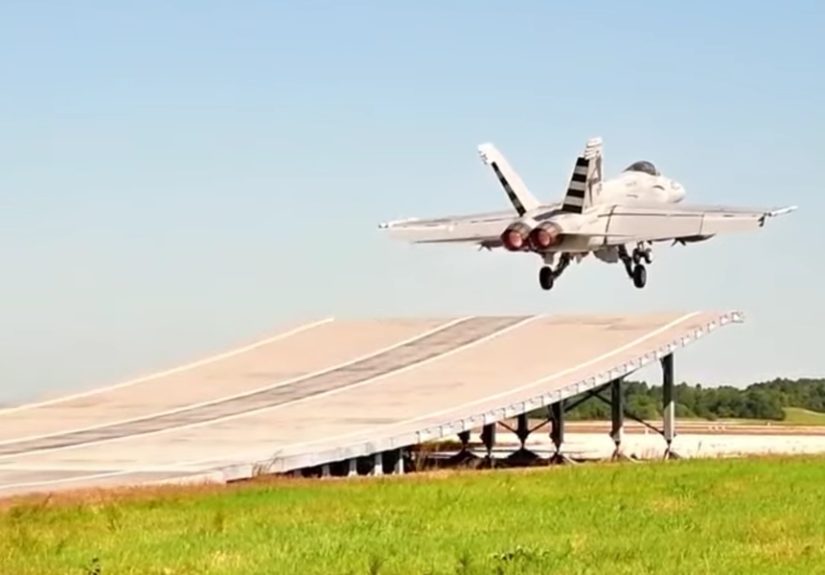
- The Demo: A Super Hornet Launches Off a Ground-Based Ski Jump
- Why Ski Jumps Are Popular (and Why They Still Have Limits)
- What the Super Hornet Brings to the Conversation
- What This Means for Real Carrier Operations
- Common Myths (Because the Internet Is the Internet)
- Why This Story Sticks
- Experience Section: What It Feels Like Around a Ski-Jump Takeoff (Without Pretending You’re in the Cockpit)
If you’ve ever watched a skateboarder roll up a half-pipe and thought, “Cool… but what if it weighed 30,000+ pounds and had twin afterburning engines?”
Congratulations: you’re already emotionally prepared for the moment an F/A-18 Super Hornet launches off a ski jump ramp.
The clip looks almost fakelike someone swapped a flight deck for a stunt park. A Super Hornet accelerates, hits a curved ramp, pitches skyward, and
keeps flying as if gravity just got a “nice try” text message. But this isn’t a movie trick. It’s a very real demonstration of how modern naval aviation
adapts to different aircraft carrier designs around the worldand why a “ski jump” can be the difference between “nice jet” and “nice jet… but it can’t
leave the ship with the stuff we need.”
Let’s break down what’s actually happening, why the Super Hornet normally doesn’t do this, how the test worked, and what it means for real-world carrier
operationsall without turning this into a physics lecture that makes your eyes take off first.
What Is a Ski Jump Ramp on an Aircraft Carrier?
A carrier ski jump is a curved, upward ramp built into the front (bow) of certain aircraft carriers. Instead of launching aircraft with catapults, these
ships rely on a short deck run plus raw engine thrust. The ramp gives the aircraft a helpful upward “kick” at the end of the deck, buying extra time in
the air for the jet to accelerate and generate enough lift to keep climbing.
STOBAR vs. CATOBAR (and Why the Acronyms Matter)
Carrier launch systems come in a few flavors, and the one that uses a ski jump is commonly called STOBAR:
Short Take-Off But Arrested Recovery. Jets power themselves down the deck, use the ski jump to rotate upward, and then land with arresting wires.
The U.S. Navy’s supercarriers are typically CATOBAR: Catapult Assisted Take-Off But Arrested Recovery. Catapults (steam or
electromagnetic, depending on the ship) fling aircraft off the deck at high speed. CATOBAR is fantastic for launching heavier aircraft, higher payloads,
and specialized planes that need more help getting airborne.
Ski jumps, by contrast, are simpler and can be lighter and less mechanically complex than a full catapult systemone reason many navies have chosen them.
The tradeoff is performance flexibility: ski-jump launches generally impose tighter limits on takeoff weight, especially in hot conditions, with minimal
wind, or when a jet is carrying a full “I brought snacks for the whole mission” loadout.
The “Physics Cheat Code” Behind the Ramp
Here’s the simple version: the ramp turns some of the jet’s forward motion into upward motion. That does two helpful things:
- It increases the jet’s flight path angle at the moment it leaves the deck.
- It buys timeseconds matterso the aircraft can keep accelerating after leaving the ship.
The jet still needs enough airspeed to fly, and it still needs to stay within safe angles of attack and performance margins. The ramp doesn’t magically
create lift out of thin air. It just helps the aircraft transition from “rolling on deck” to “flying” more efficiently when the runway is short.
So Why Is a Super Hornet Using a Ski Jump at All?
Here’s the twist: the F/A-18E/F Super Hornet is famous for operating from U.S. carriers that use catapults. In other words, it’s usually launched like a
rocket off a slingshotnot like a sprinter off a ramp.
The ski-jump footage exists because navies don’t all buy the same kind of aircraft carrier. If a country operates STOBAR carriers, any aircraft competing
for that navy’s carrier-fighter role has to prove it can safely launch from a ski jump ramp under realistic conditions. “Should work” is not a strategy.
“We actually did it, repeatedly, with real jets” is the strategy.
In the Super Hornet’s case, the ski-jump demonstration was tied to international interestespecially from navies operating ski-jump carriers. The point
wasn’t to replace catapults on U.S. carriers. The point was to show that a jet designed for catapult launches can still adapt to ramp-assisted launches
when the mission (and the customer) calls for it.
The Demo: A Super Hornet Launches Off a Ground-Based Ski Jump
The most widely shared ski-jump Super Hornet footage comes from testing conducted on land using a ramp built to mimic the geometry and effect of a carrier
ski jump. Think of it as a “carrier math” simulator you can drive a real airplane overbecause it turns out spreadsheets don’t have afterburners.
A ground-based ramp offers something extremely valuable: controlled, repeatable test conditions. Engineers can vary the aircraft’s configuration, fuel
load, and environmental assumptions while collecting datawithout needing to tie up a carrier at sea for a test series. The outcome is not just “it flew”
but “it flew with these margins, at these weights, with this performance profile.”
What Counts as a “Successful” Ski-Jump Launch?
A ski-jump takeoff isn’t judged by vibes. It’s judged by performance and safety metrics. A successful launch generally means:
- Stable departure off the ramp without an excessive sink rate or unsafe attitude.
- Enough energy to keep accelerating and climbing after leaving the deck.
- Predictable handling so pilots can fly it consistentlynot just “that one perfect run.”
- Compatibility with mission loads that matter in real operations (within STOBAR limits).
And because naval aviation is all about repeatability, a “good day” isn’t enough. Tests typically aim to show the aircraft can do this reliably across
a range of realistic setups.
Why Ski Jumps Are Popular (and Why They Still Have Limits)
Ski jumps are popular because they provide a practical pathway to fixed-wing carrier aviation without requiring the full complexity of catapult systems.
If you can launch fighters with thrust and a ramp, you can field a carrier air wing with fewer moving parts on the ship.
But physics collects its taxes. The big limitation is takeoff weight. On a catapult carrier, you can fling a heavier aircraft into the
air with a full fuel load, bigger weapons, and sometimes specialized support aircraft. On a ski-jump carrier, you may need to make tradeoffs:
- Fuel vs. payload (bring more gas, carry fewer heavy stores).
- Weather dependency (wind over deck is helpful; heat and humidity can be a performance thief).
- Sortie rhythm (launch pace and deck choreography differ from catapult operations).
None of this is “bad.” It’s simply the engineering reality of launching jets from a moving ship with limited runway. STOBAR carriers can be extremely
capable within their design envelopeespecially for fleet defense, maritime strike with appropriate loads, and projecting air power regionally.
What the Super Hornet Brings to the Conversation
The Super Hornet is a multirole workhorsebuilt for carrier life, salty air, and the unique stress of repeated launch-and-recovery cycles. It’s also
evolved over time, with newer configurations focused on range, networking, survivability improvements, and cockpit modernization.
That matters in a ski-jump context because STOBAR operations can put a premium on efficient performance. If a jet can carry useful payloads, maintain
solid bring-back capability for recovery, and integrate smoothly with a carrier’s deck and support systems, it becomes a more credible option for navies
operating ski-jump carriers.
“Okay, But Does It Look as Wild in Real Life?”
Yesand that’s part of why the footage spreads. A catapult launch is dramatic in a “blink and it’s gone” way. A ski-jump launch is dramatic in a
“did that jet just use the ramp like a bobsled track?” way. The nose rises, the horizon drops, and for a brief moment the jet seems to hover between
“still accelerating” and “already flying.”
Under the hood, though, it’s not a stunt. It’s a carefully managed performance event, backed by planning, data, and test discipline.
What This Means for Real Carrier Operations
A ski-jump-compatible Super Hornet demonstration is ultimately about operational credibility. It says, “This aircraft can function within STOBAR launch
constraints,” which is a key requirement for navies that don’t operate catapult carriers.
1) Payload and Range Planning Gets More Strategic
On STOBAR carriers, the mission planning conversation often starts earlierbefore the jet ever rolls. Teams think hard about:
fuel planning, store selection, and how to keep aircraft within safe takeoff performance limits. This doesn’t eliminate capability; it shapes it.
It also increases the value of aerodynamic efficiency and smart loadouts. A weapon that does the job at a lower weight, or a sensor that reduces the need
for extra pods, can meaningfully change what’s feasible on launch day.
2) Deck Operations Feel Different Than on U.S. Supercarriers
CATOBAR carriers are designed around catapult cycles and launch/recovery choreography that’s been refined for decades. STOBAR carriers have their own
choreography: short takeoff positions, ramp sequencing, and the timing of recoveries with arresting gear.
For pilots, the key is consistency. For deck crews, the key is flow. For engineers and planners, the key is maintaining safety margins while meeting the
mission’s demands. Everyone gets a vote, but physics counts twice.
3) Testing Proves More Than “Can It Fly?”
A ski-jump takeoff demonstration isn’t just a headline. It’s a data package. It helps answer questions like:
- How does the aircraft behave during ramp transition at different weights?
- How sensitive is performance to wind and environmental conditions?
- What operational loadouts are practical without pushing margins?
- How do procedures align with a STOBAR carrier’s deck layout and recovery system?
For a navy evaluating fighters, those answers matter as much as radar range charts and glossy brochure photos.
Common Myths (Because the Internet Is the Internet)
Myth: “The Ramp Launches the Jet Like a Catapult”
Nope. The ramp doesn’t provide a mechanical shove like a catapult. The aircraft is still accelerating under its own power. The ski jump primarily changes
the flight path angle and buys airborne time.
Myth: “Any Jet Can Do This If It Has Enough Thrust”
Also nope. Carrier suitability includes landing gear strength, structural design, control laws, arresting compatibility, deck handling requirements,
and a whole ecosystem of maintenance and support. Takeoff is just one piece of a very expensive puzzle.
Myth: “This Means the U.S. Navy Should Switch to Ski Jumps”
The U.S. Navy’s carrier concept is built around high sortie generation, heavy launch capability, and support aircraft that benefit from catapults. Ski
jumps are a smart solution for certain carriersbut not a one-size-fits-all replacement for catapult operations.
Why This Story Sticks
On the surface, it’s a jaw-dropping image: a frontline fighter jet doing something that looks like it belongs in a video game.
Underneath, it’s a perfect snapshot of modern defense aviation reality: aircraft are designed around systems, systems are designed around ships, and ships
are designed around budgets, geopolitics, and industrial choices made years (or decades) earlier.
When a Super Hornet takes off from a ski jump ramp, you’re not just watching a cool launchyou’re watching a compatibility question get answered in the
most convincing language possible: reality.
Experience Section: What It Feels Like Around a Ski-Jump Takeoff (Without Pretending You’re in the Cockpit)
Even if you’re only watching from footage or from a safe observation area during testing, a ski-jump Super Hornet launch has a very particular “wow”
signature that’s different from a standard runway departure. People who’ve spent time around naval aviation often describe the build-up as a mix of
routine and theater: the jet looks familiar, the posture looks familiar, and then the ramp shows up and your brain briefly files it under
“this is either genius engineering or cartoon logic.”
The run-up feels like a countdown you can hear. The engines settle into that deep, muscular roar that isn’t just loudit’s structured, like the sound has
layers. The aircraft starts rolling, and your attention locks onto the nose because the ramp is basically a promise: something is about to happen.
The jet accelerates with purpose, and the ramp transition happens fast enough that you don’t have time to overthink it. One moment it’s sprinting,
the next it’s angling upward, and you can almost feel the collective “oh!” from anyone watching.
What makes the ski jump moment feel so dramatic is that it’s visually legible. With a catapult launch, the jet disappears in a blink and your brain
registers it after the fact. With a ramp launch, you can watch the story unfold: the aircraft approaches the curve, begins to rotate, and then leaves the
surface with a noticeably different posture than a flat-deck departure. It’s less “shot out of a slingshot” and more “thrown into the sky with a plan.”
There’s also a weird psychological effect: you know the aircraft is engineered for this kind of environment (and the test program exists precisely to
prove that), but the visual still triggers that human instinct that says, “Wait, you can’t just drive off the end like that.” The ramp is the magic
trickexcept it isn’t magic. It’s geometry and thrust and careful performance margins, wrapped in a shape that looks like it belongs on a winter sports
course.
For aviation fans, the experience becomes sticky because it compresses a ton of “carrier ops” complexity into one moment you can actually understand with
your eyes. You don’t need to memorize acronyms to appreciate the difference between launching from a short deck with a curved ramp versus being hurled
forward by a catapult. And if you’re someone who loves the intersection of machines and design, it’s hard not to admire the practicality: a simple curve,
placed in the right spot, changes what’s possible for a whole ship’s air wing.
The most interesting part, though, is how normal it looks immediately afterward. Once the jet clears the ramp and transitions to climb, it becomes “just a
fighter jet flying” again. That’s the quiet proof that the weird-looking part worked: the drama ends, and the mission begins. In a way, that’s the whole
goal of flight testingmake the extraordinary look routine, then make the routine safe enough to repeat.