Table of Contents >> Show >> Hide
- What Is a Job Inquiry Letter?
- When Should You Send a Job Inquiry Letter?
- Why Job Inquiry Letters Still Work
- How to Write a Job Inquiry Letter That Gets Attention
- Best Structure for a Job Inquiry Letter
- Job Inquiry Letter Sample #1: Traditional Business Letter
- Job Inquiry Letter Sample #2: Job Inquiry Email
- Writing Tips That Make a Real Difference
- Common Mistakes to Avoid
- Should You Follow Up?
- Experience-Based Lessons from Real Job Searches
- Final Thoughts
If job searching sometimes feels like yelling into the void while your résumé drifts through cyberspace wearing a tiny tie, a job inquiry letter can be your secret weapon. Unlike a standard cover letter that responds to a posted opening, a job inquiry letter reaches out before the company rolls out the welcome mat. It is proactive, professional, and surprisingly powerful when written well.
This guide breaks down exactly how to write one, when to send it, what to say, what not to say, and how to avoid sounding like a robot who recently discovered ambition. You will also find job inquiry letter samples you can adapt for your own search, whether you are a recent graduate, a career changer, or a professional targeting a dream company that has not posted the perfect role yet.
What Is a Job Inquiry Letter?
A job inquiry letter, sometimes called a letter of inquiry, prospecting letter, or letter of interest, is a message you send to an employer to ask about possible openings. Instead of applying for a specific posted job, you introduce yourself, explain why you are interested in the company, and show how your skills could help solve the employer’s problems.
Think of it as a professional knock on the door. You are not barging in. You are saying, “Hello, I have value to offer, I understand what your company does, and I would love to talk if there is a fit.”
Job Inquiry Letter vs. Cover Letter
These two documents are close cousins, but they are not twins. A cover letter responds to a specific opening. A job inquiry letter reaches out when no relevant opening is posted or when you want to build a relationship before a job is announced. That means your letter should focus less on one job title and more on your broader value, your interest in the company, and the areas where you could contribute.
When Should You Send a Job Inquiry Letter?
A job inquiry email or formal letter makes sense when:
- You want to work for a specific company, even if there is no current opening.
- You are relocating and want to start conversations in a new market.
- You are changing careers and want to explain transferable skills.
- You have been networking and were given a contact name.
- You want to be considered for future roles before they are posted publicly.
In other words, this is not random fishing. It is targeted outreach. The goal is not to ask, “Do you have jobs?” The goal is to show, “Here is why speaking with me would be worth your time.” Big difference. Massive difference. Coffee-before-commute difference.
Why Job Inquiry Letters Still Work
Many employers fill roles through referrals, internal movement, networking, and early conversations long before an opening turns into a public listing. A thoughtful letter of inquiry for a job helps you step into that quieter part of the hiring process. It can also help your résumé get read by the right person instead of doing endless cardio in an applicant tracking system.
When done well, a job inquiry letter shows initiative, communication skills, professionalism, and genuine interest in the organization. It also proves you did your homework, which immediately separates you from applicants who fire off generic messages like confetti at a parade.
How to Write a Job Inquiry Letter That Gets Attention
1. Research the Company First
Before writing a single sentence, learn the company’s mission, products, recent projects, culture, and likely talent needs. Visit the company website, review leadership bios, read recent announcements, and scan LinkedIn profiles of people in the department you are targeting. This helps you sound informed rather than generic.
A strong job inquiry letter never feels mass-produced. It sounds like it could only have been written for that company.
2. Find a Real Person to Contact
Whenever possible, address your letter to a hiring manager, department head, recruiter, or team leader. Avoid “To Whom It May Concern” unless you have truly exhausted your options. A specific name signals initiative and improves the odds that your message lands in the right inbox.
3. Open with a Clear, Memorable Introduction
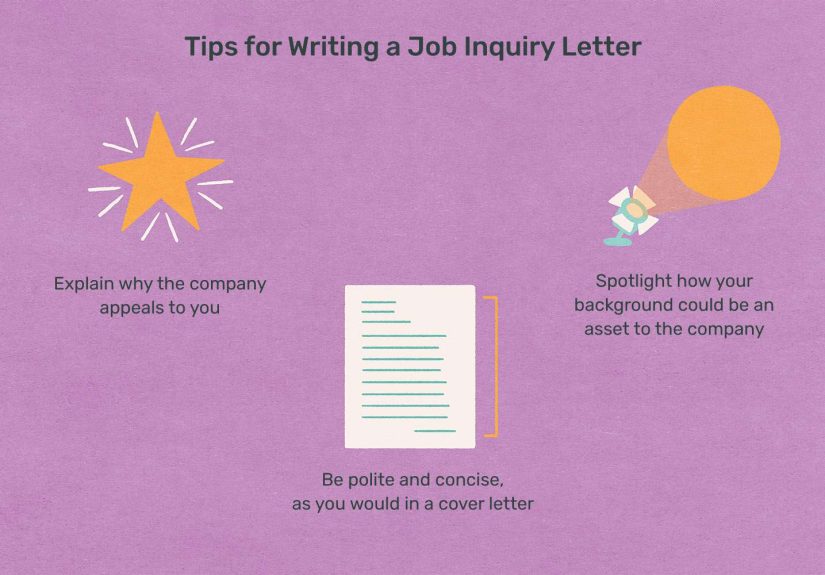
Your opening paragraph should explain who you are, why you are writing, and why this company is on your radar. Be direct, but not dull. You do not need to write a dramatic monologue. You do need to make the reader care enough to continue.
Example: “I am a digital marketing specialist with experience in lifecycle email strategy and conversion optimization, and I am reaching out because I have admired the way BrightLane blends data-driven campaigns with a distinctly human brand voice.”
4. Highlight Skills That Match the Organization’s Needs
The middle of your letter should connect your background to the company’s goals. This is where many writers go wrong by turning the letter into a paragraph version of the résumé. Do not simply repeat bullet points. Instead, select one to three relevant strengths and show how those strengths could serve the employer.
Use specific examples, brief results, and measurable impact when possible. Numbers help. So does context. “Managed social media” is bland. “Led a social media refresh that increased engagement by 38% in six months” has a pulse.
5. Explain Why This Company, Not Just Any Company
Employers can smell copy-paste enthusiasm from a mile away. If your letter could be sent to 200 companies with only the name swapped out, it is too generic. Mention a product launch, a mission statement, a business model, a client focus, or a company value that genuinely connects to your experience.
6. Keep It Brief and Professional
A good job inquiry letter sample is concise. One page is usually enough. Three to five short paragraphs work well. Recruiters are busy, and nobody wants to read your professional autobiography before lunch.
7. End with a Smart Call to Action
Close by thanking the reader, expressing interest in speaking further, and making it easy to contact you. You can say you would welcome a brief conversation about future opportunities or how your background might support the team. Confident is good. Pushy is not.
Best Structure for a Job Inquiry Letter
- Heading: Your contact information, date, employer information
- Greeting: Dear Ms. Taylor or Dear Hiring Manager
- Opening paragraph: Who you are and why you are reaching out
- Middle paragraph(s): Relevant skills, accomplishments, and company fit
- Closing paragraph: Appreciation, interest, and next step
- Professional sign-off: Sincerely, Best regards, or Kind regards
Job Inquiry Letter Sample #1: Traditional Business Letter
Job Inquiry Letter Sample #2: Job Inquiry Email
Writing Tips That Make a Real Difference
Use Keywords Naturally
If you are targeting a role family like operations, marketing, customer success, or finance, use relevant keywords naturally throughout the letter. This helps human readers and can support ATS visibility when your message is forwarded internally. Just do not stuff keywords into every sentence like a résumé smoothie gone wrong.
Match Tone to Company Culture
A law firm, startup, hospital, and nonprofit do not all speak the same language. Your tone should stay professional, but it can flex a little. A creative agency may welcome more voice and personality. A traditional corporate environment may reward a more formal approach.
Show Results, Not Just Duties
Whenever possible, mention outcomes: revenue growth, time saved, engagement gains, customer satisfaction, process improvements, retention numbers, or project completion metrics. Employers hire impact, not activity.
Proofread Like Your Reputation Depends on It
Because it does. A typo in the company name is the kind of mistake that can end your chances before they begin. Read your letter out loud, run spellcheck, and verify every proper noun.
Common Mistakes to Avoid
- Using a generic greeting when a real contact name is available
- Sending the same letter to multiple employers without tailoring it
- Repeating your résumé word for word
- Writing long, dense paragraphs that feel like homework
- Focusing only on what you want instead of what you offer
- Being overly casual, overly desperate, or overly dramatic
- Forgetting to include contact information or a professional sign-off
Should You Follow Up?
Yes, but professionally. If you do not hear back, a short follow-up in about one to two weeks is reasonable unless the employer specifically says not to contact them. Keep that note polite and brief. You are nudging, not haunting.
Experience-Based Lessons from Real Job Searches
One of the most useful things job seekers learn is that a strong inquiry letter often works best when it feels less like a transaction and more like the beginning of a professional conversation. Candidates who get positive responses usually do three things well. First, they target companies intentionally instead of blanketing the internet with generic outreach. Second, they make the employer feel seen. Third, they make their value easy to understand in under a minute.
Many professionals who have used job inquiry letters successfully say the breakthrough did not come from saying more. It came from saying the right things more clearly. For example, a career changer moving from teaching into corporate training might be tempted to explain every reason for the transition in exhausting detail. The better move is to lead with the overlap: facilitation, curriculum design, stakeholder communication, and measurable learning outcomes. That framing helps the employer picture fit immediately.
Recent graduates often have a different challenge. They worry they do not have enough experience to justify sending a letter. In reality, they often underestimate internships, part-time jobs, campus leadership, volunteer work, and class projects. The strongest inquiry letters from new graduates do not apologize for limited experience. They translate experience. A student newspaper editor becomes someone with deadline management, collaborative editing, and audience growth skills. A resident assistant becomes someone with conflict resolution, community leadership, and crisis response experience. Suddenly, the experience feels not small, but relevant.
Recruiters and hiring managers also tend to respond better when candidates avoid making the message entirely about admiration. Compliments are nice, but flattery alone does not carry a letter. Saying “I love your company” is pleasant. Saying “I admire your company’s expansion into bilingual customer education, and my experience creating accessible content for diverse audiences could support that effort” is useful. Useful wins.
Another common pattern from real job searches is that timing matters, but perfection matters more. Some job seekers wait too long trying to craft a flawless message. Others send a rushed email with no real tailoring. The sweet spot is a focused, well-researched letter sent while the company, project, or department is still top of mind. A thoughtful note tied to a company initiative or market move can open a door much faster than a generic check-in.
There is also a practical lesson many people learn the hard way: if your inquiry letter sounds like a favor request, it weakens your position. If it sounds like a clear business case, it strengthens it. Employers are not looking for someone to rescue from unemployment. They are looking for someone who can contribute. Your tone should reflect that difference with calm confidence.
Finally, the most encouraging truth is this: not every inquiry letter gets a reply, but that does not mean it failed. Sometimes it plants a seed. Sometimes it leads to a referral. Sometimes it gets forwarded internally and resurfaces weeks later when a role opens. The candidates who benefit most from this strategy treat it as relationship-building, not instant gratification. They stay professional, keep records, follow up respectfully, and continue building momentum. In job searching, a smart letter does not just ask for an opportunity. It helps create one.
Final Thoughts
A great job inquiry letter is short, specific, tailored, and persuasive. It does not beg. It does not ramble. It does not throw your résumé at the reader and hope for magic. Instead, it shows that you understand the company, know your value, and can communicate like a professional people would actually want to work with.
If you want better results, stop sending generic messages into the abyss. Write a thoughtful letter of interest, make it relevant, and give employers a compelling reason to respond. Sometimes the job you want is not posted yet. That does not mean the opportunity is not there.