Table of Contents >> Show >> Hide
- Why This Kind of Citation Confuses So Many Writers
- Method 1: Cite It in MLA Style
- Method 2: Cite It in APA Style
- Method 3: Cite It in Chicago Style
- How to Tell Whether You Are Really Citing an Article Inside a Book
- Common Mistakes That Make Citation Checkers Cry Quietly
- A Side-by-Side Example Using the Same Source
- Final Thoughts
- Real-World Experiences and Lessons From Citing Articles Inside Books
If citing an article inside of a book makes your eye twitch a little, welcome to the club. This is one of those citation tasks that looks easy until you realize the source has two titles, at least two names, and a sneaky tendency to disguise itself as something else. Is it a chapter? An essay? A reprinted article? A reference entry? A trap set by a professor who enjoys watching formatting panic unfold at 11:47 p.m.? Possibly all of the above.
The good news is that once you understand the basic logic, this citation type becomes much less dramatic. In most cases, you are not citing the whole book. You are citing a smaller work that lives inside a larger one. That means your citation needs to give credit to the author of the article or chapter, then identify the book that contains it, usually including the editor, publisher, year, and page range. The exact punctuation circus depends on the style you are using.
In this guide, we will break down the three most common ways to cite an article inside of a book: MLA, APA, and Chicago. You will also see examples, common mistakes, and practical advice for figuring out whether you should cite the chapter, the whole book, or both. By the end, you should be able to build the citation without sacrificing your dignity or your weekend.
Why This Kind of Citation Confuses So Many Writers
A citation for an article inside of a book is more layered than a basic book citation. A normal book citation usually asks for one main creator and one title. A citation for a chapter or essay inside a book asks for the author of the smaller work, the title of that smaller work, the title of the larger book, the editor or editors of that book, the publication details, and often the page range.
That is why students often make one of two classic mistakes. First, they cite the whole book even though they only used one chapter. Second, they cite the chapter but forget to name the book editor. Both errors make sense in a human way. Unfortunately, citation styles are not powered by human emotion. They are powered by rules.
A helpful mental shortcut is this: if the piece you used has its own author and its own title, it probably deserves to be cited as its own source. Then you identify the book that contains it. Think of the book as the apartment building and the article as the specific apartment. Deliver the citation to the right door.
Method 1: Cite It in MLA Style
When MLA is usually the right choice
MLA style is commonly used in literature, language studies, cultural studies, and other humanities fields. If your assignment lives in a class where people say things like “close reading,” “textual analysis,” or “thematic resonance,” MLA is probably lurking nearby.
The basic MLA format
For a typical article, essay, or chapter in an edited collection, the standard pattern looks like this:
Author Last Name, First Name. “Title of Article.” Title of Book, edited by First Name Last Name, Publisher, Year, pp. xx-xx.
Example:
Smith, Jordan. “Cities, Memory, and Rain.” Modern Essays on Urban Life, edited by Elena Brooks, Harbor Press, 2024, pp. 41-58.
In MLA, the article title goes in quotation marks, while the book title is italicized. That detail matters. The shorter work gets quotation marks; the larger container gets italics. This is one of the cleanest visual clues in the whole style.
How MLA handles in-text citations
Your in-text citation is pleasantly short:
(Smith 44)
No year is needed in the parenthetical citation. MLA cares most about the author and the page number. It is the citation equivalent of saying, “I know who said it and where to find it, let’s keep moving.”
One important MLA nuance
Here is where things get slightly spicy. Not every “article inside a book” is treated exactly the same way in MLA. If the piece appears in an anthology or edited collection, you usually cite the individual chapter or essay. But if you are working with a monograph or a book written by a single author, MLA may lead you toward citing the book as a whole instead of treating one chapter as a separate entry. In other words, the type of book matters. Do not assume every chapter gets identical treatment just because it has page numbers and a dramatic title.
MLA is flexible, but it is not freestyle jazz. Always identify whether the larger book is an edited collection, an authored textbook, or a single-author book before you lock in the citation.
Method 2: Cite It in APA Style
When APA is the better fit
APA style is common in psychology, education, business, and many social science fields. It loves dates, values clarity, and wants your citation to look like it showed up on time with a spreadsheet.
The basic APA format
For a chapter in an edited book, the standard reference entry usually follows this pattern:
Author, A. A. (Year). Title of chapter. In E. E. Editor (Ed.), Title of book (pp. xx-xx). Publisher.
If the chapter has a DOI, you add it at the end.
Example:
Smith, J. (2024). Cities, memory, and rain. In E. Brooks (Ed.), Modern essays on urban life (pp. 41-58). Harbor Press.
APA uses sentence case for chapter titles and usually for book titles as well. That means you do not capitalize every major word the way MLA often does. APA likes a calmer, more restrained title style. It is less Broadway marquee, more organized office label.
APA in-text citation
Your in-text citation usually looks like this:
(Smith, 2024, p. 44)
If you are paraphrasing rather than quoting, the page number may not always be required, but including it can still be helpful. For direct quotations, page numbers are the safe and sensible move.
One important APA nuance
APA can also get nuanced when the chapter is written by someone other than the named authors of the book, or when the book functions more like a single authored work than a collection of individually sourced chapters. In some cases, APA guidance points writers toward citing the whole book rather than the chapter. So before you build the citation, ask one key question: did the chapter function as a separately authored contribution, or is it simply one section of an authored book?
If it is a true edited volume with distinct chapter authors, cite the chapter. If not, the whole book may be the better reference. This is one of those tiny decisions that can save you from a giant formatting mess later.
Method 3: Cite It in Chicago Style
When Chicago enters the chat
Chicago style is common in history and some humanities disciplines. It comes in two main systems: Notes and Bibliography, and Author-Date. That means Chicago is a little like ordering coffee and discovering the menu has opinions.
If your instructor wants footnotes or endnotes, you are probably using Notes and Bibliography. If your instructor wants parenthetical citations with a reference list, you are probably using Author-Date.
Chicago Notes and Bibliography format
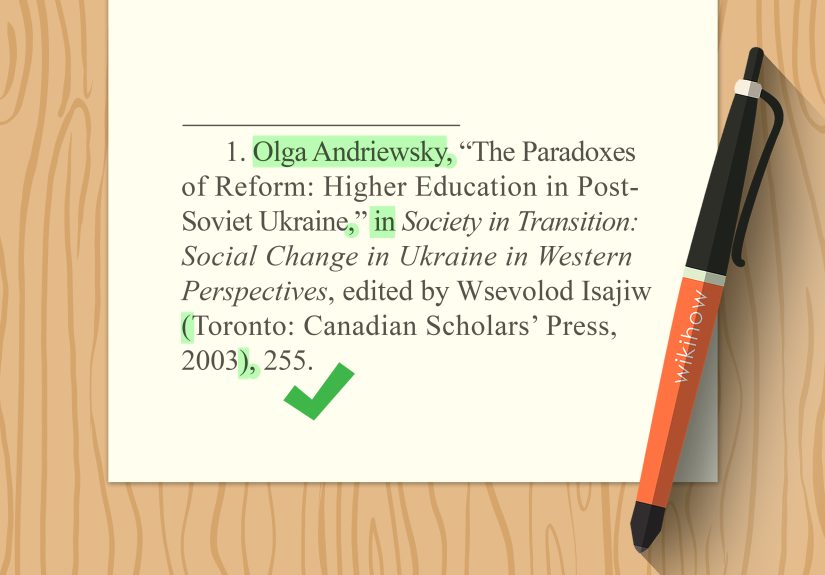
A full footnote for a chapter in an edited book often looks like this:
1. Jordan Smith, “Cities, Memory, and Rain,” in Modern Essays on Urban Life, ed. Elena Brooks (Chicago: Harbor Press, 2024), 44.
The bibliography entry can look like this:
Smith, Jordan. “Cities, Memory, and Rain.” In Modern Essays on Urban Life, edited by Elena Brooks. Harbor Press, 2024.
Some instructors, especially those working from Turabian-based classroom expectations, may want the full page range in the bibliography entry. Others may follow the Chicago quick guide, which does not require it in the bibliography or reference list. So yes, Chicago occasionally behaves like two very smart cousins giving slightly different advice at Thanksgiving. When in doubt, follow your instructor’s preferred manual.
Chicago Author-Date format
If you are using the Author-Date system, the reference list entry may look like this:
Smith, Jordan. 2024. “Cities, Memory, and Rain.” In Modern Essays on Urban Life, edited by Elena Brooks. Harbor Press.
And the in-text citation would be:
(Smith 2024, 44)
Chicago is highly readable once you know which version you are using. The biggest mistake is blending Notes and Bibliography with Author-Date, which creates a citation that belongs nowhere and frightens everyone.
How to Tell Whether You Are Really Citing an Article Inside a Book
Before you format anything, confirm what the source actually is. A lot of citation trouble comes from misidentifying the material. Use this quick checklist:
- If the piece has its own author and title and appears in a book with an editor, you are probably citing a chapter or essay in an edited book.
- If the whole book has one author and your source is just a numbered chapter, some styles may prefer citing the whole book instead.
- If the piece was originally published elsewhere and then reprinted in the book, the citation may need extra publication details depending on the style.
- If the source is actually a journal article you found through a database, do not force it into a book citation just because you read it in a course packet.
This step takes one extra minute and can prevent fifteen minutes of dramatic reformatting later.
Common Mistakes That Make Citation Checkers Cry Quietly
Forgetting the editor. If the book is edited, the editor is part of the source trail. Leaving that out is like giving someone a street name but no building number.
Italicizing the wrong title. The article or chapter title usually goes in quotation marks. The book title usually gets italics. Reverse them, and the citation starts looking confused.
Mixing styles. A little MLA plus a little APA plus one lonely Chicago footnote is not “hybrid.” It is citation soup.
Ignoring page ranges. Many chapter citations need the page range of the full chapter in the reference entry, especially in MLA and APA. Even when a style guide is flexible, your instructor may not be.
Trusting citation generators without checking them. Citation tools are useful, but they are not magical forest elves. They make mistakes, especially with edited books, reprinted essays, and unusual publication layouts. Always review the result.
A Side-by-Side Example Using the Same Source
Let’s say you used this imaginary chapter:
Jordan Smith, “Cities, Memory, and Rain,” in Modern Essays on Urban Life, edited by Elena Brooks, published by Harbor Press in 2024, pages 41-58.
Here is how it would look in each style:
MLA:
Smith, Jordan. “Cities, Memory, and Rain.” Modern Essays on Urban Life, edited by Elena Brooks, Harbor Press, 2024, pp. 41-58.
APA:
Smith, J. (2024). Cities, memory, and rain. In E. Brooks (Ed.), Modern essays on urban life (pp. 41-58). Harbor Press.
Chicago Notes and Bibliography:
1. Jordan Smith, “Cities, Memory, and Rain,” in Modern Essays on Urban Life, ed. Elena Brooks (Chicago: Harbor Press, 2024), 44.
Smith, Jordan. “Cities, Memory, and Rain.” In Modern Essays on Urban Life, edited by Elena Brooks. Harbor Press, 2024.
Same source. Three styles. Three personalities. One tired student.
Final Thoughts
If you remember only one thing, remember this: when you cite an article inside of a book, you are usually citing a smaller work inside a larger container. Start with the article or chapter author, then identify the book that holds it. After that, the rest is just style-specific punctuation, capitalization, and formatting.
MLA is ideal for many humanities papers and relies heavily on the container model. APA is clean and year-focused, making it a favorite in the social sciences. Chicago offers either footnote-based elegance or author-date efficiency, depending on the version you are using. None of these styles is impossible. They just each want to be the main character for a moment.
The real trick is not memorizing every comma. It is correctly identifying the source type and then sticking to one style with absolute consistency. Do that, and your citation page will stop looking like it was assembled during a power outage.
Real-World Experiences and Lessons From Citing Articles Inside Books
One of the most common experiences writers have with this citation type is realizing too late that they cited the wrong thing. It often starts innocently. You open a book, read one brilliant chapter, highlight half of it, and then assume you can cite the entire book because, technically, the chapter came from the book. Later, while checking your references, you notice the chapter has its own author, its own title, and maybe even its own original publication history. Suddenly, what looked like a simple book citation turns into a full identity crisis.
Another very real experience is the editor problem. A lot of writers remember the chapter author and the book title, but the editor somehow floats out of memory like a balloon leaving a birthday party. Then the citation looks incomplete, even though the writer swears they “basically had all the information.” Citation styles are annoyingly particular here for good reason: the editor helps your reader locate the exact source and understand how the book is organized. In edited collections, the editor is not decorative parsley. The editor matters.
Many students also discover that citation software is helpful right up until it is not. This happens especially with anthologies, republished essays, course readers, scanned PDFs, and ebooks with odd metadata. A generator may place the editor where the publisher should go, capitalize the title incorrectly, or decide that a chapter is a journal article because chaos is apparently part of its workflow. The lesson most experienced writers learn is simple: use the tool, but never hand over your critical thinking. Software can speed things up. It should not be allowed to drive unsupervised.
There is also the experience of style-switching confusion. A student writes one paper in MLA, another in APA, and then a history professor asks for Chicago notes. At that point, it is easy to start carrying punctuation habits from one style into another. Maybe you keep APA’s year placement in an MLA citation. Maybe you add MLA quotation patterns to a Chicago bibliography. This is normal, but it is exactly why careful proofreading matters. Citations are small, but they are sticky; yesterday’s format loves to sneak into today’s paper.
Perhaps the most useful experience writers report is that citation becomes easier the moment they stop trying to memorize every format as a random pattern. The breakthrough comes when they understand the logic: who wrote the part you used, what is that part called, what larger work contains it, who prepared that larger work, and where can your reader find it? Once that structure becomes familiar, the style guide stops feeling like a punishment and starts feeling more like a translation key. The details still matter, of course, but the process becomes far less mysterious. And honestly, anything that reduces citation panic five minutes before submission deserves a standing ovation.