Table of Contents >> Show >> Hide
- What Is a Helix Display, Exactly?
- How the 3D Printed Helix Display Works
- Why 3D Printing Changes the Story
- Why This Feels More Real Than a Typical 3D Screen
- Strengths of the Helix Approach
- Where Helix Displays Still Struggle
- Why the Original Concept Still Feels Fresh
- Real-World Applications That Actually Make Sense
- Experience Section: What It Feels Like to Encounter a Helix Display
- Final Take
Every few years, a display technology pops up and makes the internet collectively squint, grin, and say, “Wait… is that actually floating?” The 3D printed helix display belongs in that delightful category. It looks a little like a science fair project, a little like a museum artifact from the future, and a lot like proof that clever geometry can still humble expensive marketing. At its core, this kind of system uses a spinning helical surface, carefully timed light, and some seriously nerdy calibration to create graphics that appear to exist in real three-dimensional space.
That matters because most “3D” displays are not truly 3D in the physical sense. They simulate depth on a flat screen using tricks such as stereoscopy, perspective, and motion. A helix-based volumetric display plays a different game. Instead of faking depth, it sweeps a real volume and places visible points within that space. The result is less “movie theater gimmick,” more “tiny digital sculpture doing cardio.”
The phrase 3D Printed Helix Displays Graphics In 3D sounds like headline poetry written by an engineer who skipped lunch, but it is also surprisingly accurate. The helical structure can be modeled in software, fabricated with 3D printing, balanced for rotation, and then used as the surface on which projected slices of an image are painted. When those slices are synchronized with motion, your eyes blend them into a coherent object that seems to hover in space. No glasses. No headset. No dramatic voice-over required.
What Is a Helix Display, Exactly?
A helix display is a kind of volumetric display, often described as a swept-volume system. Instead of showing a complete 3D object all at once on a fixed panel, it uses a moving surface that repeatedly passes through a display volume. A light source, often a projector or scanning beam, places the right image information onto that surface at exactly the right moment. Over time, those illuminated slices form a visible three-dimensional object.
Think of it like this: if a loaf of bread could spin at high speed and a projector painted a different pattern on each slice at the exact right millisecond, you would eventually see a full 3D image. A helix is simply a much smarter slice than bread. It gives the system a continuous, spiraling surface to work with, which can make the display more elegant, more compact, and, when designed well, more stable.
This is why helix displays are often discussed alongside the broader history of volumetric imaging. Earlier systems such as FELIX demonstrated that a rotating helical screen could sweep out a cylindrical envelope and create voxels, or volumetric pixels, inside a viewable space. That historical lineage matters because modern maker projects are not inventing the idea from scratch. They are remixing it with cheaper components, better modeling tools, faster light modulation, and the mighty shortcut known as desktop fabrication.
How the 3D Printed Helix Display Works
The Helix Is the Screen and the Geometry Problem
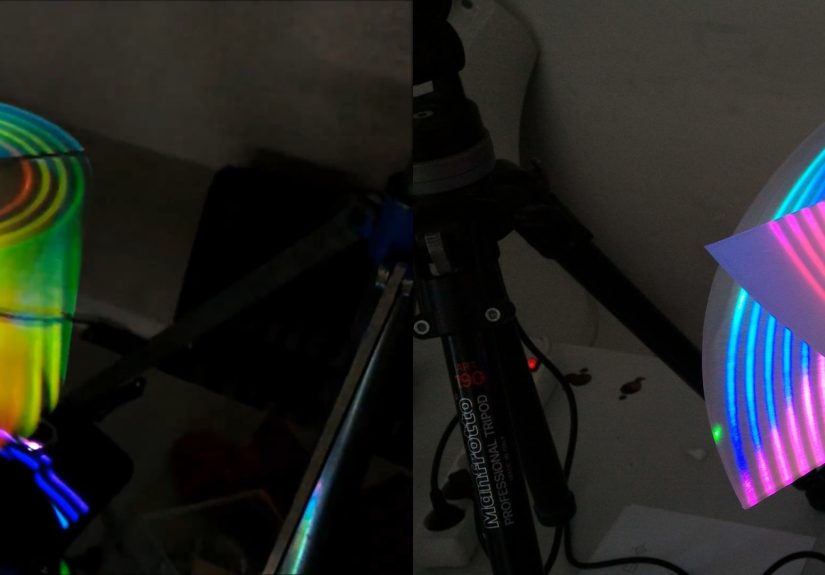
The helical form is not just there to look cool in photos. It defines where light can appear in space. In one widely shared prototype associated with Michel David’s work, the display used a rotating helix and a projected image synchronized to the rotor. By rapidly changing the image in sync with the spin, the system could choose where along the corkscrew the light landed. That is the essential trick: position by motion, shape by timing.
Earlier descriptions of the concept emphasized a double helicoid because balance and structural stability are not optional when you are spinning parts fast enough to fool human vision. If the helix wobbles, the image wobbles. If the geometry drifts, the illusion collapses. If the mechanics get sloppy, congratulations, you no longer have a futuristic display. You have a loud fan with trust issues.
The Projector Supplies the Slices
A helix display does not need to project a full 3D object in one shot. Instead, it projects a sequence of 2D slices or calculated intersections. In the underlying geometry, a 3D object is intersected with the helicoid, and that information is transformed into a 2D image that can be projected back onto the spinning surface. As the helix rotates, those projected segments appear at different spatial locations, rebuilding the object over time.
This is where high-speed projection becomes important. DLP technology, for example, is useful because digital micromirror devices can modulate light very quickly and with precise control. That kind of fast light management is exactly what swept-volume and volumetric displays need. A helix display is not just a mechanical project; it is also a timing project. The light has to arrive in the right place at the right instant, over and over again, without drifting into chaos.
Your Eyes Finish the Job
Persistence of vision does the final stitching. This principle is familiar from LED globes, spinning fan displays, and other POV builds. A pattern shown quickly across space can appear continuous to the eye. In a helix display, persistence of vision combines with motion parallax and physical depth cues to create the impression of a real object occupying a volume. That is why these displays feel so different from ordinary 3D on a flat panel.
A true volumetric display can provide depth cues like accommodation, convergence, binocular disparity, and motion parallax. In plain English, your visual system gets more of the signals it expects from real objects. That is one reason volumetric displays are often described as easier on the eyes than many conventional 3D methods. Your brain is doing less diplomatic work to reconcile mixed signals.
Why 3D Printing Changes the Story
The title starts with 3D printed for a reason. Without additive manufacturing, helix displays are much harder to build well. The geometry is weird, the tolerances matter, and the parts need to line up with the math. If the digital model says the helix has a certain pitch, width, angle, and radius, the physical object needs to match closely enough for the projection mapping to land where expected.
That is a dream scenario for rapid prototyping. 3D printing lets a designer move from CAD model to physical part quickly, revise the shape, print again, and iterate without begging a machine shop for mercy. Rapid prototyping is especially valuable here because a helix display is one of those inventions where small changes in geometry can have outsized effects on balance, brightness, visibility, and image quality. You do not want to discover that version 1 has the aerodynamics of a tortilla after spending weeks fabricating it by hand.
In practice, 3D printing can help with far more than the helix itself. It can produce motor mounts, alignment jigs, sensor brackets, projector shrouds, balancing aids, protective housings, and experimental surface carriers. For makers, researchers, and hardware artists, that means the difference between “interesting thought experiment” and “working prototype on my bench.”
Why This Feels More Real Than a Typical 3D Screen
One of the most compelling things about a helix-style volumetric display is that it can be viewed from different angles. Walk around it, and the image changes as a real object should. That is fundamentally different from many flat 3D displays, where the illusion depends on a specific viewing zone, special eyewear, or carefully controlled head position.
Historically, this promise has made volumetric display research attractive for technical fields that depend on spatial understanding. Engineering, molecular modeling, air traffic visualization, education, and collaborative design have all been cited as natural use cases. If multiple people need to see the same object at once and understand its shape without wearing goggles, volumetric display technology starts looking very attractive very quickly.
There is also a creative reason people love these systems: they look magical without being dishonest. A hologram is often used as a catch-all label in popular culture, but a helix display is not merely pretending to be 3D from a lucky angle. It is placing visible information into a real volume. That distinction matters. The wow factor is not just marketing fog; it comes from actual spatial behavior.
Strengths of the Helix Approach
1. It Delivers a Genuine Sense of Depth
A good helix display offers something flat panels struggle to match: believable spatial presence. The image can appear to occupy a real region rather than merely suggesting one. For demos, installations, and education, that alone is a crowd magnet.
2. It Encourages Low-Cost Experimentation
Because modern versions can combine 3D printing, affordable motors, commodity optics, and open design tools, makers can explore ideas that once belonged mostly to research labs. That democratization matters. Some of the most interesting display innovations now begin as weird garage projects with suspiciously optimistic wiring.
3. It Bridges Art and Engineering
Helix displays sit in a sweet spot between sculpture, optics, mechanics, and computation. They can visualize data, but they can also become kinetic art pieces. A successful build is both a machine and a performance. It does math, but it also shows off.
Where Helix Displays Still Struggle
For all their charm, helix displays are not one lucky Kickstarter away from replacing OLED televisions. They face some stubborn technical issues.
Brightness and Ambient Light
Volumetric displays often look best in dimmer environments. The projected or scattered light has to compete with room lighting, and a rotating surface is not always the most efficient thing in the world at returning photons to the viewer. In bright public spaces, the effect can lose some of its punch.
Resolution and Voxel Density
The final image quality depends on projector speed, synchronization accuracy, rotation rate, and how finely the system can sample the volume. Historical systems like FELIX worked with voxel-based imagery at modest frame rates, and even modern research continues to wrestle with the tradeoff between latency, brightness, interaction, and resolution. Making a volumetric image feel truly crisp is still a harder job than making a flat one look good.
Mechanical Complexity
Moving parts are both the personality and the headache of a helix display. Rotation introduces vibration, noise, wear, safety considerations, and calibration demands. A flat monitor mostly asks you to plug it in. A spinning helical display asks whether your bearings are aligned, your rotor is balanced, and your timing loop has had enough coffee.
Content Pipeline Challenges
Creating content for a helix display is not as simple as dragging a video file onto a USB stick. The system must convert 3D objects or animations into time-synchronized slices that correspond to the shape and position of the moving surface. The display is only half the invention. The software pipeline is the other half, and it is rarely the half that gets the glamour shots.
Why the Original Concept Still Feels Fresh
The funny thing about helix displays is that they manage to feel both old-school and futuristic at the same time. The principle has roots going back decades, yet it keeps returning because the supporting tools keep getting better. CAD software is more capable. 3D printers are more accessible. Digital projectors are faster. Microcontrollers are cheaper. Sensors are easier to integrate. What was once a fragile research curiosity can now be explored by a determined maker with a printer, a projector, and a heroic tolerance for iteration.
That is why the phrase 3D printed helix display matters more than it first appears. It signals a shift from pure theory to practical experimentation. It suggests that display innovation no longer belongs only to massive labs with million-dollar budgets. Sometimes it starts with a spiraling part on a print bed and a builder asking, “What happens if I sync this a little better?”
Real-World Applications That Actually Make Sense
Not every new display technology needs to become a living-room standard to be valuable. Helix displays are especially well suited to places where novelty, visibility, and spatial understanding matter more than pixel-perfect cinema.
Museums and science centers can use them to show molecules, planets, engines, or historical objects in a way that encourages people to walk around the image. Trade shows can use them because a floating logo or product visualization stops people in their tracks faster than yet another looping video wall. Education benefits because some concepts are simply easier to grasp when they occupy space. And art installations love anything that turns motion, light, and geometry into a shared “what on earth am I looking at?” moment.
In technical fields, the long-term case remains compelling. Volumetric displays can support collaborative viewing, which is still a weakness for many headset-based systems. If a team wants to inspect a form together without taking turns, strapping on hardware, or standing in a laser-marked sweet spot, the humble spinning helix starts looking pretty smart.
Experience Section: What It Feels Like to Encounter a Helix Display
The experience of seeing a helix display for the first time is oddly memorable because your brain does not file it neatly into an existing category. It is not a screen in the normal sense, and it is not a sculpture in the ordinary sense either. You look at it and immediately start doing tiny mental double-takes. The object appears to hover in a volume, but you can also sense that something mechanical is happening. It feels less like watching content and more like catching a machine in the act of making reality improvise.
From across the room, the first impression is usually surprise. The image seems suspended, almost casual about its own improbability. Up close, the experience changes. You begin to notice the relationship between motion and light. The display is no longer just an illusion; it becomes choreography. The helix spins, the image updates, and the whole device seems to negotiate with your visual system at high speed. It is one of the few technologies that feels both elegant and slightly mischievous, like it knows it is getting away with something.
There is also a very physical quality to the experience. Flat screens hide their labor well. A helix display does not. It reminds you that images can be mechanical events. You may hear the motor, sense the motion, or notice subtle changes in brightness as you move around it. Rather than ruining the effect, that physicality often enhances it. The machine earns its magic in plain sight. It does not whisper, “Trust me.” It says, “Here are the spinning parts, the timing, the optics, and somehow you still think that cube is floating.”
For makers and engineers, the experience can become even richer because every visual success hints at an invisible design decision. A stable image suggests careful balancing. Clean geometry suggests precise modeling. A bright, legible form suggests smart choices about surface material, projector alignment, and rotational speed. In that sense, watching the display is also reading a story about iteration. You are not only seeing the final image. You are seeing the history of trial prints, recalibration, redesign, and the occasional muttered sentence that should not be repeated near children.
For general audiences, though, the joy is simpler. People circle it. They lean in. They test it from different angles. They point at it the way people point at campfires, aquariums, and suspiciously realistic cake. That behavior says a lot. A helix display invites exploration instead of passive viewing. It turns spectators into participants because the object rewards movement. Every step changes the relationship between viewer and image, which is exactly what makes real 3D so compelling in the first place.
The longer you watch, the more you appreciate that the technology sits at a fascinating intersection of disciplines. It is display engineering, yes, but it is also industrial design, motion control, optics, fabrication, and theater. Even when the content is simple, the medium itself tells a story: that sometimes the future does not arrive as a perfect slab of glass. Sometimes it arrives as a spinning helix, a carefully aimed beam of light, and a deeply committed refusal to stay flat.
That is why helix displays linger in the mind. They do not just show a 3D image. They make you aware of how hard-earned that image is. They remind you that innovation can still be visible, mechanical, and a little weird. And honestly, in a world full of polished rectangles, a little weird feels pretty refreshing.
Final Take
The 3D printed helix display is more than a clever visual stunt. It is a vivid example of what happens when additive manufacturing, projection technology, geometry, and persistence-of-vision thinking collide in exactly the right way. It belongs to a long lineage of volumetric display experiments, but it also feels distinctly modern because 3D printing makes the concept easier to prototype, refine, and share.
No, it is not ready to replace your laptop screen. Yes, it can still be finicky, dim, noisy, and mechanically demanding. But that misses the point. Its real importance lies in what it proves: that true spatial graphics are not confined to blockbuster budgets and corporate labs. With the right model, the right timing, and a helix that does not wobble like a shopping cart wheel, a builder can create graphics that genuinely occupy space.
And that is why this technology keeps turning heads. It does not merely imitate depth. It performs it. Literally.