Table of Contents >> Show >> Hide
- What Does “Tuning Atomic-Scale Geometry” Actually Mean?
- The Moiré Effect: A Tiny Twist With Giant Consequences
- From Ordered Patterns to Disorder-Like Behavior
- Why Geometry Can Control Electricity
- Magic-Angle Graphene: The Celebrity Cousin
- Beyond Graphene: A Broader Materials Playground
- Potential Applications of Tunable Atomic-Scale Geometry
- Why This Research Is Still Early
- The Deeper Lesson: Shape Is a Material Property
- Practical Experience: What This Topic Feels Like in the Real World
- Conclusion
- SEO Tags
Imagine if the future of electronics did not depend only on inventing brand-new substances, but on giving existing materials a tiny twistliterally. Not a dramatic movie-villain twist, not a “surprise ending” twist, but a microscopic rotation between layered patterns so small that it can completely change how electricity, heat, light, and even magnetism behave.
That is the exciting idea behind recent research into tunable atomic-scale geometry. Scientists and mathematicians have shown that by rotating, stretching, or offsetting lattice-like patterns, they can create moiré structureslarge-scale interference patterns that emerge when two smaller repeating patterns overlap. At the atomic scale, these patterns are not just pretty. They can act like a control panel for material properties.
The big headline is simple: geometry can become a knob. Turn it slightly, and a material may behave more like a conductor. Turn it another way, and it may act like an insulator. In other systems, carefully tuned geometry can help create superconductivity, flat electronic bands, unusual magnetic phases, or new ways to guide light. It is like discovering that your apartment’s floor tiles secretly control the Wi-Fi, the thermostat, and your toaster’s personality.
The science is still young, but the implications are enormous. This work could help guide future designs for quantum devices, energy-efficient electronics, optical materials, sensors, thermal management systems, and possibly new families of superconductors. The key idea is not magic, although “magic-angle graphene” certainly sounds like it wandered out of a wizard’s lab. The key is structure.
What Does “Tuning Atomic-Scale Geometry” Actually Mean?
Atoms inside solids are often arranged in repeating patterns called lattices. In a crystal, those patterns can be extremely orderly, like a perfectly tiled kitchen floor designed by someone who alphabetizes their socks. Change the arrangement of atoms, and you can change how electrons move, how light interacts with the material, how heat travels, and how magnetic behavior appears.
Traditionally, scientists changed material behavior by changing chemical composition: add this element, remove that impurity, mix in another compound, bake at a different temperature, and hope the universe feels cooperative. That approach still matters. But atomic-scale geometry adds another strategy: instead of changing what a material is made of, scientists can change how its internal patterns line up.
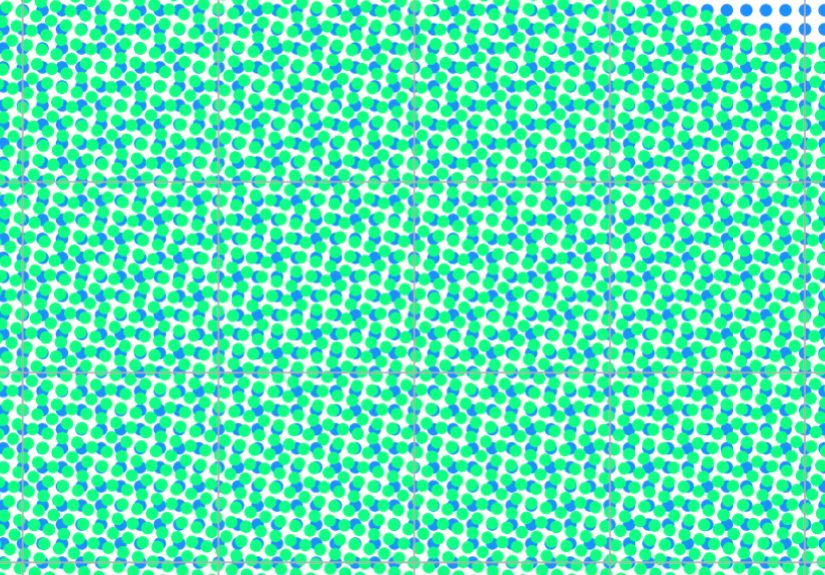
This is where moiré patterns enter the room wearing a lab coat. A moiré pattern appears when two regular patterns overlap at a slight angle or mismatch. You may have seen this effect when photographing a screen, looking at layered mesh, or noticing wavy patterns on certain fabrics. At everyday scale, it is a visual oddity. At atomic scale, it can become a powerful engineering tool.
When two atomically thin layers are stacked and one is rotated slightly, the atoms no longer line up in the same way everywhere. Some regions may align closely, while others are offset. This creates a larger repeatingor sometimes non-repeatingsuperstructure. Electrons moving through that landscape feel a new kind of terrain. In the right conditions, the terrain can slow electrons down, localize them, pair them, or guide them into unusual collective behavior.
The Moiré Effect: A Tiny Twist With Giant Consequences
The moiré effect is a reminder that size can be deceptive. A rotation of just one or two degrees sounds laughably small. It is the kind of adjustment you might make when hanging a picture frame and then declare, “Good enough.” In materials science, however, that tiny angle can be the difference between ordinary behavior and exotic physics.
In moiré materials, the twist angle controls the size and shape of the larger interference pattern. Smaller twist angles often create larger moiré cells. Those larger cells can reshape electronic bands, which are the allowed energy levels electrons can occupy inside a material. If those bands become very flat, electrons lose some of their usual freedom to zip around independently. Instead, electron-electron interactions become more important, and collective quantum behavior can emerge.
This is why twistronicsthe study of how twisting two-dimensional materials changes their electronic propertieshas become one of the most exciting fields in condensed matter physics. The name sounds like a dance move performed by robots at a wedding, but the science is serious. By controlling the relative angle between layers, researchers can explore electronic states that were previously difficult to create or study.
One famous example is twisted bilayer graphene. Graphene is a single layer of carbon atoms arranged in a hexagonal pattern. Stack two graphene sheets and rotate one at a special angle near 1.1 degrees, and the system can show superconducting and insulating behavior under certain conditions. That discovery helped launch a wave of research into moiré quantum materials.
From Ordered Patterns to Disorder-Like Behavior
The newer work on tunable atomic-scale geometry extends this idea beyond graphene. Researchers have studied how two regular lattices can be rotated and stretched relative to each other to create composite patterns with dramatically different microgeometries. These structures can be periodic, quasiperiodic, or aperiodic.
A periodic pattern repeats regularly, like a chessboard. A quasiperiodic pattern has long-range order but does not repeat in the simple way a normal crystal does. An aperiodic pattern does not repeat predictably across space, even though it may still be generated by deterministic rules. If periodic geometry is a marching band, quasiperiodic geometry is jazz with sheet music, and aperiodic geometry is jazz after three espressos.
The surprising result is that small changes in twist angle or scale can produce abrupt changes in material behavior. In some configurations, a composite may conduct current efficiently. In others, it can behave more like an insulator, blocking current. The transition resembles disorder-driven effects known from quantum physics, but in these models the effect can arise from geometry itself rather than random defects.
That is a major conceptual shift. Disorder is usually something engineers try to reduce. Here, researchers can generate disorder-like behavior from clean mathematical rules. The material is not necessarily messy; it is geometrically sophisticated. Think of it as organized chaos with a PhD.
Why Geometry Can Control Electricity
Electric current depends on how easily electrons or charges can move through a material. In a simple conductor, charges have connected pathways. In an insulator, those pathways are blocked or broken. In a composite material, where two different components are arranged together, the geometry of those components can determine whether current flows smoothly or gets trapped.
Moiré-based composites give scientists a way to design those pathways with unusual precision. By changing the relative twist and scale of the underlying patterns, researchers can create microstructures where conductive regions connect across the materialor fail to connect. That means the same basic ingredients may produce very different macroscopic behavior depending on geometry.
This is especially useful because many important material properties are transport properties. Electrical conductivity, thermal conductivity, diffusivity, magnetic response, and optical behavior all depend on how fields, particles, or energy move through structure. If geometry can control those pathways, it becomes a universal design language.
The long-term dream is to design materials backward. Instead of making a material first and then testing what it does, engineers could start with a desired behaviorsay, “block this frequency of light,” “guide heat in this direction,” or “switch current sharply”and then calculate the geometry needed to achieve it.
Magic-Angle Graphene: The Celebrity Cousin
No discussion of tunable atomic-scale geometry is complete without graphene, the celebrity cousin of this research family. Graphene has been famous for years because it is thin, strong, conductive, and unusually responsive to its environment. But twisted bilayer graphene turned the excitement dial up to “physics conference standing-room only.”
When two graphene layers are stacked at a small twist angle, their electronic structures interact. Near the so-called magic angle, the electronic bands flatten. Flat bands make electron interactions more influential, and that can lead to correlated insulating states and superconductivity. In superconductors, electrical current flows without resistance, though in these graphene systems the effect still requires extremely low temperatures.
The reason magic-angle graphene matters is not that it will instantly replace copper wires or power your gaming laptop with zero heat next Tuesday. It matters because it gives scientists a controllable platform for studying strongly correlated electrons. High-temperature superconductivity remains one of physics’ great puzzles, and moiré materials let researchers adjust variables with unusual delicacy.
Graphene also shows that geometry is not decorative. A change of angle can alter the entire electronic personality of a material. That is a wild sentence, and yet here we are.
Beyond Graphene: A Broader Materials Playground
Graphene gets the spotlight, but moiré science is bigger than carbon. Researchers are exploring twisted transition metal dichalcogenides, boron nitride layers, double bilayer graphene, trilayer graphene, multilayer systems, magnetic two-dimensional materials, and engineered composites. Each system offers different knobs: twist angle, layer number, pressure, strain, electric fields, magnetic fields, carrier density, and material choice.
This broader playground matters because different applications need different behaviors. A quantum device may need sharply defined electronic states. A photonic material may need to control how light moves. A thermal material may need to guide heat away from sensitive components. A sensor may need a response that changes dramatically when a molecule, field, or temperature shift appears.
Moiré engineering gives scientists a way to create artificial landscapes for electrons, photons, phonons, and other excitations. Instead of accepting the natural behavior of a crystal, researchers can build a new effective environment inside the material. It is a little like landscaping for quantum particles, except the lawn mower costs more than a house.
Potential Applications of Tunable Atomic-Scale Geometry
1. Next-Generation Electronics
Modern electronics depend on switching, conduction, insulation, and energy efficiency. Materials whose electronic properties can be tuned by geometry could lead to new types of transistors, memory devices, and low-power circuits. If a material can sharply switch between states, it may be useful for devices that mimic neural firing or perform specialized computing tasks.
2. Quantum Computing and Quantum Simulation
Moiré materials are promising platforms for quantum simulation because they allow researchers to create and study strongly interacting electronic systems. Instead of trying to solve every complex quantum material directly, scientists can build tunable systems that imitate important parts of the problem. This could help researchers investigate superconductivity, topology, magnetism, and correlated phases.
3. Optical and Photonic Materials
Geometry can influence how materials absorb, transmit, reflect, or localize light. Tunable moiré composites may one day help engineers design materials that block certain wavelengths while allowing others through. That could matter for imaging, sensing, optical communication, filters, and nanoscale photonic devices.
4. Thermal Management
Heat is the uninvited guest at every electronics party. As devices shrink and power density rises, controlling heat becomes more important. If geometry can tune thermal conductivity, materials could be designed to move heat away from sensitive regions or insulate areas that need protection.
5. Acoustic and Mechanical Metamaterials
The same mathematical principles may inspire acoustic and mechanical analogues. In other words, twisted or patterned structures might control sound waves, vibrations, or mechanical energy. That could lead to better vibration damping, acoustic filters, or materials that respond differently depending on frequency and direction.
Why This Research Is Still Early
It is tempting to read about tunable atomic-scale geometry and immediately imagine a future where phones charge instantly, power grids lose no energy, and laptops run cool enough to use as pillows. Science, unfortunately, enjoys taking the scenic route.
Many moiré quantum effects require ultra-clean samples, extreme precision, low temperatures, or specialized fabrication techniques. A twist angle that is off by a fraction of a degree can change the result. Real materials may contain strain, defects, relaxation effects, contamination, and other complications. Scaling these systems from laboratory devices to commercial products is not trivial.
There is also a difference between discovering a tunable phenomenon and engineering a reliable device. A laboratory sample can reveal stunning physics while still being far from manufacturing reality. Scientists must learn how stable these effects are, how reproducible they can be, how they respond to normal operating conditions, and how they integrate with existing technologies.
Still, early-stage does not mean unimportant. The transistor, laser, and graphene itself all began as scientific curiosities before becoming platforms for technology. Tunable geometry may become another foundational idea, even if its most important applications are not obvious yet.
The Deeper Lesson: Shape Is a Material Property
The most fascinating part of this research is philosophical as well as practical. We often think of materials in terms of ingredients. Silicon is silicon. Carbon is carbon. Copper is copper. But modern materials science keeps showing that structure can matter as much as composition.
Diamond and graphite are both made of carbon, yet one is hard and transparent while the other is soft and dark. The difference is atomic arrangement. Moiré materials push this lesson further: even when the layers themselves are unchanged, their relative orientation can create new behavior.
That means geometry is not just a backdrop. It is an active ingredient. It can create energy landscapes, restrict motion, amplify interactions, open gaps, localize fields, and switch transport behavior. In the language of future engineering, “What is it made of?” may be only half the question. The other half will be, “How is it arranged?”
Practical Experience: What This Topic Feels Like in the Real World
For readers outside the lab, tunable atomic-scale geometry may sound distant, but the core experience is surprisingly familiar. Everyone has dealt with systems where a tiny alignment change makes a huge difference. Move a radio antenna a little, and the signal clears. Tilt window blinds slightly, and the whole room changes. Rotate polarized sunglasses, and glare appears or disappears. The science of moiré materials is far more advanced, of course, but the intuition is similar: alignment matters.
One useful way to experience the idea is to place two mesh screens, transparent grids, or patterned sheets on top of each other. Rotate one slowly. At first, the pattern may seem ordinary. Then larger ripples appear. Rotate a little more, and the spacing changes. Sometimes the pattern looks regular; sometimes it looks complex and almost random. Nothing about the individual sheets has changed. The new behavior comes from their relationship.
That simple demonstration gives a surprisingly good mental model for moiré engineering. In materials research, the “sheets” may be atomically thin layers. The “ripples” are not just visible patterns but electronic or optical landscapes. Electrons moving through those landscapes can behave as if they are traveling through a different material entirely.
From an engineering perspective, this creates both excitement and headaches. The excitement comes from control. If a tiny geometric adjustment can unlock a useful property, scientists gain a powerful design tool. The headache comes from precision. A twist angle that is helpful in theory may be difficult to reproduce across a large chip or industrial-scale material. It is like trying to hang a thousand picture frames perfectly straight, except each frame is made of atoms and the wall is quantum mechanics.
For students and science-minded readers, this field offers a valuable lesson: breakthroughs often happen when disciplines overlap. The story of tunable geometry includes mathematics, physics, materials science, nanofabrication, electrical engineering, optics, and computation. A mathematical model of quasiperiodic structure can connect to real questions about superconductors and electronic devices. A visual pattern known for centuries can become a route to quantum technology.
For industry watchers, the experience is one of cautious optimism. This is not a plug-and-play technology ready to drop into consumer gadgets tomorrow morning. But it is the kind of platform idea that can reshape research priorities. Companies and laboratories interested in quantum computing, advanced sensors, semiconductor alternatives, photonics, and low-energy electronics are watching moiré materials because the ability to tune behavior without changing chemistry could be extremely valuable.
For everyday readers, the best takeaway is wonderfully simple: the universe is picky about arrangement. Matter does not only care what atoms are present. It cares where they are, how they repeat, how they mismatch, and how they twist. Sometimes, a tiny rotation is enough to open a new chapter in technology. Not bad for something that sounds like a polite adjustment to a crooked rug.
Conclusion
Scientists are learning how to treat atomic-scale geometry as a tunable design parameter rather than a fixed feature. By rotating, stretching, and stacking lattice patterns, researchers can create moiré structures that dramatically alter material behavior. These changes can affect conductivity, insulation, optical response, thermal transport, magnetism, and superconductivity-related phenomena.
The research is still developing, and many challenges remain before tunable moiré materials become everyday technology. Yet the principle is powerful: geometry can act like a control knob for matter. In an era where conventional electronics faces physical and energy-efficiency limits, that knob could become extremely important.
The future of materials may not depend only on discovering new ingredients. It may depend on learning how to arrange familiar ingredients with atomic precision. Sometimes the difference between ordinary and extraordinary is not a new element. It is a tiny twist.