Table of Contents >> Show >> Hide
- The Art of Making Miniature Places Feel Real
- Why Abandoned Places Work So Well in Dioramas
- How I Build a Diorama From an Idea
- Examples From the 40 Dioramas
- Why Dioramas Connect With People Online
- The Role of Light in Miniature Realism
- What 40 Dioramas Have Taught Me
- of Personal Experience: What It Feels Like to Build Tiny Worlds
- Conclusion
There is something wonderfully suspicious about a good diorama. Your eyes tell you, “That is an old street corner, obviously.” Then your brain leans closer, adjusts its tiny detective hat, and whispers, “Wait a minute… that door is the size of a chocolate bar.” That is the magic I chase in my collection of 40 realistic dioramas: miniature worlds that feel large enough to walk into, even when they can fit on a desk.
These small scenes are not just cute objects or hobby projects. They are tiny slices of atmosphere. A cracked wall, a rusty pipe, a tired wooden door, a forgotten shop window, a dusty library shelfeach detail helps the viewer believe the place existed long before the camera arrived. The goal is not simply to build something small. The goal is to make small things feel alive.
My 40 dioramas are inspired by real places in the world: quiet alleys, abandoned workshops, old bookstores, seaside corners, industrial buildings, rural houses, and urban spaces that seem to be holding their breath. Some are based on memories. Others begin with photographs, travel impressions, architectural textures, or the kind of ordinary street detail most people walk past while checking their phone. I collect those forgotten details like treasure. Not glamorous treasure, perhaps, but still treasure. A good drainpipe has more personality than some movie villains.
The Art of Making Miniature Places Feel Real
A realistic diorama succeeds when the viewer forgets scale. That means every choice has to support the illusion: proportions, color, lighting, surface texture, depth, and storytelling. A miniature wall cannot simply be painted gray. It needs stains, chips, shadows, dust, uneven edges, and signs of time. Real places are never perfectly clean unless someone has just opened a hotel brochure and lied to us.
In my dioramas, realism often comes from imperfection. A crooked sign can make a storefront believable. A missing brick can suggest decades of weather. A torn poster can hint at people who came and went. Even empty spaces can feel crowded with memory when the details are right.
Scale Is the First Rule
Scale is the skeleton of a diorama. If the door, window, chair, stairs, and props do not agree with one another, the illusion collapses faster than a cardboard roof in a thunderstorm. Many miniature artists work in common scales such as 1:12, 1:24, 1:35, or 1:87, depending on the subject. A cozy room might work beautifully at 1:12, while an urban alley or vehicle scene may feel more natural at 1:35.
But scale is not only math. It is also visual rhythm. A tiny cup on a table, a narrow step, or a realistic brick pattern gives the viewer’s eye something familiar to measure. Once the eye accepts one object, it starts believing the whole place.
Texture Turns a Model Into a Memory
Texture is where a diorama starts to breathe. Smooth foam can become stone. Cardboard can become old plaster. Balsa wood can become a weather-beaten door. Plastic can become oxidized metal. The trick is to stop thinking about materials as what they are and start treating them as what they could become.
For brick walls, I use layers: carving, sanding, base painting, washes, dry brushing, pigments, and tiny chips. For wood, I add grain lines, uneven stains, and worn edges. For concrete, I use subtle color variation because real concrete is never just “gray.” It is gray, beige, dusty, stained, faded, and occasionally dramatic for no reason.
Why Abandoned Places Work So Well in Dioramas
Many of my favorite miniature scenes are abandoned or weathered places. Not because decay is gloomy, but because it is full of visual storytelling. A brand-new wall tells you very little. A peeling wall tells you about weather, time, neglect, repair, and people who once cared enough to paint it.
Abandoned spaces also invite imagination. Who owned this workshop? Why did the chair stay behind? Why is there a single light hanging over an empty desk? A diorama does not need to answer every question. In fact, it becomes more powerful when it leaves a little mystery on the tablepreferably next to a tiny coffee cup and a suspiciously realistic layer of dust.
The Beauty of the Ordinary
One of the biggest lessons I have learned is that “ordinary” places are often the most emotional. A corner grocery store, a garage, a stairwell, or a small room with books can feel more real than a castle because viewers recognize the details. They have seen similar walls, similar lamps, similar clutter, similar chairs. The diorama becomes personal because it reminds them of somewhere they have been.
That is why the 40 dioramas in this collection do not rely on fantasy to impress. They rely on familiarity. They ask viewers to notice the poetry in a rusty gate, a faded sign, a cracked window, or a dusty shelf. Miniature art slows the world down. It says, “Look again. Even this little corner matters.”
How I Build a Diorama From an Idea
Every diorama begins as a feeling before it becomes a structure. Sometimes I see an old photograph and imagine what might exist beyond the frame. Sometimes I pass a real alley and notice a wall with perfect damage. Sometimes a scene begins with one objecta motorcycle, a doorway, a desk, a bookcaseand the world grows around it.
Step 1: Research and Reference
Before cutting the first piece, I gather references. I study architecture, colors, street surfaces, signs, weathering patterns, and how objects age. A seaside wall does not age like a city wall. A workshop floor does not gather dirt the same way as a library floor. Realism depends on these quiet differences.
Reference photos are not used to copy a place exactly. They are used to understand how the world behaves. Where does rust appear? How does dust collect? Which areas fade in sunlight? What happens to paint near the bottom of a door? The answers help the miniature feel natural.
Step 2: Composition and Story
A diorama is not only a model; it is a stage. The viewer needs a path through the scene. I think about where the eye should enter, where it should pause, and what detail should be discovered last. A strong composition makes even a tiny room feel cinematic.
For example, an old bookstore diorama might guide the viewer from the doorway to the shelves, then to a reading chair, then to a small lamp, then to one book left open on a table. Nothing has to move. The story moves in the viewer’s imagination.
Step 3: Building the Base Structure
The base structure is usually simple: foam board, wood, cardboard, plastic sheet, or mixed media. At this stage, the diorama looks embarrassingly plain. This is normal. Every miniature masterpiece goes through an awkward phase where it resembles a school project that forgot its homework.
The important thing is accuracy. Walls must be straight when they should be straight, crooked only when the story demands it. Doors and windows must sit at believable heights. Floors need weight. If the structure feels convincing, the details can shine later.
Step 4: Painting, Weathering, and Layering
Weathering is the secret sauce of realism. Washes settle into cracks and corners. Dry brushing catches raised edges. Pigments create dust and grime. Scratches reveal older layers underneath. Each technique adds history.
The key is restraint. Too much weathering can make a scene look theatrical instead of real. Not every surface needs rust, moss, stains, cracks, and dramatic tragedy. Sometimes a clean area beside a dirty area creates the most believable contrast.
Examples From the 40 Dioramas
Although each diorama has its own personality, several themes appear again and again throughout the collection.
The Forgotten Bookshop
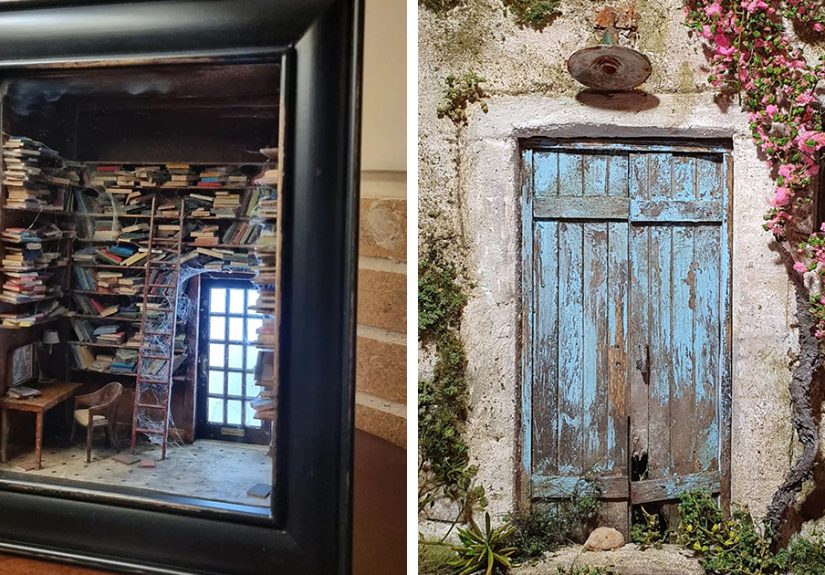
This diorama captures a narrow bookstore that feels tucked away on a quiet street. The shelves are crowded, the floor is worn, and the display window suggests a place that has survived many seasons. The challenge was making the books look varied without turning the scene into visual chaos. Tiny spines, uneven stacks, and soft lighting help create the sense of a shop where stories have been waiting patiently for decades.
The Old Garage
The garage scene is built around tools, oil stains, metal textures, and the kind of clutter that looks accidental but is actually planned very carefully. A realistic mess is harder than a clean room. Every object needs a reason to be there. A tire leaning against a wall, a workbench with scratches, a faded sign, and a dusty floor all suggest that someone just stepped out and may return any minute.
The Weathered Street Corner
Urban corners are full of small stories: pipes, posters, cables, shutters, broken plaster, and uneven pavement. This diorama focuses on layers of city life. The wall may be the main structure, but the personality comes from the details. A tiny drain, a chipped curb, or a faded advertisement can make the viewer feel they are standing on a real sidewalk.
The Quiet Rural House
Not every diorama needs urban grit. Rural scenes allow softer textures: wood, stone, dry grass, old fences, and warm light. A small house with a weathered door can feel peaceful, nostalgic, and slightly mysterious. The challenge is avoiding postcard sweetness. Real rural buildings have repairs, stains, uneven boards, and signs of practical life.
The Abandoned Workshop
This is one of the most emotional types of diorama because a workshop suggests human hands. Tools are intimate objects. They tell us someone fixed, built, shaped, and repaired things here. When the space is empty, the absence becomes the story. Dust on the bench, an old stool, and a half-finished object can say more than a full paragraph.
Why Dioramas Connect With People Online
Miniature art is extremely shareable because it gives viewers a tiny surprise. At first glance, people think they are looking at a real location. Then they realize the scene is handmade. That moment of discovery creates delight. It is the visual equivalent of finding a secret door behind a bookshelf.
Realistic dioramas also perform beautifully in photography. Macro photography, careful lighting, and shallow depth of field can make a miniature scene feel life-size. The camera becomes part of the illusion. A diorama built for photography may only need to look perfect from one angle, but that angle has to be convincing enough to fool the eye.
The Role of Light in Miniature Realism
Lighting can make or break a diorama. A flat light reveals the model as an object. Directional light turns it into a place. Shadows create depth, mood, and scale. Warm light can make a room feel lived-in; cool light can make an alley feel damp and quiet.
Small LED lights are especially useful for signs, lamps, windows, and interiors. But again, subtlety matters. If every tiny bulb glows like a stadium, the scene loses realism. The best miniature lighting feels natural, as if it belongs to the world inside the box.
What 40 Dioramas Have Taught Me
After building 40 dioramas, I have learned that patience is not optional. Miniature art rewards slow looking and slower working. There is no shortcut for believable texture. There is no magic button for atmosphere. Even the smallest object may need painting, sanding, aging, and repositioning before it feels right.
I have also learned that mistakes are part of the process. A broken piece can become debris. A paint accident can become a stain. A crooked cut can become an old repair. In miniature work, disasters often arrive wearing a tiny hat labeled “creative opportunity.”
of Personal Experience: What It Feels Like to Build Tiny Worlds
Working on these 40 dioramas has changed the way I see real places. Before I began building miniature scenes seriously, I walked through streets like most people do: noticing the big things first. A building. A shop. A road. A sign. Now I notice the little evidence of lifethe scratch marks near a keyhole, the color difference where an old poster was removed, the moss along a wall, the uneven repair on a stair, the dust trapped in the corner of a window frame.
That habit follows me everywhere. A normal walk can become a research mission. I might stop in front of an old door and think, “That peeling paint would look incredible at 1:35 scale.” This is not always convenient for the people walking with me. They may want coffee. I want to photograph a rusty hinge. Every artist has priorities.
The most satisfying part of the process is the moment when separate materials stop looking like materials. Foam stops being foam. Wood stops being wood. Paint stops being paint. Suddenly, there is a wall with history. A room with silence. A street corner with weather. That transformation feels almost magical, even though it is made from very practical steps: measuring, cutting, gluing, painting, waiting, repainting, and occasionally wondering why I chose a hobby with so many tiny parts that love to fall on the floor.
One of the hardest lessons has been knowing when to stop. Dioramas invite detail, and detail can become addictive. Add one poster, then a wire, then a bottle, then a stain, then a crack, then a tiny newspaper, then a smaller stain on the tiny newspaper. At some point, the scene becomes too busy. Realism needs breathing room. Empty space is not failure; it is atmosphere.
Another important experience is learning to build emotion, not just accuracy. A technically perfect miniature can still feel cold. A slightly imperfect one can feel unforgettable if it has mood. That is why I care so much about abandoned places, old shops, quiet rooms, and worn streets. These subjects carry emotion naturally. They remind viewers of memory, time, and change.
When people react to the dioramas, they often say they want to “step inside.” That is the best compliment. It means the scene has crossed the border between object and place. It means the viewer is not only admiring the craftsmanship but imagining sound, smell, temperature, and story. Maybe they hear rain outside the tiny window. Maybe they smell old books. Maybe they imagine footsteps in the alley. The diorama becomes a doorway.
Creating 40 dioramas has also taught me respect for small things. In a world obsessed with bigger screens, faster content, and louder everything, miniature art asks for attention. It invites viewers to slow down and look carefully. It proves that wonder does not need to be enormous. Sometimes wonder is hiding in a little doorway, behind a tiny curtain, under a roof made from painted cardboard, waiting for someone to lean closer.
Conclusion
My 40 dioramas that look like real places in the world are more than miniature scenes. They are small acts of observation, patience, and storytelling. Each one begins with a real-world detail and grows into a tiny environment filled with mood. Whether the subject is a forgotten bookstore, a weathered garage, an empty workshop, or a quiet rural wall, the purpose is the same: to make viewers pause, look closer, and feel as if they have discovered a real place in miniature form.
Dioramas remind us that beauty is not limited to grand landmarks. It can live in peeling paint, old wood, rusty metal, dusty shelves, cracked plaster, and ordinary corners. When recreated with care, these details become surprisingly powerful. They turn small models into emotional landscapes. And perhaps that is why miniature worlds continue to fascinate us: they make reality feel new again, one tiny brick at a time.