Table of Contents >> Show >> Hide
- What “Bale Lane Ground Up” Actually Refers To
- Setting the Stage: Calistoga’s Wide-Open “Nothing” and the Big View Problem
- The Dream Team: Why Collaboration Is the Real “Luxury Finish”
- Masterplan: A Low-Slung Compound That Points North (Because the Vineyard Said So)
- Materials That Age Gracefully (Because Wine Country Doesn’t Do “Disposable”)
- Interior Highlights: Where the Details Quietly Flex
- Landscape: The House That Refused to Compete With the Vineyard
- Building in Calistoga: The Unsexy (But Necessary) Part
- Design Takeaways You Can Steal (Legally) For Your Own Ground-Up Build
- Conclusion
- On-the-Ground Experiences: What a Bale Lane–Style Build Feels Like in Real Life (About )
If you’ve ever looked at an empty field and thought, “This needs a four-building compound, a terrace that behaves like a living room,
and enough glass to make a greenhouse jealous,” congratulationsyou already understand the vibe behind Bale Lane Ground Up.
This Calistoga, California, wine-country project isn’t just a pretty “modern farmhouse” for the mood board. It’s a masterclass in
ground-up construction where architecture, interiors, and landscape all agree to do the same job: frame the vineyard views,
stay calm, and never compete with the scenery.
In this deep dive, we’ll unpack what makes Bale Lane Ground Up work so wellfrom the site plan and the “architectural portals” concept,
to the material palette that’s designed to age gracefully (like a good Cabernet, not like your college haircut). You’ll also get
practical takeaways for anyone dreaming about a Napa Valley retreat, a Calistoga home build, or any
home where indoor-outdoor living isn’t a marketing phraseit’s a daily habit.
What “Bale Lane Ground Up” Actually Refers To
“Ground up” isn’t poetic fluff here. It’s literal: the project was conceived as a brand-new homesteadbuilt from scratchrather than a
renovation or addition. That matters, because a true ground-up build lets a team solve the big stuff first:
orientation, mass and scale, how the landscape flows, and
how the home behaves across seasons.
Bale Lane Ground Up is also a collaboration story. The project is widely associated with a four-part design-and-build crew:
architect Luke Wade (Wade Design Architects), interior designer Lauren Geremia (Geremia Design),
builder Total Concepts, and landscape designer Bernard Trainor. When you see the end resultserene,
cohesive, and extremely livableit’s hard not to suspect they held hands and sang “Kumbaya” at least once.
(Or maybe they just communicated like grown-ups. Equally rare.)
Setting the Stage: Calistoga’s Wide-Open “Nothing” and the Big View Problem
A lot of great projects start with constraints: steep slopes, tight setbacks, angry neighbors with binoculars. This one started with…
openness. The property was essentially a blank slateflat valley floor, big sky, bordering vineyards, and ridgelines that beg to be
treated like artwork. The challenge wasn’t “How do we squeeze a house in?” It was “How do we build a compound that
feels inevitable in a landscape that already looks complete?”
Calistoga itself is the northern tip of Napa Valleyfamous for wineries and a wellness culture tied to geothermal hot springs and
mineral-rich mud baths. That local identity nudges design toward a certain kind of luxury: not flashy, not precious, but restorative.
A place where you can go from a vineyard tasting to a long soak and still feel like the day has room to breathe.
The Dream Team: Why Collaboration Is the Real “Luxury Finish”
You can buy expensive tile. You can import statement lighting. But the rarest finish in residential construction is alignment:
everyone understanding what the home is trying to be and making decisions that support that goal.
Many cooks, better dinner
This project is known for a high-involvement processdesign-minded clients, multiple experts, and lots of active back-and-forth.
Instead of creating chaos, that collaboration sharpened the result. The team reportedly leaned into hands-on testing and iteration
(yes, even on things as “unsexy” as how exterior materials would weather and fade). That kind of attention is how you get a home that
feels effortless after the fact.
Integrated Project Delivery: a fancy term for “talk early, regret less”
Total Concepts describes using an Integrated Project Delivery (IPD) approachbringing owners, architect, contractor,
designers, engineers, and key subs into a coordinated team from the beginning. In real life, this can reduce the classic
“design vs. budget vs. schedule” food fight, because the people building the thing are in the room while decisions are made.
For a glass-heavy, detail-driven wine-country compound, that’s not a nice-to-have. That’s how you avoid heartbreak.
Masterplan: A Low-Slung Compound That Points North (Because the Vineyard Said So)
The site plan does something deceptively simple: it arranges multiple structures along an east–west axis so they open north toward the
best views. Instead of one giant “main house blob,” the program becomes a compound: a main residence, guest house, pool house,
and a barn/car barn (with a loft space above it used for movement and exercise).
Why does that matter? Because a compound can create courts and yardsoutdoor rooms with different moods:
a sunny gathering terrace, a quieter garden edge, a pool zone that feels like vacation without screaming “resort brochure.”
The buildings don’t just look at the landscape; they shape how you move through it.
Architectural portals and breezeways
One of the signature ideas associated with the project is the use of “architectural portals”framing devices and transitions that
turn walking outside into a designed experience. It’s not about grand drama; it’s about rhythm. You pass through breezeway-like
connectors and suddenly the vineyard view is centered, like someone adjusted the camera angle for you. (Nature, but edited.)
The terrace as the “outdoor living room”
There’s a key move here: the terrace isn’t an accessoryit’s the heart. The central outdoor area is designed as a true room, complete
with elements that make it usable beyond perfect weather. A portion of the terrace is covered, and the roof is handled in a way that
preserves clean lines (including clever structural strategies that hide slope while keeping a continuous beam expression).
The goal is continuity: the outdoors doesn’t feel like you “left the house.” It feels like the house got bigger.
Materials That Age Gracefully (Because Wine Country Doesn’t Do “Disposable”)
Bale Lane Ground Up is often described as serene and spare, but it’s not sterile. The material strategy is “earthy and durable,” with a
palette designed to let light and landscape stay in charge. Think tactile surfaces, natural tones, and finishes that improve as they
weatherlike cedar cladding that can soften into silvery grays rather than trying to stay “brand new” forever.
Plaster, white oak, and the art of the soft corner
One of the most interesting interior moments is a plaster-wrapped partial wall used to subtly divide spaces without chopping them up.
Plaster isn’t just a vibe; it changes how light behaves, bouncing it in a way that feels calm and continuous. Pair that with
gray-washed European white oak built-ins, and you get an interior that reads like furniture and architecture at the same timeuseful
in a house with lots of glass and not a lot of conventional “hang art here” wall space.
Steel-framed windows: gorgeous, demanding, and worth it
Steel-frame windows and doors (including expansive glass openings) are a hallmark of this project’s indoor-outdoor flow. They do two
important things at once: they keep the lines slim and modern, and they let the views behave like huge, changing paintings.
The tradeoff is precisionsteel systems and large openings require an expert build team and obsessive detailing. If you want the
clean look, you can’t get casual about tolerances.
Radiant floors that run inside to out: comfort you don’t have to think about
Understated luxury shows up in systems, not just finishes. Radiant heating (and the idea of continuous flooring zones) supports the
project’s core promise: effortless transitions. When the floor temperature feels consistent and door thresholds don’t interrupt the
experience, indoor-outdoor living stops being a design slogan and becomes the default way the home operates.
Interior Highlights: Where the Details Quietly Flex
The interior design is frequently described as clean yet soulfulminimal enough to feel restful, but layered enough to feel lived-in.
It’s also deeply personalized: a home calibrated to rituals and daily habits, not to whatever trend is currently yelling on social
media.
The kitchen: calm, practical, and secretly very fancy
The kitchen is a centerpiecebuilt for gathering, cooking, and lingering. A few choices that get talked about because they’re both
pretty and practical:
- Handmade tile (often referenced as a pale “Cloud” field tile) that reads soft and airy instead of glossy and loud.
-
Natural stone on the island (a white-honed limestone is commonly associated with the project), which keeps the
palette grounded. -
Brushed stainless on a working counter zonebecause a serious kitchen sometimes needs a surface that shrugs off
real cooking. - A built-in leather banquette that turns breakfast into a daily ritual instead of a standing meeting with your toaster.
The best part is how these elements collaborate: the tile softens light, the stone adds weight, and the stainless brings utility.
Together they create a kitchen that feels relaxedeven though it’s packed with deliberate decisions.
Lighting and furniture: sculptural, but never precious
Throughout the home, furnishings and lighting lean sculptural without turning the place into a museum. Pieces are often pulled from
respected showrooms and makers, mixed with antiques, and chosen for tactility. The effect is “designed,” yesbut also “sit down,
put your feet up, and talk for two hours.” Which, in wine country, is basically a performance requirement.
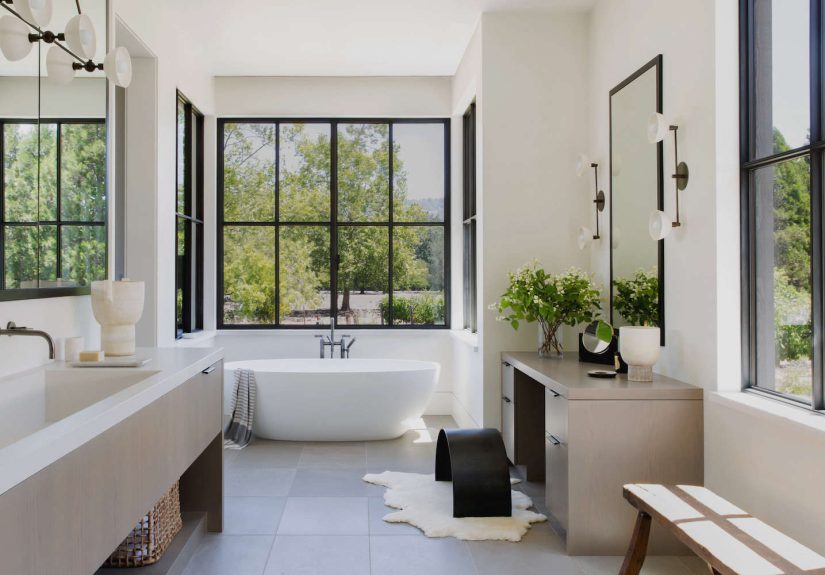
The primary bath: a ritual room (with horses, because Calistoga)
The primary bath is frequently singled out as a favorite because it treats bathing like a daily reset. There’s a focus on
relaxation and routine, and the indoor-outdoor connection continueseven to the point of an outdoor shower with pastoral views.
That’s not just luxury; it’s a reminder that the home’s whole identity is tied to land and landscape.
Landscape: The House That Refused to Compete With the Vineyard
In wine country, landscaping can easily become a flex: dramatic plantings, high-maintenance everything, a garden that requires a staff
roster. Bale Lane Ground Up takes a different approach. The landscape is designed to reinforce the architecture and the setting:
hues and textures that echo the building materials, native-leaning sensibility, and outdoor zones that feel like natural extensions
of the compound.
The biggest landscape “move” is restraint. By keeping the grounds legible and calm, the vineyard remains the star. The home becomes a
frame and a refuge, not a competing attraction.
Fire-smart wine country: defensible space without killing the vibe
Northern California’s wildfire reality has changed how thoughtful homeowners approach landscaping and exterior detailing. Modern
guidance emphasizes ember resistance closest to the homeespecially the first five feet around structures and decks. Practically,
that can look like more hardscape near the house (gravel, pavers, concrete) and fewer flammable materials right up against the walls.
The good news: in a minimalist, architecture-forward compound, that strategy can actually look cleaner, not worse.
Building in Calistoga: The Unsexy (But Necessary) Part
Ground-up construction in California means permits, inspections, and code compliance that touches everything from structure to energy.
Calistoga’s Planning & Building functions include building permit review for compliance with structural, mechanical, plumbing,
electrical, and energy-efficiency requirements. Translation: your dream terrace still has paperwork.
Energy code reality: Title 24 and modern comfort
California’s Building Energy Efficiency Standards (Title 24) shape what “high-performance” looks like in practice, including options
for prescriptive compliance and performance modeling. Recent updates continue pushing efficiency, indoor air quality considerations,
and electrification-friendly strategies (like heat pumps). For a compound that prioritizes comfort and year-round usability, those
standards aren’t just compliancethey’re part of the design toolkit.
Design Takeaways You Can Steal (Legally) For Your Own Ground-Up Build
You may not be building a four-structure Calistoga compound (although I support your ambition). But Bale Lane Ground Up offers lessons
that scale down beautifully:
1) Start with the view, then design the rooms
The project’s success is rooted in orientation. Identify your “money view” early. Then align circulation, openings, and gathering
spaces so the best vistas show up where life actually happenskitchen, living, outdoor diningnot just in a formal room no one uses.
2) Make one outdoor space the heart
Don’t scatter patios everywhere and hope one feels right. Create a primary outdoor “room” with shade, seating logic, and systems
support. When the outdoors is designed like a room, it gets used like a room.
3) Choose materials that forgive real life
Wine country living includes dust, pollen, wet towels, and the occasional red wine incident that looks like a crime scene.
Prioritize durable, repairable finishesplaster that patinas, wood that ages, stone that can be honed, metals that wear well.
4) Obsess over transitions, not just features
The magic lives in thresholds: door tracks, floor continuity, covered-to-uncovered zones, and how the house handles a chilly evening.
If you want effortless indoor-outdoor living, design the “in-between” spaces with as much care as the rooms.
5) Collaboration is a design strategy
Bring builder and key trades into conversations early, especially with large openings and custom details.
A collaborative delivery method isn’t just project managementit’s how you protect the design intent from death by a thousand
“value engineering” cuts.
Conclusion
Bale Lane Ground Up is a reminder that “modern farmhouse” doesn’t have to mean a greatest-hits playlist of trendy shiplap and barn doors.
Here, it means a restrained compound tuned to its landscape: low-slung forms, portals that frame views, natural materials that age with
grace, and interiors built around how people actually live.
The real achievement isn’t any single featureit’s coherence. Architecture, interiors, landscape, and building systems all work toward
the same goal: making Calistoga’s outdoor beauty feel like it belongs inside the home, without ever shouting over it.
Quiet confidence, vineyard views, and a terrace that earns its keephonestly, that’s the dream.
On-the-Ground Experiences: What a Bale Lane–Style Build Feels Like in Real Life (About )
A “Bale Lane Ground Up” lifestyle isn’t about constantly admiring your own house (though, sure, you’ll do a little of that).
It’s about how the place choreographs ordinary moments. Picture a typical morning: the light is soft, coming in indirectly through
large steel-framed openings, and the view isn’t a bonusit’s the background to everything. Coffee tastes better when your “screen time”
is literally looking at vines and ridgelines. You wander from bedroom to kitchen without a big shift in mood because the palette is
calm and the materials are consistent. Nothing is screaming for attention, so your brain finally stops hosting a loud internal podcast.
Then you notice the real wins: the house is designed around rituals. The kitchen banquette becomes the default place for breakfast,
the place where someone inevitably says, “We should stay one more day,” and everyone nods like it’s a serious business decision.
The terrace isn’t just “outside.” It’s where you take phone calls, read, host friends, and watch the day cool down. And because it’s
planned like a roomwith coverage and comfort featuresyou’re not limited to the five perfect weekends a year. You use it a lot.
That’s the difference between a photogenic patio and an outdoor space that earns its square footage.
Guests experience the compound like a mini-village. People drift: pool to terrace to kitchen to lawn, without bottlenecks.
If someone wants quiet, they can retreat to a guest house zone; if someone wants community, the central gathering spaces are obvious.
This separation also makes hosting less stressful. You can have people over for a long weekend without the house feeling like an airport
terminal during a weather delay.
But real-life experience also includes real-life realities. Glass is wonderful until you realize it tells the truth about fingerprints.
If you want huge openings, accept that you’re signing up for a relationship with window maintenanceor hire help and pretend you’re
“outsourcing the narrative.” Natural materials age beautifully, but they also change. Wood shifts, exterior tones fade, stone gains
character. The best mindset is to treat that aging as part of the design, not as damage. Wine country houses should look better at
year ten than at year one.
Climate and safety matter, too. In fire-prone regions, you start thinking about the first five feet around the homewhat’s planted
there, what’s stored there, what’s combustible. The most successful “Bale Lane” experience is when fire-smart choices are integrated
into the aesthetic: clean hardscape near the house, thoughtfully placed plants, and outdoor furniture choices that don’t turn into
fuel when embers show up uninvited.
Finally, the most surprising part: a home like this changes your relationship with time. Because the environment is designed for
comfort and flow, you linger more. Meals stretch. Conversations last. The house quietly suggests a better scheduleone where you stop
sprinting, start noticing the light, and realize you don’t actually need much… aside from maybe a second bottle and a good playlist.
(Design can’t fix everything, but it can absolutely improve your weekend.)