Table of Contents >> Show >> Hide
- What Is a Dyson Sphere, Really?
- Why Solid Dyson Spheres Were Considered Unstable
- The Binary-Star Loophole
- Does This Mean Aliens Have Built One?
- How Astronomers Would Search for Dyson Spheres
- Why Infrared Excess Is Both Exciting and Annoying
- Dyson Spheres, the Kardashev Scale, and Big Energy Dreams
- Could Humans Ever Build a Dyson Sphere?
- What the New Study Changes
- The Sensible Takeaway: Possible Is Not Probable
- Experience Section: Imagining Dyson Spheres Through Real-World Intuition
- Conclusion
For decades, Dyson spheres have lived in the same mental folder as warp drives, galactic empires, and suspiciously clean spaceship cafeterias: thrilling, enormous, and probably not arriving by Tuesday. But according to recent physics research, the idea may not be pure science fiction after all. Under very specific conditions, a Dyson sphereor at least a Dyson-like shell or ringcould be stable enough to exist in the real universe.
That does not mean astronomers have found alien megastructures hiding behind every suspiciously warm star. It also does not mean humanity should start dismantling Mercury this weekend, although someone on the internet has probably already made a spreadsheet. What it means is more interesting: the physics that once made solid Dyson spheres look hopelessly unstable may have a loophole. And like all good cosmic loopholes, it involves gravity, binary stars, and math that can make your coffee feel underqualified.
The main idea comes from work by Colin R. McInnes, an engineer at the University of Glasgow, who studied whether enormous artificial structures could remain stable in a two-star system. His conclusion is cautious but fascinating: a Dyson sphere could, in principle, be stable if it surrounds the smaller star in a binary system, provided the system meets strict requirements. So yes, according to physics, Dyson spheres could totally existbut the universe has attached a very long terms-and-conditions document.
What Is a Dyson Sphere, Really?
A Dyson sphere is a hypothetical megastructure built around a star to capture a huge portion of its energy. The concept was popularized by physicist Freeman Dyson in 1960, not as a blueprint for alien construction crews, but as a thought experiment about how advanced civilizations might meet enormous energy demands. If a civilization grows powerful enough, Dyson reasoned, it may eventually need more energy than a planet can provide. The obvious upgrade is the local star: a giant fusion reactor that already works, never asks for a maintenance subscription, and has been shining for billions of years.
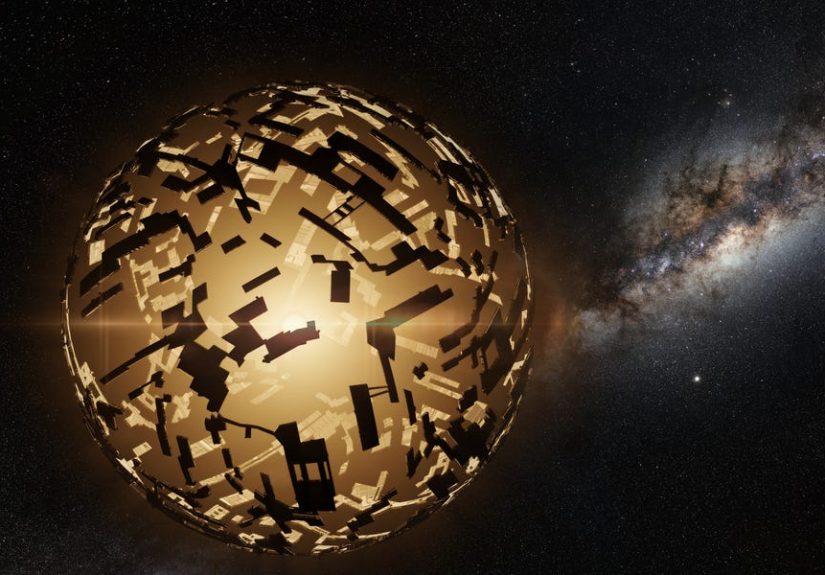
The phrase “Dyson sphere” often makes people imagine a solid shell completely enclosing a star, like a cosmic Christmas ornament with a sun trapped inside. That version is iconic in science fiction, but it is also the version that causes physicists to start rubbing their temples. A solid shell around a star would face severe stability problems, mechanical stress, radiation pressure, impacts from space debris, and the minor inconvenience of being absurdly difficult to build.
The more realistic version is usually called a Dyson swarm: millions or billions of independent solar collectors orbiting a star. Each unit would collect energy and possibly beam it elsewhere. Instead of one giant shell, picture a carefully coordinated cloud of solar satellites. It is still wildly beyond current human engineering, but it avoids some of the problems that make a rigid shell so physically troublesome.
Why Solid Dyson Spheres Were Considered Unstable
The classic objection is simple: a hollow shell around a star is not gravitationally “held” at the center in the way many people assume. Under Newton’s shell theorem, the net gravitational force inside a uniform spherical shell cancels out. That sounds peaceful until you realize the star and shell are not magically locked together. If the star drifts slightly off-center, gravity does not automatically pull it back into place. Over time, the star and shell can shift relative to one another. Eventually, the star could collide with the structure. That is not a small maintenance issue. That is the “entire civilization calls customer support at once” scenario.
This is why scientists have often treated the rigid Dyson sphere as less plausible than a Dyson swarm. A swarm can correct orbits, replace damaged collectors, and behave more like a collection of spacecraft than a single fragile cosmic eggshell. A solid shell, by contrast, must survive enormous structural demands while staying perfectly positioned around a star that refuses to sit politely for the engineering department.
That is where the new stability idea becomes intriguing. McInnes did not argue that ordinary single-star Dyson shells are suddenly easy. Instead, he asked a more precise question: are there special gravitational arrangements where such structures could be passively stable? The answer appears to be yes, but only in certain binary star systems.
The Binary-Star Loophole
Most stars in the universe are not lonely like our Sun. Many are part of binary or multiple-star systems, where two or more stars orbit a shared center of mass. These systems are gravitationally richer than a single-star setup, and that complexity can create equilibrium points where objects remain in stable or semi-stable configurations.
McInnes explored the mathematics of the restricted three-body problem, a famous problem in celestial mechanics involving the gravitational relationship between two massive bodies and a much smaller third object. In this case, the “third object” is not a planet or asteroid, but a huge ring or sphere treated as extremely light compared with the stars.
The key finding is that a Dyson sphere could be stable if it encloses the smaller star in a binary pair. The smaller star’s motion around the larger star provides a kind of gravitational anchoring effect. Instead of a shell and star drifting independently, the structure can share the smaller star’s orbit around the system’s center of mass. In plain English: the second star helps keep the whole arrangement from turning into an expensive cosmic pancake.
There is a catch, because physics loves a catch. The smaller star must be much less massive than the larger oneroughly below a certain mass ratioand the sphere itself must be extremely light compared with both stars. If the shell is too massive, its own gravity disrupts the system. If the star pair is not arranged correctly, the stability disappears. So this is not a universal recipe. It is a narrow door, but it is a door.
Does This Mean Aliens Have Built One?
No. “Physically possible” is not the same as “currently observed,” “easy to build,” or “definitely full of aliens ordering takeout.” The new research shows that under certain mathematical conditions, stable Dyson-like structures may not be forbidden by celestial mechanics. That is a big deal for theory, but it does not prove that anyone has constructed one.
Building a Dyson sphere would require materials, manufacturing, automation, orbital control, heat management, energy transmission, and long-term maintenance on a scale humanity cannot yet seriously attempt. Even a Dyson swarm would be a project of extreme civilization-level engineering. A rigid shell would be even more demanding. It would need to withstand stresses from gravity, rotation, radiation, impacts, thermal expansion, and probably whatever counts as zoning law in an alien civilization.
Still, the possibility matters because scientists searching for extraterrestrial intelligence need to know what kinds of objects might be physically plausible. If stable Dyson spheres are more likely in particular binary systems, astronomers can refine their search. Instead of looking only around single Sun-like stars, they may also consider systems where a smaller companion star could be hidden inside a large infrared-emitting structure.
How Astronomers Would Search for Dyson Spheres
The most famous Dyson-sphere signature is waste heat. Any structure that absorbs starlight and uses it for work must eventually release energy as heat. That heat would likely appear as excess infrared radiation. In other words, a Dyson sphere would make a star look dimmer in visible light and warmer in infrared light than expected.
NASA and SETI researchers often describe this as a technosignature: evidence of technology detectable across interstellar distances. A civilization does not have to wave at us with a radio message. Its engineering might leave a thermal fingerprint. If a mature star has much more infrared emission than it should, scientists naturally ask why.
But the universe is very good at producing false alarms. Dusty debris disks, young planetary systems, background galaxies, measurement errors, and line-of-sight confusion can all create infrared excess. Space is not a clean laboratory. It is more like a garage where every box is labeled “miscellaneous.”
That is why recent candidate lists are exciting but not conclusive. Project Hephaistos, for example, searched through millions of objects using optical and infrared data from Gaia, 2MASS, and WISE. The team identified seven M-dwarf candidates with unusual infrared excess worthy of follow-up. Another data-driven search found dozens of mid-infrared excess objects among millions of stars. These are not confirmed alien megastructures. They are scientific “hmm, interesting” objects, and in astronomy, a good “hmm” can launch years of careful investigation.
Why Infrared Excess Is Both Exciting and Annoying
Infrared excess is exciting because it matches the basic physics of a Dyson-style energy collector. If a structure captures starlight, it must re-radiate heat. That makes infrared surveys a logical way to search for giant energy-harvesting technology.
It is annoying because many natural objects also glow in infrared. Dust is the biggest culprit. Dust around young stars absorbs visible light and radiates heat. Dusty galaxies in the background can line up with foreground stars and make the star look suspiciously warm. Even telescope resolution can complicate the picture: what appears to be one object may actually be two or more objects blended together.
That is why follow-up observations matter. Astronomers need sharper imaging, spectroscopy, radio observations, and better models. If the infrared glow comes from dust, the spectrum may reveal dust-related features. If it comes from a smooth artificial collector, it might look more like a continuous thermal curve. The James Webb Space Telescope, with its mid-infrared capabilities, could be especially useful for sorting out these possibilities.
Dyson Spheres, the Kardashev Scale, and Big Energy Dreams
Dyson spheres are often connected to the Kardashev scale, a system for classifying civilizations by energy use. A Type I civilization uses energy at the scale of a planet. A Type II civilization uses energy at the scale of a star. A Type III civilization uses energy at the scale of a galaxy, at which point their electricity bill becomes more of a philosophical concept.
Humanity is not Type I yet. We still argue about phone chargers. But the Kardashev scale is useful because it forces us to think about energy as a marker of technological capability. If a civilization wanted to run planet-sized computers, interstellar industry, large habitats, or advanced propulsion systems, star-scale energy collection might become attractive.
That does not mean every advanced civilization would build Dyson spheres. They might prefer efficiency, smaller habitats, fusion power, black hole energy, or technologies we cannot imagine. A Dyson sphere is not destiny. It is one possible answer to the question: what happens when intelligence wants more energy than a planet can comfortably supply?
Could Humans Ever Build a Dyson Sphere?
A full solid Dyson sphere around the Sun is not a realistic human project. The material requirements alone are staggering. Some speculative proposals suggest dismantling Mercury or using asteroid resources to build a Dyson swarm gradually. Even that would require self-replicating factories, advanced robotics, powerful space-based manufacturing, and reliable energy-beaming systems.
A more plausible first step would be smaller solar-power infrastructure in space: satellites that collect sunlight without weather, nighttime, or atmosphere getting in the way. Over centuries, such systems could expand. The path from solar satellites to a partial Dyson swarm is not impossible in principle, but it is extremely long. We are closer to building better rooftop solar panels than to wrapping the Sun in a glittering machine-cloud.
Still, science advances by exploring edges. A century ago, the idea of detecting planets around other stars was mostly theoretical. Today, thousands of exoplanets are confirmed. Dyson spheres may remain hypothetical forever, but studying them sharpens our understanding of astrophysics, energy, observability, and the limits of engineering.
What the New Study Changes
The biggest change is not that Dyson spheres are suddenly practical. The change is that certain versions may be dynamically stable under specific gravitational conditions. That matters because stability has always been one of the strongest objections to rigid Dyson structures.
By showing that a Dyson sphere around the smaller member of a binary star system can be stable in principle, the research gives SETI scientists a new target category. If alien megastructures exist, they may not be distributed randomly around stars. They may cluster around systems where the physics is friendlier.
This also gives science fiction writers permission to smile smugly. Ringworlds and Dyson spheres have often been treated as beautiful impossibilities. Now, at least some versions have a mathematical escape hatch. The aliens still need materials, construction methods, heat management, and patience on a scale that makes the pyramids look like a weekend craft project. But the laws of physics may not slam the door completely.
The Sensible Takeaway: Possible Is Not Probable
The best way to understand the claim is this: Dyson spheres could exist according to physics, but only under carefully defined conditions, and there is no confirmed evidence that any do exist. The idea has moved slightly from “probably impossible as a solid shell” toward “possible in rare configurations if the system is just right.”
That is still thrilling. Science does not need instant alien confirmation to be exciting. Sometimes the fun is in discovering that the universe allows stranger architecture than we expected. A stable Dyson sphere in a binary system would be one of the most dramatic examples of astroengineering imaginable: not just building in space, but building with orbital mechanics as part of the foundation.
If astronomers ever find one, it would be the biggest discovery in human history. If they never do, the search will still improve our understanding of stars, dust, infrared astronomy, and unusual cosmic objects. Either way, Dyson spheres remain one of the most productive “what if?” questions in modern space science.
Experience Section: Imagining Dyson Spheres Through Real-World Intuition
One of the best ways to appreciate the Dyson sphere idea is to start with something familiar: solar panels. On Earth, solar panels are limited by weather, day-night cycles, seasons, dust, land use, and atmosphere. Put solar collectors in space, and many of those problems shrink. Sunlight is constant, intense, and not interrupted by clouds that seem personally offended by your weekend plans. That simple thought makes the first step toward a Dyson swarm feel less like fantasy and more like an extreme extension of technology we already understand.
Now scale that thought upward. Imagine a civilization that has covered its planet with efficient energy systems, expanded into orbit, mined asteroids, built habitats, and automated much of its manufacturing. At that stage, adding more solar collectors might be easier than discovering an entirely new energy source. The civilization starts with thousands of satellites, then millions, then perhaps billions. Over time, the star becomes surrounded by a partial cloud of energy collectors. Nobody wakes up one morning and says, “Let’s build a Dyson sphere before lunch.” It grows the way infrastructure often grows: one practical layer at a time.
This is what makes the topic so compelling. A Dyson sphere is not just a weird alien object. It is a mirror held up to our own energy habits. Human history is partly a story of finding denser and more reliable energy sources: firewood, coal, oil, gas, nuclear power, solar power, and beyond. Every major leap changed civilization. A Dyson sphere asks what the final visible version of that hunger for energy might look like from across the galaxy.
There is also a useful lesson in humility. From a distance, an advanced civilization might not look like spaceships or radio greetings. It might look like a strange star with too much infrared glow. Or it might look like nothing at all if the technology is efficient, hidden, or based on principles we have not imagined. Searching for Dyson spheres teaches us that intelligence may not announce itself in human-friendly ways. The universe may whisper in spectra, not shout in English.
For students, writers, science fans, and curious readers, Dyson spheres are a perfect bridge between imagination and physics. They are dramatic enough to feel cinematic, but grounded enough to invite real equations. They involve gravity, thermodynamics, orbital mechanics, materials science, astronomy, and the search for life. Few ideas can make a classroom, a science article, or a late-night conversation feel quite so enormous.
The most valuable experience connected to Dyson spheres may be the mental exercise itself. Try holding two ideas at once: first, that such megastructures are far beyond our present abilities; second, that the universe may not forbid them. That combination is the engine of good science. It keeps skepticism and wonder in the same room, where they can argue productively without throwing chairs.
So when a scientist says Dyson spheres could totally exist, the right reaction is not blind belief or instant dismissal. It is curiosity. What kind of star system? What kind of structure? What would the heat signature look like? Could natural dust fool us? What observations would settle the question? That is where the real adventure beginsnot with the answer, but with better questions.
Conclusion
Dyson spheres remain hypothetical, but they are no longer just decorative furniture in the mansion of science fiction. Recent physics suggests that certain Dyson-like structures could be stable in binary star systems, especially around the smaller star in a carefully balanced pair. That does not prove aliens are out there harvesting starlight, but it gives astronomers a sharper map for looking.
The search for Dyson spheres is really a search for consequences. If intelligence grows powerful enough to reshape its environment at stellar scale, the universe may show signs of that activity in light, heat, and motion. Infrared excess, unusual stellar dimming, and strange binary systems may all deserve attention. Most candidates will probably turn out to be dust, galaxies, or messy data. But science only needs one extraordinary exception to rewrite the story.
For now, the sensible answer is wonderfully balanced: Dyson spheres could exist according to physics, but they would require rare conditions and engineering far beyond anything humanity can do today. In other words, the concept is not impossible. It is just outrageously ambitiouswhich, frankly, is exactly what makes it so much fun.