Table of Contents >> Show >> Hide
- What CPR Is Actually For
- So, Can Someone Be Conscious During CPR?
- Conscious Before CPR vs. Conscious During CPR
- How to Check Responsiveness Before Starting CPR
- What CPR Looks Like for Bystanders
- What If the Person Moves or Moans During CPR?
- Can CPR Hurt Someone Who Does Not Need It?
- Where the AED Fits In
- Why Fast Action Matters
- Common Myths About CPR and Consciousness
- What Trained Responders May Do If CPR-Induced Consciousness Happens
- Specific Example: What You Should Do
- Prevention, Preparedness, and Confidence
- Experience-Based Reflections: What CPR Consciousness Can Feel Like in Real Life
- Conclusion: CPR Is for the Unresponsive, But Awareness Can Rarely Happen
CPR is one of those emergency skills everyone hopes they never have to use, right up there with changing a tire in the rain or explaining Wi-Fi to a grandparent during a power outage. But unlike those situations, CPR can be the difference between life and death. It is fast, physical, stressful, and surrounded by a lot of confusionespecially around one surprisingly common question: Can someone be conscious during CPR?
The short answer is: usually, nobut in rare situations, yes. CPR is typically performed when a person is unresponsive and not breathing normally, or only gasping. A person who is awake, talking, breathing normally, and responding should not receive standard chest compressions. However, a rare phenomenon called CPR-induced consciousness can happen when high-quality chest compressions temporarily push enough blood to the brain for a person in cardiac arrest to show signs of awareness.
That may sound like a plot twist from a medical drama, but it is real. It is also uncommon, alarming, and easy to misunderstand. This guide explains what CPR is for, why consciousness during CPR can happen, how to tell the difference between responsiveness and cardiac arrest, and what bystanders should do when every second counts.
What CPR Is Actually For
CPR, short for cardiopulmonary resuscitation, is an emergency technique used when the heart has stopped beating effectively. When the heart cannot pump blood, oxygen does not reach the brain and other vital organs. Chest compressions manually squeeze the heart between the breastbone and spine, helping circulate blood until emergency medical services arrive or an AED can restore a normal rhythm.
CPR is not a cure. It is more like a biological “hold the line” strategy. The goal is to buy time. Think of it as keeping the engine oil moving while the mechanic is sprinting across the parking lot with jumper cables.
When CPR Is Needed
CPR is generally needed when a person:
- Suddenly collapses
- Does not respond to shouting or tapping
- Is not breathing normally
- Is only gasping, snorting, or making irregular sounds
- Has no signs of normal circulation
In most public CPR guidance, the key phrase is unresponsive and not breathing normally. If someone is conscious, speaking clearly, and breathing normally, they are not the typical candidate for CPR. They may still need emergency care, but chest compressions are usually not the right move.
So, Can Someone Be Conscious During CPR?
Yes, but it is rare. The medical term is CPR-induced consciousness, sometimes shortened to CPRIC or CPR-IC. It describes a situation where a person in cardiac arrest shows signs of awareness while chest compressions are being performed.
These signs may include:
- Opening the eyes
- Moving arms or legs
- Making purposeful movements
- Trying to push rescuers away
- Moaning or speaking
- Appearing awake only while compressions continue
This can be deeply unsettling for rescuers. Imagine being told to push hard and fast on someone’s chest, only for that person to move or look at you. Your brain may immediately say, “Waitdid I just make a terrible mistake?” But in CPR-induced consciousness, the person may still be in cardiac arrest and may still need CPR.
How Can a Person Be Awake If Their Heart Has Stopped?
The answer comes down to blood flow. During cardiac arrest, the heart is not pumping effectively. But strong, high-quality chest compressions can create enough circulation to send a limited amount of blood to the brain. In rare cases, that blood flow may be enough to produce temporary awareness.
That awareness often disappears when compressions pause because the artificial circulation stops. In other words, the chest compressions may be the only reason the person is showing signs of consciousness. It is strange, but it can also be a sign that compressions are moving blood effectively.
Conscious Before CPR vs. Conscious During CPR
This distinction matters. A person who is conscious before CPR begins is very different from someone who becomes aware during active resuscitation.
If Someone Is Conscious Before CPR Starts
If a person is awake, breathing normally, talking, coughing, or clearly responding, do not start chest compressions. Instead, call 911 if the situation seems serious, help the person rest, monitor their breathing, and follow dispatcher instructions. Chest compressions on someone who does not need them can cause injuries, including bruising, rib fractures, and severe pain.
For example, if someone faints but wakes up quickly and is breathing normally, they need assessmentnot immediate CPR. If someone has chest pain but is alert and breathing, call emergency services and help them stay calm. CPR is for cardiac arrest, not every cardiac-related symptom.
If Someone Shows Awareness During CPR
If someone was unresponsive and not breathing normally, CPR was started correctly, and they later move, open their eyes, or seem aware, the situation becomes more complicated. Trained professionals may check for a pulse, rhythm, and breathing. Bystanders should not stop CPR simply because of movement unless the person is clearly breathing normally and responsive.
If an emergency dispatcher is on the phone, follow their instructions. If an AED is available, turn it on and follow the voice prompts. The AED is designed to analyze heart rhythm and tell rescuers whether a shock is advised.
How to Check Responsiveness Before Starting CPR
Before CPR begins, a quick check can help determine whether it is needed. The process should be fastthis is not the time for a full detective investigation with dramatic music.
Step 1: Make Sure the Scene Is Safe
Before helping, look for immediate dangers such as traffic, fire, electrical hazards, violence, or unsafe water. A rescuer becoming a second patient is not helpful, even if it sounds heroic in theory.
Step 2: Check for Response
Tap the person firmly on the shoulder and shout, “Are you okay?” If they respond normally, they do not need CPR at that moment. If they do not respond, move quickly to the next step.
Step 3: Call 911 and Get an AED
Call 911 immediately or tell a specific person to call. If others are nearby, point to one person and say, “You, call 911,” and to another, “You, get the AED.” Specific instructions work better than shouting into the crowd and hoping someone magically becomes organized.
Step 4: Check Breathing
Look for normal breathing. Occasional gasps are not normal breathing. Agonal gasps can happen during cardiac arrest and may sound like snorting, choking, or irregular breaths. If the person is unresponsive and not breathing normally, begin CPR.
What CPR Looks Like for Bystanders
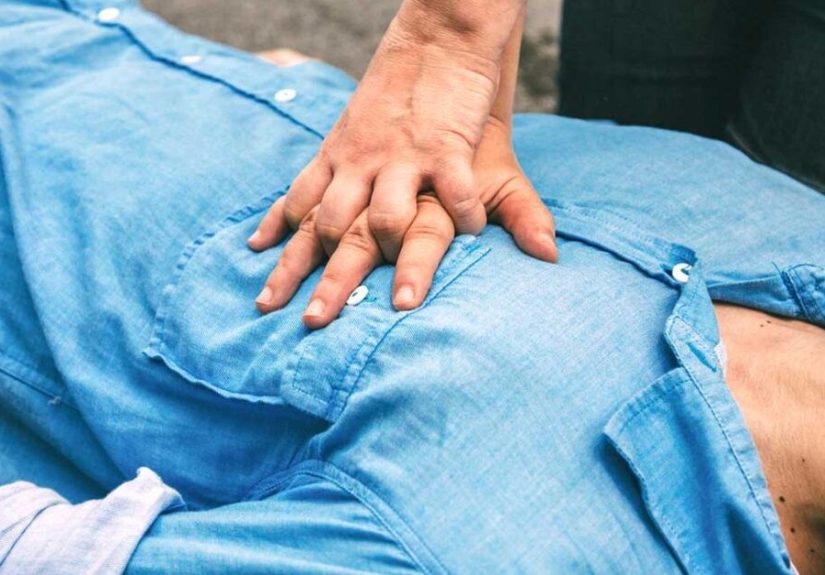
For many adults, hands-only CPR is recommended for untrained bystanders. That means chest compressions without rescue breaths. The basic idea is simple: push hard and fast in the center of the chest.
Hands-Only CPR Basics
- Place the heel of one hand in the center of the chest.
- Place your other hand on top.
- Keep your arms straight and shoulders over your hands.
- Push hard and fast at 100 to 120 compressions per minute.
- Allow the chest to fully recoil between compressions.
- Continue until help arrives, an AED tells you to pause, or the person clearly recovers.
A common rhythm tip is to compress to the beat of a song around 100 to 120 beats per minute. Yes, emergency medicine has a playlist. No, this is not the moment to take requests.
What If the Person Moves or Moans During CPR?
Movement during CPR does not always mean the person has recovered. It may be a sign of CPR-induced consciousness, seizure-like activity, reflex movement, or returning circulation. The safest action depends on the whole picture.
If the person becomes clearly responsive, starts breathing normally, and can communicate, stop compressions and monitor them closely until emergency responders arrive. If they remain unresponsive, are not breathing normally, or only show brief movements during compressions, continue CPR and follow 911 dispatcher or AED instructions.
Do Not Let Panic Make the Decision
CPR is intense. Ribs may crack. The person may gasp. Their body may move. None of that automatically means you are doing CPR wrong. The biggest mistake bystanders make is often doing nothing because they are afraid of doing something imperfectly. In cardiac arrest, imperfect CPR is usually better than no CPR.
Can CPR Hurt Someone Who Does Not Need It?
Yes. Chest compressions are forceful and can cause injury, especially in older adults or people with fragile bones. That is why responsiveness and breathing checks matter. If someone is awake and protesting, that is a strong sign to reassess immediately and follow emergency instructions.
However, fear of causing injury should not stop you from helping someone who is unresponsive and not breathing normally. Cardiac arrest is immediately life-threatening. Broken ribs can heal. A brain without oxygen cannot wait politely while everyone debates technique.
Where the AED Fits In
An automated external defibrillator, or AED, is a portable device that checks heart rhythm and can deliver a shock if needed. AEDs are commonly found in airports, gyms, schools, offices, malls, and public buildings.
If an AED is available, use it as soon as possible. Turn it on and follow the voice prompts. It will tell you when to attach pads, when to stand clear, whether a shock is advised, and when to resume CPR. You do not need to be a cardiologist. The machine does the rhythm analysis; you provide the courage and the button-pushing skills.
Why Fast Action Matters
Cardiac arrest is brutally time-sensitive. Without blood flow, the brain can begin suffering damage within minutes. Immediate CPR helps keep oxygenated blood moving, and early AED use can dramatically improve the chance of survival when the arrest involves a shockable rhythm.
This is why public CPR training is so important. Many cardiac arrests happen outside hospitals, often at home. The first person able to help is usually not a doctor, nurse, or paramedic. It is a spouse, friend, coworker, gym buddy, stranger, or someone who only recently learned CPR and is desperately hoping they remember the steps.
Common Myths About CPR and Consciousness
Myth 1: “If They Gasp, They Are Breathing Fine”
Not necessarily. Gasping can be a sign of cardiac arrest. Normal breathing is regular and effective. Agonal gasps are irregular, abnormal, and not enough to sustain life. If someone is unresponsive and only gasping, start CPR.
Myth 2: “CPR Always Brings People Back Like in Movies”
Television CPR has done many things for drama and very few things for public accuracy. In real life, CPR is physically demanding, survival is not guaranteed, and recovery may depend on the cause of arrest, how quickly CPR starts, whether an AED is used, and how fast advanced care arrives.
Myth 3: “A Conscious Person Always Means CPR Is Wrong”
Not always. If the person was conscious before compressions began, CPR likely needs to be reconsidered. But if awareness appears during CPR after cardiac arrest signs were present, CPR-induced consciousness may be occurring. That situation requires continued emergency response, careful reassessment, and professional care.
Myth 4: “Only Professionals Can Use an AED”
AEDs are designed for public use. They provide voice instructions and will not shock unless the device detects a rhythm that may benefit from defibrillation. If one is nearby, use it.
What Trained Responders May Do If CPR-Induced Consciousness Happens
Healthcare professionals and emergency medical teams have protocols for complex resuscitation situations. If CPR-induced consciousness occurs, they may evaluate pulse, rhythm, airway, oxygenation, and signs of return of spontaneous circulation. In some systems, medications for pain, anxiety, or sedation may be considered when appropriate, but there is no single universal approach for every case.
For bystanders, the job is simpler: call 911, start CPR when indicated, use an AED, and follow instructions. You are not expected to diagnose CPR-induced consciousness on the sidewalk while someone’s dog is barking and three people are filming instead of helping.
Specific Example: What You Should Do
Imagine a man collapses at a grocery store. He does not respond when tapped and shouted at. He is not breathing normally, only making occasional gasping sounds. Someone calls 911. Another person brings an AED. You begin chest compressions. After a minute, his eyes open briefly and his arm moves toward your hand.
Should you stop? Not automatically. If he is not clearly awake, not speaking normally, and not breathing normally, continue CPR while another rescuer follows AED prompts. If he starts breathing normally, speaks clearly, and responds consistently, stop compressions and monitor him closely until emergency medical services arrive.
Prevention, Preparedness, and Confidence
No one wakes up hoping to perform CPR between a coffee run and a grocery list. But preparation makes emergencies less chaotic. Taking a CPR class, learning how to use an AED, and reviewing basic first aid can make you far more likely to act when it matters.
Even a short training session can help you recognize cardiac arrest, start compressions, and avoid freezing. CPR confidence is not about becoming fearless. It is about knowing the next step even while your hands are shaking.
Experience-Based Reflections: What CPR Consciousness Can Feel Like in Real Life
People who witness a medical emergency often describe the moment as strangely quiet and wildly loud at the same time. The room may be full of noisesirens, instructions, crying, footstepsbut the rescuer’s focus narrows to one question: “What do I do next?” When the topic is CPR and consciousness, that emotional pressure can double. Seeing a person move, gasp, or appear aware during chest compressions can make even a trained bystander hesitate.
One common experience is doubt. A rescuer may think, “If they moved, maybe they are fine.” But movement during CPR is not always recovery. In real emergencies, bodies do not behave like tidy textbook diagrams. A person may gasp without breathing effectively. They may twitch without being conscious. They may briefly open their eyes because compressions are sending limited blood to the brain. These moments can be shocking, but they do not erase the original signs of cardiac arrest.
Another experience is fear of causing harm. Chest compressions are not gentle. They are deep, fast, and tiring. Many rescuers worry about broken ribs, bruising, or pain. That concern is human. Nobody wants to hurt another person while trying to help. But in a true cardiac arrest, the larger danger is lack of blood flow. CPR is not delicate because cardiac arrest is not delicate. It is the medical equivalent of a five-alarm fire.
Some survivors who recall awareness during resuscitation describe confusion, pressure, discomfort, or fragmented memories. Others remember nothing at all. Families may also struggle with what they saw. A loved one appearing awake during CPR can be emotionally overwhelming, especially if the outcome is uncertain. This is one reason emergency teams take the phenomenon seriously: it is not only a physical event, but also a psychological one for patients, families, and rescuers.
For bystanders, the most useful mindset is to focus on clear decision points. Was the person unresponsive? Were they not breathing normally? Was 911 called? Is an AED available? Are compressions continuing until clear recovery or professional help arrives? These questions keep the response grounded when the scene feels chaotic.
It also helps to remember that CPR is a bridge, not a guarantee. A rescuer’s job is not to perform a miracle. The job is to give the person a chance. That chance may come through immediate compressions, early AED use, and fast emergency medical care. Sometimes the outcome is good. Sometimes it is heartbreaking. Either way, taking action matters.
Finally, the experience often changes how people think about emergency training. CPR may seem like something “other people” need to knowuntil the person collapsing is a parent, coworker, neighbor, coach, or stranger standing two feet away. Learning CPR turns panic into a plan. And when the question is, “Can someone be conscious during CPR?” the best answer is both scientific and practical: rarely, yesbut if cardiac arrest signs are present, do not let confusion stop lifesaving care.
Conclusion: CPR Is for the Unresponsive, But Awareness Can Rarely Happen
So, can someone be conscious during CPR? Most of the time, CPR is performed on someone who is unconscious, unresponsive, and not breathing normally. If a person is awake, talking, and breathing normally, standard chest compressions are usually not appropriate. But rare cases of CPR-induced consciousness show that awareness can appear during active resuscitation when chest compressions create enough blood flow to the brain.
The practical takeaway is simple: check responsiveness, call 911, look for normal breathing, start CPR when the person is unresponsive and not breathing normally, and use an AED as soon as one is available. If signs of awareness appear during CPR, follow dispatcher instructions and continue care unless the person clearly recovers normal breathing and responsiveness.
CPR is not perfect, glamorous, or easy. But it is powerful. And in the minutes before professional help arrives, it may be the most important thing a bystander can do.
Note: This article is for general educational purposes and does not replace professional CPR training, emergency dispatcher instructions, or medical advice. In a suspected emergency, call 911 immediately.