Table of Contents >> Show >> Hide
- Why Jamie Lee Curtis’s Oscar Display Went Viral
- The Best Supporting Actress Win Was Bigger Than One Trophy
- Why the Oscar Belongs Beside the Weird Stuff
- Deirdre Beaubeirdre: The Role That Made the Shelf Make Sense
- Jamie Lee Curtis, Legacy, and the “Nepo Baby” Joke
- The Pronouns of a Trophy Became a Personal Statement
- What This Oscar Shelf Says About Modern Celebrity
- Why the Moment Still Works
- Experiences and Reflections Related to “Jamie Lee Curtis Sticks Her Oscar Exactly Where It Belongs”
- Conclusion: The Oscar Is Home
There are many ways to display an Oscar. You can place it under museum lighting, give it its own velvet throne, or casually position it in the background of a Zoom call so everyone understands you are “just like them,” except with a golden knight guarding your bookshelf. Jamie Lee Curtis, however, chose a more Jamie Lee Curtis approach: she put her Academy Award where it could live among friends, inside the gloriously weird shrine of Everything Everywhere All at Once.
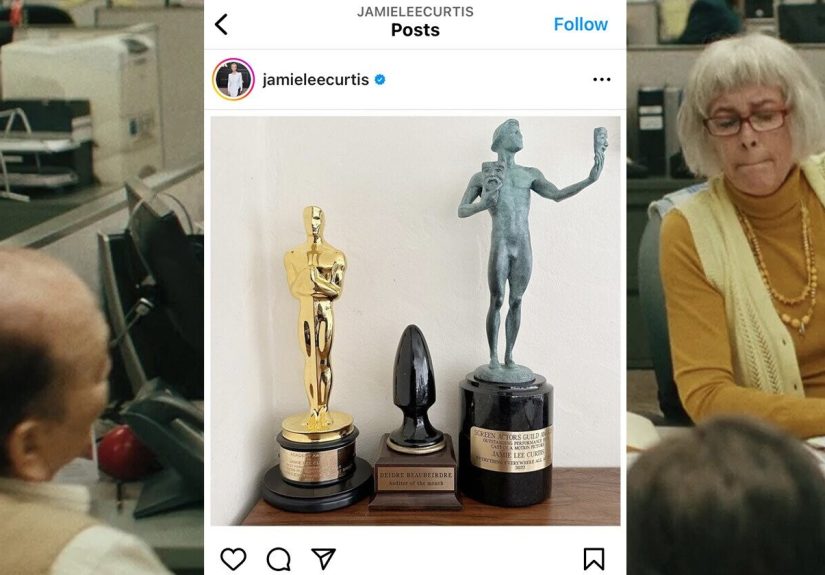
After winning Best Supporting Actress for playing IRS auditor Deirdre Beaubeirdre, Curtis shared that her Oscar had settled beside her SAG Award and one of the movie’s most infamous joke trophies. In other words, the most traditional symbol of Hollywood achievement found itself next to a prop that could only come from a multiverse comedy about taxes, family trauma, martial arts, laundry, hot dog fingers, and emotional repair. That placement was not random. It was practically a thesis statement.
The headline sounds like celebrity silliness, but there is something sneakily perfect about it. Jamie Lee Curtis did not treat the Oscar as a sacred object too delicate for ordinary oxygen. She treated it as part of a story, a team, a role, and a movie that won by refusing to behave. The Oscar did not land in a cold trophy case. It landed in the exact emotional neighborhood that helped create it.
Why Jamie Lee Curtis’s Oscar Display Went Viral
The internet loves an awards-season photo, especially when it punctures Hollywood formality. A gold statuette on a marble pedestal says, “I have achieved greatness.” A gold statuette next to a wildly absurd Everything Everywhere All at Once prop says, “I have achieved greatness, but I also remember the joke.” That is the difference between a celebrity brag and a celebrity moment.
Curtis’s display worked because it matched the movie’s DNA. Everything Everywhere All at Once, directed by Daniel Kwan and Daniel Scheinert, is a hilarious, heartfelt sci-fi action adventure about an overwhelmed Chinese American laundromat owner, Evelyn Wang, whose tax problems become a doorway into the multiverse. It is chaotic, emotional, strange, and somehow deeply human. The movie asks viewers to accept absurdity and sincerity in the same breath. Curtis’s Oscar shelf does the same thing, only with less martial arts and more home decor.
For decades, the Oscars have been wrapped in ceremony. The red carpet, the envelopes, the orchestra, the tearful speeches, the “please wrap it up” musicit is all designed to make winning feel monumental. Curtis did not reject that monumentality. She cried, thanked her collaborators, honored her late parents Tony Curtis and Janet Leigh, and understood the weight of the moment. But after the ceremony ended, she placed the award in a way that said the win belonged not only to prestige, but to play.
The Best Supporting Actress Win Was Bigger Than One Trophy
Jamie Lee Curtis’s Oscar win in 2023 marked her first Academy Award after a career that had already spanned horror, comedy, action, family films, and prestige ensembles. She was not a newcomer politely stepping into the ballroom. She was the person Hollywood had known for decades, the “scream queen” who survived Michael Myers, the comedy pro from Trading Places and Freaky Friday, the action star of True Lies, and the actor who could walk into Knives Out and make a cardigan feel suspicious.
That history mattered. Curtis’s Oscar was not simply a reward for one performance; it was a moment when the Academy recognized an actor whose work had often lived outside the most traditionally rewarded lanes. Genre films, broad comedies, and oddball ensembles have not always been treated as Oscar royalty. Curtis won for a movie that gleefully kicked open the palace door wearing mismatched shoes.
Her acceptance speech captured that collective spirit. Rather than frame herself as a lone winner, Curtis emphasized that she was standing there with hundreds of people behind her: the directors, producers, crew, castmates, family, friends, and fans of the genre films that shaped her career. That message fit the movie’s central idea: no person exists in only one version, one relationship, or one achievement. Every win is a network. Every trophy has fingerprints on it, even if someone has polished them off before the photo.
Why the Oscar Belongs Beside the Weird Stuff
Because the Movie Made Weirdness Emotional
Everything Everywhere All at Once did not win by sanding down its strangeness. It won because its strangeness had purpose. The movie’s wild visuals, alternate lives, and ridiculous gags were not random confetti sprayed over a family drama. They were the emotional language of a story about regret, identity, immigrant pressure, parent-child misunderstanding, and the exhausting business of being alive while also doing taxes. Truly, the IRS has never looked so metaphysical.
Deirdre Beaubeirdre could have been a one-note bureaucratic villain. Curtis instead made her funny, intimidating, wounded, lonely, and strangely tender. In one universe, she is a tax auditor bearing down on Evelyn. In another, she becomes part of the film’s broader web of longing and connection. The role is comedic, but not disposable. The joke has bones, a heartbeat, and possibly a very complicated filing system.
Because Curtis Understands That Prestige Needs a Sense of Humor
Some awards-season narratives treat the Oscar as the finish line of artistic seriousness. Curtis’s display suggests something healthier: seriousness is stronger when it can laugh at itself. The Academy Award is important. It is also an object. It can represent a lifetime of work and still stand next to a goofy movie souvenir without melting into gold pudding.
That attitude is one reason Curtis remains such a durable public figure. She can talk about legacy, aging, family, sobriety, beauty standards, grief, and Hollywood pressure without losing the ability to make a room laugh. She understands the absurd math of fame: one minute you are giving a speech in front of the film industry, and the next minute your trophy is being judged by the internet like a throw pillow.
Because the Award Is Part of an Ensemble Story
The placement also honored the ensemble nature of the win. Everything Everywhere All at Once had an extraordinary awards run, winning seven Oscars including Best Picture, Best Director, Best Actress for Michelle Yeoh, Best Supporting Actor for Ke Huy Quan, Best Supporting Actress for Curtis, Best Original Screenplay, and Best Film Editing. Before that, the cast had dominated the SAG Awards, where Curtis also won for supporting actress and the ensemble took the top cast prize.
By putting the Oscar near her SAG Award and a film-specific prop, Curtis visually connected the Academy win to the acting community and the movie’s own eccentric universe. It was not “Here is my Oscar, alone and superior.” It was “Here is the Oscar with the rest of the family.” And yes, this family is unusual. So is every family. This one just has better lighting.
Deirdre Beaubeirdre: The Role That Made the Shelf Make Sense
Part of the charm of Curtis’s Oscar story comes from the character she played. Deirdre Beaubeirdre is not designed like a glossy Oscar role. She is not glamorous. She is not softened for easy admiration. She sits in an office of fluorescent tension, armed with paperwork and the deadpan menace of someone who has seen too many bad receipts.
Curtis famously embraced a natural, unvarnished look for the role. She did not approach Deirdre as a vanity exercise. She leaned into the character’s physical reality, letting the performance feel lived-in rather than airbrushed. That choice matters because Hollywood has long pressured actresses, especially older actresses, to appear polished into unreality. Curtis’s Deirdre says, “No, this person exists. She has a job, a body, a desk, a mood, and absolutely no time for your nonsense.”
The Oscar sitting next to a movie prop is an extension of that same honesty. The award does not float above the work. It belongs to the work. It belongs to the odd costume choices, the blunt haircut, the paper-stacked office, the awkward glances, the strange alternate universes, and the willingness to look unpretty in a business that often treats prettiness like rent.
Jamie Lee Curtis, Legacy, and the “Nepo Baby” Joke
Curtis’s Oscar win also carried a family-history charge. She is the daughter of Tony Curtis and Janet Leigh, both major Hollywood names and both Oscar nominees. Curtis has often shown a sharp sense of humor about being a Hollywood child. The phrase “nepo baby” became a cultural lightning rod, but Curtis handled the subject with her usual mix of candor and bite. She knows she came from a famous family. She also knows a famous last name does not act for you for forty-plus years, survive career reinventions, or deliver a performance that clicks with an entire awards season.
When she cried onstage and said her parents had been nominated for Oscars and that she had just won one, the moment landed because it was both personal and professional. It was not a victory lap over her parents. It was a family echo. It was the child of Hollywood history standing inside Hollywood history, then later putting the trophy beside a goofy prop because life refuses to stay in one emotional category.
The Pronouns of a Trophy Became a Personal Statement
After the Oscars, Curtis also drew attention by referring to her statuette with they/them pronouns in support of her daughter Ruby. The gesture was small in form but meaningful in context. It showed how Curtis uses public moments not only to celebrate herself, but to signal love, family, and inclusion. An Oscar can be a symbol of achievement, but in Curtis’s hands, it also became a conversation piece about respect.
This is another reason the trophy placement felt right. Curtis did not treat the Oscar as untouchable. She personalized it. She gave it a place, a context, and even a pronoun conversation. Hollywood loves symbols, but Curtis seems interested in making symbols useful. A trophy can honor a career. It can honor collaborators. It can support a child. It can also sit next to a ridiculous souvenir and remind everyone not to become insufferable just because someone handed you gold.
What This Oscar Shelf Says About Modern Celebrity
Celebrity used to be guarded by distance. Stars were meant to seem larger than life, perfectly styled and faintly unreachable, like planets with better cheekbones. Modern audiences are different. They still enjoy glamour, but they also value signs of self-awareness. Curtis’s Oscar display hit that sweet spot. It gave fans the sparkle of awards season and the wink of someone who knows sparkle is funniest when it reflects off something unexpected.
That is why the image traveled. It was not just “Jamie Lee Curtis has an Oscar.” Everyone already knew that. It was “Jamie Lee Curtis has an Oscar and somehow made its new home feel like a punchline, a thank-you note, and a character study.” That is efficient storytelling. Screenwriters, take notes. Or don’t. The Daniels already took all the notes, folded them into origami, and turned them into a multiverse.
Why the Moment Still Works
The joke continues to work because it resists the usual awards-season stiffness. Oscars coverage can become a spreadsheet of wins, losses, campaigns, snubs, predictions, gowns, speeches, and after-party sightings. Curtis’s trophy placement cuts through all that. It says the award matters, but the movie matters more. The people matter more. The story matters more. The weirdness matters more.
It also fits the broader cultural success of Everything Everywhere All at Once. This was a film that made room for contradictions: maximalist and intimate, silly and philosophical, chaotic and precise, crude and kind, deeply specific and widely relatable. Curtis’s shelf is the home-decor version of that contradiction. The Oscar is high prestige. The prop is lowbrow chaos. Together, they tell the truth about the movie better than a thousand polite plaques.
Experiences and Reflections Related to “Jamie Lee Curtis Sticks Her Oscar Exactly Where It Belongs”
There is a surprisingly useful life lesson hiding in this Oscar placement: put your achievements where they still remember who you are. Too often, people treat success like it must be separated from the messy, funny, strange parts of life. A diploma goes in a frame. A promotion goes on LinkedIn. A trophy goes on a shelf that makes visitors lower their voices. But Curtis’s Oscar display suggests that the best accomplishments do not need to be isolated from personality. They can stand beside the odd souvenirs, inside jokes, and evidence of the journey.
Anyone who has ever worked hard for something knows that the final award rarely tells the whole story. The certificate does not show the late nights. The medal does not show the doubt. The acceptance letter does not show the embarrassing first drafts, the bad rehearsals, the awkward attempts, or the tiny private victories that made the big public one possible. That is why Curtis’s display feels emotionally accurate. The Oscar belongs next to reminders of the role, because the role is where the work happened.
In everyday terms, imagine finishing a huge project and placing the award beside the coffee mug that got you through it, the notebook full of terrible early ideas, and the ridiculous stress snack you swore you would stop eating. That little arrangement might tell a truer story than a pristine display case. Success is not sterile. It comes with crumbs, typos, nervous laughter, and at least one moment when you think, “Well, this is either genius or I need a nap.”
Curtis’s moment also reminds us not to become too precious about recognition. There is nothing wrong with being proud. Pride is healthy when it is earned and shared. But when recognition becomes too sacred, it can trap people inside a version of themselves that is stiff and performative. Curtis sidestepped that trap by letting the Oscar join the party. The trophy did not make her suddenly humorless. If anything, it gave her one more prop in the ongoing performance of being fully, loudly, unapologetically herself.
For artists, writers, performers, students, creators, and professionals, the takeaway is simple: let your wins live near your weirdness. The weirdness is not a flaw in the brand. It is the fingerprint. Curtis won for a film that turned absurdity into empathy, so of course the trophy should not be locked away from absurdity. It should stand right beside it, glowing like a tiny gold reminder that sometimes the strangest path is the one that leads directly to the podium.
Conclusion: The Oscar Is Home
Jamie Lee Curtis sticking her Oscar exactly where it belongs is more than a funny celebrity detail. It is a perfect little epilogue to one of the most unusual awards stories in recent Hollywood history. Her win honored a long career, a fearless performance, an ensemble triumph, a family legacy, and a film that made sincerity out of chaos. By placing the Oscar beside her SAG Award and a proudly ridiculous piece of movie mythology, Curtis turned a shelf into a statement.
The message is not that awards are meaningless. The message is that awards mean more when they stay connected to the art, the people, and the humor that made them possible. In Curtis’s case, the Oscar belongs exactly where it is: close to the movie, close to the joke, close to the team, and close to the wonderful absurdity that helped get it there.