Table of Contents >> Show >> Hide
- The Family Conflict That Started It All
- Why “You’re Not Their Dad” Hit So Hard
- Was Stopping Parental Duties Fair?
- The Real Problem: No Clear Stepparent Boundaries
- Why the Car Incident Was Bigger Than a Dent
- The Wife’s Mistake: Picking and Choosing His Role
- The Husband’s Mistake: Letting Pain Turn Into Punishment
- What a Healthier Solution Could Look Like
- Why This Story Went Viral
- Experience-Based Reflections: What Blended Families Can Learn From This
- Conclusion
Blended families can be beautiful, chaotic, tender, awkward, and occasionally one missing car key away from becoming a full courtroom drama. One husband recently found himself in exactly that emotional traffic jam after his wife told him he had no right to discipline her children because he was “not their dad.” His response? He stopped doing the father-like duties he had been performing for years.
The situation struck a nerve because it touches a question many stepfamilies quietly wrestle with: if a stepparent is expected to provide transportation, supervision, emotional support, household stability, and “dad energy,” should that same stepparent have any say when serious rules are broken? Or is the role more like an unpaid family intern with access to school drop-off duty?
This story is not just about hurt feelings. It is about stepparent boundaries, parental authority, responsibility, respect, and what happens when one adult is asked to carry the weight of parenthood without being allowed to touch the steering wheel. Literally, in this case, the steering wheel was part of the problem.
The Family Conflict That Started It All
According to the original story, the man had been married to his wife for about four years. She brought three children from previous relationships into the marriage, while he had no biological children of his own. The family moved into his home partly because it was located in a better school district. On paper, it sounded like a practical blended family arrangement: shared home, shared schedule, shared responsibilities, shared fridge, and probably shared arguments about who finished the cereal.
For a while, things were mostly good. Like many stepparents, he helped with everyday parenting tasks. He drove the kids to school, helped keep routines moving, made sure they were safe, and acted as an adult figure in the household. He may not have been their biological father, but he was clearly functioning as more than “Mom’s husband who happens to know where the lunchboxes are.”
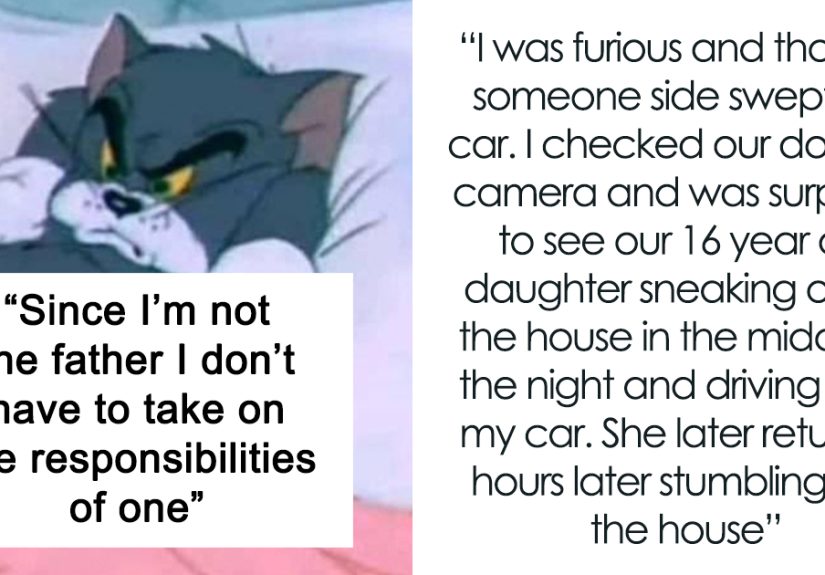
Then he discovered a large dent along the passenger side of his car. After checking doorbell camera footage, he reportedly saw his 16-year-old stepdaughter sneaking out at night, taking his car, leaving for several hours, and returning later. The damage appeared after that incident. Understandably, he was furious. A teenager taking a car without permission is not a cute coming-of-age movie moment. It is dangerous, expensive, and potentially life-altering.
When he showed the footage to his wife, he expected serious consequences. He wanted the teenager grounded from social media and required to get a job to help pay for repairs. His wife disagreed, saying the children were stressed by the family dynamic and that she would talk to her daughter. Then came the sentence that turned a parenting dispute into a household earthquake: she said he did not get a say in punishment because he was not the girl’s father.
Why “You’re Not Their Dad” Hit So Hard
In blended families, words can become emotional grenades. “You’re not my real dad” or “you’re not their father” may be factually true in a biological sense, but in a household where a stepparent has been doing parent-like labor, it can feel like a sudden demotion. One minute, you are driving kids to school, managing appointments, and being trusted with daily care. The next, you are informed that your authority expires the moment accountability becomes inconvenient.
That is the core issue here. The husband was not asking to erase the children’s biological father or declare himself Supreme Ruler of the Teenagers. He was asking whether he had a voice when his property was damaged and when a teenager’s risky behavior affected the whole household. In most healthy homes, adults do not need identical legal titles to set basic expectations around safety, respect, and honesty.
At the same time, stepparent authority is complicated. Experts often recommend that stepparents build trust gradually and avoid rushing into the role of strict disciplinarian, especially with older children. A teenager may resist a stepparent’s authority more strongly than a younger child because the teen already has established loyalties, routines, and opinions. Many teens come pre-loaded with sarcasm, emotional Wi-Fi problems, and a built-in detector for adult hypocrisy.
Still, “go slowly” is not the same as “have no boundaries.” A stepparent may not be the legal parent, but they are still an adult living in the home. They should be able to say, “You cannot take my car,” “You cannot damage my property,” and “We need a serious response when safety is involved.” That is not overstepping. That is basic civilization with seatbelts.
Was Stopping Parental Duties Fair?
After the argument, the husband said he “checked out” of parental duties. He still made sure the children were safe and fed, but he stopped doing father-like tasks. When the kids had doctor’s appointments for school sports, he refused to drive them, forcing his wife to take time off work. He also said he would no longer handle school drop-offs, even though he had done so in the past.
His reasoning was simple: if he is not allowed to be treated as a parental figure when discipline is needed, then he should not be expected to perform parental labor when it is useful. In other words, he rejected the “dad when convenient, stranger when inconvenient” arrangement.
Many readers sympathized with him. It does seem unfair for one spouse to expect childcare, transportation, supervision, and household support while denying the other spouse any authority in moments that matter. Responsibility without respect breeds resentment fast. It is like being handed the bill at a restaurant where you were not allowed to order.
However, his response also created collateral damage. The younger children did not take the car. They did not damage it. They may have had no involvement in the conflict at all. By withdrawing from all father-like duties, he may have sent them a painful message: “My care for you depends on my argument with your mother.” That may not have been his intention, but children often experience adult conflict through outcomes, not explanations.
The Real Problem: No Clear Stepparent Boundaries
This family’s crisis did not begin with the car. The car merely revealed the crack in the foundation. The real issue was that the adults had never clearly defined the stepfather’s role. Was he a supportive adult? A co-parent? A transportation helper? A bonus dad? A roommate with car insurance? Nobody seemed to know until something went wrong.
Blended families work best when adults discuss expectations before the crisis arrives. That includes discipline, school responsibilities, medical appointments, financial contributions, transportation, household rules, and how consequences will be handled. These conversations are not always romantic. Nobody puts “discuss who grounds whom” on a wedding registry. But avoiding the conversation does not make the issue disappear. It only waits until everyone is angry.
A healthy agreement might sound like this: the biological parent handles major discipline decisions, but the stepparent has the right to enforce house rules, protect personal property, report safety concerns, and participate in discussions that affect the household. That balance respects the parent-child bond while also recognizing that the stepparent is not furniture. Nice furniture, maybe, but still not furniture.
Why the Car Incident Was Bigger Than a Dent
The car damage matters, but the bigger issue is the behavior behind it. A teenager allegedly taking a vehicle at night without permission raises serious safety concerns. Depending on the circumstances, it could involve underage driving, driving without permission, leaving the home secretly, possible impairment, property damage, or an accident that was not properly addressed.
For a parent or stepparent, this is not a “we’ll have a little chat” situation. This is a “sit down, turn off the TV, nobody is leaving the room until we understand what happened” situation. The goal should not be revenge. The goal should be safety, accountability, and prevention.
Good consequences teach responsibility. They connect behavior to repair. For example, requiring the teenager to contribute to repair costs could be reasonable if handled calmly and age-appropriately. Losing driving privileges, phone privileges, or social outings may also make sense if those consequences are tied to trust and safety. The important part is that the adults present a united, measured response.
What should not happen is minimizing the incident because it is uncomfortable. Parents sometimes excuse serious behavior by blaming stress, family changes, or teenage emotions. Those factors may explain behavior, but they do not erase accountability. Stress may explain why someone snaps at dinner; it does not magically turn a damaged car into a group art project.
The Wife’s Mistake: Picking and Choosing His Role
The wife’s position appears inconsistent. She wanted her husband to help with the children in practical ways, but she rejected his input when his stepdaughter’s behavior directly affected him. That kind of selective authority is one of the fastest ways to burn out a stepparent.
Stepparents often struggle when they are expected to give time, money, labor, patience, and affection while being reminded that they are outsiders. The result can be emotional whiplash. One day they are praised for “stepping up.” The next day they are told to “stay in their lane.” The lane, apparently, includes school pickup, doctor appointments, bills, and emotional supportbut not opinions. Convenient lane. Very scenic. No exits.
If the wife did not want him to discipline her children, she needed to say that clearly long before a crisis. She also needed to define what authority he did have. Could he enforce house rules? Could he correct disrespect? Could he set limits around his property? Could he refuse to lend his car? Could he require repayment if something of his was damaged? These are not tiny details. They are the operating system of a blended household.
The Husband’s Mistake: Letting Pain Turn Into Punishment
Although the husband’s frustration is understandable, his total withdrawal may not have been the healthiest move. There is a difference between setting a boundary and making the family feel the temperature drop. A boundary says, “I will not continue doing parental labor unless we define my role and address what happened.” Punishment says, “Since I was hurt, everyone can now deal with the consequences.”
The best response would have been direct and calm: “I am not comfortable being responsible for school transportation, appointments, or daily parenting tasks unless we agree on my authority and how serious issues will be handled. I will not be used as a parent only when it helps. We need counseling or a written parenting plan for this household.”
That approach protects his dignity without making the younger kids feel abandoned. It also moves the issue from emotional payback to practical problem-solving. The goal is not to win the argument. The goal is to build a home where everyone knows what the rules are and who is responsible for what.
What a Healthier Solution Could Look Like
A more constructive solution would start with the adults speaking privately, away from the children. They need to discuss three separate issues: the stepdaughter’s behavior, the damaged car, and the stepfather’s role moving forward. Mixing all three into one shouting match only produces more confusion.
1. Address the Teen’s Behavior Seriously
The teen should be held accountable in a way that focuses on safety and repair. The adults should find out exactly what happened, whether anyone else was involved, whether there was an accident, and whether additional action is needed. Consequences should be firm, not theatrical. Nobody needs a dramatic family courtroom with a spatula as the judge’s gavel.
2. Create a Stepparent Role Agreement
The couple should define what the husband is and is not expected to do. If he drives kids to school, takes them to appointments, supervises them, or contributes financially, then he deserves a voice in household rules that affect those responsibilities. He does not need to replace their father, but he cannot be treated like a silent service provider.
3. Protect the Kids From Adult Power Struggles
The children should not be used as messengers, bargaining chips, or emotional referees. If the adults are fighting, the kids should not have to decode who is currently allowed to act like family. Consistency matters, especially in blended households where children may already feel uncertain about belonging.
4. Consider Family Counseling
Blended families often benefit from counseling because the emotional map is more complex than in a first-marriage household with shared biological children. A therapist can help the couple discuss discipline, loyalty conflicts, resentment, and unclear expectations without turning every conversation into a verbal dodgeball match.
Why This Story Went Viral
This story became popular because it exposes a deeply uncomfortable truth: many families rely on stepparents while refusing to fully honor the role they play. Online readers recognized the unfairness immediately. They also recognized the danger of the teen’s behavior and the wife’s attempt to minimize it.
At the same time, the story sparked debate because the husband’s reaction was emotionally satisfying but not perfectly mature. Many people understand the urge to say, “Fine, if I’m not the dad, I won’t do dad duties.” It is a clean comeback. It fits nicely on a mug. But real children live inside that comeback, and they can get hurt by adult boundary wars.
The viral debate is not really about whether he was “right” or “wrong.” It is about what fairness looks like in a blended family. A stepparent should not be exploited. A biological parent should not be overridden. Children should not be neglected. Serious behavior should not be brushed aside. Somehow, all of those truths must fit under one roof, preferably before someone borrows a car at midnight.
Experience-Based Reflections: What Blended Families Can Learn From This
Families who have lived through similar stepfamily tension often say the hardest part is not one dramatic fight. It is the slow build-up of unclear expectations. A stepparent starts by helping “just this once.” One school drop-off becomes every morning. One favor becomes a routine. One small financial contribution becomes expected. Then, when the stepparent asks for respect or decision-making power, everyone acts surprised, as if the family minivan has suddenly requested voting rights.
One common experience in blended homes is the feeling of being emotionally “on call.” The stepparent may be expected to attend games, provide rides, help with homework, cook meals, and support the household, but still be reminded that they are not the real parent. Over time, that can create quiet resentment. The stepparent may begin pulling away not because they do not care, but because caring without authority feels unsafe.
Another common experience involves the biological parent feeling protective. Many parents worry that giving a stepparent too much authority will make the children feel replaced, controlled, or disloyal to their other parent. That fear is understandable. Children in blended families may already be carrying grief, confusion, or anger from divorce, separation, death, or instability. A new adult stepping into the household can feel like one more change they did not choose.
The solution is not to make the stepparent either a full parent overnight or a powerless helper forever. The better path is gradual trust. A stepparent can begin as a supportive adult who enforces basic household rules and builds connection through everyday moments: making breakfast, showing up at games, asking about school, helping fix a bike, or watching a movie without trying to force deep emotional bonding. Trust grows in small deposits, not grand speeches.
For couples, the biggest lesson is to have the awkward conversations early. Who handles discipline? What happens if a child damages property? Who pays for what? Can the stepparent say no to transportation requests? What language is off-limits during arguments? These talks may feel uncomfortable, but they prevent bigger pain later.
For stepparents, the lesson is to set boundaries before resentment takes over. A healthy boundary is clear, calm, and consistent. It does not punish children for adult conflict. It says, “I want to be part of this family, but I need my role to be respected.” That sentence can save years of silent frustration.
For biological parents, the lesson is equally important: do not ask someone to show up like a parent and then dismiss them like a guest. If a spouse is helping raise your children, honor that contribution. They may not replace the children’s other parent, but they are still part of the family system. Respect is not a legal technicality. It is the glue that keeps the household from becoming a group project where one person does all the work and everyone else critiques the font.
Conclusion
So, did the man go too far by stopping parental duties after his wife said he was not her kids’ dad? The fairest answer is: he had a valid reason to set boundaries, but the way he withdrew may have caused unnecessary harm. His wife was wrong to expect parental labor while denying him any meaningful voice, especially after a serious incident involving his car. But he also needed to separate his conflict with his wife from his relationship with the children, particularly the younger ones.
The best outcome would not be revenge, silence, or a household cold war. It would be a serious reset. The couple needs a clear agreement about stepparent duties, discipline, safety, money, transportation, and consequences. The teen needs accountability. The younger kids need stability. And the husband needs to know whether he is truly part of the family or just the guy with the house, the car, and the morning drop-off route.
Blended families can absolutely work, but they do not run on assumptions. They run on communication, patience, respect, and boundaries strong enough to survive teenage chaos. Love may build the family, but clarity keeps it from backing into the passenger door.
Note: This article is for general editorial and relationship discussion only. It is not legal advice, therapy, or a substitute for speaking with a qualified family counselor or attorney when a family situation involves safety, property damage, custody, or legal responsibility.