Table of Contents >> Show >> Hide
- Why These 7 Exercises Work So Well
- 1. Squat
- 2. Lunge
- 3. Push-Up
- 4. Row
- 5. Deadlift or Hip Hinge
- 6. Plank
- 7. Step-Up or Burpee
- How to Build a Simple Workout With These Exercises
- Common Form Mistakes That Quietly Steal Your Results
- Tips to Improve Form Faster
- Experiences Related to These 7 Effective Exercises
- Conclusion
Some exercises are like that one reliable friend who owns a truck: useful in almost every situation. Whether you train in a fully loaded gym or in a living room where the “equipment” is a yoga mat, a chair, and suspiciously judgmental houseplants, the best moves share one thing in common: they train real movement patterns.
This guide breaks down seven of the most effective exercises to do at the gym or home, with picture-style form cues, beginner-friendly modifications, common mistakes, and practical tips to help you move better. These exercises target major muscle groups, build strength, improve balance, support posture, and make everyday life easierfrom lifting groceries to climbing stairs without sounding like a tired accordion.
Important note: If you have an injury, chronic condition, pregnancy-related concerns, dizziness, chest pain, or new joint pain, speak with a healthcare professional or certified fitness professional before starting or changing your workout routine. Good form is not decoration; it is the seatbelt.
Why These 7 Exercises Work So Well
A smart strength routine does not need 47 complicated movements with names that sound like superhero villains. It needs exercises that cover the big patterns: squat, hinge, push, pull, lunge, brace, and carry or condition. The seven moves below do exactly that. They can be scaled for beginners, loaded for advanced lifters, and performed in a gym or at home with dumbbells, resistance bands, or body weight.
For best results, aim to train strength at least two days per week, working the legs, hips, back, abdomen, chest, shoulders, and arms. Start with controlled movement, choose a version you can perform with clean technique, and increase difficulty gradually. Your muscles love progress. Your joints prefer progress with manners.
1. Squat

Why It Is Effective
The squat is a powerhouse lower-body exercise. It trains the glutes, quadriceps, hamstrings, calves, hips, and core. It also mirrors daily movements like standing up from a chair, picking something up, or preparing to escape an awkward conversation at a party.
How to Do It
Stand with your feet about shoulder-width apart and toes slightly turned out. Brace your core, keep your chest lifted, and push your hips back as if sitting down. Bend your knees and lower until your thighs are roughly parallel to the floor, or as low as you can go comfortably while keeping control. Press through your midfoot and heels to stand tall.
Form Tips
- Keep your knees in line with your toes; do not let them collapse inward.
- Maintain a neutral spine instead of rounding your back.
- Lower with control and stand without bouncing.
- Use a chair squat if balance or depth is difficult.
Home version: Bodyweight squat or chair squat.
Gym version: Goblet squat, dumbbell squat, barbell back squat, or leg press.
2. Lunge

Why It Is Effective
Lunges build leg strength one side at a time, which is excellent for balance, coordination, and correcting left-right strength differences. They train the glutes, quads, hamstrings, calves, hips, and core. If squats are the group project, lunges are the solo presentation: each leg has to show up and do the work.
How to Do It
Start standing tall. Step one foot forward or backward, then lower your body until both knees bend. Your front knee should stay aligned over your foot, and your back knee should move toward the floor without crashing into it. Push through the front foot to return to standing.
Form Tips
- Keep your chest lifted and shoulders relaxed.
- Avoid letting the front knee cave inward.
- Use a shorter range of motion if your knees or hips feel cranky.
- Try reverse lunges first; many people find them easier on the knees.
Home version: Reverse lunge, split squat, or supported lunge holding a chair.
Gym version: Dumbbell walking lunge, Bulgarian split squat, or cable-assisted lunge.
3. Push-Up

Why It Is Effective
The push-up trains the chest, shoulders, triceps, core, and even the glutes when done correctly. It is one of the best no-equipment upper-body exercises because it forces your body to stabilize while producing strength. It also offers endless progressions, from wall push-ups to deficit push-ups.
How to Do It
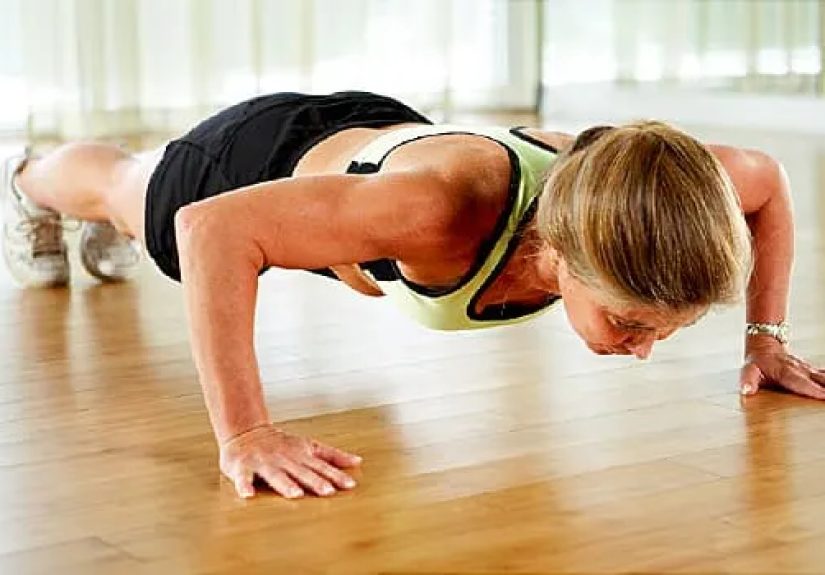
Place your hands slightly wider than shoulder-width apart. Step your feet back so your body forms a straight line from head to heels. Tighten your core and glutes. Bend your elbows and lower your chest toward the floor, then press back up without letting your hips sag.
Form Tips
- Keep your neck neutral; look slightly ahead of your hands.
- Do not flare your elbows straight out like airplane wings.
- Brace your abs before you lower.
- Choose an incline version if the floor push-up makes form fall apart.
Home version: Wall push-up, counter push-up, knee push-up, or floor push-up.
Gym version: Bench push-up, weighted push-up, dumbbell chest press, or machine chest press.
4. Row

Why It Is Effective
Rows are the antidote to “computer posture.” They strengthen the upper back, lats, rear shoulders, biceps, and core. If push-ups train the front of your upper body, rows balance the equation by strengthening the muscles that help keep your shoulders happy and your posture less shrimp-like.
How to Do It
Hold dumbbells, a resistance band, or a cable handle. Hinge at your hips with a flat back, or support one hand on a bench. Let your arm extend, then pull your elbow back while keeping it close to your body. Pause briefly, lower with control, and repeat.
Form Tips
- Keep your spine long and your ribs down.
- Pull with your back, not just your arms.
- Avoid shrugging your shoulders toward your ears.
- Use a lighter weight if you need momentum to move it.
Home version: Resistance-band row, towel row anchored safely, or backpack row.
Gym version: Dumbbell row, seated cable row, chest-supported row, or machine row.
5. Deadlift or Hip Hinge

Why It Is Effective
The deadlift is one of the most practical strength exercises because it teaches you how to lift from the floor safely. It targets the glutes, hamstrings, back, core, grip, and hips. The secret is the hip hinge: bending mostly at the hips while keeping your spine neutral. Master that, and you will be better prepared for gym lifts, yard work, luggage, laundry baskets, and the mysterious heavy box everyone expects you to move.
How to Do It
Stand with feet about hip-width apart. Hold a dumbbell, kettlebell, barbell, or backpack close to your body. Soften your knees, push your hips back, and lower the weight while keeping your back flat. When you feel a stretch in your hamstrings, press through your feet, squeeze your glutes, and return to standing.
Form Tips
- Keep the weight close to your legs.
- Do not round your lower back.
- Think “hips back,” not “squat down.”
- Stop the set when your form starts to fade.
Home version: Hip hinge with a broomstick, backpack Romanian deadlift, or single-leg deadlift.
Gym version: Dumbbell Romanian deadlift, kettlebell deadlift, trap-bar deadlift, or barbell deadlift.
6. Plank

Why It Is Effective
The plank trains your core to resist movement, which is exactly what your trunk needs to do during lifting, running, carrying, and twisting. It works the abdominal muscles, obliques, deep core, shoulders, glutes, and spinal stabilizers. Unlike crunches, planks teach your midsection to protect your spine while the rest of your body works.
How to Do It
Place your forearms on the floor with elbows under shoulders. Step your feet back and create a straight line from your head to heels. Tighten your abs and glutes, breathe steadily, and hold as long as you can maintain clean form.
Form Tips
- Do not let your hips sag or pike too high.
- Keep your gaze slightly forward, not tucked dramatically under your chest.
- Start with 10 to 30 seconds if you are new.
- Stop before your lower back starts doing unpaid overtime.
Home version: Forearm plank, knee plank, side plank, or elevated plank.
Gym version: Stability-ball plank, plank shoulder tap, cable anti-rotation hold, or weighted plank.
7. Step-Up or Burpee

Why It Is Effective
The seventh slot depends on your goal. Want strength, balance, and joint-friendly conditioning? Choose step-ups. Want a full-body conditioning blast? Choose burpees, modified as needed. Step-ups build the glutes, quads, calves, and balance. Burpees combine a squat, plank, push-up option, and jump or stand-up finish for a high-effort cardio-strength challenge.
How to Do a Step-Up
Stand facing a sturdy box, bench, or step. Place one foot fully on the surface. Press through that foot to stand tall, bringing the other foot up. Step down with control and repeat. Keep your hips level and avoid pushing off too much from the back leg.
How to Do a Modified Burpee
Stand tall, squat down, place your hands on the floor or an elevated surface, step your feet back to plank, step forward again, and stand. Add a jump only if your joints, conditioning, and form are ready.
Form Tips
- Use a lower step if your knee caves inward.
- Keep the full foot on the box during step-ups.
- For burpees, step back instead of jumping back if you lose control.
- Quality beats speed, even when the workout clock is being dramatic.
Home version: Stair step-up, low-box step-up, no-jump burpee, or elevated burpee.
Gym version: Dumbbell step-up, box step-up, medicine-ball burpee, or conditioning circuit burpee.
How to Build a Simple Workout With These Exercises
You can combine these seven exercises into a balanced full-body routine. Beginners can perform one to two sets of each movement. Intermediate exercisers can perform three to four sets. Most people do well with 8 to 12 controlled repetitions for strength movements, while planks can be held for 10 to 45 seconds depending on ability.
Beginner Full-Body Workout
- Chair squat: 10 reps
- Reverse lunge: 6 reps per side
- Incline push-up: 8 reps
- Resistance-band row: 10 reps
- Hip hinge: 10 reps
- Knee plank: 15 seconds
- Low step-up: 8 reps per side
Intermediate Full-Body Workout
- Goblet squat: 10 reps
- Dumbbell reverse lunge: 8 reps per side
- Push-up: 8 to 12 reps
- Dumbbell row: 10 reps per side
- Romanian deadlift: 10 reps
- Forearm plank: 30 seconds
- Step-up or modified burpee: 10 reps
Rest 45 to 90 seconds between sets. Train two or three nonconsecutive days per week. Add walking, cycling, swimming, or another aerobic activity on other days for heart health and recovery. The best routine is not the fanciest one; it is the one you can repeat without your calendar filing a complaint.
Common Form Mistakes That Quietly Steal Your Results
One of the most common mistakes is rushing. Fast reps can feel productive, but they often hide poor alignment. A controlled squat will usually beat a wobbly speed squat. The same goes for push-ups, rows, and deadlifts. If you cannot pause briefly during the hardest part of the movement, the weight or variation may be too difficult.
Another mistake is ignoring the core. Your core is not just for planks or beach photos. It supports nearly every strength exercise. Before each rep, lightly brace as if someone is about to poke your stomach. You should still be able to breathe; do not turn every set into a red-faced submarine mission.
Finally, many people skip modifications because they think easier versions “do not count.” That is fitness nonsense wearing a fake mustache. Wall push-ups, chair squats, supported lunges, and elevated planks absolutely count when they match your current level and help you practice excellent form.
Tips to Improve Form Faster
Use a Mirror or Video
A mirror can help you spot obvious alignment issues, such as knees caving during squats or shoulders shrugging during rows. Even better, record a short video from the front and side. You may notice things you cannot feel in the moment.
Slow Down the Eccentric
The lowering phase of an exercise is called the eccentric phase. Try taking two to three seconds to lower into a squat, lunge, push-up, or deadlift. This improves control, increases time under tension, and gives your brain more time to supervise the movement.
Choose the Right Difficulty
Your exercise should feel challenging but controlled. If your form breaks on rep three, the version is too hard. If you finish 15 reps while discussing dinner plans, it may be too easy. Aim for effort that leaves one to three good reps “in the tank.”
Warm Up Before You Work Hard
Spend five to ten minutes warming up with brisk walking, marching, arm circles, hip hinges, light squats, and gentle lunges. A warm-up tells your joints, muscles, and nervous system, “Good morning, team, we are doing things now.”
Experiences Related to These 7 Effective Exercises
The first thing most people learn when practicing these seven exercises is that “simple” does not mean “easy.” A squat looks basic until you try to keep your heels grounded, knees aligned, chest lifted, and breathing normal all at once. Suddenly, standing up and sitting down becomes a full committee meeting. That is why these movements are so valuable: they reveal how your body actually moves.
Many beginners have a similar experience with push-ups. They start on the floor, complete one heroic half-rep, then discover gravity has been lifting heavier than they expected. The smart move is not to quit; it is to elevate the hands on a wall, counter, bench, or sturdy table. Within a few weeks, the same person who thought push-ups were impossible may be lowering with control and feeling stronger through the chest, shoulders, arms, and core.
Rows often create one of the fastest “aha” moments. People who sit at desks all day may feel their upper back working in a way that is both unfamiliar and deeply satisfying. When performed correctly, rows can make posture feel more supported, as if the shoulders finally remembered they do not have to live next to the ears.
Deadlifts and hip hinges tend to be the most humbling. Many people bend from the lower back because it feels natural at first. Learning to push the hips back while keeping the spine long can feel awkward, like trying to bow politely while carrying groceries. But once the hinge clicks, daily lifting feels safer and stronger. Picking up a laundry basket, suitcase, or bag of dog food becomes less of a dramatic event.
Planks teach patience. A good 20-second plank can be more useful than a sloppy two-minute plank performed with sagging hips and a lower back begging for legal representation. The experience is usually better when people focus on breathing, squeezing the glutes lightly, and creating a straight line from head to heels. The goal is not to suffer; the goal is to stabilize.
Lunges and step-ups build confidence because they resemble real life. Stairs, curbs, hills, and getting up from the floor all require single-leg strength. At first, balance may feel shaky. Holding a wall, rail, or chair is not cheating; it is smart practice. Over time, the legs become more coordinated, and movement feels smoother.
The biggest lesson from these exercises is consistency. You do not need a perfect gym outfit, a complicated spreadsheet, or a playlist that could power a movie trailer. You need repeatable practice, good form, reasonable progression, and enough recovery. Start where you are, improve one cue at a time, and let the results stack quietly. Fitness is rarely one dramatic transformation scene. More often, it is a collection of small wins: one cleaner squat, one stronger push-up, one steadier plank, and one day when the stairs feel strangely less annoying.
Conclusion
The seven most effective exercises to do at the gym or home are not magic tricks. They are practical, scalable movements that train your body for strength, stability, posture, balance, and everyday performance. Squats, lunges, push-ups, rows, hip hinges or deadlifts, planks, and step-ups or burpees cover nearly everything a smart full-body routine needs.
Focus on form before intensity. Use picture cues, modify when needed, and progress gradually. When these exercises are performed consistently, they can help you build a stronger body without needing a complicated routine. In other words, you can stop chasing the “secret” workout. The secret is boring, effective, and very good at its job.