Table of Contents >> Show >> Hide
- What “Forever Writing” Actually Means
- Why Monofilament Fishing Line Seems Like a Smart Medium
- But Let’s Not Pretend It Is Actually Forever
- What Anglers Already Know About Mono That Archivists Should Notice
- How It Compares to Real Long-Term Data Preservation
- The Environmental Catch Nobody Should Ignore
- Could Writing on Fishing Line Ever Be Truly Useful?
- Final Thoughts
- Experience Section: What It Feels Like to Think About Writing on Fishing Line
- SEO Tags
Most people see monofilament fishing line and think one of three things: bass, bird’s nests, or the mysterious ability of a spool to tangle itself when nobody is looking. What they usually do not think is, “Ah yes, the future of long-term data storage.” And yet here we are.
The strange little idea behind Forever Writing On Monofilament Fishing Line is surprisingly simple. Instead of trusting your thoughts, files, or messages to hard drives, flash memory, cloud accounts, or whatever digital cupboard currently holds humanity’s photos and tax returns, you physically mark information onto fishing line. It is weird. It is charming. It is a little garage-lab, a little doomsday-prepper, and a little “what if a tackle box became an archive?”
On the surface, the concept sounds like a joke someone invented after getting too philosophical in the sporting goods aisle. But the deeper you go, the more interesting it becomes. Fishing line is cheap, light, flexible, easy to store, and already designed to survive rough handling. At the same time, it also comes with real-world limitations that anglers know all too well: stretch, memory, aging, UV exposure, tangling, and the grim fact that discarded line can stick around in the environment far longer than anyone wants.
So no, monofilament fishing line is not a magic scroll for the apocalypse. But as a thought experiment, a maker project, and a conversation about long-term storage, it is genuinely fascinating. And honestly, anything that makes us compare a flash drive to a fishing spool deserves at least one serious look and one amused eyebrow raise.
What “Forever Writing” Actually Means
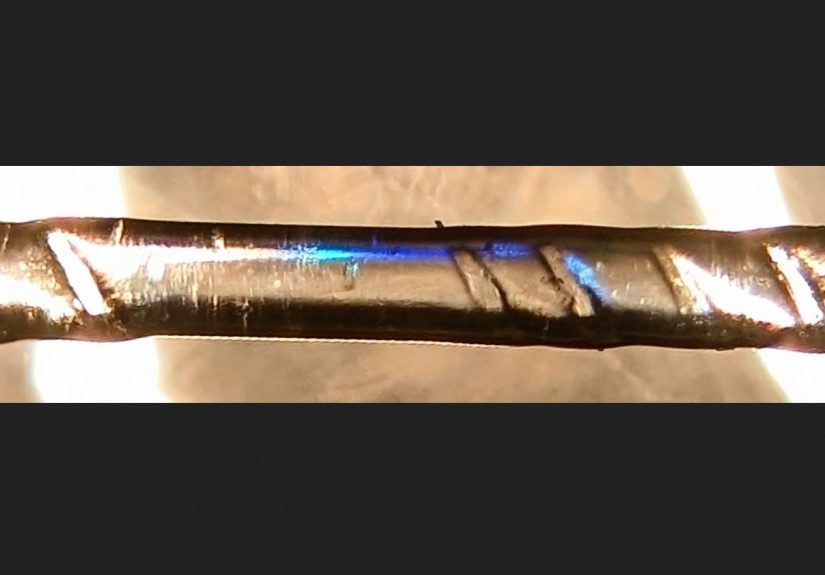
The headline refers to a low-tech-but-clever idea: using fishing line as a physical writing medium. In the best-known version of the concept, text is encoded by making tiny marks or nicks along the length of the line. Instead of saving words to silicon, they are carved into a durable polymer strand. Think of it as a handmade, highly impractical, oddly beautiful offline archive.
The appeal is easy to understand. Digital storage feels permanent until it very much is not. Files vanish. Drives fail. Formats age out. Passwords disappear into the same cosmic void that also holds missing socks and charger cables. Traditional archives know this, which is why long-term preservation usually depends on redundancy, migration, monitoring, and controlled storage conditions rather than blind faith in one perfect medium.
That is exactly why writing on fishing line captures the imagination. It swaps the invisible fragility of digital data for something physical. You can hold it. Bury it. Spool it. Hide it in a box. In a world full of files that vanish behind corrupted sectors and subscription cancellations, that tactile quality has a certain romance.
And to be fair, physical media has always had a dramatic advantage: when people can see that something exists, they are more likely to believe it might survive. A strip of marked line feels more stubborn than a folder named “Final_Final_REAL_v3.” That folder, as history has shown, is living on borrowed time.
Why Monofilament Fishing Line Seems Like a Smart Medium
Monofilament fishing line has long been the dependable workhorse of the angling world. It is affordable, widely available, easy to handle, and forgiving. That last trait matters. Anglers like mono because it stretches under pressure, absorbs shock, ties well, and behaves more kindly than braid when someone is still learning the difference between “tight line” and “congratulations, you just invented a knot sculpture.”
Those same traits are part of why monofilament feels attractive as a storage medium. A single, continuous strand is easy to feed through a homemade machine. It is flexible enough to spool, transport, and stash. It is lightweight. It is not dependent on electricity to hold its information. It does not need an operating system, a subscription, or a firmware update from the gods of planned obsolescence.
There is also the cost factor. Fishing line is cheap enough that experimentation feels possible. You do not need a clean room, a semiconductor fab, or a corporate budget. You need line, a mechanism for making marks, patience, and the sort of personality that looks at a spool of polymer and whispers, “I can store literature on this.”
For anglers, none of this sounds shocking. Mono has always been the practical choice. It casts well, offers reliable knot strength, and works across a wide range of conditions. If you wanted a line that feels approachable and adaptable, mono is the classic answer. So as raw material for a quirky archive project, it makes intuitive sense. Fishing line was already built to survive being pulled, tensioned, wound, unwound, and dragged through unpredictable environments. That is not a bad résumé.
Why the idea feels smarter than it first sounds
Here is the clever part: the concept does not depend on line being electronically “readable.” It depends on line being physically markable. That removes a whole category of failure. No dead batteries. No fried circuits. No mysterious error message that says your storage device is both connected and not connected at the same time. The message is literally in the medium.
For survivalists, makers, tinkerers, and people who deeply distrust the lifespan of consumer electronics, that physicality is the sales pitch. You are not saving data into an abstract system. You are scratching it into matter.
But Let’s Not Pretend It Is Actually Forever
Now for the part where the fishing reel of truth starts clicking loudly.
Calling anything “forever” is bold. Calling polymer fishing line “forever” is bolder. Calling nicked fishing line forever is bold enough to make archivists reach for tea and stress snacks.
Even great monofilament is not immortal. Anglers already know line changes with age, storage, sunlight, and abuse. It can coil. It can weaken. It can become less pleasant to handle. Proper storage matters, which is why experienced anglers do not recommend baking a spool in the sun and then acting surprised when it behaves like crunchy spaghetti.
There is also the obvious structural problem: if your encoding method requires physically damaging the line to store information, you are introducing weak points into the very thing you hope will last. That does not kill the concept, but it does turn the word “durable” into a negotiable term.
Then there is decoding. Writing is only half the problem. Future readability matters just as much. If you hide your data on an anonymous strand of marked plastic, will anyone know how to interpret the marks? Will they know the spacing? The bit structure? The character system? The error rate? A medium that survives but becomes unreadable has not won the war. It has merely died in an unusually dramatic costume.
Capacity is another issue. Fishing line is not exactly a high-density storage superstar. This is not a practical replacement for enterprise backup, archival tape libraries, or even a humble external SSD. It is more like a physical manifesto about persistence than a realistic everyday storage platform.
What Anglers Already Know About Mono That Archivists Should Notice
One of the funniest things about this whole concept is that fishing people already understand its tradeoffs better than many tech people would. Ask an angler about monofilament fishing line and you will get a very balanced review.
- It stretches: Great for shock absorption, not always great for sensitivity.
- It is manageable: Easy to spool and knot, which is why beginners love it.
- It is versatile: It works for topwater, general-purpose setups, and a wide range of species.
- It has memory: Leave it wound long enough, and it may come off looking like a spring trying to escape its destiny.
- It ages: Storage conditions matter more than people want to admit.
Translate those traits into data storage language and things get interesting. Stretch means the medium is forgiving but not dimensionally rigid. Manageability means it is easy to work with but not necessarily ideal for ultra-precise, high-density encoding. Memory means shape retention can become a problem over time. Aging means your so-called forever medium is still negotiating with chemistry.
In other words, monofilament is wonderfully practical and deeply imperfect. Which, come to think of it, makes it one of the more human storage media ever proposed.
How It Compares to Real Long-Term Data Preservation
Real digital preservation is boring in the most important way: it is built on process. Archives do not bet everything on one “miracle” medium. They use controlled conditions, multiple copies, format migration, verification, and routine management. That may sound less romantic than burying a spool of encoded line in the backyard, but romance has never been a recognized preservation standard.
That is the biggest lesson buried inside the fishing-line concept. It is not really that fishing line beats every other medium. It is that modern people are still searching for a way to make data last longer than our gadgets do. We know discs age. We know storage media can degrade. We know “saved” is not the same thing as “safe.” So every once in a while, somebody looks away from the server rack and toward the garage workbench.
And honestly, good. Weird ideas are useful. They force us to ask the right questions. What survives? What stays readable? What fails gracefully? What depends on infrastructure? What can be understood by someone generations from now without proprietary software and a prayer?
Fishing line may not answer those questions perfectly, but it does ask them loudly. Sometimes that is enough to make an idea worth taking seriously.
The Environmental Catch Nobody Should Ignore
There is also a serious downside to all this polymer optimism: discarded fishing line is a well-known environmental problem. Wildlife can become entangled in it. Marine debris programs treat lost or improperly disposed fishing line as persistent trash for a reason. Recycling programs exist specifically because monofilament and fluorocarbon do not simply wave goodbye and dissolve into good intentions.
That reality creates a strange tension in the “forever writing” idea. The same persistence that makes fishing line attractive as a storage medium is part of what makes it dangerous when abandoned. In other words, if you want to celebrate the long life of the material, you also need to accept responsibility for what happens when that material is lost, tossed, or forgotten.
So if anyone is tempted to make a time capsule out of fishing line, the rule is simple: be intentional, be contained, and for the love of pelicans and sea turtles, do not confuse “archiving” with “littering with ambition.”
Could Writing on Fishing Line Ever Be Truly Useful?
In mainstream terms, probably not. You are not about to replace cloud backups, tape systems, or professional archival workflows with a spool and a homemade nicking rig. That would be like replacing a public library with a very dedicated squirrel.
But useful does not always mean scalable. This idea could be genuinely valuable in niche situations:
- as a maker project that teaches physical encoding and data resilience;
- as a conversation piece about long-term storage and media decay;
- as a low-tech art object where the medium is part of the message;
- as an experimental backup for very small amounts of important text;
- as a symbolic reminder that durability is a material problem, not just a software problem.
That last point matters most. The project is compelling because it flips the usual story. We are used to hearing that progress means more abstraction, more invisibility, and more speed. Writing on monofilament fishing line argues the opposite. Maybe progress also means making data physical again. Maybe survival is not always sleek. Maybe sometimes the future of memory looks suspiciously like something sold next to sinkers and soft plastics.
Final Thoughts
Forever Writing On Monofilament Fishing Line is one of those ideas that sits right on the border between ingenious and mildly unhinged, which is usually where the most memorable projects live. It is not the ultimate storage solution. It is not a replacement for disciplined digital preservation. And it is definitely not proof that every fishing aisle secretly doubles as a data center.
But it is a brilliant reminder that information always lives somewhere physical. In metal. In silicon. In paper. In magnetic coatings. In grooves. In scratches. In polymers. Every storage medium is a bet against time. Fishing line simply makes that bet visible in a new and very odd way.
And maybe that is why the idea sticks. Not because it is perfect, but because it asks a timeless question in a delightfully tackle-box format: if you really wanted your words to outlast the machine, what would you write them on?
Experience Section: What It Feels Like to Think About Writing on Fishing Line
There is something oddly intimate about the idea once you picture it in real life. Not in a lab paper, not in a forum thread, but in your hands. A spool of line is humble. It is lightweight, nearly invisible in places, and easy to underestimate. You can hold hundreds of yards of it in one palm. That changes the emotional scale of the project. A hard drive feels like technology. Fishing line feels like possibility wrapped around a cylinder.
Imagine setting up a small encoder on a workbench. The room smells faintly of metal, dust, machine oil, and whatever mysterious scent every garage has decided to keep since 1987. The line feeds forward in tiny increments. A marking mechanism taps the strand. Tick. Tick. Tick. You are not “saving a file.” You are physically making one. The process feels slower, stranger, and somehow more honest.
That tactile quality matters. Modern storage is usually invisible. You drag a file, watch a progress bar, and trust a hidden system. Writing on monofilament breaks that spell. Suddenly, storage is mechanical again. You become aware of spacing, tension, alignment, fragility, and repeatability. The line can kink. The marks can vary. The spool can slip. It reminds you that all recording, no matter how futuristic it looks on the outside, is still a physical event.
There is also a weird emotional pleasure in the absurdity of it. You look at a spool and think, “This could hold a letter.” Then, “This could hold a manifesto.” Then, inevitably, “This could hold my grocery list for the next thousand years.” The idea invites humor because it sits so far outside normal computing habits. And that humor is useful. It keeps the project from becoming pompous. Any storage concept involving fishing line should arrive with curiosity, not a cape.
At the same time, the experience carries a cautionary undertone. Anyone who has spent time around fishing gear knows line is both tough and temperamental. It can save the day on the water and still become a coiled little menace in storage. That dual personality gives the whole project its realism. You are not working with fantasy material. You are working with a thing that already has a life history in people’s garages, boats, backpacks, and tackle trays.
And maybe that is the most memorable part of the experience: the collision between the ordinary and the monumental. Fishing line is ordinary. Memory is monumental. Putting them together feels like a practical joke told by philosophy. Yet the longer you sit with it, the more poetic it becomes. A clear strand, barely visible, carrying marks that mean something to someone. A message wrapped in patience. A record stored not in a glowing device, but in a line thin enough to disappear against the light.
That image lingers. Whether or not monofilament ever becomes a serious storage medium, the experience of imagining it already does something valuable. It makes you think harder about what lasts, what fails, and what it means to leave a message behind. Not bad for a material most people buy to catch fish and accidentally knot around a folding chair.